The UAE and the SDGs: A Goal-by-Goal Scorecard
UAE SDG Progress: Strengths, Weak Spots, and the New Private Sector Mandate
The UAE ranks first worldwide on 152 global development indicators. It sits in the top 10 on 425 more. It also scores just 32% on SDG 6, clean water and sanitation, one of three goals the government itself has flagged as the country’s hardest to reach. On the UN’s own composite ranking, the UAE sits 71st out of 169 countries, with a score of 71.5. Both pictures are true at once. A country can lead the world on foreign aid and youth literacy while still lagging on water security and waste. That gap is the honest starting point for understanding where the UAE stands on the SDGs.
There’s a newer piece to this story too. The UAE recently launched Companies for Good 2031. The strategy asks the private sector to deliver more than Dh20 billion in verified sustainability projects by 2031. For any business operating in the UAE, that’s no longer a government-only conversation. This article walks through UAE performance on all 17 SDGs individually, then covers what the private sector mandate actually requires.
How the UAE approaches the SDGs
The UAE established its National Committee on SDGs in 2017. The Ministry of Cabinet Affairs and the Ministry of Foreign Affairs and International Cooperation co-chair it, alongside 15 federal member entities. Their job covers monitoring progress, coordinating across ministries, and submitting the country’s periodic reports to the UN.
That structure sits inside a longer domestic strategy. Vision 2021 came first. A 50-year development plan followed in 2020, broken into 10-year intervals. The current phase runs under the We the UAE 2031 vision, which the government also uses as its reference point for SDG and CSR policy. The UAE has floated a post-2030 concept too, called XDGs 2045, aimed at extending sustainable development planning past the UN’s original deadline.
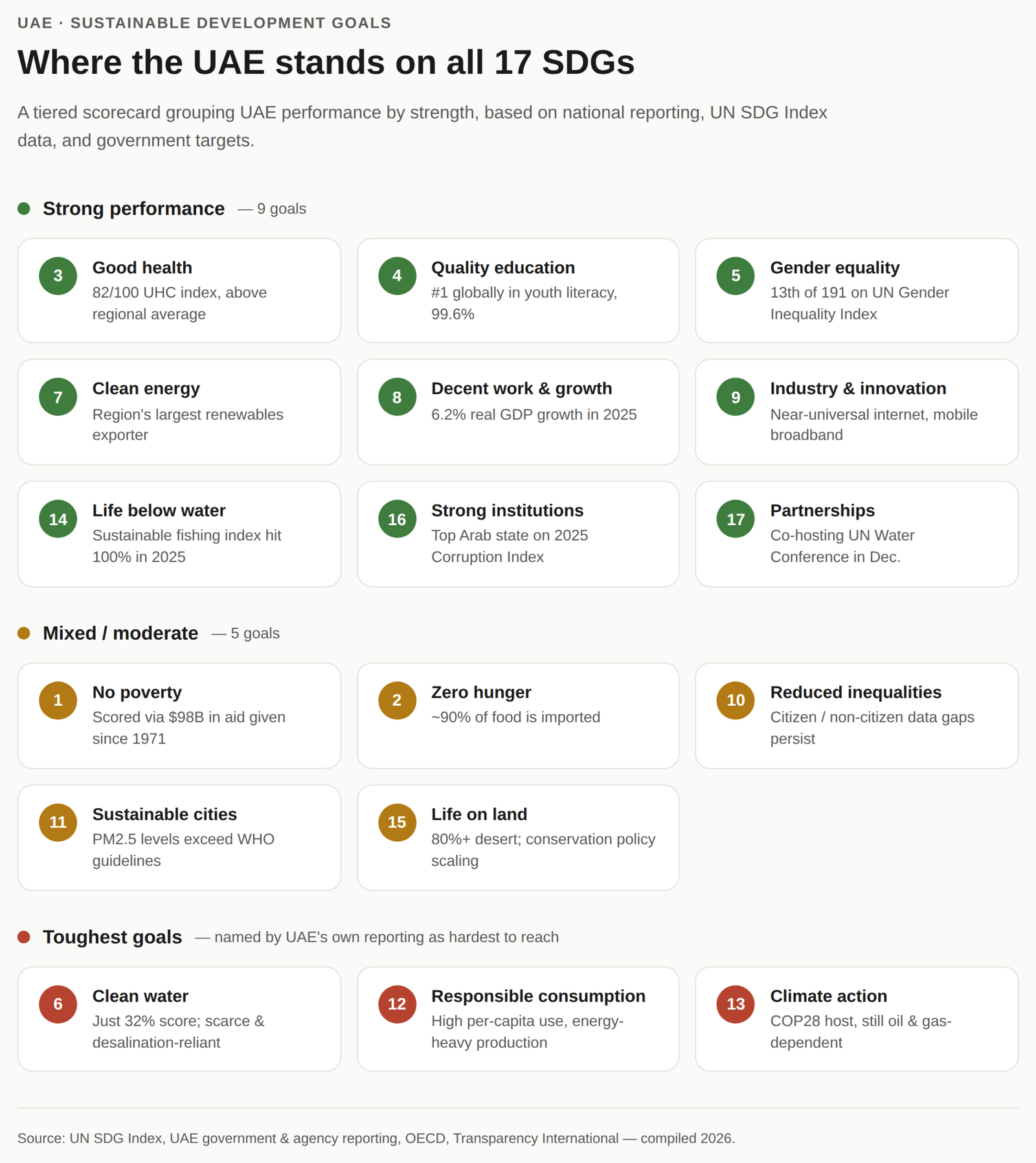
UAE performance on all 17 SDGs
SDG 1: No poverty
The UAE’s own extreme poverty rate is close to statistically negligible, and the government frames this goal mainly through its foreign aid record rather than domestic deprivation. The country has given a cumulative AED 360 billion, close to $98 billion, since 1971 through mid-2024. On more recent OECD figures, the UAE gave an estimated $3.4 billion in official development assistance in 2025, about 0.61% of GNI. That keeps the UAE among the small group of donor countries still tracking toward the UN’s long-standing 0.7%-of-GNI aid target, a bar most wealthy nations have missed for decades. Oak’s SDG 1 breakdown covers the global poverty data behind this aid record in more detail.
SDG 2: Zero hunger
The UAE imports roughly 90% of its food, which makes this goal as much about supply chain resilience as domestic agriculture. The government has invested heavily in agriculture projects abroad, in countries including Vietnam, Cambodia, Egypt, Pakistan, and Sudan, to secure food supplies and buffer against market shocks. Domestically, initiatives combining IoT, AI, and water-efficient farming are being tested to grow local production in a country with almost no arable land. Regionally, SDG 2 is one of the toughest goals across the Arab world, and the UAE’s structural food-import dependence keeps it firmly in that category even as its supply diversification strategy outperforms most neighbors.
SDG 3: Good health and well-being
This is one of the UAE’s stronger goals. Life expectancy at birth sits around 76 years overall (75 for men, 78 for women), and the UHC service coverage index stands at 82 out of 100, above the regional average. Maternal mortality is low, at roughly 3 to 9 deaths per 100,000 live births depending on the estimate used, and immunization coverage for measles and DTP3 both exceed 95%. According to Boston Consulting Group’s Sustainable Economic Development Assessment, UAE healthcare standards outperform regional and global averages on several dimensions. The main strain points are lifestyle-linked: overweight and obesity rates are both above global averages, reflecting a broader Gulf-region pattern.
SDG 4: Quality education
Education is arguably the UAE’s single best-performing goal. The country recorded a 99.6% literacy rate among 15-to-24-year-olds in the UN’s SDG 2025 Index, ranking first globally in youth literacy. Average years of schooling reached 13.36 in 2024, per the Sustainable Development Report 2025. The UAE’s own government data shows 77% of Emirati women enrolling in higher education after secondary school, and women make up 70% of all university graduates and 56% of STEM graduates at government universities. Education sits at the center of the We the UAE 2031 vision as a driver of the knowledge economy.
SDG 5: Gender equality
The UAE performs unusually well on this goal by regional standards. Women hold 50% of seats in the Federal National Council. Across government institutions, women make up two-thirds of the public sector workforce, with 30% in leadership roles. In the private sector, women own roughly 1 in 10 companies, and Emirati businesswomen run projects worth more than AED 50 billion. The UAE ranks 13th out of 191 countries on the UN’s Gender Inequality Index. The Gender Balance Council’s SDG 5 Pledge, expanded in December 2025, commits partner institutions to raising women’s representation in leadership to at least 30% within measurable timeframes. Gaps remain in gender-disaggregated labor market data, including the gender pay gap, which the UN Women data hub flags as an area still under-monitored.
SDG 6: Clean water and sanitation
Water is the UAE’s starkest weak point. The country scores 32% on SDG 6, driven by natural water scarcity and heavy reliance on desalination for both drinking water and, indirectly, irrigation. The Ministry of Energy and Industry has responded with the UAE Water Security Strategy 2036, aimed at cutting average per-capita water demand and diversifying supply sources. Oak’s SDG 6 breakdown covers the global scale of the water crisis behind this national pressure.
SDG 7: Affordable and clean energy
This is a genuine bright spot. Masdar has grown into the Middle East’s largest exporter of renewable energy. The UAE Energy Strategy 2050 sets a 50% clean-energy target and aims to cut power-sector emissions by 70%, with flagship projects like the Mohammed bin Rashid Al Maktoum Solar Park driving the shift. Electricity access is effectively universal, and mobile broadband and internet access, which sit under adjacent goals, are also near-saturation. The UAE’s Net-Zero 2050 strategy, the first MENA commitment to carbon neutrality, is projected to create 200,000 green jobs and add 3% to GDP through more than 25 sector programs.
SDG 8: Decent work and economic growth
The UAE’s real GDP grew 6.2% in 2025 to AED 1.9 trillion, with non-oil GDP growing even faster at 6.8% to AED 1.5 trillion, according to the Federal Competitiveness and Statistics Centre. Construction led sector growth at 11.1%, followed by finance and insurance at 10.4%. Non-oil activity now accounts for roughly three-quarters of the economy, a deliberate outcome of the diversification strategy behind the We the UAE 2031 vision, which targets AED 3 trillion in GDP within the decade. Access to financial services is high: most of the adult population holds a bank account. The open question for this goal going forward is labor market quality metrics, informality, and equal pay data, which are less consistently published than the headline growth numbers.
SDG 9: Industry, innovation and infrastructure
The UAE performs strongly on digital infrastructure specifically. Internet penetration and mobile broadband subscriptions, two of the indicators the UN’s own tracking flags as furthest along globally, are both near-universal in the country. Government investment in AI strategy, space programs, and advanced manufacturing under the Operation 300bn industrial strategy supports this goal, alongside free zones built specifically around innovation and logistics infrastructure such as ports and airports.
SDG 10: Reduced inequalities
This is one of the harder goals to score cleanly for the UAE, since much of the underlying data, including a published Gini coefficient, is not consistently released. What is documented is a large gap between citizen and non-citizen labor protections, given that the resident population is overwhelmingly composed of foreign workers. The government has introduced wage protection systems and labor reforms over the past decade to narrow some of these gaps, but independent monitoring bodies still flag inequality between different resident categories as an under-measured area of national SDG reporting.
SDG 11: Sustainable cities and communities
Dubai and Abu Dhabi have both built sustainability targets into long-term urban master plans, covering public transport expansion, green building codes, and waste-to-energy infrastructure. Air quality remains a live challenge: PM2.5 concentrations in UAE cities, driven partly by desert dust and partly by transport and construction emissions, exceed WHO guidelines, which is one of the headline indicators the SDG Index itself tracks for this goal. Government investment in metro and public transit expansion in both emirates is a direct response to this pressure.
SDG 12: Responsible consumption and production
Alongside SDG 6 and SDG 13, this is one of the three goals the UAE’s own private sector report names as its hardest to reach. High per-capita consumption, energy-intensive desalination, and waste generation rates above regional averages all weigh on this score. The government’s response includes national waste diversion targets and circular economy policy work, but the goal remains a genuine national weak point rather than a data gap.
SDG 13: Climate action
The UAE held the COP28 presidency in 2023 and paired it with tangible commitments rather than symbolic ones, including the UAE Consensus that, for the first time at a COP, referenced transitioning away from fossil fuels. Domestically, the Net-Zero by 2050 strategy is the anchor policy. Despite that leadership role, SDG 13 is still flagged by the UAE’s own reporting as one of its three toughest goals, reflecting the emissions intensity that comes with an economy still substantially built on oil and gas, alongside energy-hungry desalination and cooling demand. Oak’s SDG 13 breakdown covers the global warming trend behind this pressure.
SDG 14: Life below water
The UAE has made real, measurable progress here in the past two years. The Environment Agency Abu Dhabi raised its sustainable fishing index to 100% by the end of 2025, up from just 8% in 2018, through the “Hamdan bin Zayed: The World’s Richest Seas” initiative aimed at doubling fish stocks by 2030. The National Carbon Sequestration Project, targeting 100 million mangrove trees planted by 2030, had passed 30 million trees by mid-2025 using drone-assisted planting and tissue culture propagation. Mangroves double as marine nurseries and coastal carbon sinks, linking this goal directly to SDG 13.
SDG 15: Life on land
Desertification and habitat pressure from rapid urban growth are the core constraints here, in a country where over 80% of land is desert. The National Strategy to Combat Desertification and the National Biodiversity Strategy are the two main policy responses. Public environmental awareness reached 89% in 2024 government reporting, and the broader environmental behavior index rose to 85%, both used as proxy indicators for how well conservation policy is landing with residents.
SDG 16: Peace, justice and strong institutions
The UAE scored 69 out of 100 on Transparency International’s 2025 Corruption Perceptions Index, ranking 21st out of 182 countries and the highest of any Arab state, ahead of countries including France and the United States. That score has climbed steadily from the low 50s in the early 2000s, reflecting sustained investment in e-government services that reduce citizens’ exposure to discretionary bureaucracy. Institutional stability and low crime rates are consistent strengths. Independent bodies still note that data transparency and press freedom indicators, both tracked under this goal globally, score lower than the corruption metric.
SDG 17: Partnerships for the goals
This is where the UAE’s global positioning is clearest. Beyond its aid record under SDG 1, the UAE is set to co-host the UN Water Conference with Senegal in December, tying SDG 6 and SDG 17 together on the world stage. The UAE Local Network of the UN Global Compact runs regular workshops helping businesses build SDG reporting into their operations, and the Private Sector Advisory Council gives companies a direct line to the National Committee on SDGs. Companies for Good 2031, covered in detail below, is the newest and most concrete expression of this goal, translating international partnership commitments into a domestic reporting requirement for business.
The private sector mandate: Companies for Good 2031
Majra, the UAE’s federal CSR fund, recently announced Companies for Good 2031. The strategy sets a clear target: private sector companies are expected to deliver more than Dh20 billion in verified, sustainability-linked projects by 2031. It builds on existing momentum. The UAE’s private sector contributed Dh3.23 billion in CSR activity in 2025 alone, spread across 191 participating companies.
Participation isn’t informal. Companies taking part have to report their sustainable policies to Majra, covering areas like Emiratisation, carbon footprint reduction, flexible working conditions, and support for people of determination. The highest recognition under this framework is the Impact Seal, awarded based on an Impact Index that scores companies against ESG standards and their measurable contribution to the SDGs.
This sits alongside two existing channels for business engagement. The Private Sector Advisory Council gives companies a direct line to the National Committee on SDGs. The UN Global Compact’s UAE Local Network runs workshops on building the SDGs into corporate strategy and reporting. Its flagship program, UAE SDG Pioneers, recognizes business leaders making measurable progress on specific goals.
How UAE businesses can position for this
Start tracking CSR and ESG activity as reportable data, not goodwill. Majra’s framework expects documented policies, not general statements about sustainability. Emiratisation numbers, carbon metrics, and workplace policies all need to be recorded in a form that can actually be reported.
Target the goals the UAE has already flagged as priorities. SDG 6, 12, and 13 carry more weight nationally than a generic sustainability initiative would. A water-efficiency upgrade or a verified waste-reduction program lines up directly with where the country says it needs the most help.
Get the underlying compliance right first. Sustainability reporting sits on top of a company’s existing legal and financial structure. That foundation needs to be in order first, from company registration to corporate tax compliance. Otherwise ESG reporting becomes a scramble instead of a meaningful add-on.
Use the existing business networks rather than building from scratch. The Private Sector Advisory Council and the UN Global Compact’s UAE Local Network already run the workshops and reporting templates most companies need. Joining an existing channel is faster than building an internal ESG reporting process alone.
UAE SDG snapshot: 17 goals at a glance
| SDG | Where the UAE stands |
| 1. No poverty | Negligible domestic poverty; AED 360 billion in foreign aid given since 1971 |
| 2. Zero hunger | Imports about 90% of food; overseas agriculture investments buffer supply risk |
| 3. Good health | Life expectancy ~76-78 years; UHC service coverage index of 82/100 |
| 4. Quality education | 99.6% youth literacy, first globally; 13.36 average years of schooling |
| 5. Gender equality | 50% of Federal National Council seats held by women; ranked 13th of 191 on GII |
| 6. Clean water | Scores just 32%; one of the UAE’s three flagged toughest goals |
| 7. Clean energy | 50% clean-energy target by 2050; Masdar is the region’s top renewable exporter |
| 8. Decent work | Real GDP grew 6.2% in 2025; non-oil sector now ~75% of GDP |
| 9. Industry & innovation | Near-universal internet and mobile broadband; strong digital infrastructure |
| 10. Reduced inequalities | Under-monitored; citizen vs. non-citizen labor protection gaps persist |
| 11. Sustainable cities | Strong transit investment; PM2.5 air quality still above WHO guidelines |
| 12. Responsible consumption | One of the UAE’s three flagged toughest goals; high per-capita consumption |
| 13. Climate action | COP28 presidency in 2023; still a flagged toughest goal despite the leadership role |
| 14. Life below water | Sustainable fishing index hit 100% in 2025, up from 8% in 2018 |
| 15. Life on land | 30 million of a 100-million-tree mangrove target planted by mid-2025 |
| 16. Strong institutions | CPI score of 69/100, ranked 21st of 182, highest in the Arab world |
| 17. Partnerships | Co-hosting the 2026 UN Water Conference; Companies for Good 2031 launched |
Frequently Asked Questions
Is the UAE on track to meet the SDGs by 2030?
It’s ahead on many indicators and behind on others. The UAE ranks 71st out of 169 countries on the UN’s SDG Index, with strong scores on education, health, and gender equality, but its own reporting names SDG 6, SDG 12, and SDG 13 as its most difficult goals to reach.
Which SDGs does the UAE perform best on?
Education (SDG 4) and gender equality (SDG 5) are consistently the UAE’s strongest goals, backed by a 99.6% youth literacy rate and 50% female representation in the Federal National Council. Health (SDG 3) and partnerships (SDG 17) also rank as relative strengths.
Which SDGs does the UAE struggle with most?
SDG 6, clean water and sanitation; SDG 12, responsible consumption and production; and SDG 13, climate action, according to the UAE’s own private sector SDG report. Water scarcity and desalination dependence are the biggest drivers behind the low SDG 6 score.
What is Companies for Good 2031?
It’s a national strategy that asks UAE private sector companies to deliver more than Dh20 billion in verified sustainability projects by 2031. Majra, the UAE’s federal CSR fund, coordinates it.
Do UAE businesses have to report their CSR activity?
Companies participating in Companies for Good 2031 have to report their sustainable policies to Majra. That includes Emiratisation, carbon footprint reduction, and workplace conditions, scored under the Impact Index for Impact Seal recognition.
Where can a business go to get involved with the UAE’s SDG efforts?
The Private Sector Advisory Council and the UN Global Compact’s UAE Local Network are the two main channels. Both offer direct engagement with the National Committee on SDGs, plus practical guidance on incorporating the SDGs into business reporting.
Conclusion
Laid out goal by goal, the UAE’s SDG record doesn’t fit a single headline. It leads the world on youth literacy and gender representation. Additionally, it funds one of the largest foreign aid programs relative to GNI anywhere. It also still scores 32% on clean water and sits among its own flagged toughest goals on waste and climate. What’s changed now is that the private sector mandate has real numbers attached: Dh20 billion by 2031, tracked through an actual index. For businesses operating in the UAE, that makes ESG and SDG alignment a compliance and reporting question as much as a values one. If your business needs the legal and financial foundation sorted before building an SDG-aligned reporting process on top of it, Oak’sUAE company registration andcorporate tax advisory services can help get that structure in place.