The Vision 2030 – SDG Gap: What Tenders and Lenders Actually Check
Vision 2030 & the SDGs: A Business Scorecard, Not a Matching Exercise
Most companies doing business in or with Saudi Arabia treat Vision 2030 and the UN Sustainable Development Goals as one checklist. In practice, it just wears two labels. That mix-up costs more than a confused sustainability report. Tenders linked to PIF-backed entities now ask for both. Financing tied to green or sustainability-linked sukuk asks for both, too. Investor due diligence increasingly wants to see where a company sits against each framework, separately, with evidence. A business that cannot say which framework a claim comes from looks unprepared. That is true even when the underlying work is solid.
This article gives founders, CFOs, and boards a working scorecard. It covers what each framework actually measures and where they overlap. It also shows how a private company, not just a Tadawul-listed giant, can score itself against both without hiring a full ESG department.
Vision 2030 and the SDGs are related, not identical
Vision 2030 is Saudi Arabia’s own national transformation plan, launched in 2016. It is built around three official pillars: a vibrant society, a thriving economy, and an ambitious nation. It has its own KPIs, its own delivery programs, and its own fiscal logic, all published through the Vision 2030 annual reports. The SDGs are a separate 2015 UN framework of 17 global goals. Every UN member state, including Saudi Arabia, reports against them periodically through bodies such as the United Nations in Saudi Arabia.
The two frameworks share a lot of subject matter. Employment, private-sector growth, gender inclusion, health, education, sustainable cities, and institutional effectiveness show up in both. But a Vision 2030 KPI and an SDG indicator can measure the same theme in different units. They often use different baselines, too, and they report to different audiences. Saudi Arabia’s own UN-facing reporting treats the overlap as partial alignment, not equivalence. It flags several SDGs as areas where national priorities and global goals already reinforce each other, including gender equality, decent work, and global partnerships.
For a business, the practical distinction is this. Vision 2030 compliance signals are read by Saudi regulators, PIF-linked buyers, and government tender committees. SDG alignment is read by international investors, lenders, multinational supply-chain partners, and ESG rating agencies. A company that only tracks one framework is invisible to half its audience.
Mapping the three pillars to the goals that matter for a business
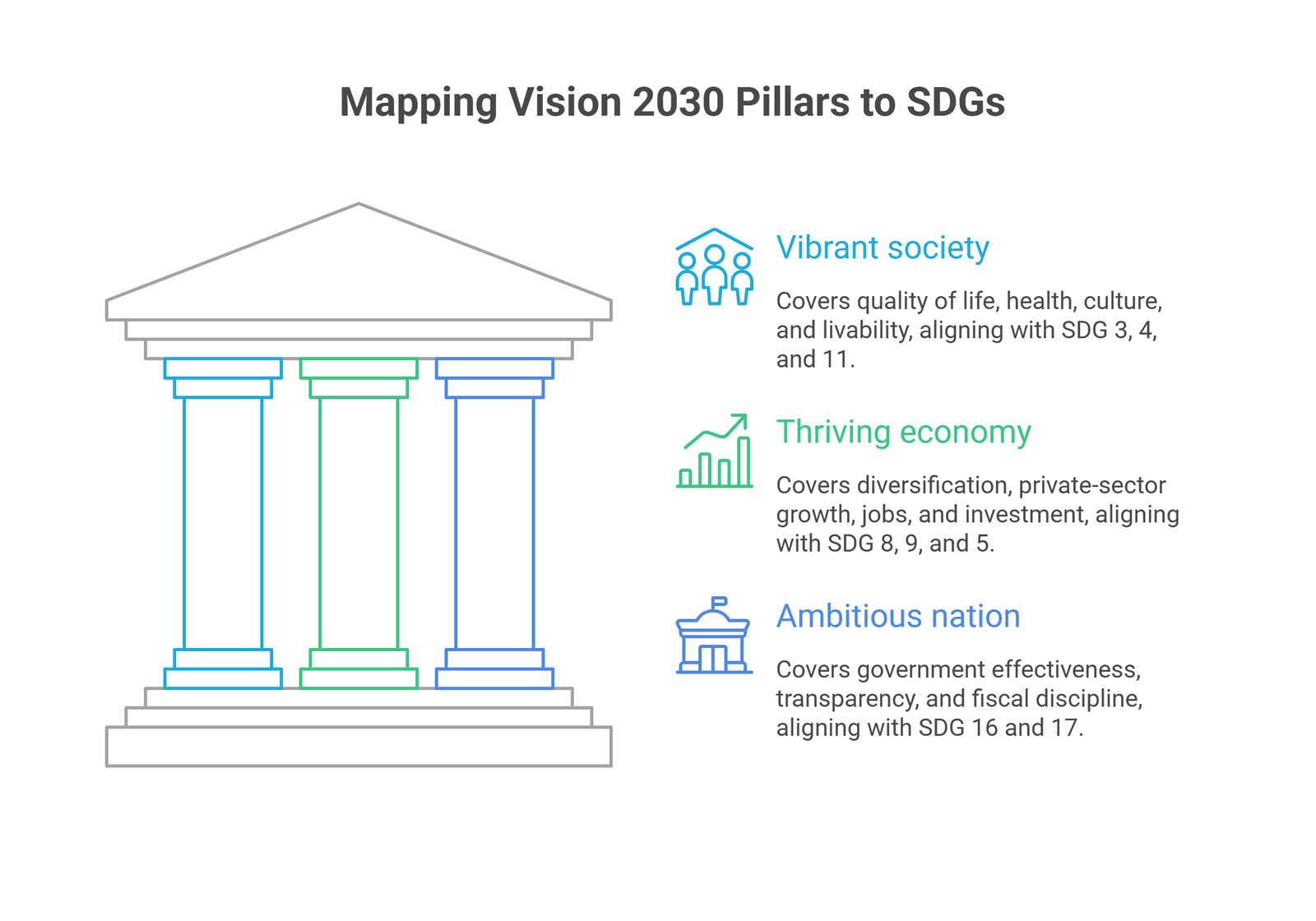
Saudi Vision 2030 cascades into 96 strategic objectives. The SDGs run to 17 goals with 169 targets underneath them. Matching all of one against all of the other is a research project, not a business tool.
Most companies get more mileage from a narrower map. It pairs the three official pillars against the handful of SDGs that actually show up in due diligence packs, tender documents, and lender questionnaires.
| Vision 2030 pillar | What it covers | SDGs a company is usually asked about | Where this shows up for a business |
| Vibrant society | Quality of life, health, culture, livability | SDG 3 (health), SDG 4 (education), SDG 11 (sustainable cities) | Employee wellbeing programs, local hiring, facilities standards |
| Thriving economy | Diversification, private-sector growth, jobs, investment | SDG 8 (decent work and growth), SDG 9 (industry and infrastructure), SDG 5 (gender equality) | Saudization ratios, women in the workforce, non-oil revenue share, export data |
| Ambitious nation | Government effectiveness, transparency, fiscal discipline | SDG 16 (institutions), SDG 17 (partnerships) | Governance disclosures, anti-corruption controls, joint-venture reporting to government partners |
This table is the starting point for the business scorecard below. It tells a company which pillar owns which theme. It also gives the SDG language to reuse when a lender asks for “sustainability alignment” instead of “Vision 2030 alignment.”
The business scorecard: rate yourself, pillar by pillar
A national scorecard rates the Kingdom. A business scorecard rates the company. Use the same self-check questions across each pillar. Then rate honestly on a simple three-band scale: on track, developing, or behind.
| Pillar and theme | Self-check question | On track looks like | Behind looks like |
| Vibrant society | Do we track employee health, safety, and local wellbeing metrics beyond legal minimums? | Documented wellness and safety KPIs, reviewed at least annually | No metrics beyond mandatory occupational safety filings |
| Thriving economy: workforce | Can we produce a current Nitaqat tier and female participation numbers on demand? | Ratios tracked monthly, tied to a hiring plan | Numbers only assembled reactively when a regulator asks |
| Thriving economy: private-sector contribution | Do we know what share of our revenue is genuinely private-sector-driven, versus dependent on state contracts? | A clear breakdown, used in investor and lender conversations | No internal visibility into this split |
| Ambitious nation | Do we have documented governance and anti-corruption controls we can hand to a joint-venture partner or lender? | A written policy, reviewed and version-controlled | Informal practices, nothing in writing |
| Cross-cutting: disclosure | Could we produce a one-page ESG or SDG summary within a week if a lender asked? | Yes, from an existing internal tracker | No, it would need to be built from scratch |
A company that scores “behind” on more than two rows is not failing Vision 2030 or the SDGs. It is failing to have evidence on hand. That is a much cheaper problem to fix, and it is the one most tenders and lenders actually penalize.
Workforce localization: the fastest row to fix, and the one most often ignored
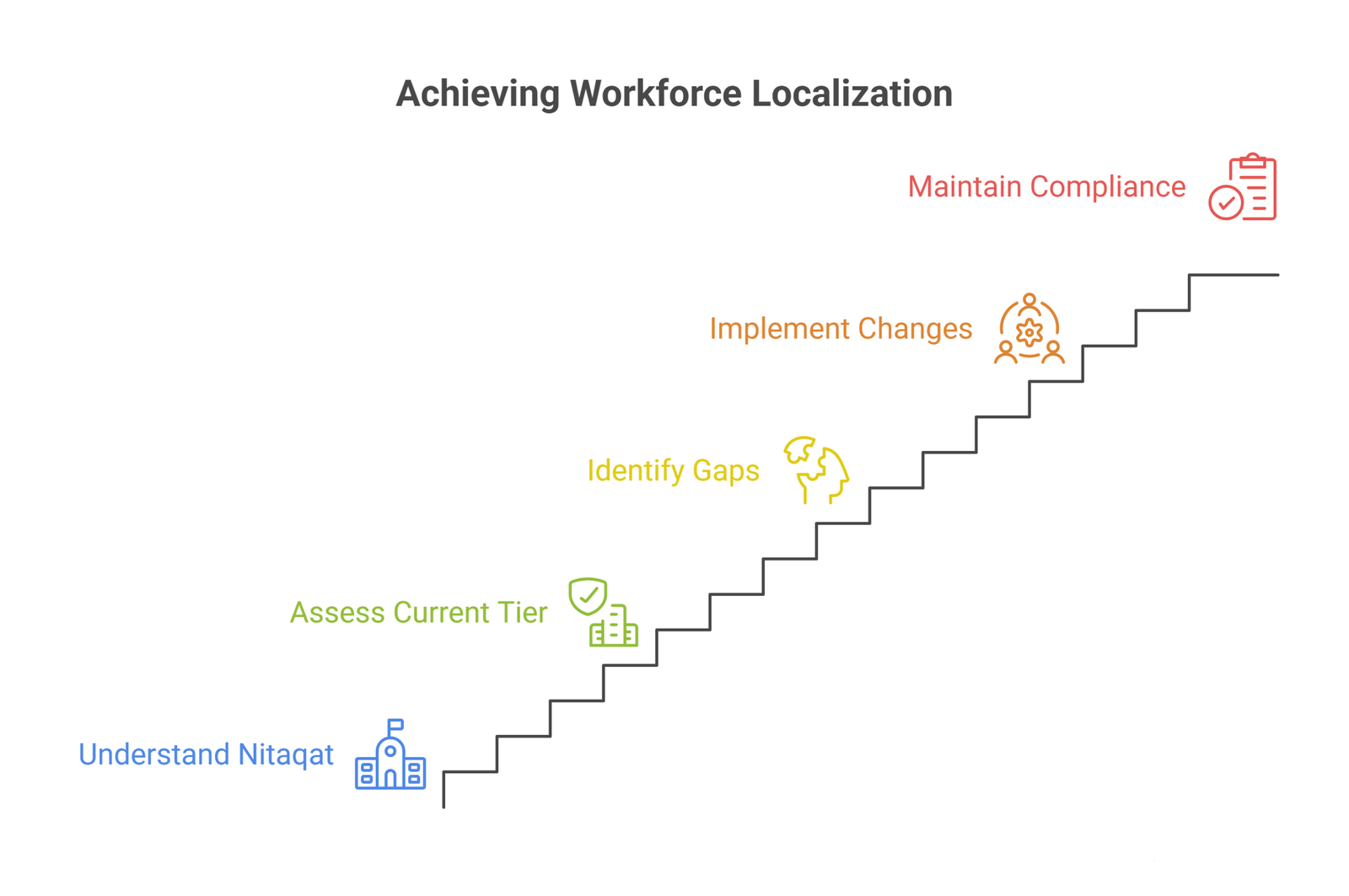
The thriving economy pillar’s workforce row deserves its own section. It changed materially in 2026, and most companies are still working from an outdated picture.
Saudization is enforced by the Ministry of Human Resources and Social Development (HRSD). Nitaqat is the scoring system that implements it, run through the government’s Qiwa labor platform. Every private establishment is sorted into one of five color-coded tiers: Platinum, High Green, Mid Green, Low Green, or Red. The tier is based on its Saudi-national employment ratio, weighed against its sector and size band.
The tier is not a vanity metric. It gates new expatriate work visas and General Manager iqama renewals. It also gates commercial registration updates, MISA investment license renewals, government tender eligibility, and access to Hadaf training subsidies. A company in the Red tier can lose the ability to sponsor new hires at all.
HRSD launched a new phase of the program, Nitaqat Mutawar, running from 2026 through 2028. It aims to localize more than 340,000 additional private-sector jobs. Several profession-specific quotas rose sharply alongside it, including a 60% localization requirement in marketing roles. This is the single fastest row on the scorecard to check. Most companies already have the headcount data internally. The gap is usually that nobody has checked the current tier requirement against current headcount since the rules changed.
The private-sector mandate is moving from voluntary to expected
Formal ESG disclosure in Saudi Arabia is still officially voluntary for most listed companies. The Saudi Exchange issued its ESG Disclosure Guidelines in 2021 on a comply-or-explain basis. They build on the Capital Market Authority’s 2019 guidance, and both point issuers toward established frameworks such as GRI and SASB. That voluntary framing, though, is thinner than it looks.
Two developments already carry binding weight. Issuers of green, social, and sustainability-linked debt, including sukuk, now face mandatory disclosure requirements tied to those instruments. The CMA and the exchange also point clearly toward alignment with the ISSB’s IFRS S1 and S2 sustainability standards, alongside the TCFD climate-disclosure framework. No confirmed universal mandate date exists yet. But the signal has stayed consistent across several years of regulatory statements.
None of this is a direct legal obligation for a private company that is not listed. But it changes what a listed customer, a PIF-linked buyer, or a bank will ask a private supplier or borrower to produce. A company with current Nitaqat data, a governance policy, and a basic SDG-pillar mapping can answer a due-diligence questionnaire in a day. A company starting from zero can take a quarter, if it manages it at all.
Reading your own score honestly
National Vision 2030 scorecards rate individual KPIs against 2030 targets. Tourism and female workforce participation are typically read as ahead of schedule. Renewable energy capacity and the 65% private-sector GDP contribution target are typically read as behind. The Kingdom does not treat a “behind” rating on one pillar as a verdict on the whole program. A business should not treat its own “behind” rows that way either.
The useful discipline is treating each row on the scorecard above as independently fixable. A company that is strong on workforce localization but has no written governance policy does not need an overhaul. It needs one document, reviewed by counsel, and a habit of updating it. The scorecard’s job is to show which gap is cheapest to close first. It is not meant to produce a single pass or fail grade.
Turning the scorecard into a plan
Three moves separate a scorecard that sits in a drawer from one that changes how due diligence conversations go.
First, assign an owner to each pillar row, not just to “ESG” in the abstract. Workforce data usually sits with HR or a fractional CFO function. Governance documentation usually sits with legal or a controller. Second, build the tracking into whatever financial reporting cadence already exists. Don’t run it as a separate annual scramble. A financial consulting engagement that already produces monthly management accounts is the natural place to add three or four ESG-adjacent lines. Third, treat the scorecard as a living input to investor and lender documents, not a one-off. A business plan built for a Saudi expansion or an investor round should carry the pillar mapping above as a section from the start.
Companies entering the Saudi market for the first time face an added layer before any ESG question even comes up. Local entity setup, GOSI registration, and day-to-day operational compliance all come first. Firms supporting foreign investors establishing in Saudi Arabia typically handle that operational layer alongside the financial and governance work. That is usually where the scorecard gets used for the first time, inside the initial due-diligence pack.
Frequently Asked Questions
Are Vision 2030 and the SDGs the same thing?
No. Vision 2030 is Saudi Arabia’s national transformation plan, with its own pillars, KPIs, and delivery programs. The SDGs are a global UN framework. They overlap on themes like jobs, health, and gender inclusion, but they are measured, owned, and reported differently.
Does a private, unlisted company need to comply with Tadawul’s ESG guidelines?
Not directly. Those guidelines apply to companies listed on the Saudi Exchange. A private company feels the effect indirectly, through due diligence requests from listed customers, PIF-linked buyers, or lenders who are themselves moving toward ISSB-aligned reporting.
What is Nitaqat and why does it belong on a business scorecard?
Nitaqat is the HRSD’s Saudization scoring system. It sorts companies into five tiers based on their ratio of Saudi national employees. It sits under the thriving economy pillar and overlaps with SDG 8 on decent work. A current, defensible Nitaqat tier is one of the fastest things a company can be asked to produce.
How often should a company update its scorecard?
Quarterly is a reasonable cadence for workforce and financial rows, since that data usually already exists internally. Governance documentation needs updating whenever the policy itself changes, not on a fixed schedule.
Is ESG disclosure mandatory in Saudi Arabia yet?
Formal, universal ESG disclosure is not yet mandatory for most listed companies, though the framework is comply-or-explain. Mandatory disclosure already applies to issuers of green, social, and sustainability-linked debt. Further mandatory rules are widely expected as the market moves toward ISSB alignment.
What happens if a company scores “behind” on most rows?
It means there is no evidence trail yet. It does not mean the underlying business is doing poorly. The fix is usually documentation and assigned ownership rather than new spending. It is far cheaper to build before a lender or tender asks than during the request itself.
The scorecard is a starting document, not a report card
A Vision 2030 and SDG scorecard is only useful if someone keeps updating it. The value is not in the one-time exercise of filling in the table. It is in being able to hand a current version to a lender, a joint-venture partner, or a tender committee without a scramble. Companies that treat the scorecard as a living part of their financial reporting, rather than a once-a-year compliance document, get the payoff: faster financing and fewer stalled deals.
Are you preparing for Saudi market entry, an investor round, or a tender that references sustainability alignment? Oak Business Consultant’s financial consulting and virtual CFO services can build this scorecard into your existing reporting. That way, it’s ready before anyone asks for it.