Pre-Seed Funding: How Much to Raise, What It Costs You
Pre-Seed Funding Explained: Round Sizes, SAFEs, and Dilution
Most founders picture pre-seed funding as a friend or a relative writing a check out of goodwill. That still happens, but it is not what pre-seed looks like anymore. In 2025, roughly 92% of pre-seed rounds under $4 million closed on a SAFE with a valuation cap. The median cap for rounds under $1 million sat around $10 million. Founders who walk into a raise without understanding that structure end up giving away more equity than they need to. Some also scare off investors who expect a standard term sheet.
This guide covers what pre-seed funding actually looks like today: typical round sizes, how SAFEs work, how much of the company you give up, and where the money really comes from.
What is pre-seed funding?
Pre-seed is the earliest formal round of outside investment a startup raises. It typically happens before there is meaningful revenue or a finished product. It sits between a founder’s own savings and a proper seed round. Investors write the check based on the founding team and the size of the market opportunity. Early signals of demand matter too, but a track record does not exist yet.
A company at this stage usually has at least one of the following in place: a working prototype or MVP, some evidence of customer interest, or a founding team with relevant domain experience. Customer interest can mean interviews, a waitlist, or a letter of intent. Any paying customer, even one, makes the round noticeably easier to close.
Round sizes vary more than most founders expect. Deals under $250,000 made up nearly half of all pre-seed rounds in 2025. The broader range for a formal pre-seed round runs from about $250,000 to $2.5 million. The old assumption that pre-seed tops out around $250,000 is outdated. It reflected the market several years ago, not the current one.
Pre-seed vs. seed vs. Series A
Founders often lump all early rounds together, but each stage has a different job to do.
| Stage | Typical raise | Typical valuation | What investors need to see |
| Pre-seed | $250K to $2M | $10M to $15M cap (SAFE) | A team, a problem worth solving, early signal |
| Seed | $2M to $5M | ~$16M pre-money | Product-market fit signals, $5K to $50K MRR |
| Series A | $8M to $20M | ~$49M pre-money | Repeatable growth, roughly $1M ARR |
Seed funding assumes the idea has already been tested in some form. Pre-seed comes before that. The product is still rough, and the goal is to reach the point where a seed investor has something real to evaluate.
How pre-seed deals get structured
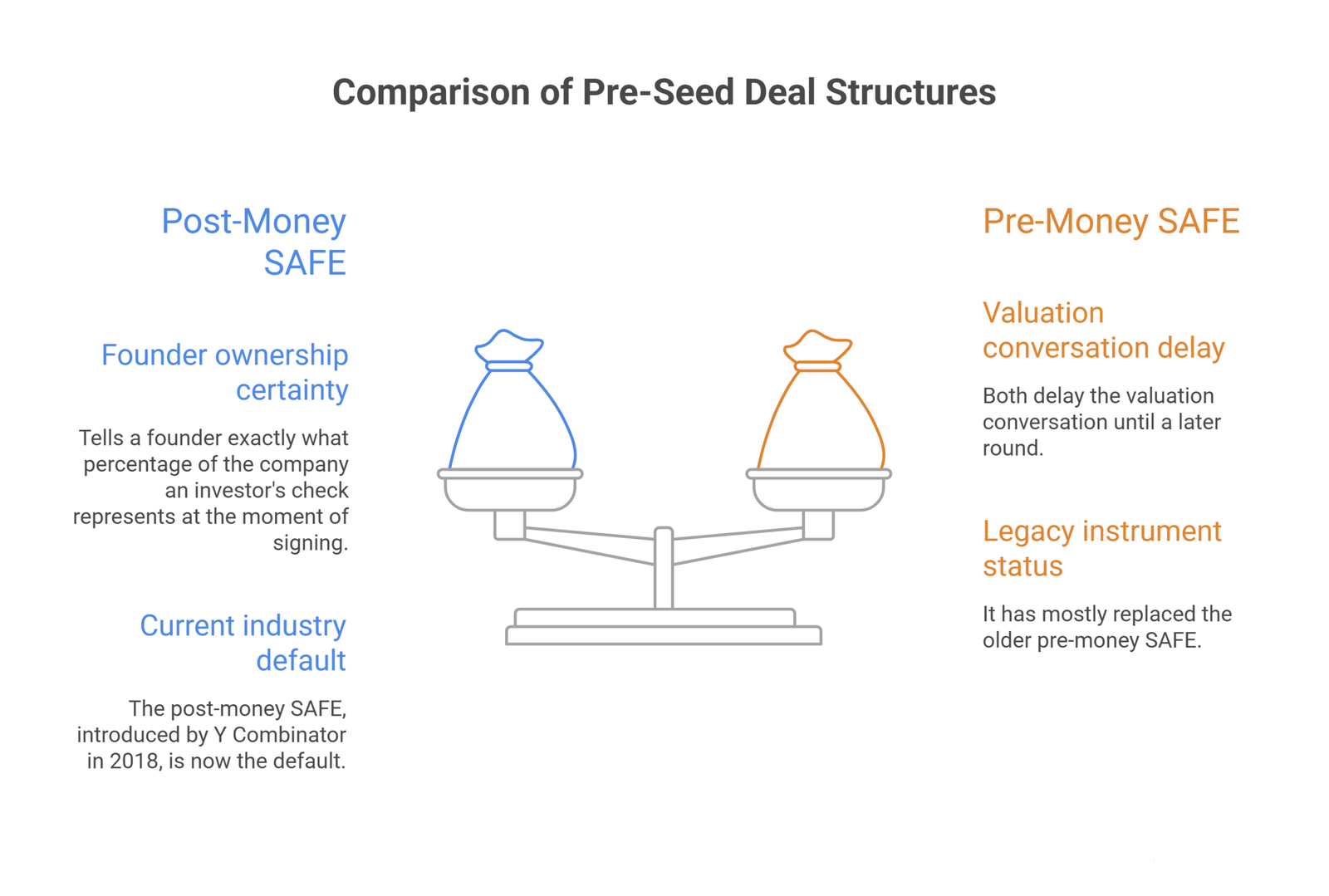
Almost no pre-seed round today is priced the way a Series A is. Instead, founders and investors use a SAFE (Simple Agreement for Future Equity) or a convertible note. Both delay the valuation conversation until a later round.
The post-money SAFE, introduced by Y Combinator in 2018, is now the default. It tells a founder exactly what percentage of the company an investor’s check represents at the moment of signing. That clarity is why it has mostly replaced the older pre-money SAFE. Two terms matter most inside a SAFE:
The valuation cap sets the highest price at which the SAFE converts into equity at the next priced round. If the company’s value has grown past the cap by then, the SAFE holder still converts at the cap. An aggressive cap protects the investor’s upside because of this. A discount rate, when included, gives the investor a set percentage off the next round’s share price instead of, or alongside, a cap. Around 61% of 2025 SAFEs used a cap only. Stacking a cap and a discount together tends to cost founders more equity than a straightforward priced round would.
Before signing more than one SAFE, model out what happens to your cap table if all of them convert at once. Founders who raise across several SAFEs at similar caps sometimes find they have given up 15% or more of the company. That can happen before a single priced round has even taken place.
How much equity you’re giving up
Dilution at pre-seed depends heavily on how much is raised and at what cap, but the pattern is consistent enough to plan around:
- Raises under $250,000 typically cost 5% to 6% of the company
- Raises between $250,000 and $999,999 typically cost 10% to 12%
- Raises between $1 million and $2.4 million typically cost 19% to 20%
- Raises above $2.5 million can run 24% to 30% or more
That last band is worth pausing on. A large SAFE round can sometimes dilute a founder more than a priced seed round of the same size would. That happens because there is no negotiation over valuation the way there is in a priced deal. The fix is not avoiding SAFEs. It is picking a realistic cap rather than an aspirational one, and keeping a running model of dilution across every instrument issued.
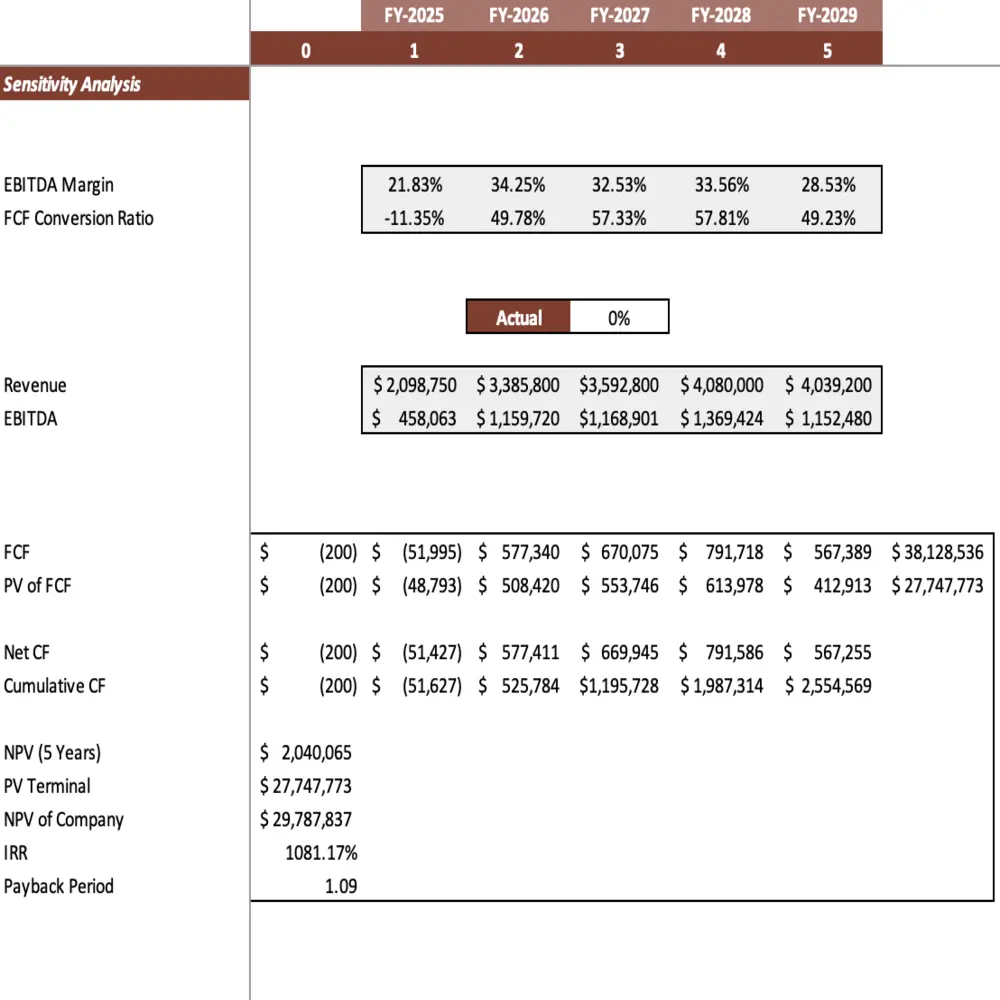
A financial model built before the raise, not during it, makes this math far easier to track as new investors come in.
Where pre-seed money actually comes from
Pre-seed capital comes from a narrower set of sources than later rounds, and each one expects a different check size.
Friends and family remain a common first source, particularly for founders without savings of their own to invest. There is no standard check size here. It depends entirely on the relationships involved.
Angel investors, usually former founders or operators investing their own money, typically write checks between $25,000 and $250,000. Beyond capital, a good angel brings mentorship and a network of warm introductions for the next round.
Accelerators and incubators, such as Y Combinator or Techstars, combine a fixed check with a structured program. YC’s standard check is $500,000, and founders also get access to a full cohort of investors. A Demo Day at the end of the program often creates real urgency among outside investors.
Dedicated pre-seed venture funds write the first institutional check, usually between $250,000 and $2 million. A fund’s term sheet effectively anchors the round. That matters more than the check size itself, since it sets terms other investors tend to follow.
Crowdfunding and grants round out the list. Equity crowdfunding platforms double as early marketing. Government or competition grants, common in biotech and deep tech, provide capital without giving up any equity at all.
When to start raising
There is no fixed calendar date for pre-seed. The better signal is your runway. Set a cash floor in advance, and start the raise well before you hit it, since fundraising itself takes months.
Before approaching investors, most founders benefit from having a working prototype and some form of customer validation. A clear read on the size of the opportunity helps too. So does a pitch deck that states the ask plainly: how much you’re raising, what it funds, and the timeline to your next milestone. Investors are underwriting your ability to hit that milestone, not just the idea itself.
Plan for 18 to 24 months of runway rather than the bare minimum. Series A benchmarks have risen, so startups now need more time to reach the traction that stage requires.
How to find pre-seed investors who won’t bail
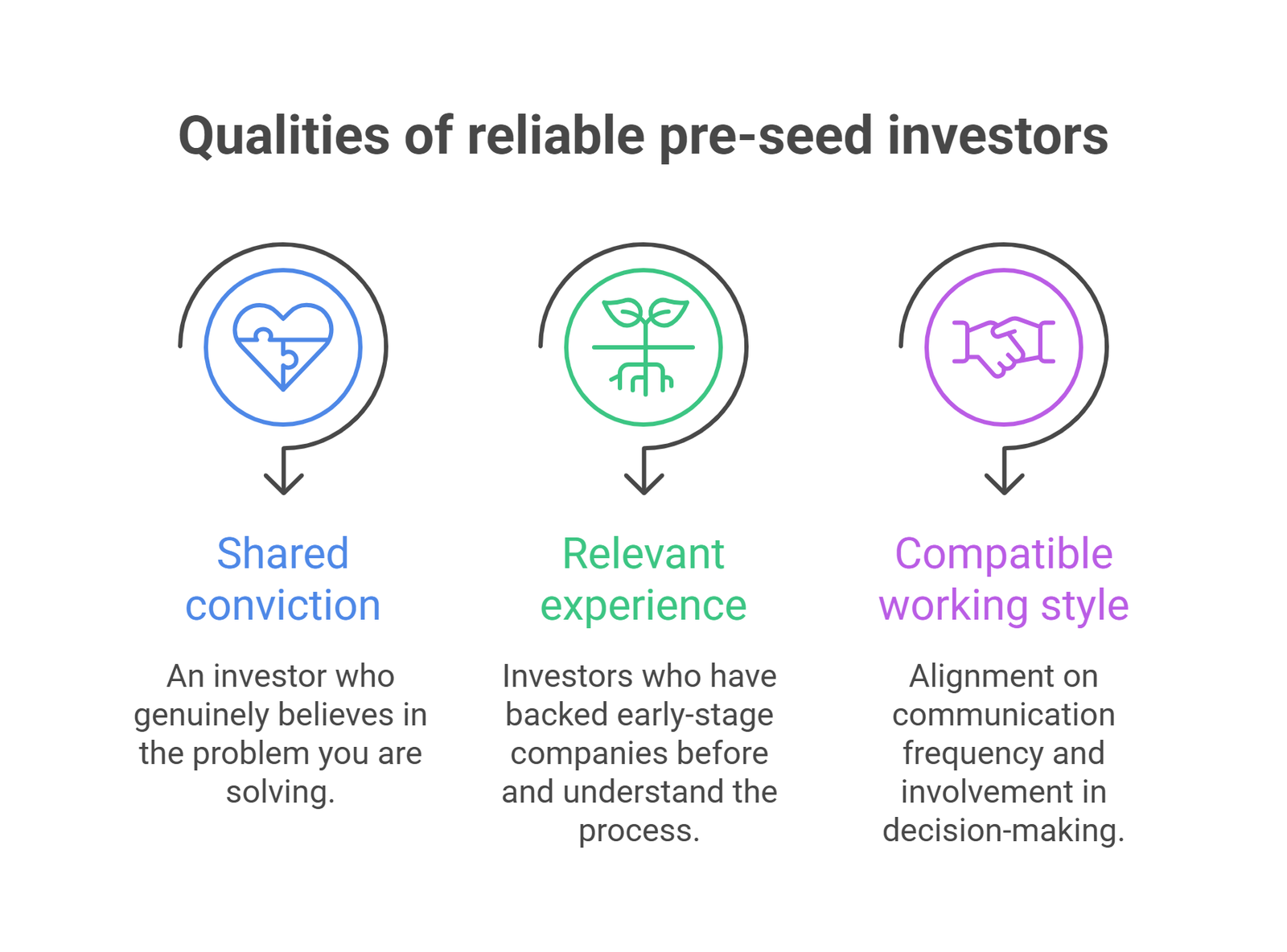
Not every check is worth taking. Three qualities separate investors worth keeping from ones that create problems later.
Shared conviction. An investor who does not genuinely believe in the problem you’re solving is likely to disappear the moment things get hard. Every early-stage company hits a rough patch eventually.
Relevant experience. Investors who have backed early-stage companies before know that the first year rarely goes according to plan. They are far less likely to panic over a missed milestone than a first-time angel would be.
Compatible working style. Some investors want monthly updates and nothing more. Others expect a seat at the table on every decision. Sort out which kind you’re dealing with before signing anything, not after.
Warm introductions convert at five to ten times the rate of cold outreach. It is worth building relationships with founders, accountants, and lawyers who already have investor connections before you need to fundraise. When that network is not enough, structured programs and thoughtful cold outreach still work. This is especially true when a fund’s actual portfolio suggests genuine thesis fit.
Frequently Asked Questions
How much should a startup raise at pre-seed?
Most rounds fall between $250,000 and $2 million. Deals under $250,000 still make up close to half of all pre-seed rounds. The right number depends on how much runway you need to reach a seed-worthy milestone, not on what feels impressive.
What’s the real difference between pre-seed and seed funding?
Pre-seed happens before there is a finished product or proof of demand. Seed funding happens once there is some evidence of product-market fit, typically alongside early revenue.
Do pre-seed rounds use a SAFE or a priced equity round?
Almost always a SAFE, specifically the post-money version. Priced rounds only become common once a raise exceeds roughly $4 million.
How much equity does a founder give up at pre-seed?
Typically 5% to 20%, depending on how much is raised. Smaller rounds under $250,000 dilute less. Rounds above $2.5 million can dilute 24% or more.
Can you raise pre-seed funding without a finished product?
Yes. Most pre-seed companies are pre-revenue with only a prototype or MVP. Investors are betting on the team and the size of the opportunity more than on the current build.
How long should a pre-seed round last?
Plan for 18 to 24 months of runway. That gives enough time to hit the milestones a seed investor will want to see, with a buffer if the market shifts.
What do pre-seed investors actually look for?
A founding team with relevant domain experience, a clearly defined problem, and early signals of demand. That could be a waitlist, customer interviews, or a working prototype.
Getting the raise right the first time
The biggest mistake founders make at this stage is not the pitch. It’s going in without a clear number or an accurate cap table model. Many also lack a sense of what a fair valuation cap looks like for a round their size. Getting those details wrong at pre-seed compounds at every round that follows.
Oak Business Consultant works with founders on the business plans and financial models that back up a pre-seed ask. That support continues into CFO-level services once the round closes and reporting expectations start.
Talk to our funding team about what a realistic pre-seed round looks like for your company.