

Month-End Close Acceleration Guide



$0
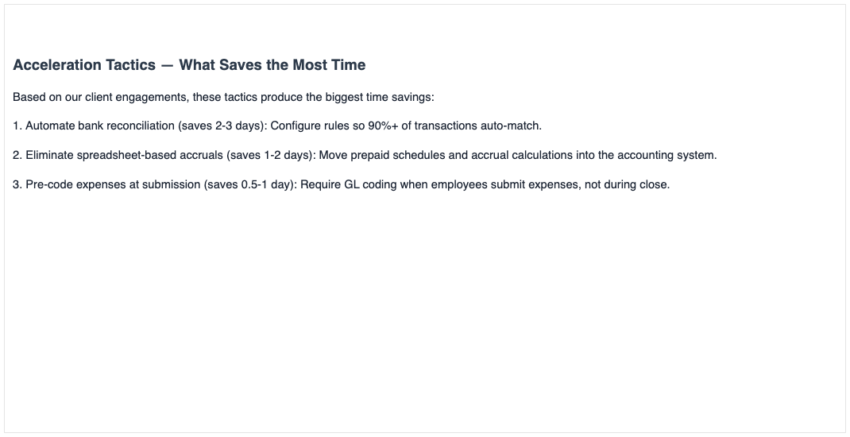
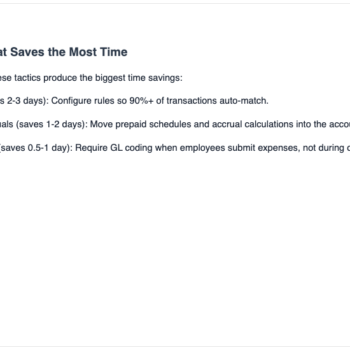
Our guide highlights specific financial close optimization for SaaS tactics that produce the biggest ROI. For example, moving to GL coding at the point of submission for employee expenses can save up to a full day of manual re-classification. By implementing system-generated revenue entries, you eliminate the need for complex, spreadsheet-based revenue recognition schedules that are prone to formula errors.
- Description
- Reviews (0)
Description
Stop Reporting the Past and Start Forecasting the Future
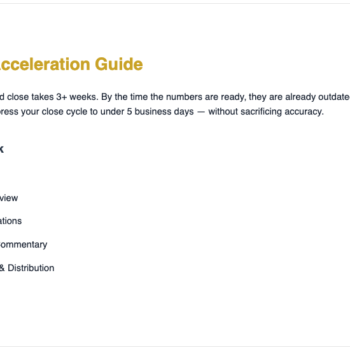
For many high-growth companies, the financial close is a grueling marathon. It stretches well into the third week of the following month. By the time the leadership team receives the board package, the data is stale. The opportunity to pivot based on those insights has already passed. If your finance team is buried in manual reconciliations and “hunts” for missing invoices, you aren’t just losing time. You’re losing strategic leverage.
The Month-End Close Acceleration Guide is a comprehensive financial close process improvement template. It is designed to compress your cycle from weeks to just five business days. This isn’t about working harder. It’s about implementing a continuous accounting implementation guide. This shifts the workload away from the “crunch” and into a streamlined, automated flow.
The 5-Day Close Framework: A Day-by-Day Roadmap
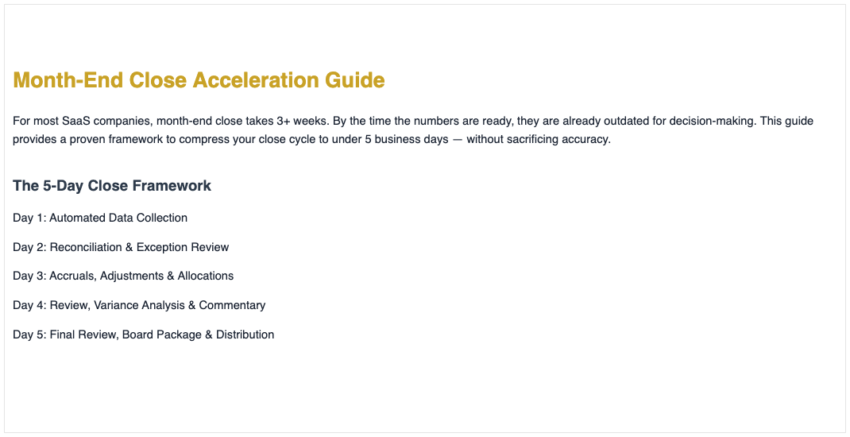
The core of this guide is our day-by-day close acceleration framework. We break down the massive task of closing the books into manageable, parallel-processed stages:
Day 1 Automated Data Collection
Move from manual uploads to API-driven feeds. This stage focuses on your automated financial close workflow template, ensuring bank, payroll, and subscription data flow directly into the GL.
Day 2 Reconciliation & Exception Review
Shift your team to an exception-only review framework. Instead of matching every transaction, your staff only addresses the 5–10% of items the system couldn’t auto-reconcile.
Day 3 Accruals, Adjustments & Allocations
Use our accruals and adjustments checklist to handle everything from unbilled revenue accrual calculations to system-generated prepaid amortization automation.
Day 4 Review & Variance Analysis
Leverage a variance analysis and commentary template to identify material differences (over 10%) compared to budget or the prior month.
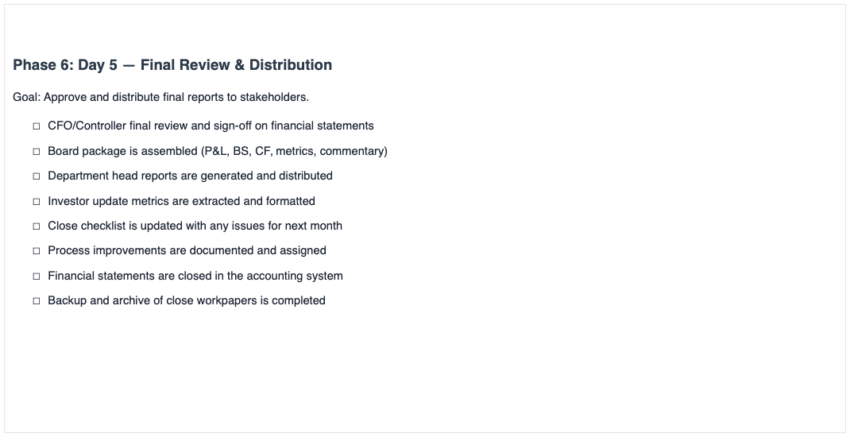
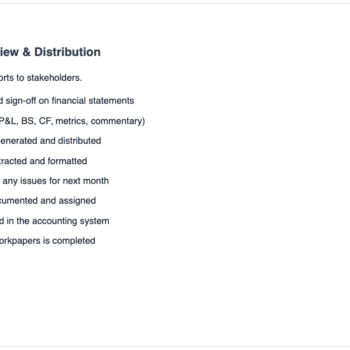
Day 5 Final Review & Distribution
Assemble your board package and distribute reports to department heads, ensuring the “close” is finalized in the accounting system.
Why Choose the Month-End Close Acceleration Guide?
This guide provides more than just theory; it offers a tactical SaaS month-end close checklist that addresses the unique complexities of recurring revenue and digital operations.
Key Features and Benefits:
- Continuous Accounting vs. Traditional Close: Learn how to record intercompany transactions and record expenses in real-time rather than waiting for month-end.
- Hard Close vs. Soft Close Methodology: Master the art of the “Hard Close” for quarterly reporting and “Soft Close” for rapid monthly insights.
- Automation Roadmap: Identify which close tasks can be automated first to see immediate time savings of 2–3 days.
- Standardized Workflows: Use our month-end close SOP template to ensure every task has a clear owner, deadline, and dependency.
Built for Modern Finance Leaders
Whether you are in the trenches or leading from the boardroom, this guide serves the various stakeholders of the financial close.
- Controllers & Accounting Managers: Use the 5-day close checklist to judge and improve your team’s performance, moving toward close compression and better work-life balance.
- CFOs & Founders: Implement this as a “marching order” for your finance department to ensure you have an investor update metric extraction process that is fast, accurate, and defensible.
- Venture Capital Operating Partners: Use the guide as a close process bottleneck analysis tool when stepping into new portfolio companies to professionalize their operations.
FAQs
1. How do I reduce my month-end close from 3 weeks to 5 days?
It starts with a 30-day action plan. You must identify your three biggest bottlenecks, automate your bank reconciliation process, and move toward parallel processing for month-end close tasks so the team isn’t waiting on a single “blocker.”
2. What are the benefits of a “Hard Close” versus a “Soft Close”?
A hard close vs soft close methodology allows for flexibility. A hard close is an absolute cut-off for external audits, while a soft close allows for faster internal reporting by using estimates for non-material items, enabling leadership to make decisions by Day 5.
3. Can I automate accruals and adjustments?
Yes. By using a recurring journal entry template and setting up prepaid amortization scheduling within your ERP, you can eliminate manual calculations. This guide provides the templates needed to move these from spreadsheets into your system.
4. How do I handle variance commentary?
Our management discussion points for close commentary help you focus on the “why” behind the numbers. Instead of just stating a balance changed, the guide helps you document the business driver, making your board package assembly much more valuable.
Be the first to review “Month-End Close Acceleration Guide”
You must be logged in to post a review.














Reviews
There are no reviews yet.