

SaaS Revenue Recognition Checklist Tool
$0
Our checklist is structured around the core revenue recognition 5-step model, ensuring no detail of your customer arrangements is overlooked. By using this SaaS revenue recognition policy template, you can transform a manual, error-prone process into a streamlined, defensible workflow.
- Description
- Reviews (0)
Description
The ASC 606 5-Step Model Checklist for SaaS
For modern software companies, revenue is more than just cash in the bank—it is a rigorous accounting exercise. Since the implementation of ASC 606 and IFRS 15, the landscape for subscription-based businesses has shifted from simple billing to complex, judgment-based recognition. Failing to align with these standards doesn’t just result in messy books; it creates ASC 606 restatement risk that can tank a valuation, stall a funding round, or cause a “deal killer” during enterprise procurement.
The SaaS Revenue Recognition Checklist is a definitive professional resource designed to bring your finance function into full compliance. Whether you are navigating bundled professional services or mid-term contract modifications, this checklist serves as your audit-ready revenue recognition SaaS roadmap.
Navigate the Complexities of ASC 606 with Confidence
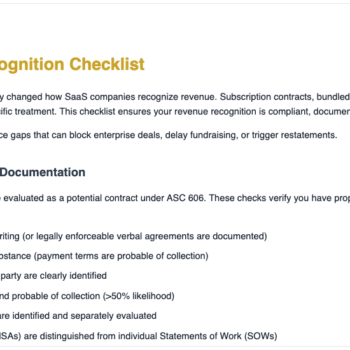
1. Identify the Contract and Performance Obligations
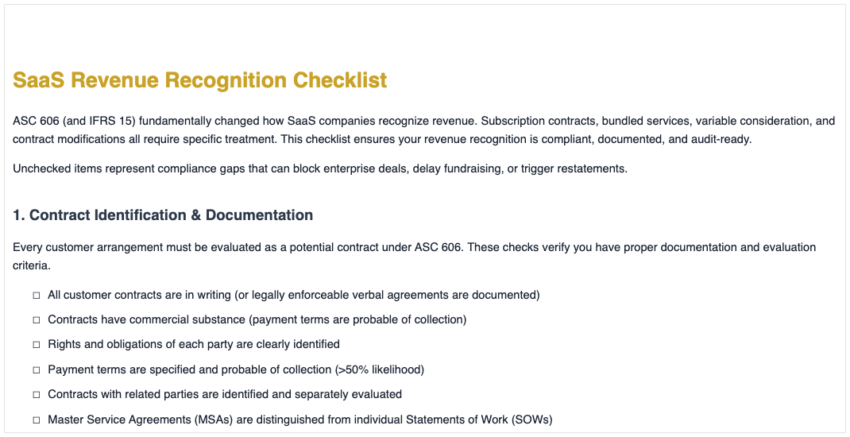
Every MSA and SOW must be scrutinized. Our performance obligations checklist ASC 606 helps you determine if implementation fees, training, or support are “distinct” or must be bundled with the subscription.
- Distinguish between Master Service Agreements and individual Statements of Work.
- Identify material rights deferred revenue SaaS implications for future purchase options.
- Evaluate principal vs agent revenue recognition for third-party marketplace integrations.
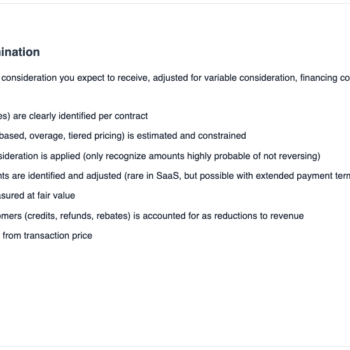
2. Determine and Allocate Transaction Price
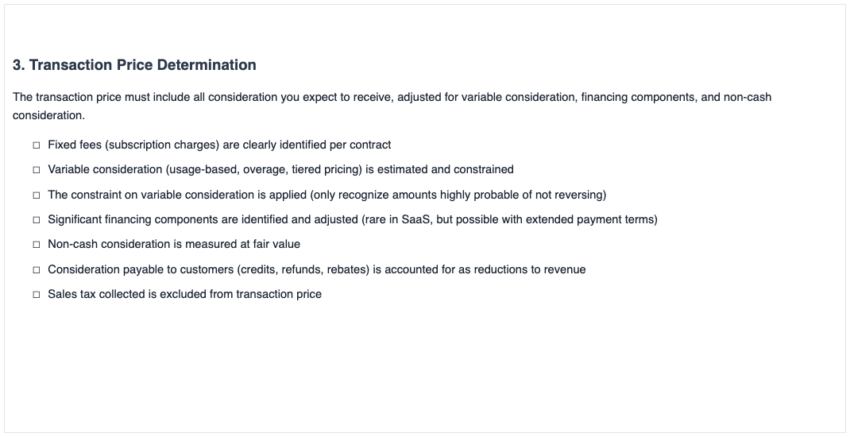
Calculating the transaction price allocation SaaS requires a deep dive into variable consideration checklists. You must estimate usage-based fees and tiered pricing while applying the variable consideration constraint checklist SaaS to prevent revenue reversals.
- Establish standalone selling price (SSP) documentation for bundled SaaS services.
- Document SSP estimation methods, including adjusted market and residual approaches.
- Adjust for significant financing components in multi-year upfront payments.
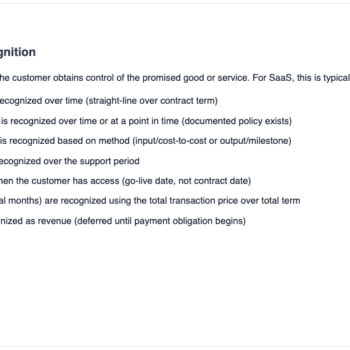
3. Mastering the Timing of Recognition
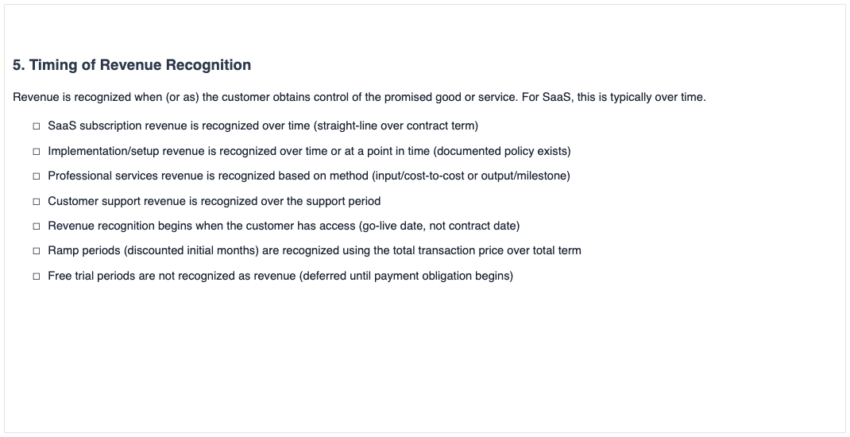
For SaaS, the control transfer usually happens “over time.” Our checklist ensures you use the correct go-live date revenue recognition start trigger rather than just the contract signature date.
- Apply straight-line revenue recognition for subscriptions with ramp periods.
- Track contract asset vs deferred revenue SaaS when performance precedes billing.
- Document the cost-to-cost method for SaaS implementation revenue or milestone-based recognition for professional services.
Essential Features for Audit Readiness
Documentation is the foundation of a clean audit opinion. This toolkit includes a SaaS revenue recognition journal entries template and a deferred revenue tracking template to ensure your balance sheet is always reconciled.
- Contract Modification Tracking: Navigate the complexities of the cumulative catch-up method vs. prospective treatment for upsells and downsells.
- Deferred Revenue Management: A deferred revenue classification short term vs long term template ensures proper presentation on your financial statements.
- Audit Trail & Policy Memos: Get a revenue recognition policy memo template for auditors that documents your management judgments and SSP analysis.
Who is This Checklist For?
- SaaS Controllers & Accounting Managers: This is your “pre-close” manual. Use it to verify that unbilled revenue tracking SaaS is accurate and that your system-generated revenue reports are version-controlled and reliable.
- Revenue Operations (RevOps) & Sales Leaders: Revenue recognition often breaks during the sales cycle. Use the SaaS contract review checklist revenue to ensure custom enterprise clauses—like acceptance criteria—don’t accidentally delay revenue recognition.
- Fractional CFOs & External Auditors: If you are preparing a client for a first-year audit, this is your fractional CFO diagnostic tool. It allows you to perform a gap analysis and implement a SaaS revenue recognition checklist that satisfies big-four audit standards.
Frequently Asked Questions (FAQs)
1. What are the 5 steps in the SaaS revenue recognition model?
Under ASC 606, companies must follow a specific sequence: identify the customer contract, identify the performance obligations checklist ASC 606 items, determine the transaction price, allocate that price to each obligation, and recognize revenue as control is transferred. Our ASC 606 5-step model checklist ensures you document every stage for the auditors.
2. How do I handle contract modification revenue recognition in SaaS?
When a customer upsells or downsells mid-term, you must determine if the change creates a separate contract or a modification. Our SaaS contract modification revenue recognition examples help you decide between a cumulative catch-up method or prospective treatment, ensuring your contract modification revenue recognition SaaS policy remains compliant.
3. When should revenue recognition for a subscription actually start?
Revenue recognition typically begins at the go-live date revenue recognition start point—when the customer has access to the software—rather than the contract signature date. Our SaaS revenue recognition checklist helps you track this “point of control” to avoid premature or delayed recognition.
4. How do I document Standalone Selling Price (SSP) for bundled services?
Auditors require a standalone selling price documentation template that shows how you allocated value to a subscription vs. implementation fees. Our checklist guides you through SSP estimation methods SaaS leaders use, such as the adjusted market assessment or the residual approach for legacy pricing.
5. What is the difference between a contract asset and deferred revenue?
Contract asset vs deferred revenue SaaS classification depends on whether you have performed the work before billing (asset) or received payment before performing the work (liability). Our deferred revenue tracking template ensures you correctly classify short-term vs. long-term liabilities on your balance sheet for audit-ready revenue recognition SaaS standards.
Be the first to review “SaaS Revenue Recognition Checklist Tool”
You must be logged in to post a review.










Reviews
There are no reviews yet.