Do You Need an Interim CFO or a Part-Time CFO?
Interim CFO or part-time CFO: which one does your business need?
Hiring senior finance help comes down to two questions. How much CFO does the business need each week? And for how long?
An interim CFO answers with full-time cover for a set period. A part-time CFO answers with a share of each week and no end date. Pick the wrong one and the business either pays for hours it does not use or goes without cover when it matters.
This guide explains the difference, what each costs, and how to choose.
Short answer: pick an interim CFO when the need is urgent and has an end date. Pick a part-time CFO when the need is steady and the business cannot yet justify a full-time hire.
Interim CFO vs part-time CFO at a glance
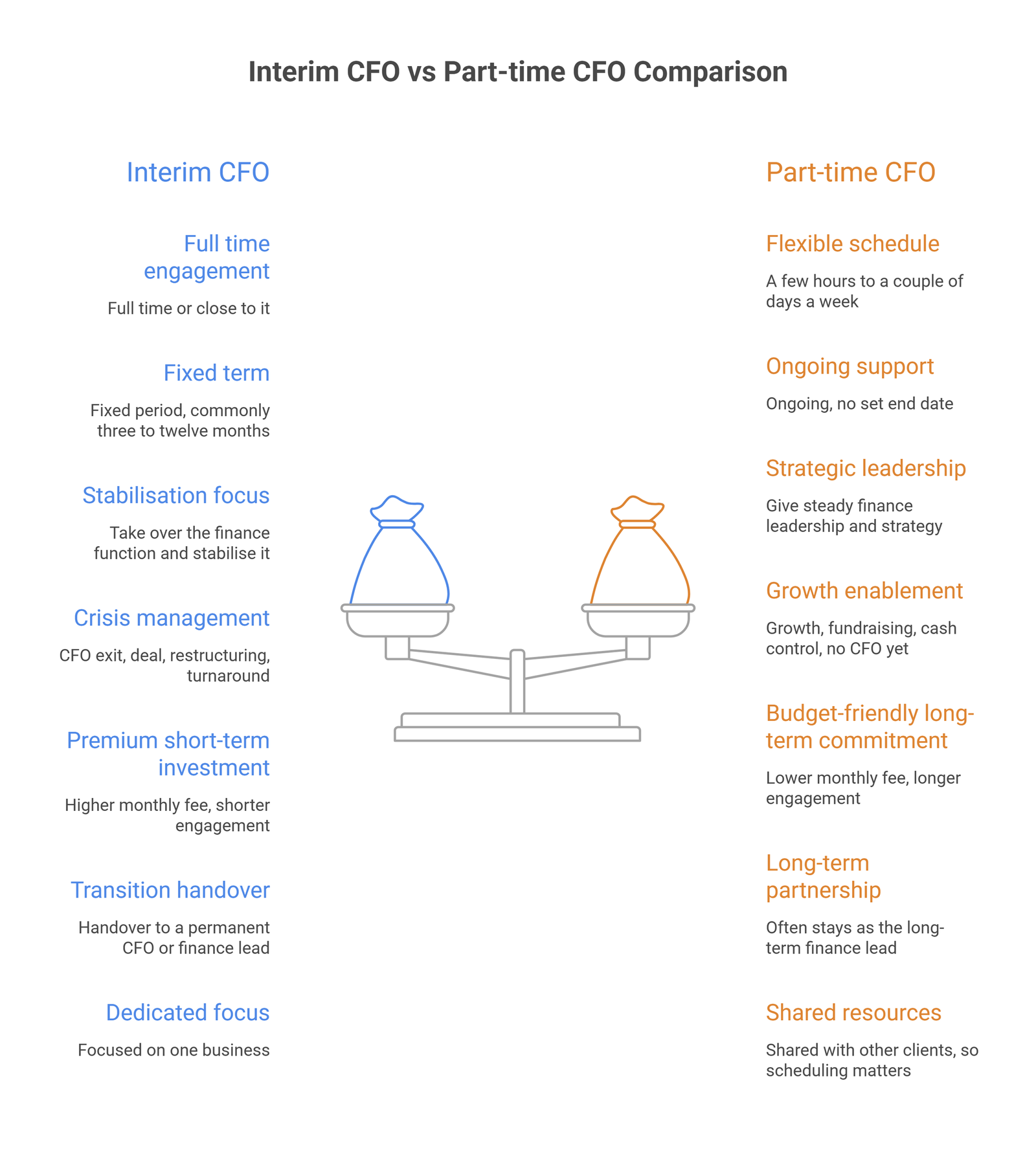
| Interim CFO | Part-time CFO | |
| Time commitment | Full time or close to it | A few hours to a couple of days a week |
| Duration | Fixed period, commonly three to twelve months | Ongoing, no set end date |
| Main job | Take over the finance function and stabilise it | Give steady finance leadership and strategy |
| Typical trigger | CFO exit, deal, restructuring, turnaround | Growth, fundraising, cash control, no CFO yet |
| Cost pattern | Higher monthly fee, shorter engagement | Lower monthly fee, longer engagement |
| What happens at the end | Handover to a permanent CFO or finance lead | Often stays as the long-term finance lead |
| Availability | Focused on one business | Shared with other clients, so scheduling matters |
What is an interim CFO?
An interim CFO is an experienced finance leader who joins temporarily to run the finance function. Think of the role as a temporary but complete CFO. The person owns reporting, cash, controls and the finance team, and answers to the CEO and the board.
Businesses usually bring one in for a specific event:
- The CFO resigns, retires or is removed, and the seat cannot stay empty.
- A merger, acquisition or sale needs due diligence and integration work.
- A restructuring, refinancing or turnaround needs hands-on control.
- The month-end close is slow or messy ahead of an audit.
- The CFO is on extended leave, and the role needs a full-time stand-in.
- A permanent search is under way and someone must hold the fort.
Day to day, an interim CFO runs reporting and the month-end close, manages cash and lender relationships, leads the finance side of any deal, tightens controls and briefs the board. Before leaving, the person documents processes and trains the team.
The strength of an interim CFO is speed. The person has seen similar situations before and needs little ramp-up. The trade-offs are a higher monthly cost and a clear end date. Knowledge leaves with the person unless the handover is planned from day one.
Oak’s temporary CFO services cover this kind of engagement.
What is a part-time CFO?
A part-time CFO works for your business on an ongoing basis, but for fewer hours than a full-time executive. The work is regular and strategic. It usually covers budgets, forecasts, cash flow, KPI reporting and investor materials. The CFO also guides the bookkeeper or accountant who runs the day-to-day numbers.
Most providers use “part-time CFO”, “fractional CFO” and “outsourced CFO” for the same thing. A minority draw a line. They treat a part-time CFO as a steady generalist on a fixed schedule, and a fractional CFO as a project-based advisor who leaves when the goal is met. Definitions differ by market, so check what a provider means before comparing quotes.
This guide uses “part-time” and “fractional” for the common model: senior finance leadership for a slice of the week, on an ongoing basis. Oak’s fractional CFO services work this way.
When an interim CFO is the better choice
Choose an interim CFO when three things are true. The need is urgent. The workload is heavy enough to fill most of the week. And the situation will end or change within months.
A deal is the clearest example. Due diligence, data rooms, lender calls and integration planning take far more hours than a part-time schedule allows. The same goes for a sudden CFO exit. The finance team still needs a leader tomorrow, and the board needs someone who can sign off on the numbers.
An interim CFO also works as a bridge. The person stabilises the function, finds out what the business really needs, and prepares the ground for the permanent hire.
When a part-time CFO is the better choice
Choose a part-time CFO when the need is real but not daily. Typical signs:
- No CFO exists yet, and the founder still builds the financial model.
- Revenue is growing, but a full-time CFO salary would strain the budget.
- A fundraise is coming, and investors will expect a clean forecast and clear metrics.
- A controller or accountant keeps the books, but nobody owns strategy and cash planning.
- Most of the work can fit into a few days a month.
The advantage is cost and continuity. The same person learns the business over time and can scale hours up or down as needs change. The weak point is availability. A part-time CFO serves other clients too, so response times and meeting rhythm should be agreed in writing.
Where a full-time CFO fits
Neither option replaces a permanent CFO forever. A full-time hire makes sense when finance decisions need a CFO every day. Typical signs are several entities or countries, regular board and lender reporting, frequent deals and a finance team that needs a permanent leader.
Until then, the part-time or interim route costs less and starts faster. A permanent search often takes months, while interim and part-time CFOs can usually start within days or weeks.
How the choice plays out by business type
| Situation | Better fit | Why |
| Early-stage startup preparing to raise | Part-time | Needs a model, runway tracking and investor reporting, not daily CFO cover |
| Retail business with tight margins and seasonal cash | Part-time | Needs steady cash forecasting and margin tracking through the year |
| Restaurant with thin margins | Part-time | Needs food cost, labour cost and cash discipline reviewed on a regular rhythm |
| Fintech or any company in an M&A deal | Interim | Deal workload is heavy, full time and short-lived |
| CFO has just resigned | Interim | The seat needs a full-time occupant now |
| Covenant breach or turnaround | Interim | Needs hands-on control and constant lender contact |
| Messy books ahead of an audit | Interim, then part-time | Interim for the clean-up, part-time to keep the discipline |
How much do they cost?
Part-time CFOs usually bill a monthly retainer. Oak’s guide to the cost of a fractional CFO puts the typical range at $3,000 to $15,000 a month, depending on scope and hours.
Interim CFOs cost more per month. The work is full time, focused on one business, and often urgent. Fees vary widely by market, seniority and scope, so quotes from different providers can look very different.
The cheaper option on paper is not always the cheaper option. A part-time CFO who cannot cover a lender deadline can cost more than an interim CFO who can. When comparing quotes, ask for:
- A fixed monthly fee and a clear list of deliverables.
- A defined end date for interim work.
- The number of hours or days included each week.
- What happens if the scope grows.
Can you move from one to the other?
Yes, and many businesses do. A common path looks like this.
A small company starts with a part-time CFO. A deal or leadership gap arrives, so it brings in an interim CFO for a few months. Once the complexity becomes daily, it hires a permanent CFO. Oak’s full-time CFO services support that final step.
A part-time CFO can also raise hours for a busy quarter, then scale back. That is often cheaper than switching models.
For the wider question of outside help versus an in-house hire, see Oak’s comparison of external vs internal CFOs.
Three questions that settle the choice
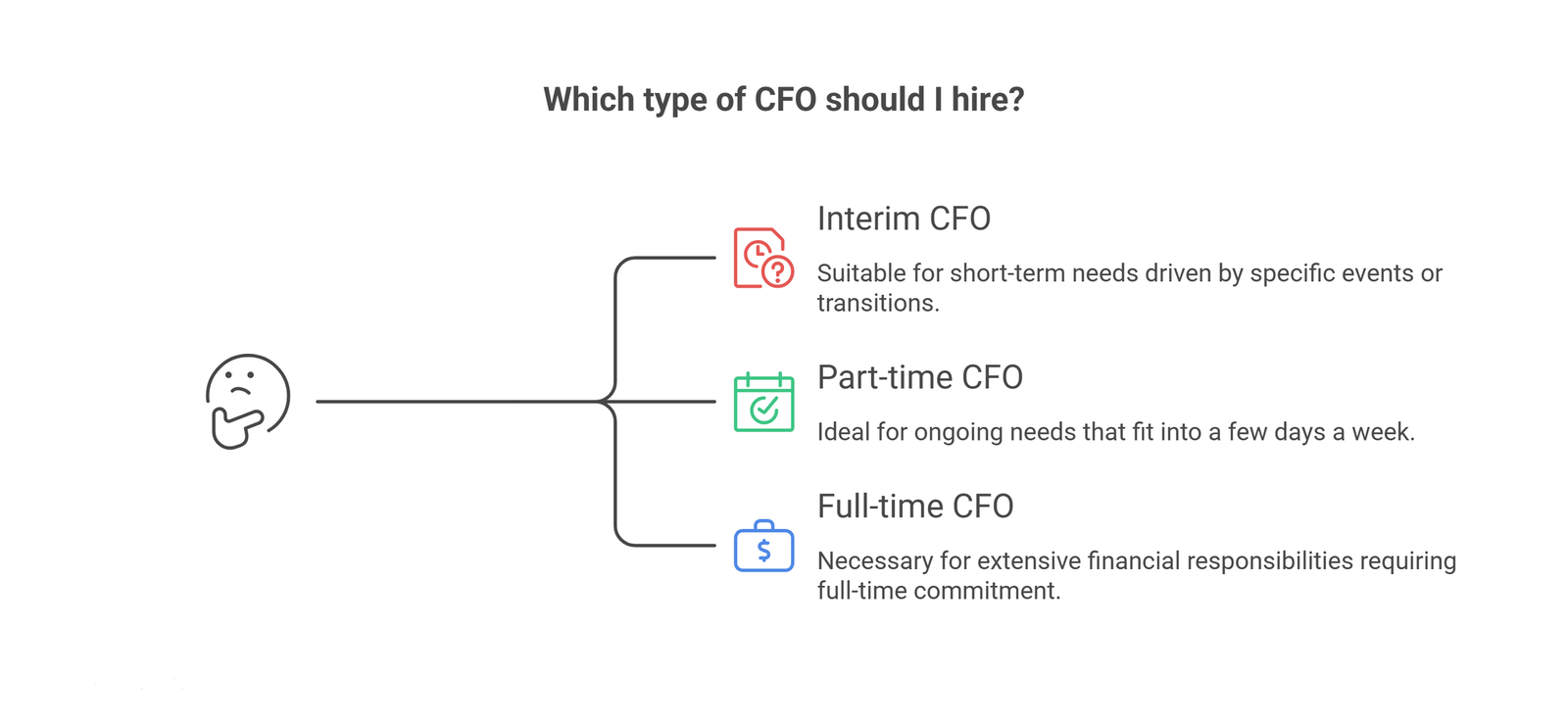
1. Is there a dated event behind the hire? A sale, an audit, a resignation or a lender deadline points to interim. A general need for better numbers points to part-time.
2. Could the work fit into two days a week? If it could, a part-time CFO can handle it. If it needs most of the week, look at interim or full-time.
3. Who owns finance when this period ends? If the answer is “the same person, just keep going,” choose part-time. Moreover, if the answer is “someone new, still to be found,” choose interim.
If the answers split, begin with an interim CFO and plan the handover to a part-time or permanent CFO from the start.
What to agree before anyone starts
Most disappointing CFO engagements fail on setup, not on talent. Settle these points in writing:
- Authority. The CEO and board should state that the CFO holds full CFO authority, whatever the title or hours.
- Scope. List the deliverables, such as monthly reporting, the forecast and the cash plan.
- Hours and response times. This matters most for part-time work.
- Reporting rhythm. Agree when the CEO and board will see numbers.
- Success measures. Define what good looks like, such as a clean close on time, a rolling cash forecast or a funded deal.
- Handover. Require process notes, a documented close calendar and training for the team.
- Exit terms. Set the notice period on both sides.
How to choose the right person
Technical skill is the easy part. Look for these instead:
- A track record in your type of situation, such as a deal, a turnaround or a growth phase.
- Experience at your size. A CFO from a large group may struggle in a ten-person finance team.
- Credibility with boards, lenders and investors.
- A habit of leaving the function stronger and handing over cleanly.
Frequently Asked Questions
What is the difference between an interim CFO and a part-time CFO?
An interim CFO works full time for a limited period, usually to cover a gap or lead a transition. A part-time CFO works fewer hours on an ongoing basis and focuses on steady financial leadership.
Is a part-time CFO the same as a fractional CFO?
Usually, yes. Most firms use the terms interchangeably, along with “outsourced CFO”. A minority treat fractional as project-based, so confirm what a provider means.
How long does an interim CFO usually stay?
Engagements commonly run from three to twelve months. The length depends on the event. A CFO search or a deal timeline usually sets the end date.
Which is cheaper, an interim CFO or a part-time CFO?
A part-time CFO is cheaper per month because it uses fewer hours. An interim CFO costs more per month but for a shorter period. The right comparison is cost against the problem being solved.
Can an interim CFO become the permanent CFO?
Sometimes. It depends on the person, the business and the agreement. Raise it at the start, so both sides know whether conversion is an option.
Can a small business hire an interim CFO?
Yes. Size matters less than the situation. A small company facing a CFO exit, a sale or a lender deadline can use an interim CFO. For routine needs, a part-time CFO is usually the better fit.
How fast can a CFO start?
Interim and part-time CFOs can often start within days or a few weeks. A permanent CFO search usually takes several months.
Match the CFO to the problem, not the title
The label matters less than the problem. Write the need in one sentence first. “We need someone to run finance for six months while we sell the company” points to an interim CFO. “We need someone to own the forecast and the cash plan every month” points to a part-time CFO.
Not sure which sentence describes your business? Oak’s team can review your situation and recommend the right model. Explore Oak’s CFO services or book a call to talk it through.