Building a Financial Consulting Business: Steps and Tips
How to Build a Financial Consulting Business?
Anyone can hang out a shingle that says “financial consultant.” Getting a client to actually pay for it is a different problem, and it’s usually the part that trips people up. Certifications, a niche, and a nice website matter, but they won’t tell you what to charge, how to structure the business so a bad engagement doesn’t wipe out your savings, or where your first paying client is actually going to come from. This guide covers all of that.
What is a financial consulting business?
A financial consulting business is a professional services firm that advises individuals, businesses, and organizations on managing money, investments, and financial risk. Most firms are built around one or two people with deep experience in a specific area, rather than a broad bench of generalists.
Key services financial consulting firms offer
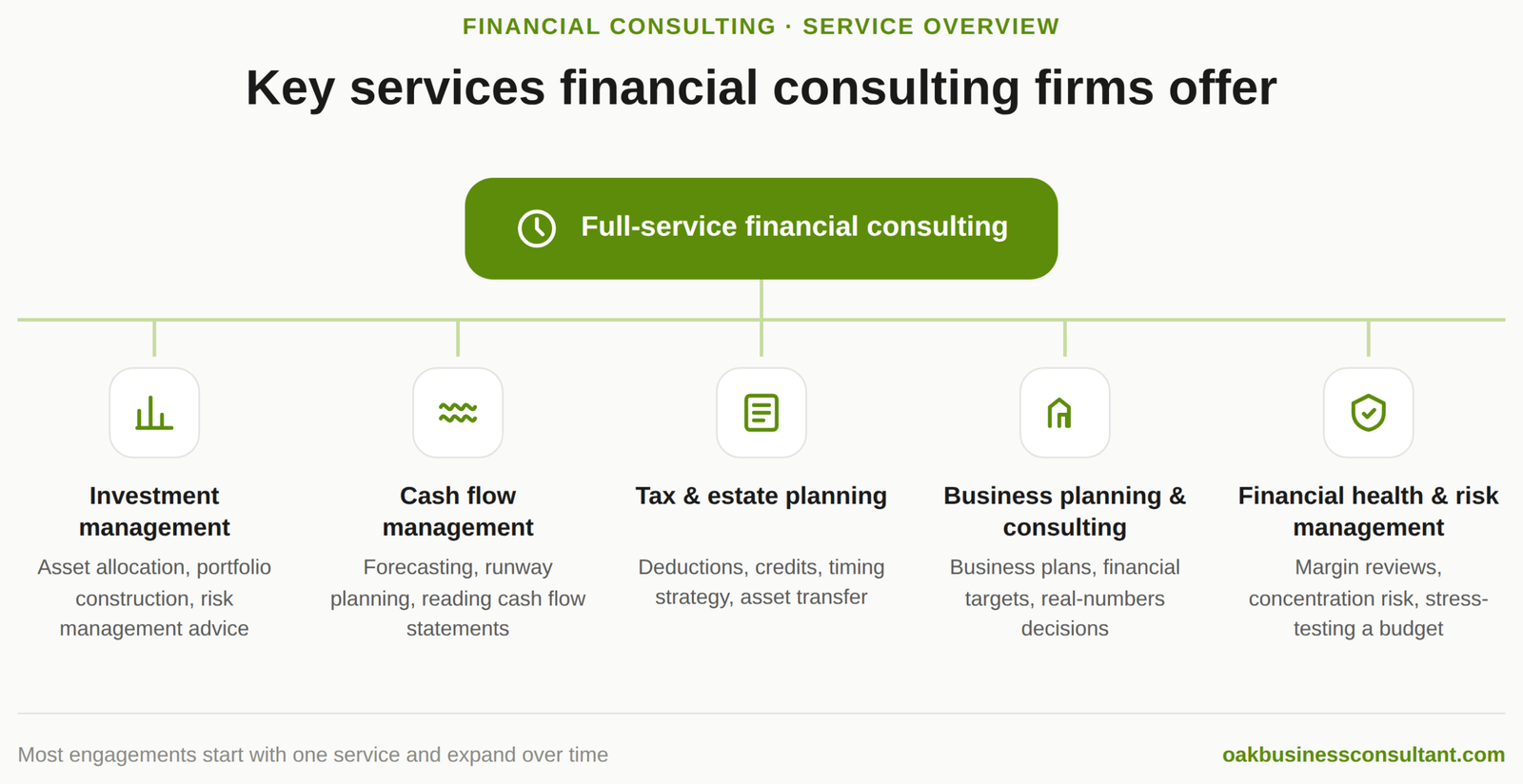
Investment management
This covers asset allocation, portfolio construction, and risk management advice. Clients hire an investment-focused consultant to help decide what to hold, when to rebalance, and how much risk they can stomach.
Cash flow management
Cash flow work means forecasting, reading cash flow statements, and building a runway plan so a business doesn’t run out of money between invoices. This is one of the more common entry points for a new financial consultant, since almost every small business struggles with it at some point. Our financial modeling services build exactly this kind of forecast for clients who need it done right the first time.
Tax and estate planning
Tax planning identifies deductions, credits, and timing strategies to reduce a client’s liability. Estate planning makes sure assets pass to the right people with the least friction. Both usually require coordination with a CPA or attorney, even if the consultant leads the strategy conversation. If you’d rather bring in tax advisory support than build that expertise from scratch, it’s a common way to round out a young practice’s service list.
Business planning and consulting
This includes building business plans, setting financial targets, and helping a founder or owner think through operational decisions with real numbers attached instead of gut feel.
Financial health and risk management
Ongoing work to catch problems before they become emergencies: reviewing margins, flagging concentration risk, stress-testing a budget against a bad quarter.
Critical steps to starting a financial consulting business
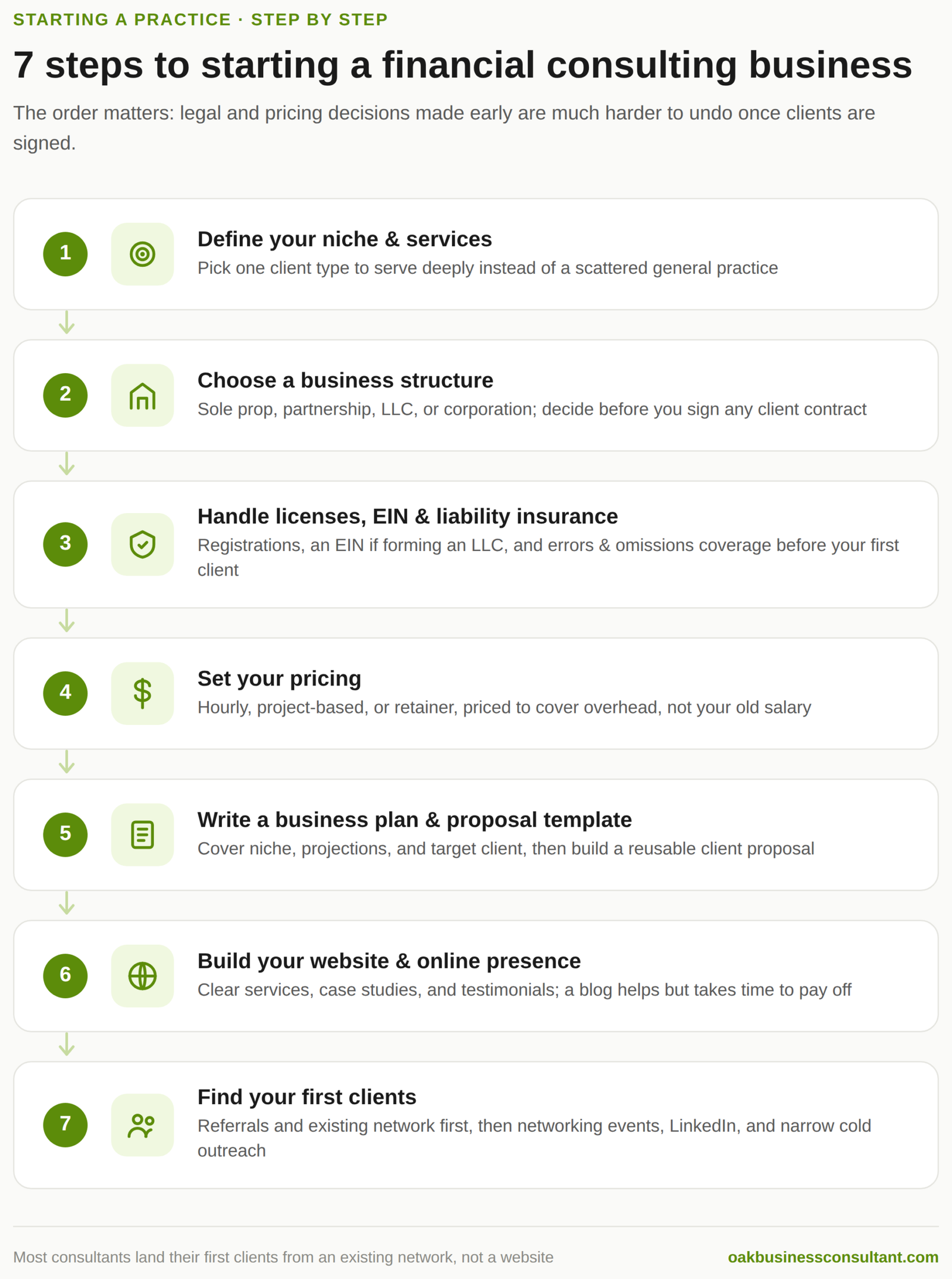
Define your niche and services
“Financial consulting” covers investment advice, tax strategy, retirement planning, cash flow work, and more. Pick a lane. A consultant who works exclusively with dental practices on cash flow will out-earn a generalist within a year or two, because referrals compound inside a niche in a way they never do across a scattered client list.
Choose a business structure
This decision affects your taxes, your personal liability, and how much paperwork you deal with every year. The four common options:
- Sole proprietorship: no separation between you and the business, and no state filing required. Simplest to start, but your personal assets are exposed if a client sues.
- General partnership: same personal liability exposure as a sole proprietorship, just split between two or more owners.
- LLC: separates your personal assets from the business and passes income through to your personal tax return. Most solo and small financial consulting practices land here.
- Corporation: a separate legal entity, more paperwork, usually only worth it once you’re hiring staff or raising outside capital.
If you sign a client contract as a sole proprietor and form an LLC later, you’re still personally on the hook for that earlier contract. Structure the business before you sign anything, not after.
Handle licenses, registrations, and an EIN
Requirements vary by state and by the specific service you offer. At minimum, expect to need a general business license and, if you’re working from home, possibly a home occupation permit. If you’re forming an LLC or corporation, or plan to hire, get an EIN from the IRS. It’s free and takes a few minutes online. If you’re giving investment advice for a fee (not just financial planning in general), check whether you need to register as an investment adviser with your state or the SEC; that’s a real regulatory line, not a formality.
Set your pricing before you need it
This is the step most first-time consultants skip, and it costs them money for years afterward. The three common models:
- Hourly: simplest to bill, but it caps your income to the hours you can personally work.
- Project-based: a flat fee for a defined scope. Rewards efficiency, since you keep the difference if you finish faster than estimated.
- Retainer: a recurring monthly fee for ongoing access. Best for cash flow predictability once you have a track record.
Whatever you charge, build in your self-employment taxes, software, and the time you’ll spend on unbillable admin work. Don’t price against what you earned as an employee; that number never accounted for the overhead you’re about to carry yourself. And don’t underprice to win your first clients. It’s much harder to raise a rate on an existing client than to set it correctly from day one.
Write a business plan and a client proposal template
Your business plan should cover your niche, target client, competitors, marketing approach, and financial projections. A plan built to attract investors looks different from one meant to guide your own decisions, so decide which one you’re writing first. If you’re still working through the fundamentals, our financial planning resources cover the groundwork most first-time founders skip.
Separately, build a reusable proposal template covering scope, timeline, terms, and price. You’ll customize it per client, but starting from a template means you’re not writing a contract from scratch under deadline pressure.
Get professional liability insurance
If a piece of advice you give costs a client money, they can sue, and general business insurance usually won’t cover that. Professional liability insurance (also called errors and omissions insurance) covers legal costs and damages if a client claims your advice caused financial harm. Most established financial consultants carry this before they take on their first paying client, not after a close call.
Build a website and online presence
Your site needs a clear description of your services, who you work with, and how to reach you. Case studies and testimonials do more to build trust than a long bio. A blog that answers the specific questions your niche searches for, using the right keywords in the process, brings in organic traffic over time, but it’s a slow channel. Don’t count on it for your first clients.
Find your first clients
This is the step the “build a nice website” advice usually leaves out, and it’s the one that actually gets you paid. Most consultants land their first few clients through their existing network: former employers, colleagues, and people who already know their work. From there:
- Referrals: ask satisfied clients directly. A referral comes with built-in trust that cold outreach can’t replicate.
- Networking events: local chamber of commerce meetings and industry-specific meetups put you in front of people who need what you do.
- LinkedIn and social media: sharing useful, specific advice, not generic tips, is what gets a stranger to reach out.
- Cold outreach: works, but expect a low response rate. Target it narrowly at your niche instead of blasting broadly.
Have a 30-second explanation of who you help and what problem you solve ready at all times. You won’t always get advance notice of when you’ll need it.
Best practices for running a successful financial consulting business
Focus on the relationship, not just the transaction
Understanding a client’s actual goals and risk tolerance, not just their immediate ask, is what turns a one-off project into a recurring client. Regular check-ins, even brief ones, keep you top of mind for the next engagement and the next referral.
Stay current on regulation and market changes
Financial rules change often enough that a strategy that worked last year can be outdated this year. Subscribe to a couple of industry publications relevant to your niche and treat continuing education as part of the job, not an occasional extra.
Systematize the parts of the business that aren’t client-facing
A CRM to track client interactions, a template for proposals and invoices, and a standard onboarding checklist all save time you’d otherwise spend rebuilding the same process for every new client. Use bookkeeping support or accounting software to keep your own books clean; it’s hard to advise clients on financial discipline if your own invoicing is a mess.
Pricing models compared
| Model | Best for | Income predictability | Effort to bill |
| Hourly | New consultants building a track record | Low | Low |
| Project-based | Defined-scope engagements (a business plan, a forecast) | Medium | Medium |
| Retainer | Ongoing advisory relationships | High | Low once set up |
Frequently Asked Questions
Do I need a license to start a financial consulting business?
It depends on what you offer. General financial consulting on business strategy or cash flow typically doesn’t require a special license, but giving investment advice for a fee usually requires registering as an investment adviser with your state or the SEC. Tax and estate work often needs coordination with a licensed CPA or attorney even if you lead the engagement.
How much does it cost to start a financial consulting business?
Costs vary widely, but expect to budget for business formation and registration fees, professional liability insurance, accounting or CRM software, and a website. Many consultants start with a few thousand dollars or less if they work from home and keep the tech stack lean.
What’s the difference between a financial consultant and a financial advisor?
The terms overlap in everyday use, but “financial advisor” often implies managing a client’s investments directly, sometimes under a fiduciary duty, while “financial consultant” more often means advising on business strategy, cash flow, or planning without directly managing assets. Check your state’s specific definitions, since the regulatory line matters more than the job title.
Should I charge hourly, by project, or on retainer?
Hourly is easiest to start with while you’re still learning how long engagements actually take. Project-based work rewards efficiency once you have a track record. Retainers offer the most predictable income but usually only make sense once a client already trusts you.
How do I get my first clients without an existing network?
Lean on networking events and LinkedIn content in your specific niche rather than broad cold outreach. A narrow, specific pitch to the right ten people outperforms a generic pitch to a thousand.
Conclusion
The technical side of financial consulting, the certifications, the frameworks, the analysis, is the part most people already feel ready for. The business side is where new consultants usually stumble: pricing too low, skipping the liability insurance, or building a website before they’ve figured out where a single client is actually going to come from. Get the business structure, pricing, and client acquisition plan sorted before you take on your first engagement, and the technical work you’re already good at has a much better shot at turning into a sustainable practice.
If building out the financial models, forecasts, or business plan behind your own practice (or a client’s) feels like the part you’d rather hand off, our virtual CFO and strategic advisory services can help you get investor-ready numbers without hiring a full-time hire. Contact us to talk through what your practice actually needs.