Persisting Through Funding: How to Turn Investor Rejection into Your Next Yes
Why investors say no, and what to do about it
Most early-stage founders hear “no” far more often than “yes.” A pre-seed or seed round can take somewhere between 100 and 200 investor conversations to close. That is the reality, not an exception. If you have been turned down 15 or 20 times already, that is not a warning sign. It is roughly where the process is supposed to be.
The problem is that most founders read each rejection as a verdict on the business. Usually it is a verdict on fit: wrong stage, wrong sector thesis, or wrong timing for that particular fund. Understanding the difference changes how you fundraise, because it tells you what to fix and what to simply outlast.
Why you will hear “no” more than you hear “yes”
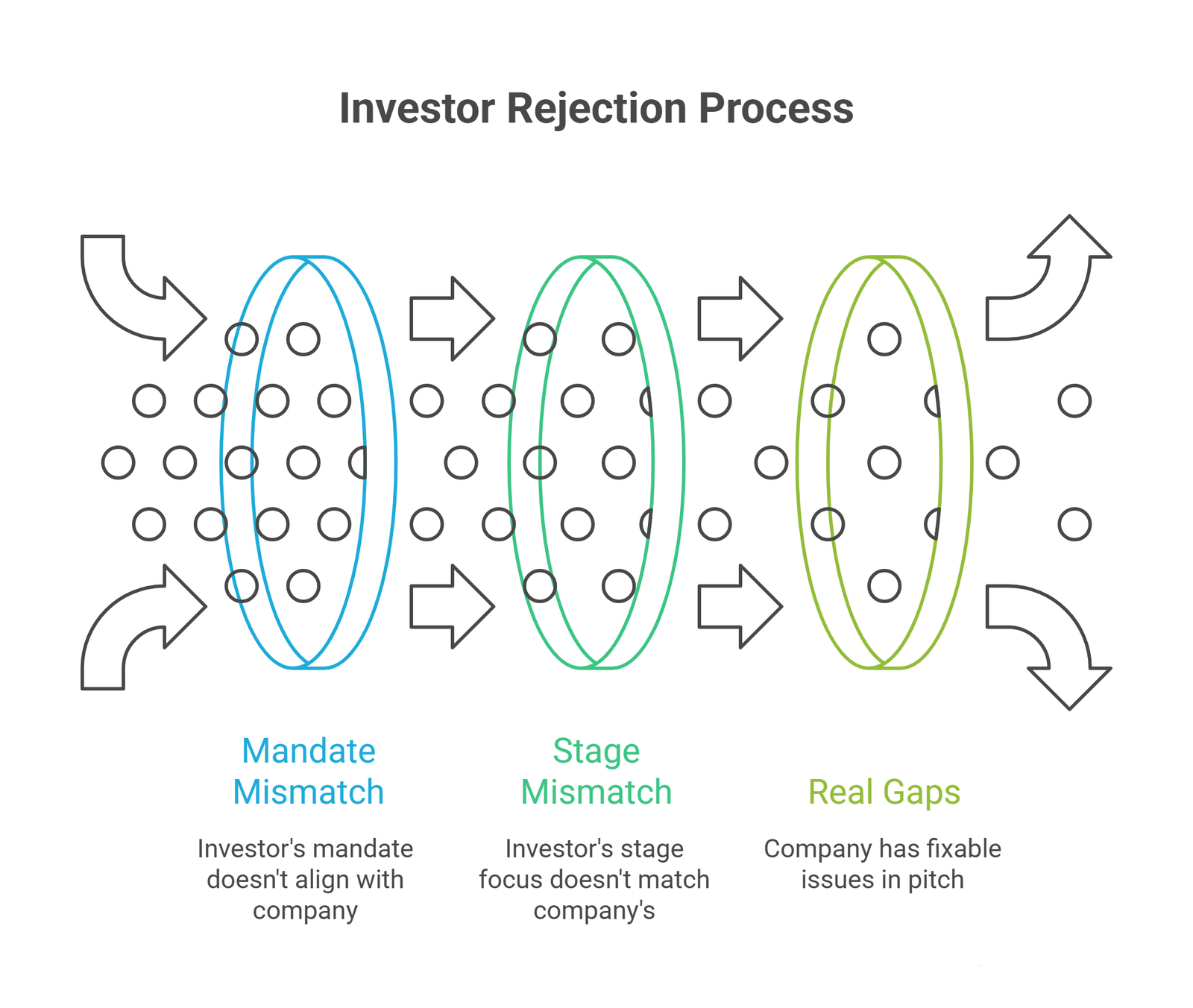
Investors are not rejecting your company as often as they are rejecting a mismatch. A seed fund that only writes checks into SaaS will pass on a strong retail concept without reading past the first slide. That is not because the retail idea is weak. It is because the idea falls outside the fund’s mandate.
The same applies to stage. A fund built for Series A metrics has little reason to say yes to a pre-revenue idea, no matter how promising it looks.
That does not mean every rejection is noise. Some point to real, fixable gaps. A pitch deck might bury the ask, financial projections might not hold up under a basic sanity check, or a market-size slide might overstate the opportunity. The skill is telling the two apart. That starts with going after the right kind of funding in the first place.
Protect your mindset between meetings
Rejection stings every time, even after the twentieth pitch. That does not mean something is wrong with you or the business. It means you are doing the volume of outreach that fundraising actually requires.
Do not let one no bleed into the next meeting. Book pitches close together where you can, so a bad conversation on Monday does not shape how you show up on Tuesday. Talk to other founders who are fundraising or have raised before. Hearing that a stranger’s rejection count looks just like yours does more for your confidence than any pep talk from someone who has not been through it.
Keep the rejection separate from your sense of the business. An investor passing on your pitch is a decision about their portfolio, not a verdict on your judgment or your work so far.
Match the funding source to your stage
Founders waste months pitching the wrong type of investor. A bank has no framework for evaluating a pre-revenue idea. A venture fund, meanwhile, is rarely the right fit for a stable, cash-generating small business that just needs working capital. Before you build a pitch list, check your company against what each source actually looks for.
| Funding source | Best-fit stage | What they mainly evaluate | Typical timeline |
| Bootstrapping / revenue | Pre-launch to early revenue | Founder commitment, lean spending | Ongoing |
| Friends and family | Idea to pre-seed | Personal trust, not the business plan | Weeks |
| Angel investors | Pre-seed to seed | Founder-market fit, early traction | 1 to 3 months |
| Venture capital | Seed to growth | Scalability, market size, team | 3 to 6 months |
| Bank loans | 2+ years of operating history | Cash flow, collateral, credit history | 1 to 2 months |
| Revenue-based financing | Post-revenue | Monthly recurring revenue, margins | 2 to 6 weeks |
If you are pitching outside the stage a source typically funds, you are not collecting real feedback. You are collecting rejections that were decided before you opened your mouth. A clear, well-researched business plan makes it easier to see which row you actually belong in. It also helps you explain that fit to an investor in the first two minutes of a call.
What a rejection is actually telling you
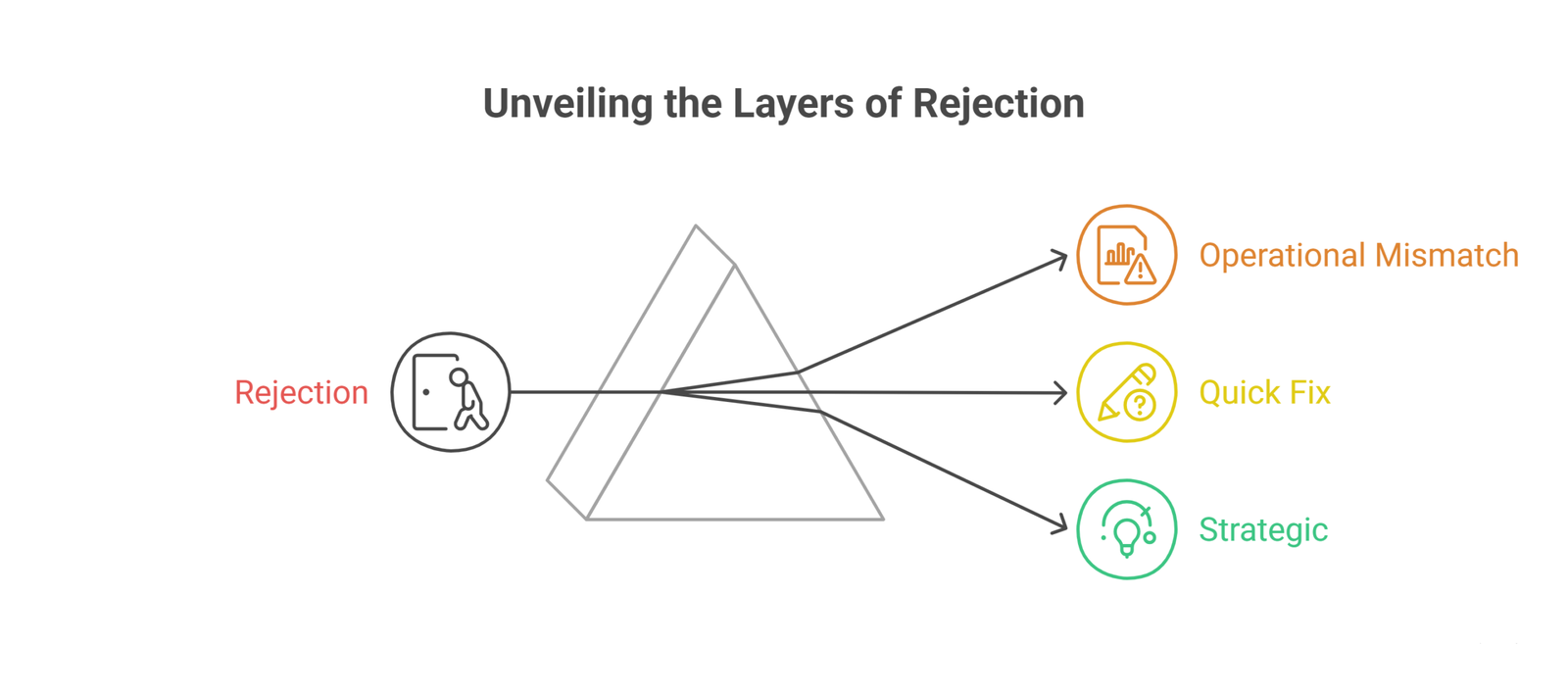
Not every “no” carries the same weight. Broadly, they fall into three buckets.
The first is operational mismatch. The investor’s thesis, geography, or check size never lined up with your company. The decision was made on paper before the meeting even happened. These rejections say nothing about your business.
The second is a quick fix: an unclear ask, a confusing slide order, or financials that raise more questions than they answer. These are worth fixing before your next pitch, and they usually take days, not months.
The third is strategic: real concerns about market size, competitive positioning, or whether the team can execute at the scale being proposed. These take longer to address. They also matter more than the other two. They tell you what needs to change before the next round, not just the next meeting.
Turn every “no” into a data point
Instead of accepting a vague pass, ask specific questions. What would make this a fit in the future? Was anything unclear in the pitch? Is there someone else in their network worth talking to? Investors who decline are often willing to give a real answer if you ask directly, rather than asking what they thought overall.
Log every conversation, including the reason given for the pass. After ten or fifteen calls, patterns show up. If three different investors flag the same weak spot, whether that is the go-to-market slide or the revenue model, take it seriously. That is no longer one opinion. It is a signal worth acting on before your next round of outreach.
Respond to every rejection with the same short, professional message. Thank them for their time, note any feedback given, and stay open to reconnecting later. Investors talk to each other. A founder who takes rejection with grace is more likely to get a second look once the metrics improve.
Keep the business moving while you fundraise
Fundraising can consume a founder’s calendar for months, and the business still has to run in the meantime. Keep hitting operational milestones, whether that is signing customers, shipping features, or improving margins. A founder who can say “we grew 20 percent since we last spoke” has a stronger case than one who went quiet for three months.
If a round is taking longer than expected, look at alternatives. These can keep the company funded without pausing the larger raise. Private investors writing smaller checks, revenue-based financing, or a bridge from existing backers can buy runway. None of these should force a discounted round out of desperation.
Be consistent about the problem you are solving
Every pitch should tie back to one clear problem and how the business solves it. If your marketing, product roadmap, and financial model each seem to be telling a different story, investors notice. It reads as a lack of focus rather than ambition.
This consistency also has to hold up under scrutiny. If you promise a scalable model in the deck, the unit economics in your financial model need to actually scale. Investors read pitch decks for a living. Gaps between the story and the numbers are usually the first thing they catch.
The math eventually favors you
Most companies that keep fundraising find money somewhere. That might be a lead investor who finally says yes, a strategic partner, or a smaller round that hits the next milestone. The founders who run out of options are usually the ones who stopped adjusting after the fifth or tenth rejection. They are not the ones who kept refining the pitch and the plan.
Frequently Asked Questions
How many investor rejections should I expect before closing a round?
For an early-stage round, 100 to 200 investor conversations is a realistic range before you close. Getting told no 20 or 30 times is normal, not a sign the business is failing.
How do I know if a rejection is about my pitch or about the business itself?
Ask the investor directly what would need to change for a yes. If the answer points to a mismatch in stage, sector, or check size, it was never really about your pitch. If it points to something specific in your numbers or your market story, that is worth fixing.
Should I keep pitching the same investors after they say no?
Yes, if the rejection was about timing or missing traction rather than a fundamental mismatch. Many investors who pass early come back once a company hits the milestone they were waiting for.
What should I do if fundraising is taking longer than planned?
Keep running the business and hitting operational goals in the meantime. Look at smaller bridge options too, such as revenue-based financing or additional angel checks. That way, a slow round does not turn into a cash crisis.
Is it normal to change my pitch deck during a fundraising round?
Yes. Refining the deck based on investor feedback is expected. It usually improves your odds with the next group of investors you approach.
Does a longer fundraising process mean my business idea is weak?
Not necessarily. Timing, market conditions, and investor mandates all affect how long a round takes. That is often independent of how strong the underlying business is.
How do I stop taking rejection personally?
Separate the decision from your identity. An investor is judging fit with their portfolio and mandate, not your worth as a founder. Talking to other founders who are also fundraising helps put your own rejection count in perspective.
To conclude
Persistence in fundraising is not about ignoring rejection. It is about reading each “no” correctly, fixing what is actually fixable, and running the business while the process plays out. At Oak Business Consultant, we help founders build the financial models, business plans, and pitch decks that make investor conversations go faster. Get those right before you sit down with the next investor.