SDG 15: Life on Land, At This Rate, Deforestation Won’t Stop for 25 Years
Life on Land (SDG 15): The 25-Year Countdown to End Deforestation
Deforestation is slowing. It fell from 12 million hectares a year in 2010-2015 to 10 million a year in 2015-2020. At that rate, halting deforestation entirely would still take another 25 years past the 2030 deadline.
SDG 15 asks the world to protect forests, halt biodiversity loss, and reverse land degradation. Over 47,000 species are now threatened with extinction. Every major species group tracked by the Red List Index is still declining.
This guide covers what SDG 15 actually commits the world to. It shows where progress stands, target by target. It also ranks the countries protecting their land best. That includes the UAE and the US, and the ones falling furthest behind.
What is SDG 15
SDG 15 calls for protecting and restoring terrestrial ecosystems. That’s the UN’s own framing. It covers sustainable forest management, combating desertification, reversing land degradation, and halting biodiversity loss. It’s the fifteenth of 17 Sustainable Development Goals.
All 193 UN member states adopted it in 2015, as part of the 2030 Agenda. The goal covers forests, mountains, drylands, soil health, species extinction, and wildlife trafficking together. A country can pledge huge protected areas and still let the land inside them degrade. It can plant millions of trees and still lose old-growth forest faster than it replants. SDG 15 tracks pledges against real, measured outcomes on purpose.
The official targets and indicators behind SDG 15
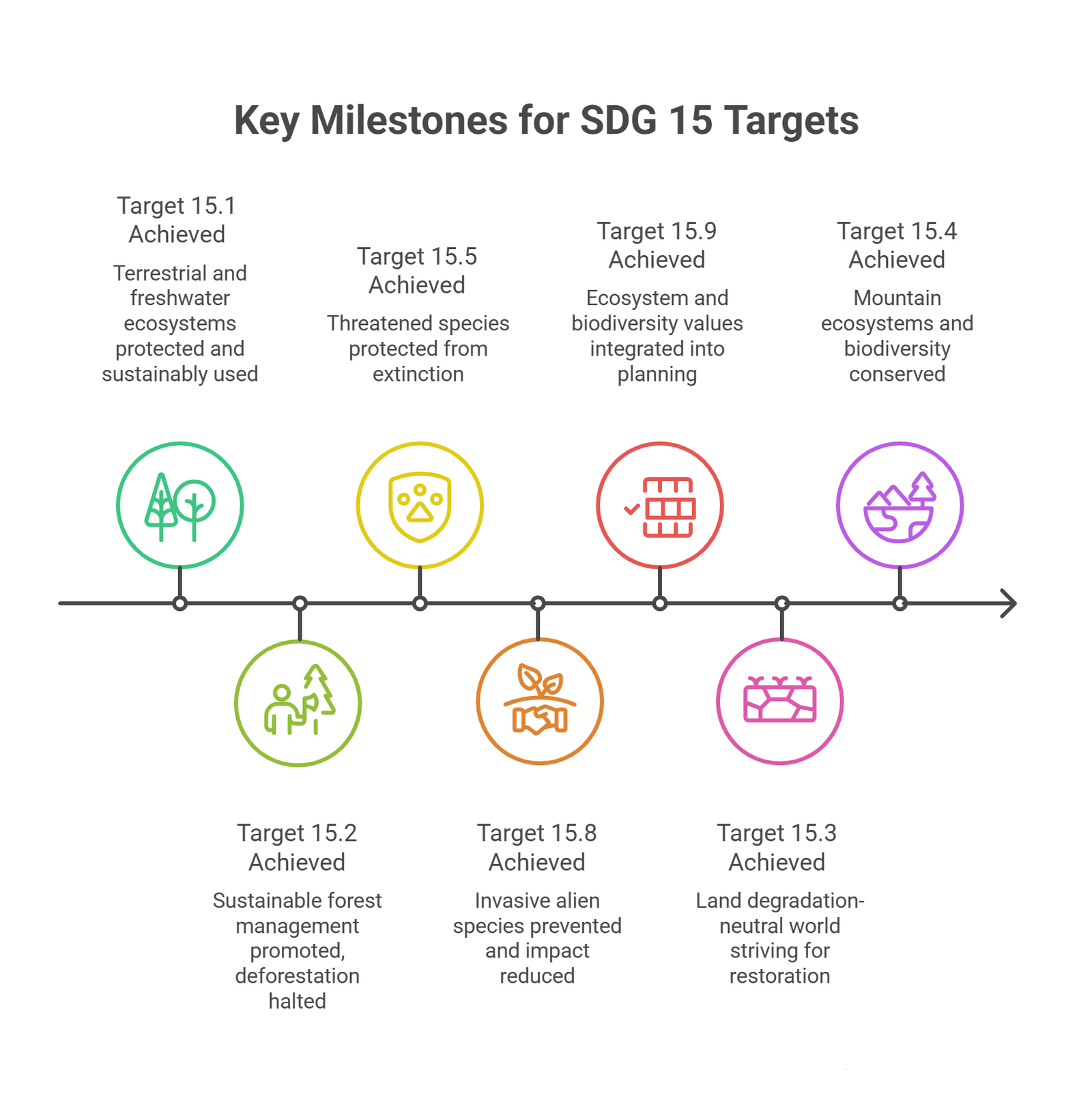
SDG 15 breaks down into 12 targets, tracked through 14 indicators, according to the UN’s SDG 15 page.
Target 15.1: By 2020, protect and sustainably use terrestrial and freshwater ecosystems. That includes forests, wetlands, mountains, and drylands especially. Tracked through forest area as a share of total land. Also tracked through the share of important biodiversity sites covered by protected areas.
Target 15.2: By 2020, promote sustainable management of all forest types. Halt deforestation, restore degraded forests, and substantially increase afforestation and reforestation. Tracked through progress toward sustainable forest management.
Target 15.3: By 2030, combat desertification and restore degraded land, striving for a land degradation-neutral world. Tracked through the share of land that is degraded relative to total land area.
Target 15.4: By 2030, conserve mountain ecosystems, including their biodiversity. Tracked through mountain biodiversity site coverage, and the Mountain Green Cover Index.
Target 15.5: Take urgent action to reduce degradation of natural habitats and halt biodiversity loss. By 2020, protect threatened species from extinction. Tracked through the Red List Index.
Target 15.6: Promote fair and equitable sharing of the benefits from genetic resources, and promote appropriate access to them. Tracked through countries that have adopted frameworks ensuring fair benefit-sharing.
Target 15.7: Take urgent action to end poaching and trafficking of protected species. Address both demand and supply of illegal wildlife products. Tracked through the share of traded wildlife that was poached or illicitly trafficked.
Target 15.8: By 2020, introduce measures to prevent invasive alien species. Significantly reduce their impact on land and water ecosystems. Tracked through countries with national legislation controlling invasive species.
Target 15.9: By 2020, integrate ecosystem and biodiversity values into national and local planning and development processes. Tracked through national biodiversity targets and biodiversity accounting integration.
Target 15.a: Mobilize and significantly increase financial resources to conserve and sustainably use biodiversity and ecosystems. Tracked through official development assistance for biodiversity conservation.
Target 15.b: Mobilize resources to finance sustainable forest management, with adequate incentives for developing countries. Tracked through the same finance indicator applied to forest management.
Target 15.c: Increase global support to combat poaching and trafficking, including by boosting local communities’ sustainable livelihood options. Tracked through the share of traded wildlife poached or illicitly trafficked.
Where global progress actually stands
The 2025-2026 UN DESA reporting cycle shows a familiar pattern. Actions are improving. Outcomes are not keeping pace. Countries are creating more protected areas and spending more on conservation, but species keep declining and land keeps degrading.
Forests covered about 4.1 billion hectares of the world’s land surface in 2020, or 31%. Between 2000 and 2020, forest cover shrank by roughly 100 million hectares. Agricultural expansion drove nearly 90% of that loss. Asia, Europe, and Northern America actually gained forest over that period. Latin America and sub-Saharan Africa lost the most.
There’s a genuinely recent bright spot. Tropical rainforest loss dropped 36% in 2025 compared to the year before, according to World Resources Institute. Wildfires still threaten to erase those gains. Fires alone emitted an estimated 6,687 megatons of CO2 globally in 2023. That’s more than double the EU’s total fossil fuel emissions that year.
Land degradation is getting worse, not better. At least 100 million hectares degrade every year, an area the size of Egypt. Between 2015 and 2019, the global share of degraded land rose from 11.3% to 15.5%, affecting 3.2 billion people. Reaching land degradation neutrality by 2030 would require restoring roughly 1.5 billion hectares.
Financing that restoration is badly behind. The UN Convention to Combat Desertification puts the cost at $1 billion a day. That’s the price of fighting desertification and drought between 2025 and 2030. Current annual funding sits at $66 billion, just 18% of what’s needed.
Species loss remains the starkest number on this list. Over 47,000 species are now threatened with extinction. Every major species group on the Red List Index is declining, especially corals, amphibians, and cycads. The index has fallen 12% since 1993.
Protected areas tell a more encouraging story, on paper. Target 15.1’s original goal, 17.6% terrestrial coverage, was actually achieved by 2020. The Kunming-Montreal Global Biodiversity Framework has since raised that bar to 30% by 2030. Protection of key biodiversity areas has nearly doubled since 2000, rising from 25% to 44%. Progress has stalled since 2015, though.
The table below sets out where the core indicators stood as of the latest reporting.
| Indicator | Baseline or earlier figure | Most recent figure |
| Global forest cover, share of land surface | 31% (2020, roughly stable since) | 31%, down 100 million hectares since 2000 |
| Annual deforestation rate | 12 million hectares/year (2010-2015) | 10 million hectares/year (2015-2020) |
| Tropical rainforest loss, year-over-year | Rising through 2024 | Down 36% in 2025 |
| Share of degraded land globally | 11.3% (2015) | 15.5% (2019) |
| Land restoration needed for neutrality by 2030 | N/A | 1.5 billion hectares |
| Annual desertification financing need vs. actual | N/A | $365 billion needed, $66 billion funded (18%) |
| Red List Index (species extinction risk) | 1.0 baseline in 1980 | Down 12% since 1993 |
| Terrestrial area under protection | 17.6% target, achieved by 2020 | 30% target set for 2030 |
| Key biodiversity areas covered by protected areas | 25% (2000) | 44% (2024), progress stalled since 2015 |
| Biodiversity-related development finance | $9.5 billion (2015) | $11.9 billion (2023) |
Source: UN DESA, Goal 15 progress reporting; World Resources Institute, 2025 tropical forest loss data.
Countries ranked by SDG 15 performance
Ranking countries on pledged protected area alone hides most of the real story. Some countries protect land on paper and let it degrade anyway. Others start from a near-zero forest baseline and build fast. The list below weighs recent trajectory alongside absolute results. It runs from the strongest performer to the weakest.
Costa Rica leads outright, having reversed a collapsing forest cover trend entirely. Brazil earns its place through the sharpest single-year improvement on this list. The UAE shows what fast, well-funded restoration looks like from a desert baseline. Indonesia shows steady, if incomplete, progress on its own deforestation problem. The US shows what regression looks like when a federal conservation target gets abandoned. The Democratic Republic of the Congo anchors the bottom, still losing primary forest faster than almost anywhere else on Earth.
| Rank | Country | Key signal | Standing |
| 1 | Costa Rica | Forest cover rebuilt from 26% (1983) to roughly 54% today | Reversed one of the world’s worst deforestation trends into one of its best recoveries |
| 2 | Brazil | Cut Amazon deforestation 50% in 2023 versus 2022 | Sharpest recent improvement of any major forested country |
| 3 | United Arab Emirates | Protected areas expanded to 19.04% of national territory | Fast, well-funded restoration from a desert baseline with almost no natural forest |
| 4 | Indonesia | Cut deforestation 14% in 2021-2022 versus 2020-2021 | Real, measured progress, though loss levels remain high in absolute terms |
| 5 | United States | Reversed its national 30×30 conservation pledge in early 2025 | Less than 3% of US land is both protected and ecologically connected |
| 6 | Democratic Republic of the Congo | Source of over 75% of Congo Basin primary forest loss | Weakest governance capacity on this list, with loss still rising |
Costa Rica

Costa Rica had one of the world’s worst deforestation records by the 1980s. Forest cover fell to just 26% of the country by 1983, down from over half in 1950. Cheap cattle credit and land-titling laws that rewarded clearing land drove much of that loss.
The turnaround came through Forestry Law No. 7575, passed in 1996. It created Payments for Ecosystem Services, a program that pays landowners directly for forest protection, reforestation, and sustainable management. FONAFIFO, the fund that runs it, has distributed over $524 million to more than 18,000 families since 1996.
Forest cover now sits at roughly 54% of the country. The program has prevented over 1 million hectares from deforestation and reforested nearly 70,000 more. Costa Rica now backs that with a formal World Bank agreement. It’s worth up to $60 million, for verified emissions reductions through 2025.
Brazil
Brazil delivered the sharpest single-year improvement of any major forested country. Deforestation in the Legal Amazon fell 50% in 2023 compared to 2022, according to the UN’s own SDG 15 reporting.
That cut came from renewed enforcement after years of rising deforestation under the prior administration. Satellite monitoring, protected-area enforcement, and crackdowns on illegal logging and mining all played a role. Brazil still holds one of the largest shares of remaining tropical forest on Earth. That makes any single-year swing consequential globally.
The country’s challenge now is holding that gain. Agricultural expansion, particularly cattle ranching and soy, remains the dominant long-term pressure on the Amazon. A single enforcement cycle reversing years of prior loss is a real result. It isn’t yet a settled trend.
United Arab Emirates

The UAE’s SDG 15 story starts from a very different baseline than the rest of this list. It’s a desert nation with almost no natural forest to protect. Its approach instead centers on rapid, engineered restoration of coastal and marine-adjacent ecosystems.
Protected areas now cover 19.04% of UAE territory, up sharply in recent years. The centerpiece is a national pledge, made at COP27, to plant 100 million mangrove trees by 2030. By mid-2025, over 30 million had already gone into the ground, using drone-assisted seeding and tissue culture propagation.
The UAE paired that with a related fisheries turnaround. Abu Dhabi’s Sustainable Fishing Index jumped from just 8% in 2018 to 100% by the end of 2025. Mangroves capture up to five times more carbon than tropical rainforests per hectare. That makes the restoration push relevant well beyond the UAE’s own borders.
Indonesia

Indonesia cut deforestation by 14% in 2021-2022 compared to the prior year, according to UN reporting. That’s real progress in a country with a history of major forest loss. Palm oil and pulpwood expansion have historically driven most of it.
The reduction reflects tighter enforcement of a moratorium on new forest and peatland clearing permits. Fire-prevention efforts in peat-heavy provinces also got stronger. Indonesia’s peatland fires are a particular concern. Burning peat releases carbon stored over thousands of years, not just the trees above it.
The progress is real but incomplete. Indonesia’s absolute forest loss remains high even after the improvement. A single year of decline is welcome, but it hasn’t reversed decades of net forest loss. Costa Rica’s multi-decade program has done that instead.
United States

The US shows what regression looks like on SDG 15. In 2021, the federal government committed to protecting 30% of US land and water by 2030. It called the plan America the Beautiful. That executive order was reversed in early 2025.
The practical impact goes beyond the pledge itself. Less than 3% of US land is both protected and ecologically connected, according to Conservation Corridor’s 2025 analysis. Connectivity matters because isolated protected patches can’t sustain species that need large ranges, like large carnivores and migratory animals.
Some US states have kept their own 30×30 pledges in place. New York and California are among them, even after the federal target was dropped. That state-level patchwork is now doing work the federal government isn’t. It’s an uneven substitute for a single national target.
Democratic Republic of the Congo

DRC holds the world’s second-largest area of primary tropical forest, after Brazil. It also anchors the bottom of this list. DRC alone accounted for over 75% of primary forest loss across the Congo Basin. That’s true of the most recent assessment period.
The drivers are different from Brazil’s or Indonesia’s. Nonmechanized, small-scale forest clearing for subsistence agriculture causes more than 90% of DRC’s forest loss, not industrial agriculture or logging. That makes the problem harder to solve through enforcement alone. It’s driven by basic household needs, not corporate supply chains.
DRC has land-use planning processes underway, and it participates in REDD+ carbon-finance programs. Neither has yet slowed the underlying loss rate. DRC’s case shows something stark. Even a nation holding one of the planet’s biggest carbon sinks can lack the resources to protect it.
What organizations and institutions are doing
The institutional architecture behind SDG 15 splits across reporting, forest-specific technical work, ecosystem restoration, and the global biodiversity framework itself.
UN Department of Economic and Social Affairs
DESA compiles the annual SDG progress report. It tracks all 14 indicators across forests, land degradation, species extinction, and biodiversity finance.
Food and Agriculture Organization
The FAO is the custodian agency for three of SDG 15’s core indicators. They cover forest area, sustainable forest management, and mountain green cover. Its Forest Resources Assessment is the primary global data source behind Target 15.1 and 15.2.
UN Environment Programme
UNEP co-leads the UN Decade on Ecosystem Restoration alongside FAO, running from 2021 to 2030. Its 2026-2029 strategy is built around what it calls the triple planetary crisis: climate change, biodiversity loss, and pollution.
Convention on Biological Diversity Secretariat
The CBD Secretariat administers the Kunming-Montreal Global Biodiversity Framework, adopted in 2022. That framework set the 30% protected-area target now driving most national conservation pledges, including the UAE’s and Brazil’s expansion plans.
How businesses can contribute to SDG 15
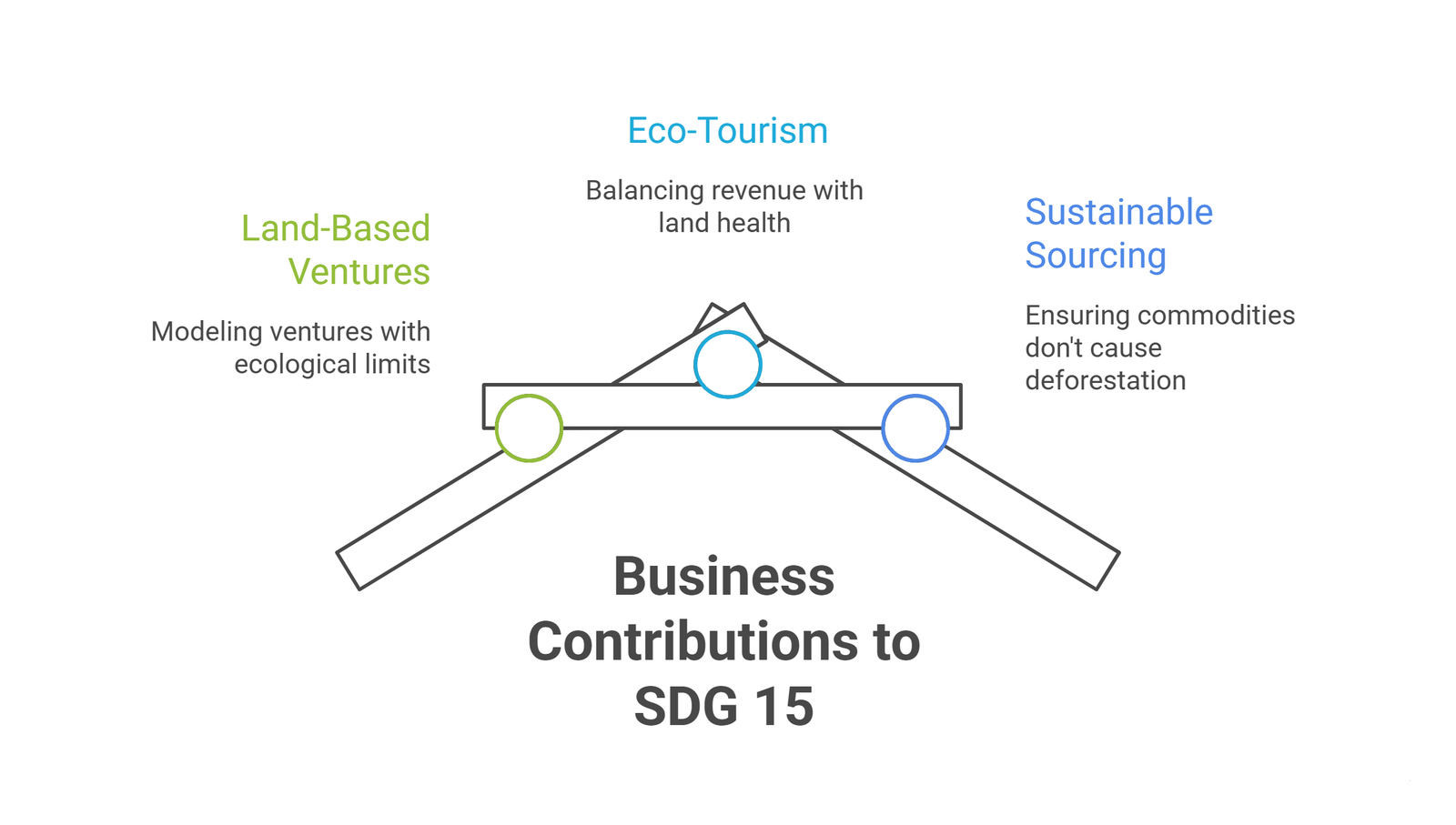
Most companies touch SDG 15 somewhere in their supply chain, even without a formal environmental mandate. Agriculture, timber, palm oil, and tourism all sit directly on land-use decisions the goal is trying to fix.
Model land-based ventures with real ecological limits built in
Target 15.3 is about land degradation neutrality, not maximum short-term yield. A farming or timber venture modeled around soil health and rotation, not pure output, holds up better. It survives future regulation and buyer scrutiny more easily. Oak’s Farming Excel Financial Model builds land rent, direct costs, and multi-year cash flow into one plan. That structure makes ecological tradeoffs visible before capital moves, not after.
Treat eco-tourism and land-based hospitality as a modeling problem, not just a marketing one
Ecotourism ventures live or die on the health of the land they’re built around. Oak’s work modeling an eco-resort expansion across three island properties shows what that balance looks like in practice. Revenue forecasts, sensitivity analysis, and investor-ready valuation all factored in one thing. The resource base has to stay intact to keep generating revenue.
Source palm oil, timber, and soy with real deforestation risk in view
Target 15.2 is specifically about halting deforestation and restoring degraded forest. Agricultural commodities tied to forest clearing carry direct exposure to that risk. Palm oil, soy, and pulpwood are chief among them, facing the same enforcement Brazil and Indonesia are now tightening. A sourcing review that checks a supplier’s deforestation footprint costs far less. A shipment blocked at a border under new due-diligence rules costs far more.
Frequently Asked Questions
How many SDG 15 targets and indicators are there?
Twelve targets, tracked through 14 indicators. Nine cover outcome areas like forests, land degradation, and species loss. Three cover finance and implementation.
Is the world on track to meet SDG 15 by 2030?
No. Land degradation is rising, not falling. Every major species group on the Red List Index remains in decline, despite real gains in protected-area coverage.
Which countries are performing best on SDG 15?
Costa Rica leads through a multi-decade forest cover reversal. Brazil posted the sharpest recent improvement, and the UAE shows the fastest restoration from a near-zero forest baseline.
Which country is performing worst on SDG 15?
The Democratic Republic of the Congo. It alone accounts for over 75% of primary forest loss across the entire Congo Basin.
What changed for US land conservation in 2025?
The federal government reversed its 2021 pledge to protect 30% of US land and water by 2030. Some individual states have kept their own versions of the target in place.
Why does the UAE rank well despite having little natural forest?
The ranking weighs trajectory and effort against baseline, not raw forest area. The UAE expanded protected areas to over 19% of its territory. It’s also running one of the world’s largest active mangrove restoration programs.
Can a business without a land or agriculture mandate still contribute to SDG 15?
Yes. Reviewing supply chains for deforestation-linked commodities is one realistic starting point. Modeling land-based ventures around ecological limits, not just yield, is another.
Conclusion
The number worth sitting with isn’t the 30% protection target countries have rallied around since 2022. It’s the 25-year gap between the current deforestation slowdown and actually reaching zero.
Costa Rica shows a multi-decade reversal is possible when payments for ecosystem services replace incentives to clear land. Brazil shows enforcement alone can cut deforestation in half within a single year. That takes real political will to apply. The Democratic Republic of the Congo shows something else. Holding one of the planet’s biggest forests isn’t enough without the resources to protect it.
None of that gets solved by pledges alone. A land-based venture, an agricultural supply chain, or an eco-tourism expansion all need the same thing underneath them. A financial model built around real ecological limits, not an optimistic one. If your organization is building the numbers behind a land, agriculture, or eco-tourism venture, Oak’s financial modeling services can help. Oak builds the model that holds up past the pitch.