Top Financial Budget Templates and Their Uses
Best Financial Budget Templates and Their Uses
Whether you are running a business, managing a household, or planning a major project, the right budget template can be the difference between financial clarity and constant chaos. This guide walks you through everything you need to know about financial budget templates, from the basics to the best options available today.
What Is a Financial Budget?
A financial budget is a structured plan that estimates an organization’s or individual’s revenues and expenses over a specific period. Think of it as a financial roadmap: it tells you where your money is coming from, where it is going, and whether you will end up ahead or behind.
Businesses use financial budgets to:
- Track sales, costs, and cash flow in real time
- Set short-term and long-term financial goals
- Reduce unnecessary spending
- Prepare for high-demand seasons or slow periods
- Keep stakeholders informed about financial performance
A budget can be in surplus (more income than expenses), in deficit (more expenses than income), or balanced. The goal is always to work toward surplus, or at least balance, while investing wisely in growth.
Financial budgets are typically prepared monthly, quarterly, half-yearly, or annually depending on the size and needs of the organization. For startups, monthly reviews are strongly recommended because conditions change quickly. For mature businesses, quarterly reviews often work well.
Why Every Organization Needs a Budget
Budgeting is not just an accounting exercise. It is a decision-making tool that touches almost every part of how a business or household operates. Here is why creating a financial budget matters so much.
1. It Helps Increase Earnings
To build a budget, you first have to understand your total revenue, and that exercise alone can open your eyes to new opportunities. You might discover that one product line consistently underperforms, or that a particular client segment delivers most of your profit. You can then make smart decisions about where to focus your energy and where to pull back.
Budgets also highlight areas where costs can be trimmed, which directly improves profit margins without requiring more sales.
2. It Ensures Payments Are Made on Time
One of the most practical benefits of a budget is that it allocates money to specific obligations before spending happens. Salaries, vendor payments, rent, and loan repayments all get planned in advance. This prevents the scramble of realizing mid-month that you do not have enough cash to cover a critical payment, which protects relationships with employees, suppliers, and lenders.
3. It Gets You Ready for Tax Season
Many businesses run into trouble at tax time not because they are unprofitable, but because they spent money freely during the year without setting aside funds for their tax obligations. A budget that accounts for estimated taxes throughout the year prevents nasty surprises and avoids the penalties that come with late or insufficient tax payments.
4. It Accelerates Debt Repayment
If your business carries debt, budgeting can dramatically speed up the process of paying it off. By allocating a defined portion of monthly income to debt repayment, you reduce the interest burden faster and free up more cash for operations and growth over time.
The Three Core Sections of a Financial Budget

A complete financial budget is typically made up of three interconnected components. Understanding each one helps you build a budget that gives you a full picture of your financial health.
Capital Expenditure Budget
This section covers spending on long-term assets such as machinery, equipment, vehicles, and technology infrastructure. It takes into account the cost of the asset, its expected useful life, depreciation, and whether you are replacing existing equipment or adding something new. A capital expenditure budget helps you plan large purchases without disrupting day-to-day operations.
Budgeted Income Statement
The budgeted income statement presents a side-by-side comparison of what you projected to earn and spend versus what actually happened. It covers revenue, cost of goods sold, operating expenses, and net profit. This comparison is valuable because it shows you exactly where your estimates were accurate and where they need adjustment for the next period.
Budgeted Balance Sheet
The budgeted balance sheet projects what the business’s financial position will look like at the end of the budget period. It includes assets, liabilities, and equity. When prepared alongside the income statement and cash flow budget, it gives you a comprehensive view of where the business stands financially, not just whether it made money during the period.
What Is a Budget Template?
A budget template is a pre-built document or spreadsheet that gives you a ready-made structure for recording your financial data. Instead of building a budget from scratch every month or every year, you simply fill in the relevant numbers for your specific situation.
Templates can be simple or sophisticated. A basic personal budget template might have a few rows for income and a list of common expenses. A business budget template might include multiple tabs for revenue projections, departmental spending, capital expenditures, and cash flow analysis.
The real value of a template is that it removes the burden of designing the structure, so you can focus entirely on the numbers and the decisions they inform.
Types of Budget Templates
Budget templates come in many forms, and the right type depends on your goals, the size of your operation, and how much detail you need.
Personal Budget Templates track individual income and household expenses, including rent, groceries, utilities, and discretionary spending. They are a great starting point for anyone trying to get control of their personal finances.
Business Budget Templates cover all revenue streams and expense categories for a company. They often include projected versus actual comparisons and are updated regularly throughout the year.
Department Budget Templates are designed for specific teams or divisions within a larger organization. Each department gets its own budget allocation, and spending is tracked at the departmental level to improve accountability.
Project Budget Templates track income and costs related to a specific project, such as a construction job, a product launch, or a marketing campaign. They help ensure the project stays within its financial scope.
Monthly Budget Templates focus on a single calendar month and give a close-up view of cash flow. They are particularly useful for individuals and small businesses that need to manage money tightly from month to month.
Annual Budget Templates take a higher-level view, projecting revenue and expenses across a full year. They are often used for strategic planning and are reviewed quarterly for accuracy.
Why Budget Templates Matter
Budget templates are not just convenient shortcuts. They serve a real purpose in financial management.
For businesses, templates create consistency. When every department uses the same structure, it becomes much easier to consolidate budgets, compare performance across teams, and present financial data to leadership or investors. Inconsistency in budget formats is one of the most common reasons financial reporting breaks down inside growing companies.
For individuals, templates make budgeting less intimidating. Many people avoid budgeting altogether because they do not know where to start. A template solves that problem instantly by showing you exactly what information to gather and where to put it.
Templates also reduce errors. When formulas are already built in, you are less likely to make calculation mistakes that lead to bad decisions.
How to Build a Financial Budget Template from Scratch
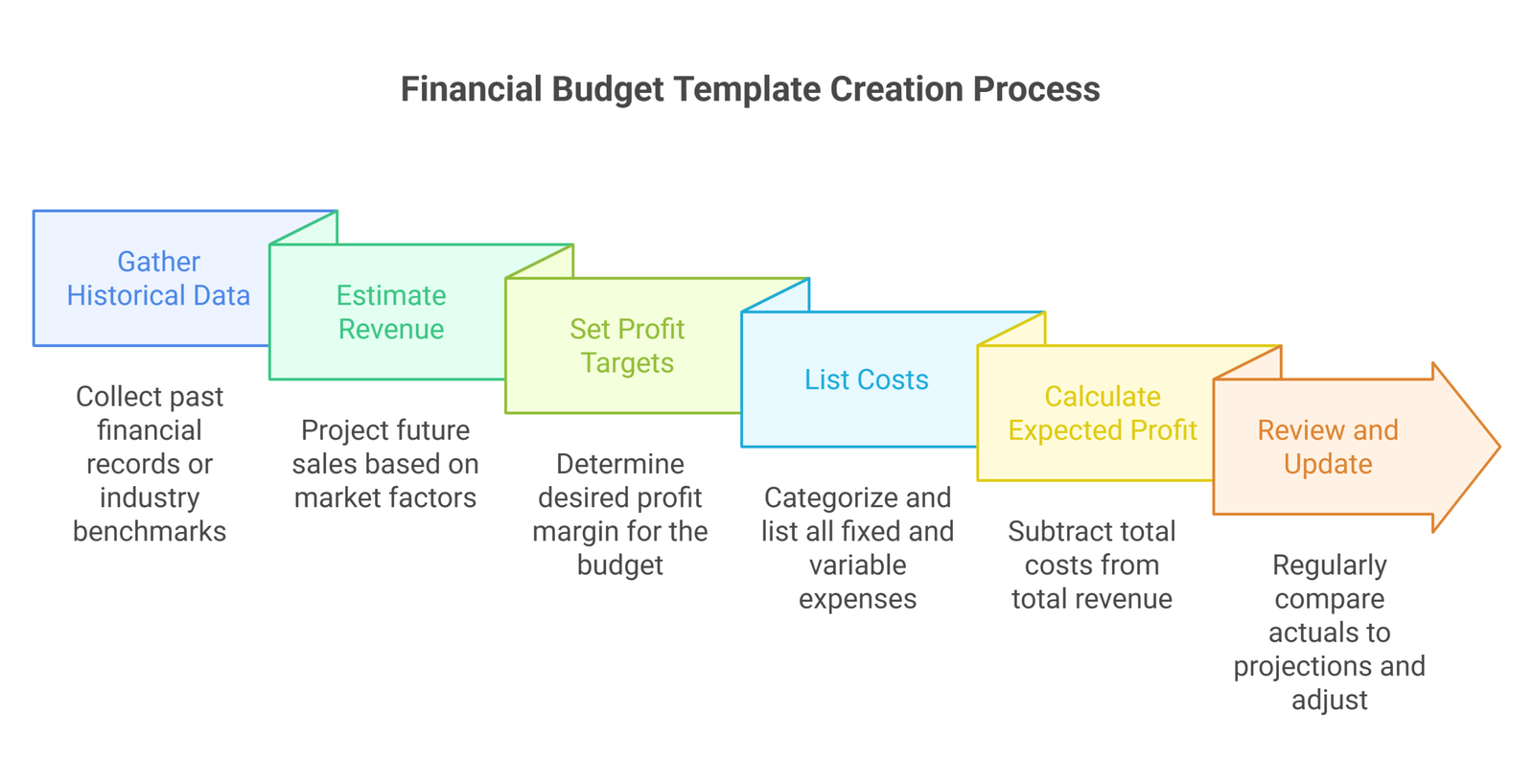
If you prefer to build your own template rather than use a pre-made one, here is a practical process to follow.
Step 1: Gather historical data. Pull together your past revenue figures, operating costs, payroll expenses, and any other financial records you have. If you are a new business without historical data, look for industry benchmarks to use as a starting point.
Step 2: Estimate your revenue. Project your expected sales for the period you are budgeting for. Be realistic. Account for seasonal fluctuations, planned promotions, and any market changes you are aware of.
Step 3: Set profit targets. Before you finalize your expense plan, decide what profit margin you are aiming for. Working backward from a profit target is often more effective than simply tracking expenses and hoping for the best.
Step 4: List all fixed and variable costs. Fixed costs include things like rent, insurance, and software subscriptions. Variable costs change with your level of activity, such as materials, shipping, and sales commissions. Both categories need to be in your template.
Step 5: Calculate your expected profit. Subtract total expected costs from total expected revenue. If the result is not where you want it, adjust either the revenue projections (by identifying growth opportunities) or the expense projections (by finding savings).
Step 6: Review and update regularly. A budget is a living document. Plan to compare your actual numbers against your projections at least once a month and update the template accordingly.
Top Financial Budget Templates

Here are the most useful financial budget templates available, organized by purpose.
Business Financial Budget Template
This is the most comprehensive template for companies of any size. It tracks all income sources and expense categories, shows projected versus actual figures, and gives management a clear view of overall financial health. A good business budget template will also include a cash flow section so you can see not just whether you are profitable, but whether you actually have enough cash on hand at any given point.
Best for: Small businesses, startups, and growing companies that need a full financial overview.
Department Budget Template
Designed for teams and divisions within a larger organization, department budget templates let you plan spending at the team level, assign budget items to individual team members, and track how each department performs against its allocation. This improves both accountability and transparency. You can set up automated alerts when spending approaches the department limit and run year-over-year comparisons to spot trends.
Best for: Mid-size to large organizations where different teams control their own spending.
Home Construction Budget Template
Construction projects have a way of going over budget, which is why a dedicated template is so helpful. A good home construction budget template covers labor and materials, contingency reserves for unexpected repairs, projected renovation costs, and a rolling balance so you always know how much of your budget remains. Tracking costs this way from the start of a project prevents the shock of discovering an overrun when it is too late to course-correct.
Best for: Homeowners, contractors, and project managers overseeing construction or renovation work.
Monthly Budget Template
A monthly budget template is the most practical tool for day-to-day financial management. You enter your income at the top, then work through fixed expenses, variable expenses, savings contributions, and debt payments. The template calculates your remaining cash flow automatically. For anyone just starting out with budgeting, a monthly template is the best place to begin because it is simple, actionable, and immediately useful.
Best for: Individuals, freelancers, and small business owners who manage finances month to month.
Google Sheets Budget Template
Google Sheets budget templates are free, cloud-based, and accessible from any device. Because they live in Google Drive, they can be shared easily with an accountant, a business partner, or a spouse. Google offers several built-in templates through its template gallery, and there are hundreds of free community-built options available online. The collaborative nature of Google Sheets makes it especially useful when multiple people need to view or update the same budget.
Best for: Remote teams, couples managing shared finances, and anyone who wants cloud-based accessibility without a software subscription.
Microsoft Excel Budget Template
Excel remains the gold standard for financial modeling and budgeting. Microsoft offers a wide range of free templates through its template library, covering personal budgets, family budgets, small business budgets, event budgets, and more. Excel’s formula capabilities are unmatched, and for users who are comfortable with spreadsheets, it offers the highest degree of customization. You can build sophisticated models with charts, pivot tables, and scenario analysis.
Best for: Finance professionals, accountants, and anyone who needs advanced modeling capabilities.
Vertex42 Free Budget Spreadsheets
Vertex42 is one of the best free resources for budget templates. It offers templates for family budgets, personal budgets, monthly cash flow tracking, debt payoff planning, and more. All templates are available as both Excel and Google Sheets files. They are clean, well-organized, and easy to adapt to your specific needs. If you are not sure which template to start with, Vertex42 is an excellent first stop.
Best for: Individuals and families looking for free, high-quality templates with no strings attached.
How to Prepare and Use Your Budget Template
Even the best template is useless if it is not set up correctly. Here are four foundational steps to making your budget template work for you.
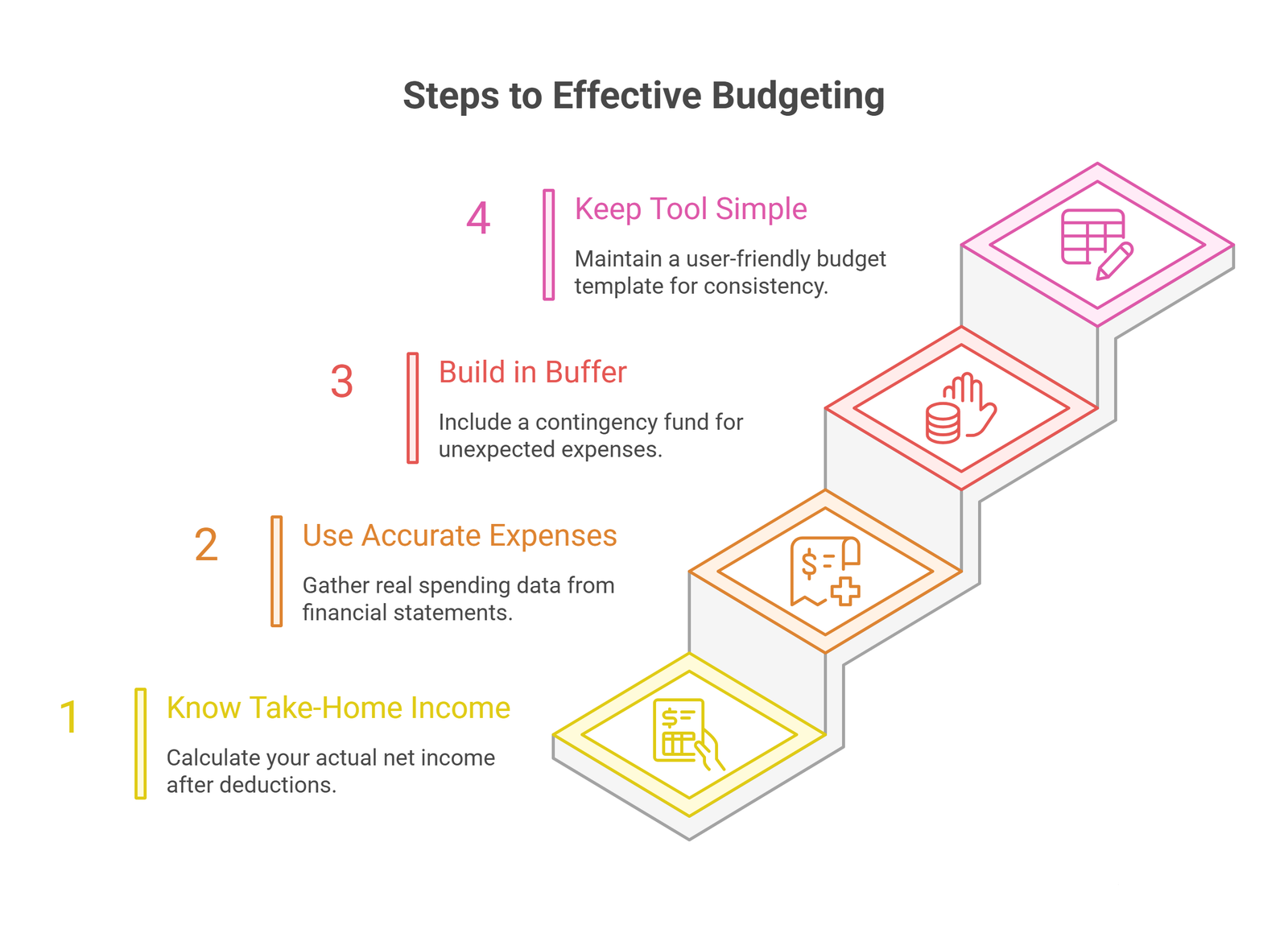
Know Your Real Take-Home Income
Many people make the mistake of building their budget around their gross salary. Your actual take-home pay is significantly lower once you factor in income tax, pension contributions, health insurance premiums, and any other deductions. Always use your net income as the basis for your budget so your numbers reflect reality.
Use Accurate Expense Numbers
Pull your actual spending data from bank statements, credit card statements, or accounting software rather than estimating from memory. People almost always underestimate what they spend. Looking at real numbers might feel uncomfortable, but it is the only way to build a budget that holds up.
Also, do not forget irregular expenses. Things like annual insurance renewals, vehicle registration fees, and property taxes are entirely predictable but easy to overlook when building a monthly budget. Divide these annual costs by 12 and include them as monthly line items so they do not catch you off guard.
Build in a Buffer
Life rarely goes exactly according to plan. Unexpected expenses happen: a piece of equipment breaks down, a client pays late, or an urgent repair comes up. Your budget should include a contingency line, typically around 5 to 10 percent of total expenses, that gives you room to absorb surprises without blowing up your financial plan.
Keep the Tool Simple Enough to Actually Use
The most sophisticated budget tool is worthless if it is too complicated to maintain consistently. When you are first getting started, prioritize simplicity over comprehensiveness. A basic spreadsheet that you update every week is far more valuable than a complex financial model you abandon after the first month.
Benefits of Using a Budget Template
Here is a quick summary of what you gain when you commit to using a budget template consistently.
Financial awareness: You stop guessing where your money goes and start knowing. This awareness alone is enough to change spending behavior for most people.
Organization: Everything lives in one place. Instead of piecing together your financial picture from a dozen different statements and receipts, your budget template gives you a single source of truth.
Proactive planning: A budget forces you to think ahead. Instead of reacting to financial problems after they happen, you anticipate them and prepare solutions in advance.
Time savings: Once a template is set up, updating it each month takes a fraction of the time it would take to build a budget from scratch. The structure is already there; you just plug in the numbers.
Accountability: When your spending is written down and compared to a plan, it is much harder to rationalize overspending in any category.
Common Mistakes People Make with Budget Templates
Knowing what to avoid is just as important as knowing what to do.
Forgetting irregular expenses: Annual and semi-annual costs get forgotten constantly. Review your last 12 months of spending before finalizing any budget to catch these gaps.
Being overly optimistic about revenue: Budget templates based on best-case revenue projections will fail. Build your budget around conservative, realistic revenue estimates and treat anything above that as upside.
Never reviewing actuals against projections: A budget that is never compared to what actually happened offers very little value. Schedule a monthly review and treat it as a non-negotiable.
Using too many categories: Overly detailed budgets become a maintenance burden. Group expenses into meaningful categories rather than tracking every tiny sub-expense separately.
Treating the budget as permanent: Your budget should evolve as your business or personal situation changes. Review and revise it at least quarterly.
Frequently Asked Questions
What is the difference between a financial budget and a financial forecast?
A budget is a planned target, it represents what you intend to earn and spend over a period. A forecast is a prediction based on current data of what you actually expect to happen. Budgets are set at the beginning of a period; forecasts are updated throughout the year as new information becomes available.
How often should I update my budget template?
For most businesses, a monthly review of actuals against budget is the minimum. Quarterly, you should do a more thorough review and update your projections for the rest of the year based on what you have learned.
Do I need accounting software, or is a spreadsheet enough?
For individuals and very small businesses, a spreadsheet is often perfectly sufficient. As your business grows and transactions increase in volume and complexity, dedicated accounting software like QuickBooks, Xero, or FreshBooks will save you significant time and reduce errors.
What should I do if my actual spending consistently exceeds my budget?
First, determine whether your budget was realistic in the first place. If the targets were too aggressive, adjust them. If the budget was realistic but spending is running over, identify the specific categories where the overruns are happening and look for concrete ways to reduce costs or increase revenue in those areas.
What is a zero-based budget?
A zero-based budget is an approach where every dollar of income is assigned a specific purpose, so your income minus all allocations (expenses, savings, debt repayment) equals zero. It requires more discipline than a traditional budget but gives you complete control over every dollar you earn.
Conclusion
A financial budget template is one of the most practical tools available to anyone who wants to take control of their money. It does not need to be complicated, and it does not require a finance degree to use. What it requires is consistency: the willingness to record your numbers honestly, compare them to your plan regularly, and make adjustments when things do not go as expected.
The templates covered in this guide range from simple monthly spreadsheets to sophisticated business budgets, and the right choice depends entirely on your situation. If you are just starting out, pick the simplest option that covers your needs. If you are managing a growing business with multiple departments, invest the time in building a more structured system.
What matters most is not which template you choose. What matters is that you start, keep at it, and let the data guide your decisions. Over time, a well-maintained budget does not just tell you where your money went. It shapes where your money goes next.
Templates get you organized. A Fractional CFO gets you scaled. Downloading a great budget template is an excellent first step, but static spreadsheets can’t fix structural cash leaks or plan out aggressive growth phases. Oak Business Consultant provides Fractional CFO services that look past raw data to turn your tracking templates into dynamic, investor-ready financial strategies. Schedule Your Free Budget Strategy Session.