

Private investors for your startup: All you Need To Know
Private investors for your startup: how to find, pitch and close
A startup can have a strong product and still stall for lack of cash. Private investors solve that problem. But they only say yes to founders who know who to approach and what to bring to the table.
The wrong investor can cost more than no investor. This guide explains who private investors are, where to find them, how to prepare, and which terms to watch before signing.
What is a private investor?
A private investor is an individual or firm that puts money into a business in exchange for equity or a share of the returns. The term is broad. It covers a retired founder writing a first check. It also covers a fund investing pooled money for institutions.
Founders who treat all of them the same tend to pitch badly. Each type has a different source of money, a different goal and a different tolerance for risk.
Types of private investors
| Type | Typical stage | Source of money | What they want | Best fit |
| Friends and family | Pre-seed | Personal savings | Trust in the founder | Idea stage, small amounts |
| Individual investors | Any stage | Personal wealth | Portfolio diversification, interest in the sector | Small local startups and growing private companies |
| Angel investors | Pre-seed to seed | Their own money | Early promise, sector fit, a personal connection | Founders with a prototype or first customers |
| Angel groups and syndicates | Seed | Pooled from several angels | Same as angels, with more structured checks | Startups that need a larger first round |
| Venture capital (VC) | Seed to growth | Pooled funds from institutions | A large market, fast growth, a big exit | Startups built to scale quickly |
| Corporate VC | Seed to growth | A company’s balance sheet | Strategic fit and partnerships | Startups with a product that complements a big player |
| Private equity (PE) | Mature business | Fund capital | A controlling stake, restructuring or expansion | Established, profitable companies |
| Institutional investors (pension funds, insurers, hedge funds) | Mostly later stage | Large pools of managed assets | Diversified, steadier returns | Rarely invest in startups directly. They usually back VC and PE funds |
One point is often blurred. Private equity usually targets mature companies. Most early-stage startups will not meet its criteria, so angels and VCs are the realistic starting point.
Angels deserve a closer look because they often write the first outside check. Oak’s guide to understanding angel investors explains how they think and why they back people as much as ideas.
What private investors bring besides money
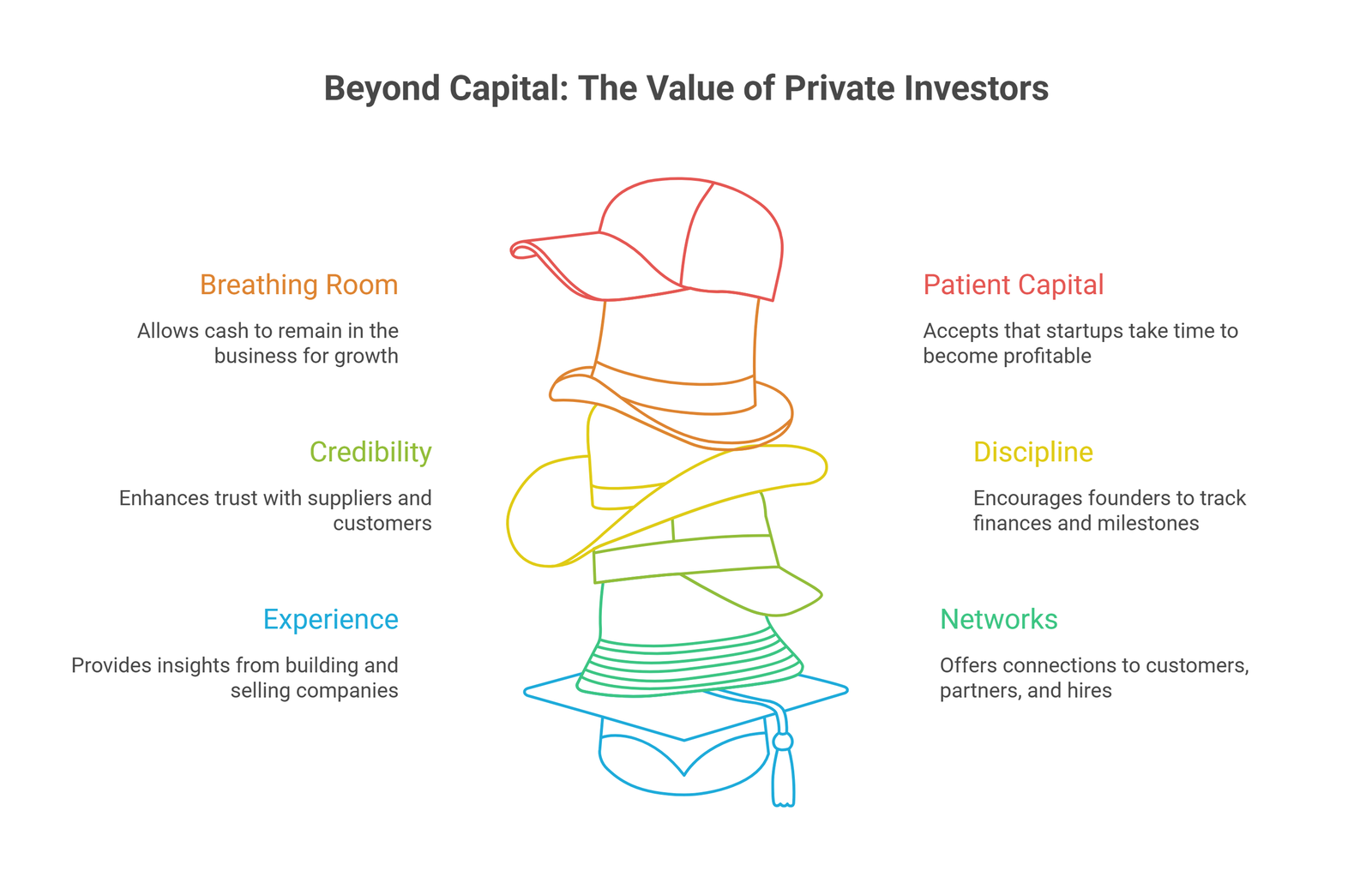
Capital is the obvious benefit. The rest can matter more.
- Experience. Many investors have built or sold companies. They spot mistakes early.
- Networks. Introductions to customers, partners, hires and later-stage investors.
- Credibility. A respected name on the cap table tells suppliers and customers the business is taken seriously.
- Discipline. Regular investor updates push founders to track cash, burn and milestones.
- Breathing room. Unlike a bank loan, equity funding usually has no fixed repayment schedule. Cash stays in the business while it grows.
- Patient capital. Private investors accept that startups take time to turn a profit. Many stay involved through later rounds.
The trade-off is ownership. Every share sold is a share the founders no longer hold.
Private investors vs public investors
Public investors buy shares of listed companies through stock markets and funds. They are mostly passive. Prices move daily, and they can sell in minutes.
Private investors buy into companies that are not listed. Their stake is harder to sell. In return, they get direct access to founders and often a say in strategy. That closeness is why they can help a startup, and why choosing the right one matters.
Should you bootstrap or raise?
Outside money is not always the right move. Timing matters.
| Bootstrap when | Raise when |
| Product-market fit is not yet clear | Customers keep buying and come back |
| Revenue comes from lumpy, one-off deals | Revenue is repeatable |
| The scaling playbook is still unclear | A clear path to scale exists and needs cash |
| The business can grow profitably alone | Growth is limited by money, not demand |
If equity does not suit the business, other routes exist. Oak’s guide on how to raise money for a business without a loan covers grants, revenue-based financing and crowdfunding.
Where to find private investors
Most private investors are found through relationships, not public listings. Start with these routes:
- Warm introductions. Ask advisors, mentors and other founders. This is usually the strongest route.
- Angel networks and online platforms. Angel groups and syndicate platforms list active investors by sector and stage.
- Accelerators and incubators. Many offer mentorship first and funding second. They also open doors to investors.
- Local business communities and banks. Bankers often know wealthy clients looking for deals.
- Events and pitch nights. Investors attend them to find deal flow.
- Social media and online communities. Many VCs and angels share their thesis publicly. Engage before you pitch.
- Matchmaking services. Oak runs a matchmaking service for founders and investors that screens businesses against investor criteria.
Treat fundraising like a sales pipeline. Expect many conversations for each yes. Take the meetings, since each one sharpens the pitch.
What private investors look for
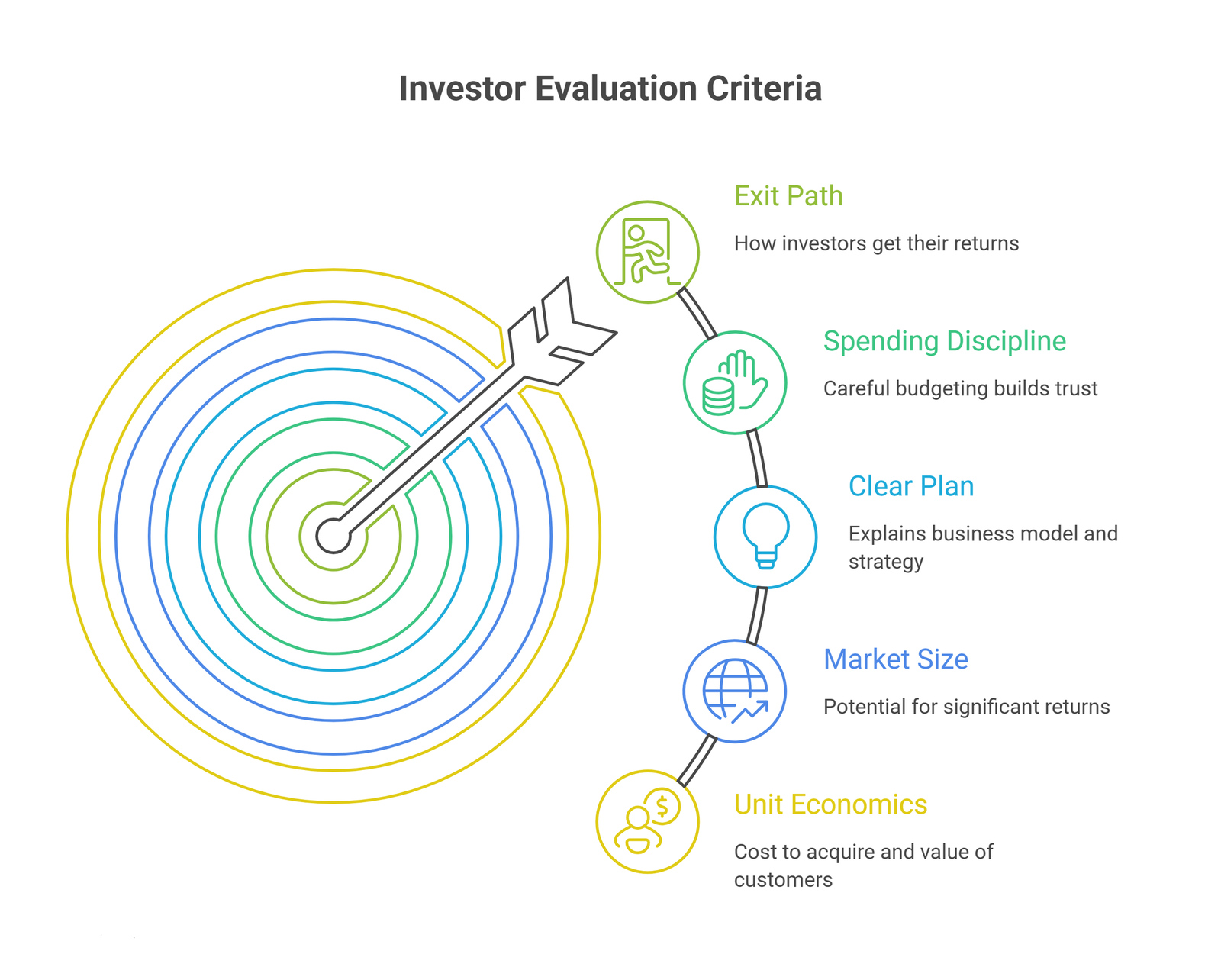
Investors compare dozens of startups. These factors move a deal forward:
- The team. For early-stage companies, the founders are often the main asset.
- Traction. Revenue growth, customer growth or signed partnerships.
- Unit economics. What each customer costs to win and what each brings in.
- Market size. A market large enough to return the investment many times over.
- A clear plan. Founders must explain the model, the strategy and the use of funds in plain words.
- Spending discipline. A history of careful budgeting builds trust in how new money will be used.
- An exit path. Startup investing is illiquid. Investors need to see how they get paid, through a sale, a merger or a public listing.
Build your investor package
Investors judge preparation quickly. A complete package includes four items.
A pitch deck. Keep it to 10 to 15 slides. Cover the problem, the solution, the market, the business model, traction, the team, financials and the ask. A ready structure helps, such as Oak’s seed funding pitch deck template.
A business plan. Investors request a fuller plan once they show interest. It supports due diligence.
A financial model. Projections must be realistic and explainable. A good financial model for startups shows how the investment turns into growth and lets founders test scenarios.
A one-sentence story. If a stranger cannot repeat what the company does after hearing it once, the pitch is too complicated. Practice it until it sounds natural.
Valuation, equity and control
Valuation is the biggest negotiation. Two formulas cover the basics.
- Post-money valuation = pre-money valuation + investment amount
- Investor ownership = investment amount ÷ post-money valuation
Illustrative example. An angel invests $200,000 at an agreed pre-money valuation of $2 million. The post-money valuation is $2.2 million. The angel owns about 9% of the company.
Early rounds commonly involve giving up roughly 10% to 25% of the company. Treat that as a rule of thumb, not a rule. Traction, growth and market conditions all move the number.
Ownership is only part of control. Check these terms before signing:
- Board seats. Who sits on the board and how many votes each seat carries.
- Voting rights. Preferred shares can give investors more say than their percentage suggests.
- Liquidation preference. It decides who gets paid first in a sale.
- Performance conditions. Some agreements let investors claw back value if targets are missed.
Founders who plan several rounds should aim to keep a healthy majority for as long as possible. Each round dilutes the founders further.
Funding rounds at a glance
| Round | Typical investors | What you need to show |
| Pre-seed | Founders, friends and family, some angels | A real problem, a capable team, an early prototype |
| Seed | Angels, angel groups, seed funds, early VCs | Early traction and a path to product-market fit |
| Series A | Institutional VCs | Repeatable revenue and a scalable model |
| Series B and later | VCs and growth investors | Strong, proven growth metrics |
| Late stage | PE, corporate investors and others | Readiness for a sale or public listing |
Many startups stall between seed and Series A. Investors at that point want proof of a repeatable model, not just promise.
Negotiate with confidence
Preparation strengthens a founder’s hand. Before talks begin, settle three questions:
- How much money is needed, and what will it be spent on?
- How much equity are you willing to give up?
- What terms would make you walk away?
Asking for too much costs credibility. Asking for too little forces a second raise on worse terms.
Watch for warning signs too. Pressure to close fast, vague terms, an investor with no relevant experience, or early demands for control all deserve a pause. A bad deal is worse than a slow one.
Understand the risk investors accept
Private investing is high risk. Most startups return little or nothing. A few large wins carry the whole portfolio. Investors also cannot sell their stake easily, so their money stays tied up for years.
This shapes how they behave. They want a credible route to a big outcome. Founders who acknowledge the risk openly, and explain how they will manage it, earn more trust than those who promise certainty.
Frequently Asked Questions
What is a private investor?
A private investor puts personal or pooled money into a business to earn a return. Returns come from equity, dividends or interest. For startups, the main payoff usually arrives at an acquisition, merger or public listing.
How much equity should a startup give up?
There is no fixed answer. Early rounds often involve roughly 10% to 25%. The number depends on traction, growth, the amount raised and the valuation. Aim to keep control for as long as possible.
Do I need a pitch deck and a business plan?
Yes. The pitch deck wins the first meeting. The business plan and financial model support the deeper review that follows.
What is the difference between angel investors and venture capitalists?
Angels invest their own money, usually at the earliest stages. VCs invest pooled money from institutions, usually in larger amounts and in companies that have shown early growth. VCs also often expect a board seat.
When should a startup raise money?
Raise when customers keep buying, revenue is repeatable and money is the main limit on growth. Before that, bootstrapping keeps ownership intact.
What if investors say no?
Rejection is normal. Ask for feedback, refine the pitch and keep meeting new investors. Often only one yes is needed, and it must come from the right partner.
Choose a partner, not just a check
The best investor relationship works like a long partnership. Money arrives once. Advice, introductions and support continue for years. Founders who screen investors as carefully as investors screen them usually end up with better terms and better backing.
Ready to raise? Oak’s capital raising consultants prepare business plans, pitch decks, financial models and valuations so founders can approach investors with confidence.


