How To Write A Traditional Business Plan
How to write a traditional business plan (and know if you actually need one)
Most founders sit down to write a business plan because someone asked for one, a bank, an investor, a grant committee, and then spend weeks filling out a template built for a different kind of pitch. A traditional business plan is a specific, heavier document with a specific job: proving to a lender or investor that you have done the work. Getting the format right matters as much as getting the content right, because a traditional plan that reads like a lean one-pager stretched to twenty pages tends to undercut the very credibility it is supposed to build.
Traditional plan or lean plan: pick before you start
Before writing a single section, decide which kind of plan the situation calls for.
| Traditional business plan | Lean plan | |
| Length | Roughly 15 to 30 pages, plus appendices | 1 to 2 pages |
| Audience | Banks, VCs, grant committees, formal lenders | Internal teams, early-stage pivots, quick partner briefings |
| Financial detail | Full 3 to 5 year projections, income statement, cash flow, funding ask | High-level numbers only, if any |
| Best for | Businesses seeking a loan, formal investment, or a franchise/grant application | Early-stage validation, internal alignment, fast-moving startups |
If you are applying for a bank loan or courting an institutional investor, write the traditional version. If you are validating an idea internally, a lean plan will save you weeks and get you to the same clarity faster. The rest of this guide covers the traditional format section by section.
Executive summary
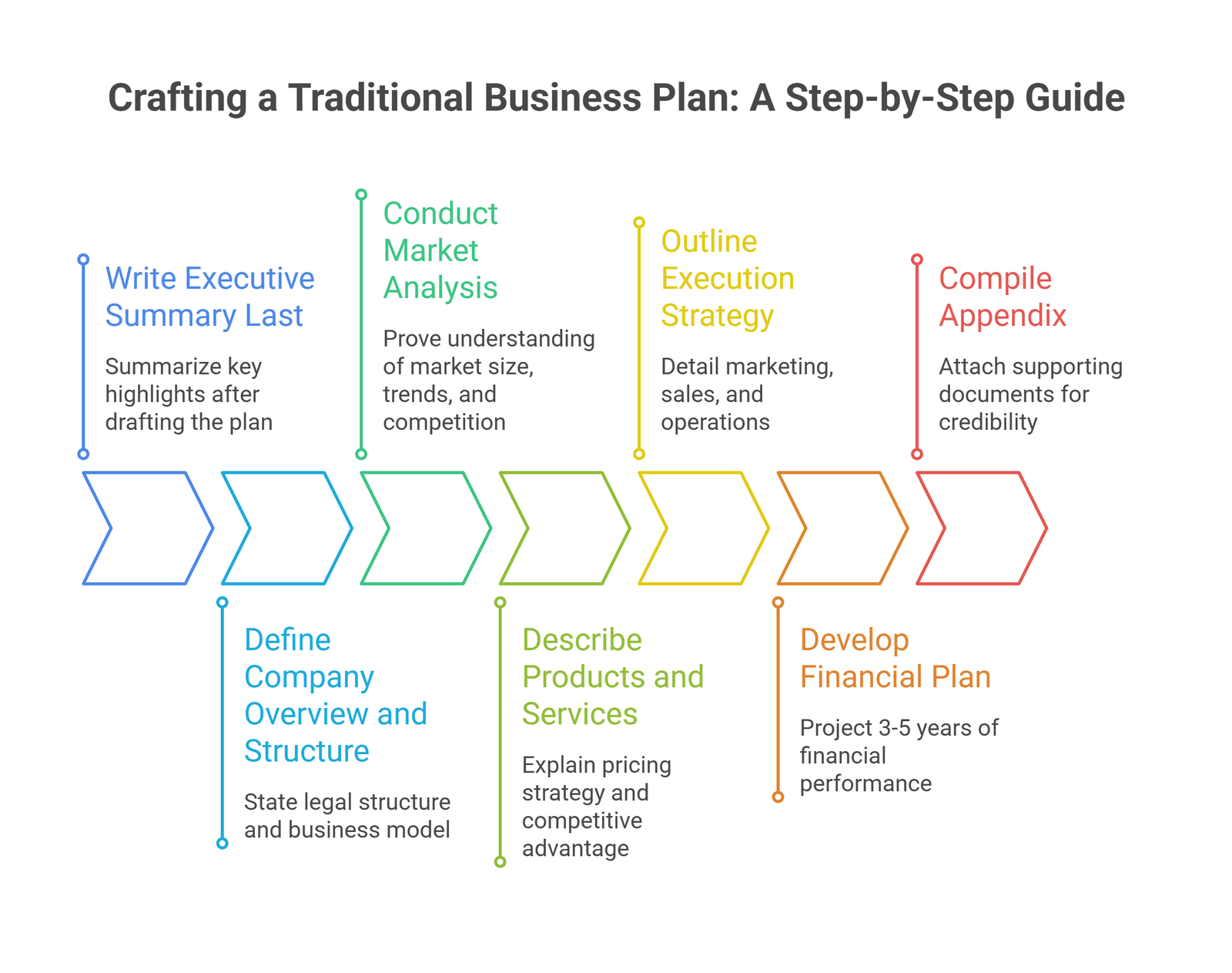
Write this section last, even though it appears first. Most people summarize a story well only after they have written the whole thing, so draft everything else, then come back and pull the highlights.
Keep the summary tight. This is not the place for detail, if a potential investor wants more, they will ask for it. Many investors read only the executive summary before deciding whether to keep reading, so it needs to independently make the case for your business: the problem you solve, who you serve, and why now.
At minimum, pull the following into this section once the rest of the plan exists: your mission and business concept, your product or service, your competitive advantage, your target market, your financial highlights, and, if you’re raising money, a specific ask.
Team
Investors fund people as much as ideas. List the core team with relevant qualifications and experience, and be specific about what each person actually does day to day rather than listing job titles alone.
Financials
Summarize the numbers investors care about most: when you expect to break even, your projected profitability, and how much capital you’re requesting. The full detail lives in your financial plan section later; here you’re previewing the numbers that matter.
Company overview and structure
State your legal structure (LLC, partnership, corporation, sole proprietorship) and where the business is based and operates from. Note your business model too, most companies fall into business-to-consumer, business-to-business, direct-to-consumer, or some hybrid, and that distinction shapes how a reader interprets everything else in the plan.
Name your competitive advantage explicitly rather than leaving it implied: are you winning on price, on quality and differentiation, or on serving a narrow niche better than anyone else? Investors read this section closely, and an unclear legal structure or a vague competitive advantage is a common red flag in due diligence.
Team
Expand here on who’s involved and why they’re qualified, going deeper than the executive summary’s preview. A small team is not a weakness if every person’s role and relevant background is clear, vague roles are the actual problem.
Market analysis
This section is where most thin business plans get caught out, and it’s often the longest one in a traditional plan. Its job is to prove you understand the market you’re entering, not just the product you’re building.
Cover four things:
- Market size, growth, and trends. How big is this market today, and where is it heading? Note the specific economic, technological, or social trends behind that trajectory rather than asserting growth without evidence.
- Target market. Go beyond broad demographics. Include purchasing habits, decision drivers, and, where you can estimate it, the size of the addressable market you’re actually positioned to capture.
- Competitive analysis. Name your direct and indirect competitors and compare pricing, positioning, and market share where you can find it. Skipping this section, or softening it into a vague “we have no real competitors,” is one of the fastest ways to lose an experienced reader’s trust.
- SWOT. A short strengths, weaknesses, opportunities, and threats breakdown forces you to state your weak points before a reader finds them for you.
Products and services
Describe what you actually sell, and go further than a feature list. For each product or service, explain your pricing strategy: how you arrived at that price, what it reflects about your costs and positioning, and why customers should pay it over a competitor’s rate. A price that isn’t explained reads as a guess.
Cover the product lifecycle, what’s shipping now versus what’s planned, and mention any intellectual property, patents, or proprietary process that protects your position. If sourcing or production quality is part of your story (handmade goods, specialized materials, a proprietary process), say so here; it’s evidence for the competitive advantage you claimed earlier.
Execution
If the earlier sections describe what your business is, execution is how you’ll actually run it.
Marketing and sales
Lay out how you’ll reach your target market and which channels you’ll use, social media, paid advertising, content, direct outreach, partnerships. The right channel depends entirely on where your audience already spends attention; a plan aimed at Gen Z buyers that leans on print advertising will read as out of touch. Then cover your sales process: how leads get generated, qualified, and closed, and how you’ll measure whether the marketing spend is actually working.
Operations
Describe the day-to-day processes that keep the business running. A manufacturing business and a service business have almost nothing in common here, so be specific to your model: suppliers, production, fulfillment, inventory, the actual mechanics of delivering what you sell. If a supplier disappeared or a key input doubled in price tomorrow, a strong operations section shows you’ve thought about the backup plan.
Milestones and metrics
Set specific timelines for specific goals, not “grow the business” but concrete targets with dates attached. Pair each milestone with the metric you’ll use to track it, so the plan gives investors something they can check your progress against later.
Financial plan
This is the section that carries the most weight with lenders and investors, and the one most founders under-invest in.
Forecast
Traditional plans typically project 3 to 5 years out, covering sales, expenses, profit, assets, and liabilities. Building this properly usually means a full financial model, not just a rough spreadsheet, since lenders and investors will test your assumptions, not just your conclusions. If you’re applying for an SBA-backed loan in the US, you’ll also need your NAICS industry classification code on hand, lenders use it to benchmark your numbers against others in your space. If you don’t have someone in-house who builds financial models regularly, this is one section worth outsourcing rather than guessing at; see our walkthrough on creating a startup financial model for how the pieces fit together.
Financing
If you need outside capital, spell out exactly how much, what it’s for, and what form you’re seeking, loan, equity, or some mix. Vague financing asks (“some investment to grow”) read as a founder who hasn’t done the math.
Appendix
Attach the supporting documents: full financial statements, detailed models, projections, and anything else that backs up claims made earlier in the plan. Investors and lenders check this section closely even when they’ve skimmed the rest, so keep it complete and organized rather than an afterthought.
Keeping it current
A traditional business plan isn’t a document you write once and file away. Established businesses should revisit theirs at least once a year; faster-growing companies often benefit from a lighter quarterly check-in on short-term objectives and financial projections, saving the full overhaul, market analysis, SWOT, and long-term goals included, for the annual pass.
Certain changes should trigger an update outside that schedule regardless: a new competitor entering your market, a real shift in consumer demand, a supplier or cost change that alters your numbers, or a new regulation that touches your industry. Comparing your plan’s projections against what actually happened, a simple plan-vs-actual check, is often the fastest way to catch drift before it becomes a real problem.
A few patterns reliably weaken a plan at any stage: financial projections that aren’t grounded in real market data, goals stated without a measurable target attached, a competitive analysis that quietly avoids naming real competitors, and a product section that leads with features instead of why the customer actually buys. If any of these show up in a draft, it’s worth fixing before the plan goes in front of anyone.
Frequently Asked Questions
How long should a traditional business plan be?
Typically 15 to 30 pages excluding appendices. Shorter plans read as underdeveloped for a bank or institutional investor audience; much longer plans tend to bury the case rather than strengthen it.
Do I need a traditional plan or would a lean plan work?
If you’re seeking a bank loan, formal investment, or applying for something like a grant or franchise agreement, use the traditional format. If you’re validating an idea internally or need to move fast, a lean one-to-two-page plan gets you there faster.
Should I write the executive summary first or last?
Last. Write the full plan, then distill the highlights, it’s much easier to summarize a story you’ve already told in full than to guess at highlights in advance.
How many years should my financial forecast cover?
Three to five years is standard for a traditional plan, covering sales, expenses, profit, and your balance sheet position.
How often should I update my business plan?
At least annually if you’re an established business, quarterly if you’re growing fast. Update it immediately, regardless of schedule, when a competitor, supplier cost, or regulation changes in a way that affects your numbers.
Can I write a traditional business plan myself, or should I hire help?
You can write most of it yourself if you know your business well. The financial forecast is the section where outside help pays off fastest, since lenders and investors will test your assumptions and a shaky model can undercut an otherwise strong plan.
What’s the biggest mistake founders make in a traditional business plan?
Softening or skipping the competitive analysis and the financing ask. Both read as unfinished thinking to an experienced investor, even when the rest of the plan is polished.
Conclusion
A traditional business plan is a specific tool for a specific job: convincing a lender or investor that you’ve done the work behind your pitch. Get the format right, invest real time in the market analysis and financial plan, and don’t skip the sections that feel uncomfortable to fill in, those are usually the ones an investor reads first.
If you’d rather have that financial forecast built by people who do it daily, Oak Business Consultant’s investor-ready business plan service handles the modeling, projections, and structure so your plan holds up under real scrutiny. Browse our business plan templates to see the format in action, or get in touch to talk through what your plan needs.