How To Go About Creating Your Startup Financial Model
Introduction

Every startup begins with an idea. But somewhere between the founding vision and a fully funded, scaling business lies a critical bridge: the startup financial model. Without it, founders are navigating in the dark, making resource decisions on instinct, pitching investors without evidence, and building businesses that look convincing on paper but collapse under the weight of unanticipated costs.
A startup financial model is far more than a spreadsheet of numbers. It is a structured, dynamic representation of how your business is expected to generate revenue, manage costs, and sustain cash flow over time. It answers the questions that founders, investors, and boards need answered before committing capital: Is this business viable? How long until profitability? What happens if growth is slower than expected?
What Is a Startup Financial Model?
A startup financial model is a quantitative representation of your company’s expected financial performance. Built typically in Excel or Google Sheets, it integrates assumptions about market size, pricing, sales volume, operating costs, and funding to project revenue, profit, and cash flow over a defined period, usually three to five years.
Unlike financial statements for established companies, which are grounded in historical data, startup financial models are inherently forward-looking. They are built on assumptions, which means the quality of the model depends directly on the quality of the assumptions behind it.
A well-constructed model does three things well: it reflects the reality of your business model, it is honest about uncertainty, and it is built in a way that allows it to be updated as your business grows and conditions change.
Why Every Startup Needs a Financial Model
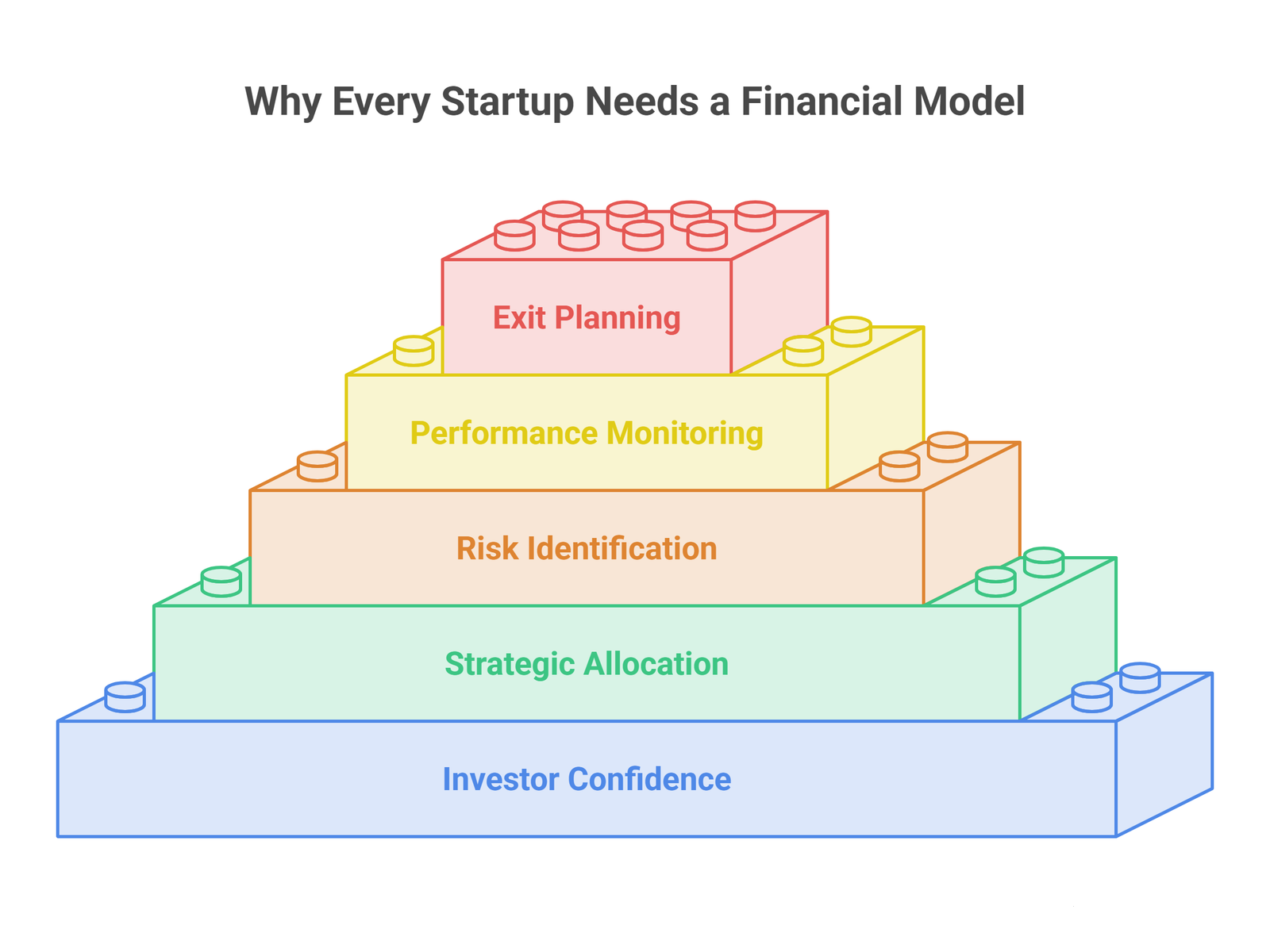
Investor Confidence
Investors do not fund ideas; they fund businesses with credible plans. A financial model is the primary document through which investors evaluate the financial potential of your startup. It demonstrates your understanding of the market, your revenue drivers, and your path to profitability. A model that holds up under investor scrutiny signals that you are a founder who understands their business deeply.
Explore Oak’s startup financial model templates to see investor-ready examples across industries.
Strategic Resource Allocation
A financial model forces founders to think carefully about where money goes and what return is expected. Without this discipline, early-stage startups burn through limited capital on costs that do not generate proportionate value. The model creates a framework for evaluating every spending decision against its projected impact on revenue and growth.
Risk Identification and Scenario Planning
Every startup faces uncertainty. A financial model does not eliminate that uncertainty, but it makes it visible. By stress-testing assumptions and modeling multiple scenarios, founders can identify which variables pose the greatest financial risk and build contingency plans before a crisis arrives.
Performance Monitoring
Once a startup is operational, the financial model serves as a benchmark. Comparing actual results to projected figures reveals where the business is outperforming or underperforming, enabling faster course corrections. This is a core function of sound financial planning and a habit that separates high-performing startups from those that fail silently.
Exit Planning
Investors and acquirers value startups largely on projected future cash flows. A robust financial model with defensible assumptions strengthens your negotiating position and supports a higher valuation when it matters most. Oak’s business valuation services are built on exactly this kind of financial foundation.
The Key Components of a Startup Financial Model
Before walking through how to build a model, it helps to understand what it needs to contain. A complete startup financial model is built around three core financial statements, supplemented by a set of assumptions and supporting analyses.
1. The Income Statement (Profit and Loss Statement)
The income statement shows how your startup generates revenue and what it costs to do so. It captures revenue at the top, subtracts the cost of goods sold (COGS) to arrive at gross profit, then deducts operating expenses, including sales, marketing, research and development, and general and administrative costs, to arrive at operating income.
For startups, the income statement is particularly important because it illustrates the path from a loss-making early stage to eventual profitability. Investors use this statement to evaluate gross margin quality, operating leverage, and the timeline to break-even. Learn more about how income statements differ from balance sheets and why both matter.
Key line items to model in the income statement:
- Revenue broken down by product, service, or customer segment
- Cost of Goods Sold (COGS), including direct labor, hosting, materials, or fulfilment costs
- Gross Profit and Gross Margin as a percentage of revenue
- Operating Expenses including salaries, marketing spend, rent, and software
- EBITDA (Earnings Before Interest, Taxes, Depreciation, and Amortization) as a proxy for operational profitability
2. The Cash Flow Statement
A business can be profitable on paper and still run out of cash. This is one of the most dangerous traps for early-stage startups, and the cash flow statement is the tool designed to prevent it.
The cash flow statement tracks all cash entering and leaving the business across three activities: operating, investing, and financing. It shows whether the business is generating or consuming cash and how long the current runway will last at the current burn rate.
For startups, the cash burn rate is a critical metric. Understanding how long your current cash reserves will last before additional funding is needed is essential for fundraising timing, hiring decisions, and operational planning. Sound cash flow management is one of the most valuable disciplines a startup founder can develop.
3. The Balance Sheet
The balance sheet provides a snapshot of the startup’s financial position at a given point in time. It shows what the business owns (assets), what it owes (liabilities), and the residual equity belonging to shareholders.
For early-stage startups, the balance sheet is most useful for tracking how capital has been deployed, how much debt the business is carrying, and what the net equity position looks like over time. As the business matures, the balance sheet becomes increasingly important for lenders and institutional investors.
Together, these three statements form what is known as an integrated 3-statement financial model, where changes in one statement flow automatically through to the others. This integration is what gives the model its analytical power.
How to Build a Startup Financial Model: A Step-by-Step Approach
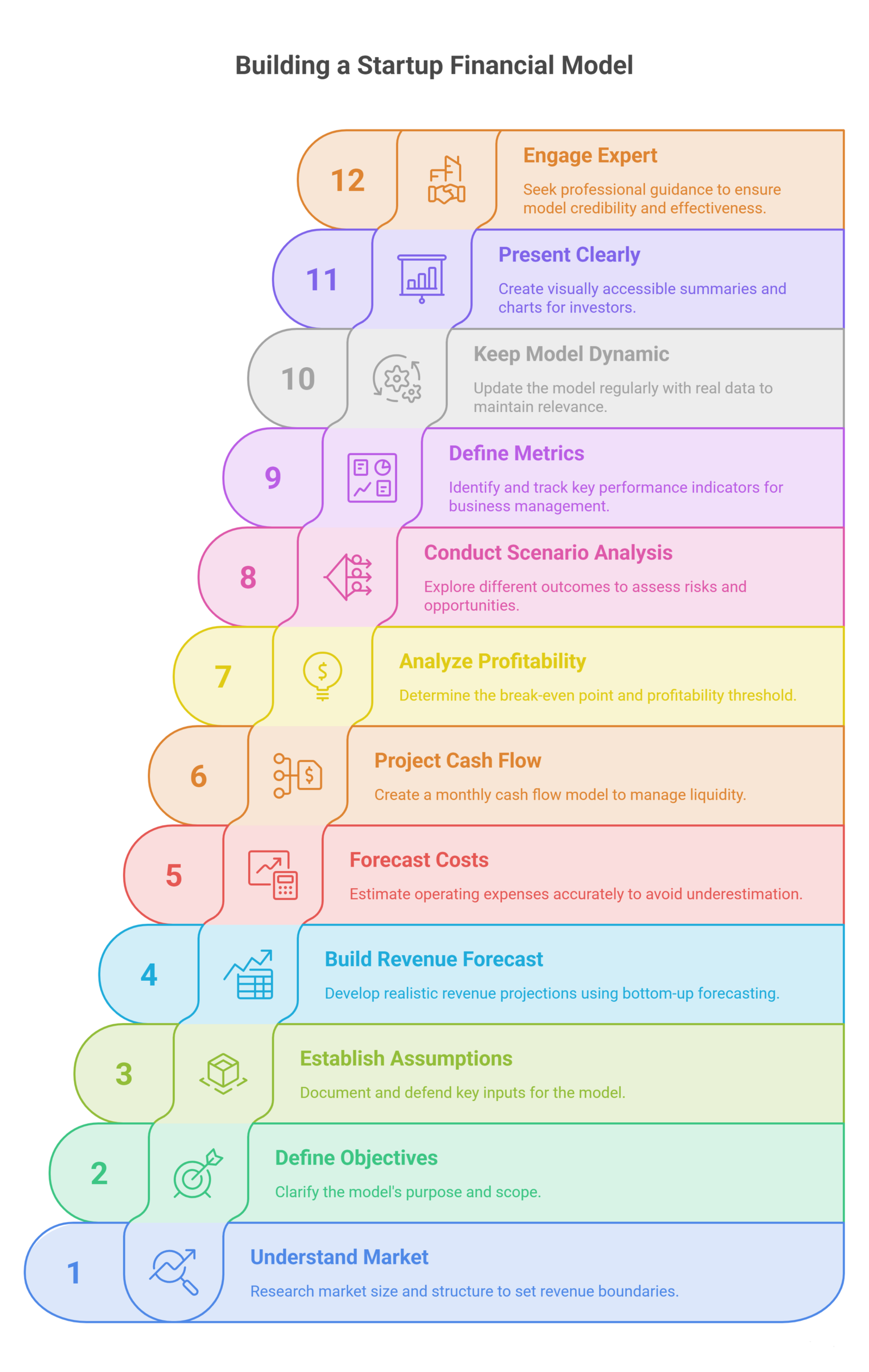
Step 1: Understand Your Market
Every reliable financial model begins with market research. Before you can project revenue, you need to understand the size and structure of the market you are entering. This means defining your Total Addressable Market (TAM), your Serviceable Addressable Market (SAM), and your Serviceable Obtainable Market (SOM).
The significance of TAM, SAM, and SOM cannot be overstated. Investors scrutinize these figures closely because they set the upper boundary for your revenue projections. A startup targeting a $500 million market cannot credibly project revenues that exceed a realistic share of that market within the modeled timeframe.
This market intelligence also shapes your unit economics. How many customers can you realistically acquire in year one? At what cost? What is the average revenue per user? These questions must be answered with reference to market realities, not wishful thinking.
Step 2: Define Your Objectives Clearly
Ask yourself what the model is being built to accomplish. This question determines both its scope and its level of detail.
If you are building the model to raise a seed round, you need to demonstrate a credible path to the milestones that will justify a Series A. Moreover, if you are modeling to support internal planning, you need a model that can be updated monthly and integrated with actuals. If you are preparing for acquisition due diligence, the model needs to withstand forensic-level scrutiny.
Setting clear financial goals before building ensures the model is fit for purpose. A model built without a clear objective tends to be either too superficial to be useful or too complex to be maintained.
Step 3: Establish Your Assumptions
Assumptions are the foundation of the entire model. They should be explicit, documented, and defensible. Common assumption categories for a startup financial model include:
- Revenue assumptions: pricing, volume, conversion rates, and churn. For more on structuring these, see Oak’s guide on revenue assumptions.
- Cost assumptions: headcount growth, cost of goods, marketing spend as a percentage of revenue
- Market assumptions: market growth rate, competitive intensity, customer acquisition dynamics
- Operational assumptions: payment terms, inventory cycles, capitalization policy
A useful practice is to create a dedicated assumptions tab in your spreadsheet where every key input is stored. This makes it easy to run scenario analysis and update the model as your business evolves.
Step 4: Build Your Revenue Forecast
Revenue forecasting is where most startup financial models live or die. The two primary approaches are top-down and bottom-up.
Top-down forecasting starts with the total market size and assumes a percentage capture. While this gives investors a sense of opportunity, it is often viewed skeptically because it does not reflect the mechanics of how you will actually sell.
Bottom-up forecasting is more credible and more useful operationally. It starts with your actual sales levers: how many salespeople you have, how many calls each makes per week, what the conversion rate is at each stage of the funnel, and what the average deal size is. This approach produces numbers that are grounded in execution reality.
For SaaS and subscription businesses, revenue modeling must capture Monthly Recurring Revenue (MRR), annual contract values, churn rates, and expansion revenue. For transactional businesses, the focus is on transaction volume, average order value, and repeat purchase rates. Tailor your revenue model to the specific mechanics of your business model.
Step 5: Forecast Operating Costs and Expenses
Underestimating costs is one of the most common and damaging mistakes in startup financial modeling. Founders tend to be optimistic about revenue and optimistic about costs, which produces projections that are doubly unrealistic.
Categorize your costs carefully:
- Fixed costs do not vary with volume and include salaries, rent, insurance, and software subscriptions
- Variable costs scale with revenue or volume, including payment processing fees, delivery costs, and commissions
- Semi-variable costs have a fixed component but also scale, such as customer support teams that grow as customer numbers increase
- One-time costs include legal setup, product development, and initial marketing campaigns
Build your cost model monthly for at least the first 24 months, then quarterly or annually for the subsequent period. This granularity ensures the model reflects the cash timing that matters most to early-stage operations.
Step 6: Project Cash Flow
Link your revenue forecasts and cost structure to a monthly cash flow model. This is the mechanism that makes the financial model practically useful for managing the business.
The cash flow projection should show your opening cash balance, add cash receipts from customers, subtract cash payments to suppliers, employees, and other creditors, and calculate your closing cash balance for each period. This reveals your burn rate, your runway, and the specific months where cash could become tight.
Always include a buffer. Build your model assuming receivables are collected later than expected and payables fall due earlier. This conservative posture is not pessimism; it is the discipline that keeps startups from running aground on a cash crisis they could have seen coming.
Step 7: Run a Profitability and Break-Even Analysis
Identify the revenue level at which total revenue equals total costs. This is your break-even point. Above it, the business is profitable. Below it, every unit of revenue is insufficient to cover the cost structure. Understanding this threshold is essential for internal planning and for communicating to investors when the business transitions from cash-consuming to self-sustaining.
A break-even analysis is particularly valuable for hardware businesses, marketplaces, and any startup model where fixed cost structures are significant. For SaaS businesses, the equivalent concept is the point at which MRR exceeds monthly operating expenses.
Step 8: Conduct Scenario Analysis
No startup operates in a straight line. Build at least three scenarios into your model: a base case reflecting your best estimate, a downside case assuming slower growth and higher costs, and an upside case reflecting accelerated traction.
Scenario analysis forces you to identify the assumptions that drive the most variance in outcomes. If a 10% reduction in conversion rate halves your revenue, that is a critical risk factor that deserves immediate operational attention. If a 20% cost overrun is manageable, you have more resilience than you might have assumed.
Investors expect founders to have thought through multiple outcomes. A model with only one scenario signals that the founder has not grappled seriously with risk. A model with well-reasoned scenarios demonstrates the kind of analytical rigor that builds investor confidence.
Step 9: Define and Track Key Metrics
A startup financial model should surface the KPIs that matter most to your business. These are the metrics that investors will ask about and that your team should be managing to. For most startups, this includes some combination of:
- Monthly Recurring Revenue (MRR) and its growth rate
- Customer Acquisition Cost (CAC) and its relationship to Customer Lifetime Value (CLV)
- Gross Margin as a percentage of revenue
- Churn Rate for subscription businesses
- Burn Multiple, which measures how much cash is burned for each dollar of net new ARR added
- Runway in months at the current burn rate
Connecting these metrics to your financial model ensures that the model is a living management tool rather than a static document produced for a single fundraise. For more on tracking SaaS-specific metrics, see Oak’s resource on SaaS metrics and KPIs.
Step 10: Keep the Model Dynamic and Up to Date
The value of a financial model is not in its initial construction but in its continued relevance. As your business generates real data, load that data into the model and compare it to your projections. Understand the sources of variance. Were revenue projections off because the market assumption was wrong? Or because the sales process took longer than expected? These distinctions matter for improving the next iteration.
Outstanding founders treat their financial model as a living document. They update it monthly, present it quarterly to their boards, and use it as a compass for major operational decisions. This is what it means to run a financially disciplined startup.
Step 11: Present It Clearly
A financial model that cannot be explained is not ready for investors. Build in clear, visually accessible summary outputs: a one-page dashboard showing headline revenue, burn rate, runway, and key milestones. Use charts to communicate trajectory. Write assumption notes that explain the logic behind every key input.
A marketing KPI dashboard that sits alongside the financial model can help make the connection between top-of-funnel activity and revenue projections visible to both internal teams and investors.
Step 12: Engage a Financial Expert
Financial modeling for startups requires judgment that comes from experience. The assumptions that drive a model, the structure that makes it credible, and the presentation that resonates with investors are all skills developed through repeated exposure to real startup financing situations.
Oak Business Consultant’s financial modeling services are designed specifically for founders who want investor-ready models built to the highest standard. Our team has worked across industries and funding stages, delivering models that have supported successful seed rounds, Series A raises, and acquisition processes.
Common Mistakes to Avoid in Startup Financial Modeling
Overestimating early revenue. Startups consistently underestimate how long it takes to close early customers. Build in realistic sales cycle timelines and conservative conversion assumptions for the first 12 to 18 months.
Ignoring the cash conversion cycle. Revenue recognized on an income statement and cash actually received in the bank account are often separated by 30, 60, or 90 days. A model that ignores this will present a misleadingly healthy cash position.
Building a model that cannot be updated. Hardcoded numbers, circular references, and poorly structured spreadsheets become a liability as the business evolves. Build for maintainability from the start.
Using top-down market share assumptions without operational support. Stating that you will capture 1% of a $10 billion market is not a revenue model. It is a hope. Back every revenue projection with bottom-up logic.
Confusing profit with cash. A startup can generate accounting profit and still run out of cash. Always maintain a cash flow statement alongside the income statement.
Building a Financial Model for a Startup Business Plan
If you are building a startup financial model specifically for inclusion in a business plan, the model should align directly with the market analysis, go-to-market strategy, and operational plan described in the plan’s narrative sections.
The financial model is the quantitative expression of the business plan. Revenue projections should reflect the customer segments identified in the market analysis. Cost projections should reflect the team structure and operational model described in the operations section. Headcount assumptions should align with the organizational plan.
For a detailed guide on the broader planning process, see Oak’s 7 ultimate steps to writing a business plan.
Types of Startup Financial Models
Not every startup requires the same model structure. The right model depends on the business model, the stage of the company, and the purpose the model is meant to serve.
Three-Statement Model: The most complete and commonly required model, linking the income statement, balance sheet, and cash flow statement in an integrated structure. Required for investor-grade financial presentations.
Revenue-Only Model: Suitable for very early-stage startups in the ideation phase, where the focus is on stress-testing revenue assumptions before building a full model. This is often a precursor to the three-statement model.
SaaS Financial Model: Designed for subscription businesses, with emphasis on MRR growth, churn, cohort analysis, and customer lifetime value. SaaS financial models have distinct mechanics from transactional business models and should be structured accordingly.
DCF Valuation Model: Used primarily in later-stage fundraising and M&A contexts, the discounted cash flow model estimates present value based on projected future free cash flows. For a deeper look at this concept, see Oak’s resource on the importance of NPV for financial modeling.
Scenario and Sensitivity Model: Often built as an extension of the three-statement model, this structure allows users to toggle between base, upside, and downside cases and perform sensitivity analysis on key assumptions.
Frequently Asked Questions
How long should a startup financial model project into the future?
For fundraising, most investors expect a three-to-five-year projection, with the first two years modeled monthly. For internal operations, a rolling 12-month model updated monthly is most practical.
What is the difference between a financial model and a financial forecast?
A forecast predicts a single expected outcome; a financial model is a broader tool that lets you change assumptions and test multiple scenarios. Every model contains a forecast, but a forecast alone is not a full model.
How long does it take to build a startup financial model?
A template-based model can be ready in a few days; a fully integrated three-statement model built from scratch typically takes two to four weeks depending on business complexity.
What tools should I use to build a startup financial model?
Excel and Google Sheets remain the industry standard, offering the flexibility needed for custom, integrated models that can evolve as the business grows.
Do investors actually read the financial model in detail?
At Series A and beyond, yes. Seed-stage investors often focus on key assumptions and headline metrics, but having a complete model ready builds credibility and prepares you for due diligence questions.
Can I use a financial model template, or do I need to build from scratch?
Starting with a quality template is a smart approach, but it must be customized to your specific business mechanics. Oak’s startup financial model templates are built to investor-grade standards and are a strong starting point.
How do I model a startup with no historical data?
Anchor assumptions in market research, industry benchmarks, and comparable company data, then use bottom-up revenue modeling to build projections from actual sales mechanics rather than top-down market share estimates.
Conclusion
Building a startup financial model is one of the highest-leverage activities a founder can invest time in. It forces clarity about the business model, surfaces risks before they become crises, and creates the credibility with investors that converts promising ideas into funded companies.
The model you build today will not be perfect. It will be wrong in some of its assumptions, and the projections will diverge from actuals as the business evolves. That is expected and acceptable. What matters is that the model is built on honest assumptions, structured to be updated as new information arrives, and used as an active management tool rather than a document produced once and filed away.
A startup that operates with a clear, well-maintained financial model has a structural advantage over one that does not. It makes better decisions about hiring and spending, it identifies cash risks before they become emergencies, and it enters every investor conversation from a position of financial confidence rather than uncertainty.
If you are ready to build a financial model that meets investor expectations and drives smarter internal decisions, Oak Business Consultant is here to help. Explore our financial modeling services, browse our library of startup financial model templates, or book a call with our team to discuss your specific needs.