All You Need to Know about Pro forma Cap Table Excel Template
What is a cap table? A founder’s guide to building and reading one
Most founders first hear the word “cap table” moments before they need one, usually when a lawyer asks for it ahead of incorporation, or an investor asks for it ahead of a term sheet. That’s unfortunate timing, because a cap table built casually in month one tends to cause real problems by Series A: unclear ownership, missed tax filings, or a funding round that stalls in due diligence because nobody can say with confidence who owns what. Getting the structure right from day one is far cheaper than fixing it later.
What a cap table actually is
A capitalization table, or cap table, is the authoritative record of who owns what in your company: every founder’s shares, every investor’s stake, every employee’s stock options, and every instrument that will eventually convert into equity. It typically shows, for each holder, the type of security they hold, how many shares or units, the price paid, and the resulting percentage of ownership.
Early on, a cap table might be one line per founder in a spreadsheet. After a few funding rounds, an option pool, and some employee departures, that same document becomes a multi-sheet model tracking vesting schedules, liquidation preferences, and fully diluted ownership across every security type the company has ever issued.
The cap table exists to answer questions that matter constantly, not just at exit: how much of the company do the founders still control, what happens to ownership if every option and convertible note converts, and who gets paid first if the company is sold.
When to create one
Create your cap table the day you incorporate, even if it’s just you and a co-founder splitting ownership 50-50. A spreadsheet is a perfectly fine starting point. What matters is starting the habit of documenting every equity decision immediately, rather than trying to reconstruct history later when a lawyer or investor asks for it.
What belongs on a cap table
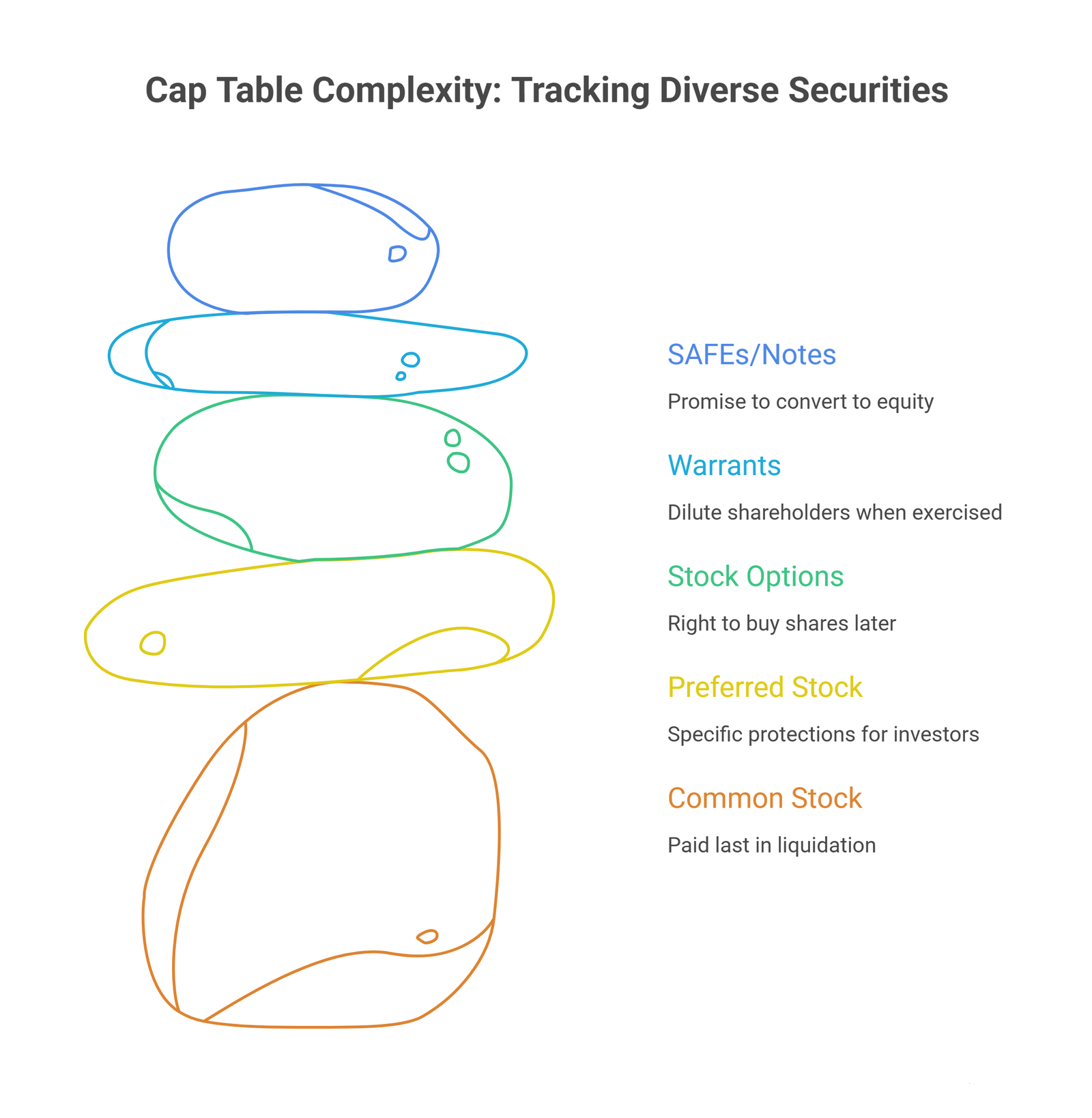
A functional cap table tracks several distinct security types, each with different rights and different implications for dilution.
Common stock
Founders typically hold common stock, and employees hold it once they exercise their options. Common shareholders vote on company matters, but in a sale or liquidation they’re paid last, after every class of preferred stock has been satisfied according to its own terms.
Preferred stock
Investors typically receive preferred stock, which carries specific protections common stock doesn’t have. The most important is the liquidation preference: a 1x preference means preferred holders get their original investment back before common shareholders see anything from an exit; some deals carry 2x or 3x preferences. Preferred stock can also carry anti-dilution protection, which adjusts an investor’s conversion rate if the company later raises money at a lower valuation than before, and board or voting rights over major decisions like a sale of the company. Each funding round typically issues a new series (Series A, Series B, and so on) with its own negotiated terms, so your cap table needs to track which series each investor holds and what rights attach to it.
Stock options
Options give employees the right to buy shares at a fixed strike price, set by the company’s most recent valuation of its common stock. They don’t represent real ownership until exercised, and they vest over time, commonly four years with a one-year cliff: nothing vests until the employee has stayed a full year, then the remainder vests monthly or quarterly after that. If someone leaves before the cliff, the unvested options are simply forfeited back into the pool.
Warrants
Warrants work similarly to options but usually go to lenders or service providers rather than employees, often as a sweetener attached to a debt deal. They dilute existing shareholders when exercised, the same as options, so they need to be tracked with the same care.
SAFEs and convertible notes
Most early-stage startups today raise their first outside capital through a SAFE (Simple Agreement for Future Equity) rather than a priced equity round, with a convertible note as the debt-based alternative. Neither is common or preferred stock at the time it’s issued, both are a promise to convert into equity later, usually at the next priced round, based on a valuation cap, a discount to that round’s price, or both.
This is one of the most common cap table mistakes: treating SAFEs and notes as if they don’t count yet because they haven’t converted. They absolutely belong on the cap table as outstanding obligations, and their eventual conversion often dilutes existing shareholders more than founders expect, sometimes by 10 to 20 percent of the company, because the math compounds with whatever valuation the next round actually lands at.
Building your first cap table
Authorize your shares. Most startups authorize a round number, commonly 10 million shares, at incorporation. The absolute number is arbitrary; what matters is the percentage each holder ends up with, not the raw share count.
Issue founder shares with vesting attached. Even if you and a co-founder are splitting ownership 50-50 on day one, put those shares on a vesting schedule, the same four-year, one-year-cliff structure used for employees. Skipping this is a common and expensive mistake: if a co-founder leaves after six months with fully vested shares, they walk away owning a chunk of a company they didn’t help build, and investors will notice this during due diligence. If you’re in the US, file an 83(b) election with the IRS within 30 days of the grant, it lets founders pay tax on the (near-zero) value of unvested shares now rather than on a much higher value as they vest later. Missing this window is one of the more expensive paperwork mistakes a founder can make.
Reserve an option pool before you raise, and negotiate when it’s created. Institutional investors will require an option pool, typically 10 to 15 percent of fully diluted shares, sized to cover the hiring plan between now and the next round. The timing matters more than founders often realize: a pool created before the round closes (pre-money) dilutes only the founders, while a pool created after the round closes (post-money) means new investors share that dilution too. Investors will usually push for pre-money pools; it’s worth understanding which one you’re agreeing to before you sign a term sheet.
Track every grant as it happens. Each option grant needs a board resolution, a signed option agreement, a strike price tied to a current valuation of the common stock, and a vesting schedule. Update the cap table the same day, not at the next board meeting.
Model dilution before you commit to a round’s terms. Before signing anything, build a pro forma version of the cap table showing ownership before and after the proposed round, including any option pool top-up. Founders often forget that refreshing the pool dilutes them again on top of the new investor’s stake.
How dilution compounds
A single funding round rarely looks dramatic in isolation, but the effect across several rounds adds up faster than most founders expect. Two founders starting at 50 percent each might see their combined stake fall this way as the company scales:
| Stage | Each founder’s ownership |
| At incorporation | 50% |
| After a 10% pre-money option pool | 45% |
| After a seed round | ~40% |
| After a Series A (with pool refresh) | ~31% |
| After a Series B (with another pool refresh) | ~25% |
None of these individual steps is unreasonable on its own, an option pool, a seed round, a Series A are all normal parts of building a company, but by Series B the founders who started at 50 percent combined may be down near 25 percent between them. That’s not a reason to avoid raising capital; it’s a reason to model dilution deliberately before each round rather than discovering the total afterward.
Keeping your cap table compliant
A cap table isn’t just a planning tool, it sits on top of real legal requirements. In the US, most venture-backed startups are Delaware C-corporations, which are legally required to maintain a formal stock ledger recording every shareholder, share count, and issuance date; a spreadsheet is fine as long as it’s accurate and reconciles to the cap table. Companies also need a current 409A valuation, an independent appraisal of the fair market value of the common stock, obtained at incorporation, after every funding round, and at least annually, since it sets the legal strike price for new option grants. Granting options without a current 409A risks tax penalties for both the company and the employees who received them.
Update the cap table the same day any of the following happens: new shares are issued, options are granted or exercised, an employee leaves and forfeits unvested equity, or a new round or convertible instrument closes. Waiting until the next board meeting, or worse, until an investor asks for it during due diligence, is how small inconsistencies turn into expensive cleanup projects.
Who needs to see the cap table
Startup founders often debate how openly to share equity information. A few principles help:
Employee equity is effectively part of their compensation, so treat it with the same discretion as salary information; broadcasting one employee’s grant to the whole company isn’t necessary or fair to anyone. Each employee does need clear, individual visibility into their own equity: how much they hold, its current value based on the latest 409A, and how their vesting is tracking. A cap table management platform handles this kind of individual, permissioned access far better than a shared spreadsheet.
Full access to the whole cap table is normally limited to board members, the CFO or finance lead, legal counsel, and investors with contractual information rights. Giving every employee full visibility into everyone else’s equity tends to create more friction than transparency, since grants vary by role, timing, and negotiating leverage in ways that aren’t always obvious from the numbers alone.
Common cap table mistakes
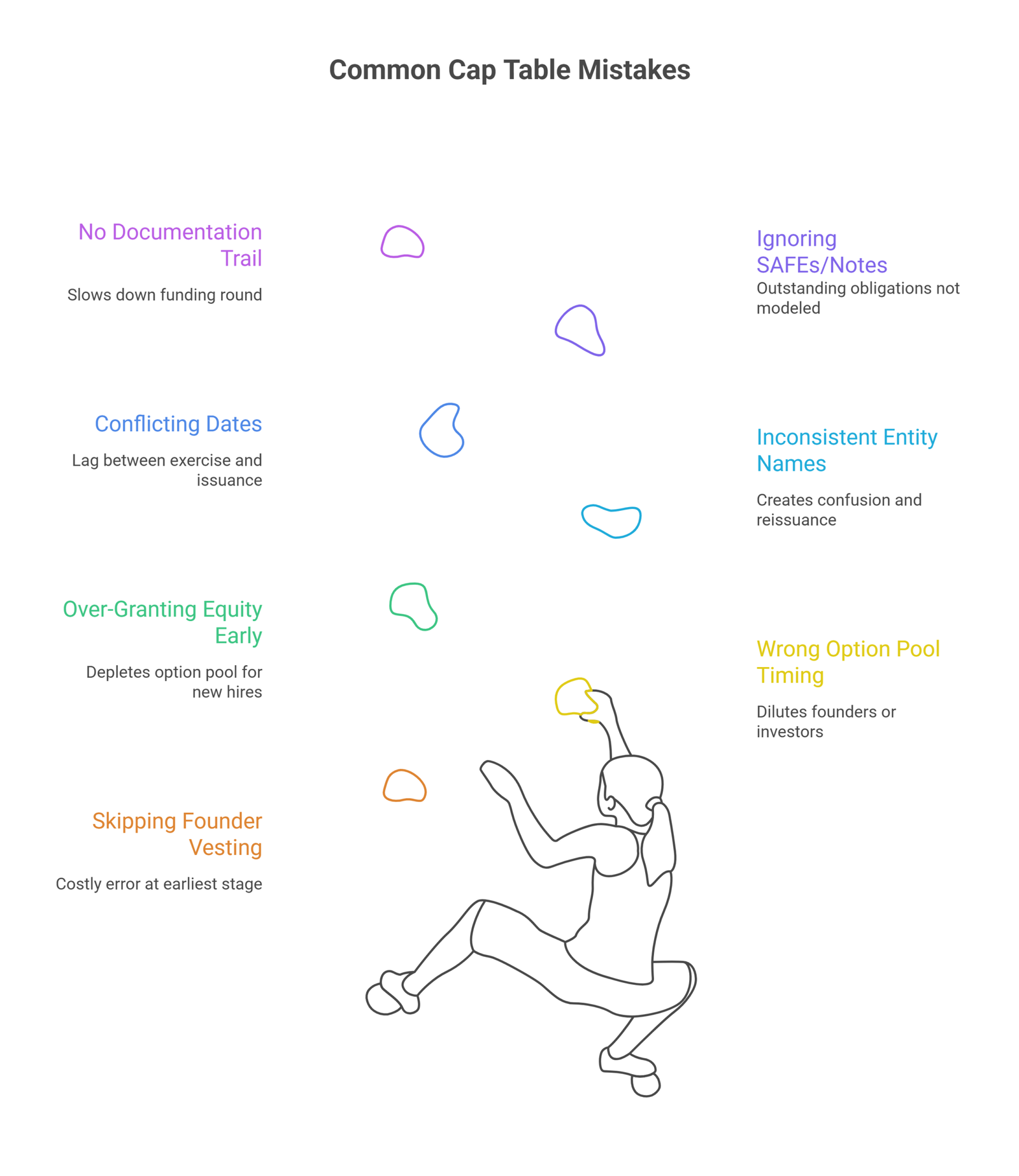
Skipping founder vesting. Covered above, and still one of the most common and costly errors at the earliest stage.
Creating the option pool at the wrong time. A pre-money pool dilutes founders only; a post-money pool spreads the dilution to new investors too. Know which one is on the table before you sign.
Over-granting equity early. It’s tempting to hand out generous percentages to the first few hires, but by Series A a depleted option pool with no room for new grants is a common and avoidable problem. Scale grants to the risk and stage of the hire, and treat advisor equity as a rare exception, not a default.
Inconsistent entity or shareholder names. The same investor entered as “XYZ Capital” in one place and “XYZ Capital LLC” in another creates confusion and, in the worst case, forces the cancellation and reissuance of stock certificates.
Conflicting dates between option exercises and certificate issuance. These should match exactly; a lag between them is one of the more common sources of cap table errors.
Treating SAFEs or convertible notes as if they don’t count yet. They’re outstanding obligations the moment they’re signed, not just at conversion, and need to be modeled into any dilution scenario from day one.
No documentation trail. Every grant, exercise, and departure needs a board resolution or signed agreement behind it. Missing paperwork is one of the fastest ways to slow down or derail a funding round during due diligence.
Frequently Asked Questions
What is a cap table in simple terms?
It’s the record of who owns what percentage of your company, across every founder, investor, and employee, and every type of security they hold, from common stock to unconverted SAFEs.
When should I create my first cap table?
The day you incorporate, even if it’s a single row showing a 50-50 split between two founders. A spreadsheet is fine to start.
Are SAFEs and convertible notes part of the cap table before they convert?
Yes. They’re outstanding obligations from the moment they’re signed and need to be included in any dilution modeling, even though they aren’t common or preferred stock yet.
What’s the difference between a pre-money and post-money option pool?
A pre-money pool is created before a funding round closes and dilutes only existing shareholders, mainly founders. A post-money pool is created after the round closes, so new investors share in that dilution too. Investors typically prefer pre-money pools.
What is a 409A valuation and why does it matter?
It’s an independent appraisal of your common stock’s fair market value, required to legally set the strike price on employee stock options. You need one at incorporation, after each funding round, and at least annually.
Who should have access to the full cap table?
Typically board members, the CFO or finance lead, legal counsel, and investors with information rights. Individual employees should be able to see their own equity clearly without necessarily seeing everyone else’s.
How much does founder ownership typically shrink after a few funding rounds?
It varies widely, but two founders starting at 50 percent combined might realistically be down to somewhere around 25 percent combined by a Series B, once an option pool, a seed round, and two priced rounds with pool refreshes are accounted for.
Conclusion
A cap table is not paperwork you deal with once and file away, it’s a living record that needs updating the same day anything changes, and it carries real legal weight around vesting, 409A compliance, and shareholder documentation. Getting the structure right from incorporation, vesting on founder shares, a clearly negotiated option pool, and every SAFE or note properly tracked, saves founders from the kind of cleanup that can stall or sink a funding round later.
If you’d rather have a professional build and maintain this alongside your broader financial model, Oak Business Consultant’s CFO services team can set up your cap table correctly from incorporation and keep it audit-ready through every funding round. You can also see how this fits into a broader financial plan for your startup, or get your pro forma balance sheet built alongside it.