Cash vs Profit: Why a Profitable Business Can Still Run Out of Money
Cash vs profit: what your P&L won’t tell you about your bank balance
A founder checks the profit and loss statement and sees a healthy number. Payroll is due in four days, and the bank balance says something different. This gap between what the books say and what the bank says is one of the most common reasons growing businesses get into trouble, and it has nothing to do with bad luck. It happens because profit and cash flow measure two different things, and a business can be strong on one while quietly failing on the other.
What profit actually measures
Profit is what is left after a business subtracts its costs from its revenue over a period of time. It answers a single question: did the business earn more than it spent? There are three commonly used versions of the number, and each strips out a different layer of cost.
| Profit type | Formula | What it shows |
| Gross profit | Revenue − Cost of Goods Sold | Whether the core product or service is priced sensibly |
| Operating profit | Gross profit − operating expenses | Whether day-to-day operations are efficient |
| Net profit | Operating profit − interest, tax, depreciation, amortization | What is left for owners after every obligation |
Most owners who say “we’re profitable” mean net profit, the bottom line on the income statement. The important detail is that this figure is built on accounting rules, not on money that has actually changed hands. A sale counts toward profit the moment it is recorded, whether or not the customer has paid yet, and non-cash charges like depreciation reduce profit without ever touching the bank account. Reading these numbers correctly matters more than most owners assume; our guide to financial analysis techniques covers the ratios worth tracking alongside the headline profit figure.
What cash flow actually measures
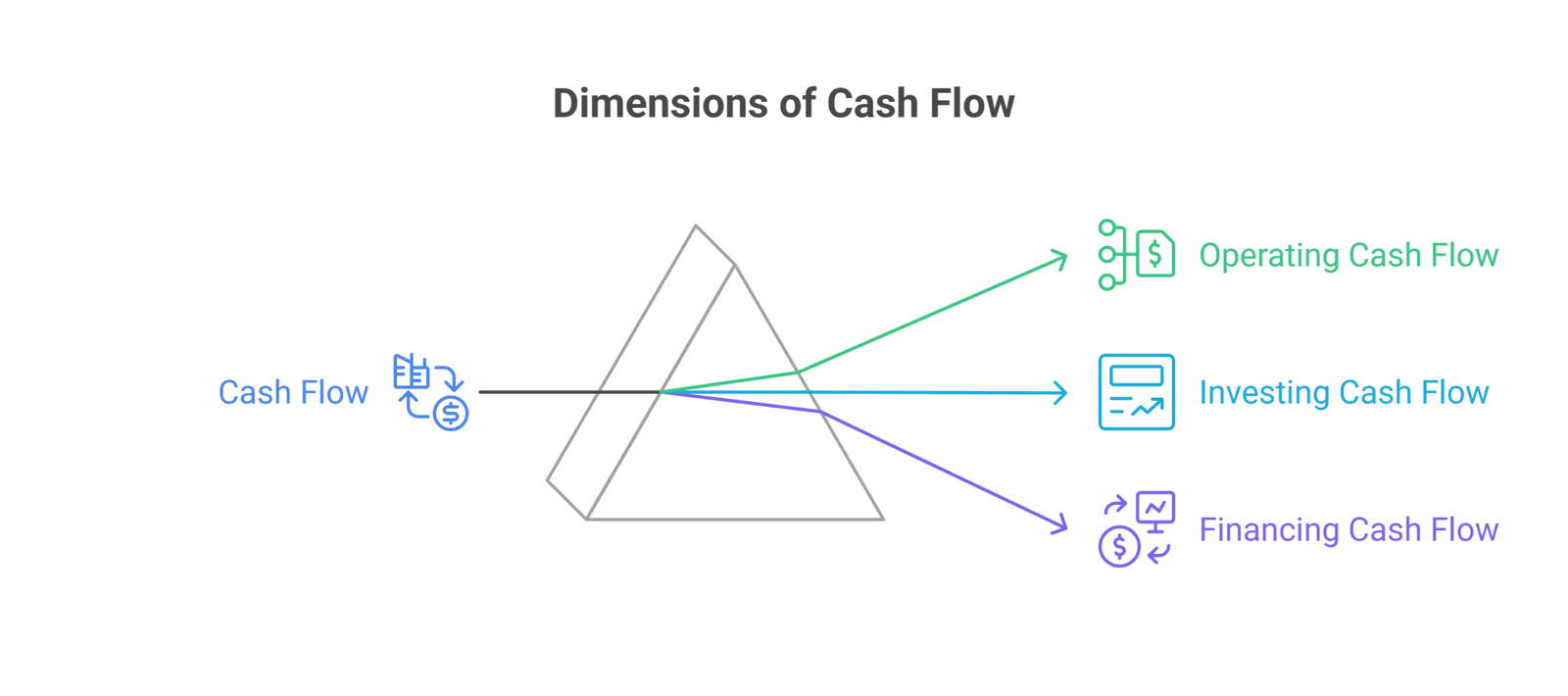
Cash flow is simpler in concept: it is the actual money moving in and out of the business bank account during a period. It ignores accounting adjustments entirely and only counts cash that has physically arrived or left. Analysts usually split it into three buckets:
- Operating cash flow – cash from day-to-day business activity: customer payments received, supplier and payroll payments made.
- Investing cash flow – cash spent on or recovered from long-term assets, such as buying equipment or selling a property.
- Financing cash flow – cash raised from or repaid to lenders and investors, including loan draws, loan repayments, and dividend payments.
A cash flow statement pulls all three together to show whether a business is building up cash or burning through it, which is a very different lens than the income statement provides.
Why the two numbers diverge
The gap between profit and cash comes down to two things: timing and accounting method.
Timing. Most businesses invoice customers with terms like net-30 or net-60 rather than collecting payment on the spot. A sale is booked as profit the day it happens, but it doesn’t become cash until the invoice is actually paid, sometimes months later. The same lag applies to expenses: a bill incurred this month may not be paid until next month, so it hits profit before it hits cash.
Accounting method. Businesses that use accrual accounting record revenue when it is earned and expenses when they are billed, regardless of when money moves. Businesses using cash accounting only record a transaction when cash actually changes hands. Most growing companies use accrual accounting for tax and reporting purposes, which is exactly why their profit and cash positions can tell two different stories in the same month.
Non-cash items add a third layer. Depreciation, amortization, stock-based compensation, and impairment losses all reduce reported profit without moving a single dollar out of the bank. Getting this split right in the books is largely a bookkeeping problem before it’s a strategy problem, which is where clean accounting and bookkeeping work pays for itself.
A worked example
Say a business makes a $20,000 sale on 15-day credit terms. The moment the invoice is issued, revenue and profit both rise by $20,000. That same month, the business has to cover $5,000 in rent, utilities, and salaries, paid in cash immediately. On paper, the income statement shows a $15,000 profit.
But the customer hasn’t paid yet. If the business doesn’t have $5,000 in reserve to cover those bills while it waits on the invoice, it is looking at a real cash shortfall despite a genuinely profitable month. This is the exact mechanism behind “profitable but broke”: the profit is real, but it isn’t liquid yet.
Can you be profitable and cash-flow negative, or the reverse?
Both situations are common, and neither one is a contradiction.
A business can be profitable and cash-flow negative when revenue is booked faster than it’s collected, when it is investing heavily in inventory or equipment, or when it is paying down debt principal, which reduces cash but never touches the profit calculation.
A business can also be cash-flow positive and unprofitable. This happens when a company sells assets, draws on a credit line, or brings in investor capital to keep cash flowing in, even while its underlying operations are losing money. The cash position looks fine right up until the financing runs out.
Neither number alone tells the full story. Cash flow shows whether a business can meet its obligations right now; profit shows whether the underlying model actually works over time.
The fast-growth trap
Rapid growth is usually treated as unambiguously good news, but it is one of the fastest ways to turn a profitable business into a cash-starved one. As orders increase, a company often has to pay its suppliers or manufacturers up front to produce more inventory, while its own customers, especially retailers buying on credit, don’t pay until they’ve resold the product. Nike went through exactly this cycle multiple times in its early years: booming sales, real profit on paper, and a business that was perpetually close to running out of cash because manufacturing had to be funded before retailers settled their accounts. Popularity was never the problem. The mismatch between when cash went out and when it came back in was.
Keeping cash and profit aligned
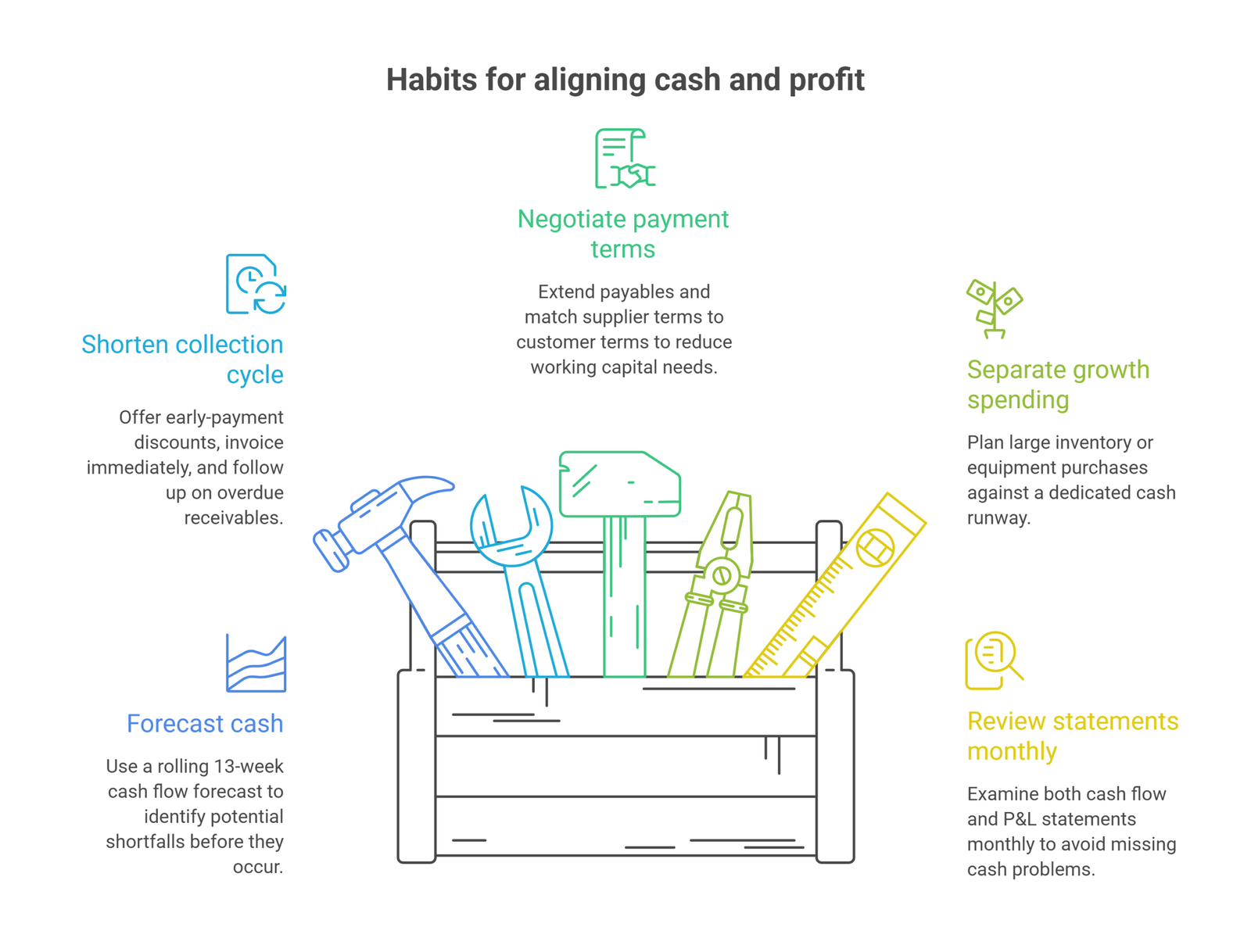
A few practical habits keep the gap between the two numbers from turning into a crisis:
- Forecast cash, not just profit. A rolling 13-week cash flow forecast shows exactly when money is expected in and out, so shortfalls are visible weeks before they happen rather than the day payroll is due. Our breakdown of FP&A tools covers what to build that forecast in.
- Shorten the collection cycle. Offering a small early-payment discount, invoicing immediately rather than at month-end, and following up on overdue receivables all pull cash forward.
- Negotiate payment terms on both sides. Extending payables where reasonable and matching supplier terms to customer terms reduces how much working capital the business has to fund itself.
- Separate growth spending from operating cash. Large inventory or equipment purchases tied to growth should be planned against a dedicated cash runway, not assumed to be covered by “the business is profitable.” A financial model that projects profit and cash side by side makes this gap visible before it becomes a shortfall.
- Review both statements monthly, not just the P&L. A business that only checks its income statement will miss a cash problem until it’s already overdue.
Cash flow vs profit at a glance
| Cash flow | Profit | |
| Measures | Actual money moving in and out of the bank | Revenue minus costs over a period |
| Timing | Recorded when cash is received or paid | Recorded when a sale or expense occurs |
| Includes | Loans, asset sales, investor capital | Only sales and operating costs |
| Shown on | Cash flow statement | Income statement (P&L) |
| Tells you | Whether bills can be paid right now | Whether the business model works |
Frequently Asked Questions
Is cash flow the same as profit?
No. Cash flow tracks actual money moving through the business bank account, while profit is an accounting measure of revenue minus expenses over a period. A business can show either number moving in a different direction from the other in the same month.
Why would a profitable company run out of cash?
Usually because revenue is tied up in unpaid customer invoices, because it’s investing heavily in inventory or growth, or because non-cash accounting charges make profit look larger than the actual cash available.
Which matters more, cash flow or profit?
Both matter, for different horizons. Cash flow determines whether a business can pay its bills this week or month. Profit determines whether the business model is sound over the long run. A business needs to monitor both, not choose one over the other.
What’s the fastest way to check if a business has a cash flow problem?
Compare net profit for a period against the change in the bank balance over the same period. A large, persistent gap between the two is the clearest early sign that cash is not keeping pace with profit.
Does fast growth always create cash flow problems?
Not always, but it frequently does when a business has to pay suppliers before it collects from customers. The faster a company grows under those terms, the more working capital it needs to fund the gap.
Build a cash position that matches your profit
Profit proves the business model works. Cash keeps the business open while that model plays out. Businesses that track both, with a rolling cash flow forecast built alongside their financial model, catch shortfalls months before they become a crisis instead of days before payroll. Oak Business Consultant’s fractional CFO services help growing companies build that forecast and read it correctly, before the gap between profit and cash turns into a payroll problem.