Financial Model Template for Startups
Startup financial model: the template investors actually trust
Most first-time founders build a financial model to satisfy an investor’s request, then never open the file again. That is backwards. A financial model earns its keep long before a pitch meeting: it is the tool that tells you whether you can afford the next hire, how many months of runway a slower sales quarter would cost you, and whether the business survives on its own revenue if funding takes longer than expected.
This guide covers what a startup financial model actually needs to include, how to forecast revenue and costs without guessing, and where founders most often get the numbers wrong.
Why startups need a financial model
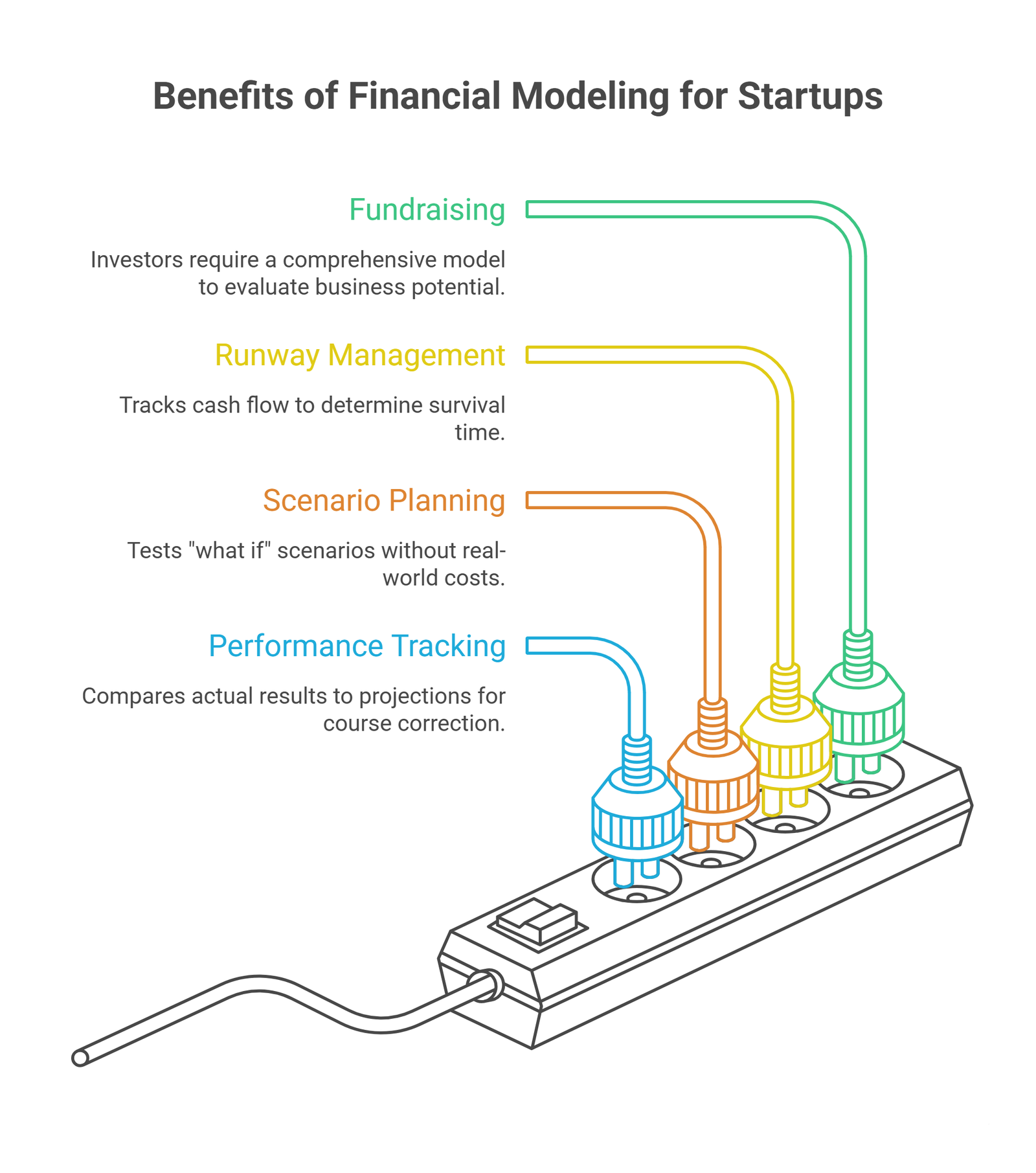
Fundraising. Investors expect three statements, not a single revenue chart. A model that shows how revenue, costs, and cash move together over 24-36 months is what lets an investor evaluate the business instead of taking your growth story on faith.
Runway and cash discipline. Cash flow, not profit, is what kills startups. A model that tracks monthly cash in and cash out tells you exactly how many months you have before the account hits zero, which is the single most important number in an early-stage business.
Scenario planning. A model lets you test “what if” before it costs real money: what happens to runway if a hire is delayed two months, or if churn rises from 3% to 6%. Testing this in a spreadsheet is free. Testing it by living through it is not.
Performance tracking. Once built, the model becomes a benchmark. Comparing actual monthly results against projections shows where the business is ahead of plan or falling behind, early enough to correct course.
The three statements a model is built on
Every startup financial model rests on three linked statements.
Income statement (P&L). Revenue, cost of goods sold, gross profit, operating expenses, and net income over a period. This is where you see whether the business model actually produces a profit at scale, separate from cash timing.
Balance sheet. A snapshot of assets, liabilities, and equity at a point in time, built on Assets = Liabilities + Equity. It shows what the company owns, owes, and is worth on paper, and is what lenders and later-stage investors check for solvency.
Cash flow statement. Splits cash movement into operating, investing, and financing activities. This is the statement that actually keeps a startup alive, since a business can be profitable on paper and still run out of cash if customers pay slowly or expenses land before revenue does.
A model only becomes useful once these three statements are linked, so a change in one assumption, like a slower sales month, flows through to cash on hand automatically instead of requiring a manual rebuild.
Before you build: gather real inputs, not placeholders
A model is only as good as what feeds it. Before opening a spreadsheet, pull together:
- Historical financials, if the business has any trading history
- Industry benchmarks for your specific business model (SaaS, e-commerce, services), since a generic template will misrepresent your cost structure
- Market sizing: total addressable market (TAM), serviceable available market (SAM), and serviceable obtainable market (SOM), to set revenue targets that are ambitious but not fictional
- A clear definition of your revenue streams, since a subscription business, a marketplace, and a one-time-sale business need entirely different revenue logic in the model
Skipping this step and jumping straight to formulas is the most common reason founder-built models fall apart under investor questions: the structure looks right, but the assumptions underneath were never checked against anything real.
Revenue forecasting: top-down vs. bottom-up
Top-down forecasting starts from total market size and estimates what share of it the business can realistically capture. It is fast, but investors are skeptical of it in isolation, since “we only need 1% of a $10B market” says nothing about how that 1% gets acquired.
Bottom-up forecasting starts from what you can actually observe: current conversion rates, sales capacity, or existing customer data, and builds revenue up from there. This is the version investors trust, because it ties back to real operating numbers.
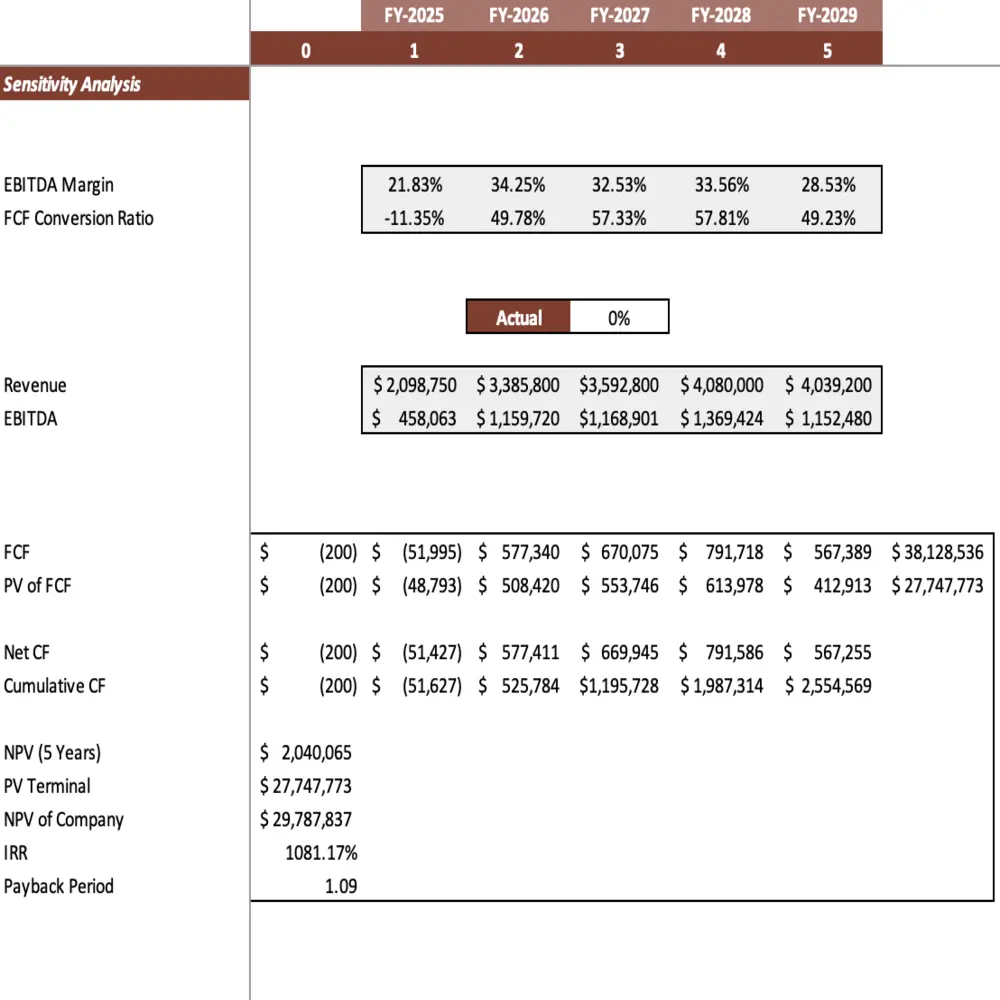
Worked example: a SaaS startup with 12 customers paying $2,500/month has $30,000 in current MRR. If the model assumes 3 new customers a month at the same price point with 3% monthly churn, that single assumption set is enough to project MRR twelve months out, and every number in it can be checked against what is actually happening in the business today.
Build the top-down number as a sanity check, and the bottom-up number as the actual forecast.
Costs, burn rate, and runway
Separate every cost into two categories:
Fixed costs stay constant regardless of activity: rent, salaries, insurance, core software subscriptions.
Variable costs scale with revenue or usage: payment processing fees, cloud hosting tied to usage, commission-based sales costs, shipping.
From these two categories, two numbers matter more than almost anything else in an early-stage model:
Net burn rate = Total cash outflow – Total cash inflow, per month.
Runway = Cash balance ÷ Monthly net burn.
A startup with $300,000 in the bank and $25,000 in monthly net burn has 12 months of runway. Delaying a single planned hire by two months, or cutting one underused software subscription, changes that runway number immediately and visibly, which is exactly why the model needs to be live and editable rather than a static one-time projection.
Break-even analysis
Moreover, Break-even revenue tells you the point at which the business covers its own costs without external funding.
Break-even revenue = Fixed Costs ÷ Gross Margin %
Example: fixed costs of $30,000/month and a 60% gross margin mean the business needs $50,000 in monthly revenue to break even ($30,000 ÷ 0.60). Everything above that line is what funds growth, buffer, or profit. This single number gives founders a concrete target to check hiring and marketing spend against, instead of growing based on optimism alone.
Capital expenditures and financing
If the business needs physical equipment, technology infrastructure, or property, plan for it explicitly in the model as CapEx, not buried inside operating expenses. Depreciation, whether straight-line or declining balance, then flows into the income statement as an expense and into the balance sheet as a reduction in asset value over time.
Financing options each affect the model differently:
- Equity financing dilutes ownership but adds no repayment obligation. Model the post-raise cap table alongside the financials.
- Debt financing requires modeling interest expense and a repayment schedule against cash flow.
- Leasing spreads CapEx over time instead of requiring it upfront, which is often the better choice for early-stage cash preservation.
- Grants don’t require repayment but often come with reporting conditions that should be reflected in how the funds are budgeted.
Scenario and sensitivity analysis
Build three versions of the model, not one:
| Scenario | Assumption | What it tells you |
| Best case | Revenue grows faster than plan, costs stay controlled | Upside if execution goes well |
| Base case | Revenue and costs track current trends | The plan you actually operate against |
| Worst case | Sales slow, costs hold steady or rise | Minimum runway and where to cut first |
Then run sensitivity analysis on the two or three variables that move the model most, typically churn rate, customer acquisition cost, and sales cycle length. Change one variable at a time and watch what happens to cash balance and net income. This is what tells you whether the business is fragile in one specific area or genuinely resilient across a range of outcomes.
SaaS and recurring-revenue metrics to build in
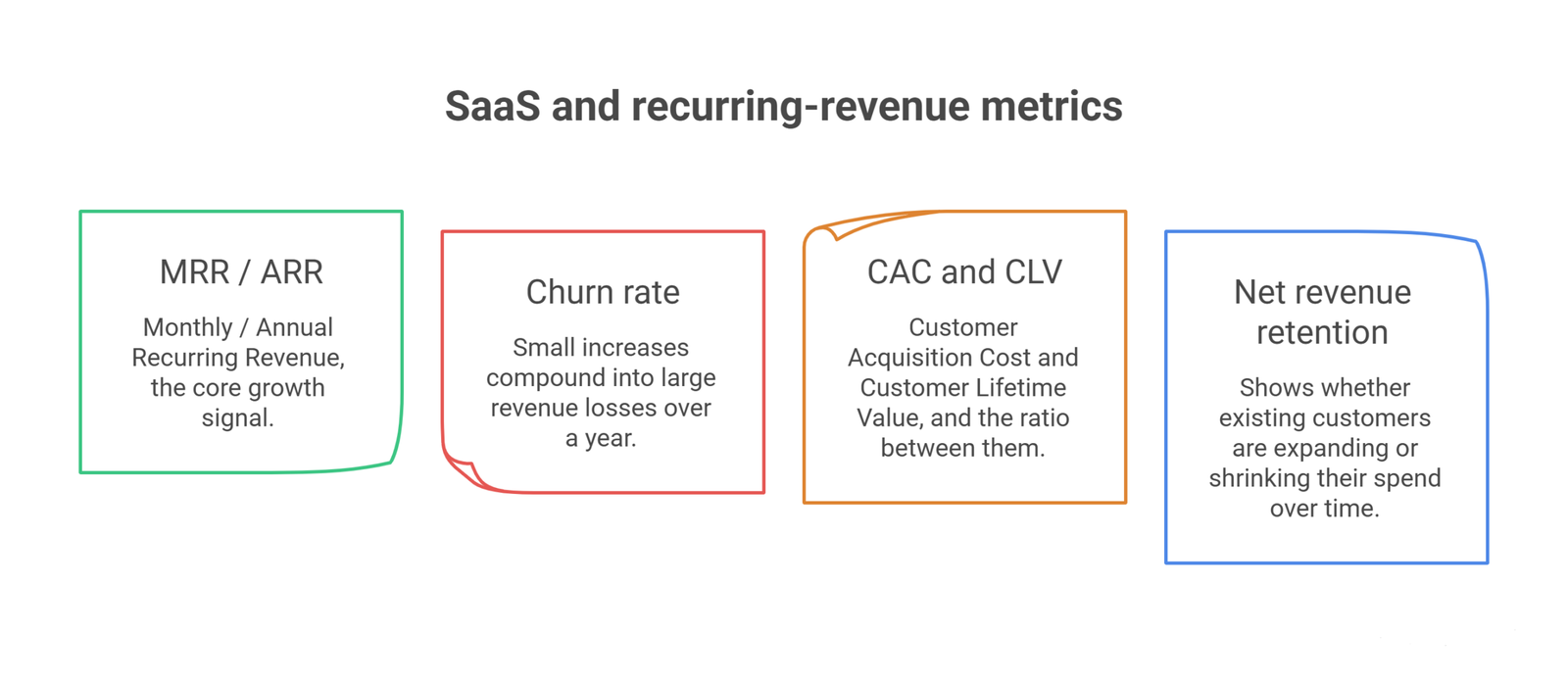
A generic three-statement model understates what actually drives a subscription business. If the startup runs on recurring revenue, the model needs to track:
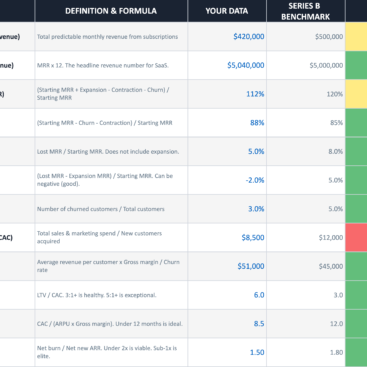
- MRR / ARR (Monthly / Annual Recurring Revenue), the core growth signal
- Churn rate, since even small increases compound into large revenue losses over a year
- CAC (Customer Acquisition Cost) and CLV (Customer Lifetime Value), and the ratio between them, which is the clearest signal of whether growth spend is sustainable. If this ratio isn’t already part of your reporting, it’s worth reviewing how CAC and CLV work together before finalizing revenue assumptions.
- Net revenue retention (NRR), which shows whether existing customers are expanding or shrinking their spend over time, independent of new sales
Leaving these out of the model doesn’t just weaken an investor pitch. It means the founder is running the business without visibility into the metrics that actually predict whether growth is sustainable or just expensive.
Valuation methods a startup model should support
- Discounted cash flow (DCF): projects future cash flows and discounts them to present value. Requires a complete three-statement model to produce credible inputs.
- Comparables (“comps”): values the company relative to similar businesses using revenue or growth multiples. Useful as a sanity check against DCF output.
- Cost-to-duplicate: estimates what it would cost to rebuild the company’s assets and technology from scratch. Most relevant pre-revenue, when DCF has little to work with.
None of these methods work well on a model that hasn’t been stress-tested first. A valuation built on unrealistic revenue assumptions produces a confident-looking number that falls apart in due diligence.
Common mistakes that undermine a founder-built model
- Overcomplicating the structure. A model with dozens of interlinked tabs that only the builder understands becomes unusable the moment someone else needs to update it.
- Underestimating expenses, particularly ones that are easy to forget until they show up: customer acquisition cost, payment processing fees, and contractor costs during scaling.
- Ignoring competitive and market reality. Revenue projections built without checking market size or competitor pricing tend to be optimistic in a way investors notice immediately.
- No contingency built in. A model with no buffer for a slower quarter or a delayed close isn’t a forecast, it’s a best-case scenario wearing a forecast’s clothes.
- Never updating it. A model built once for a pitch deck and never touched again stops being useful within a quarter, since assumptions about churn, pricing, and cost all shift as the business actually operates.
Frequently Asked Questions
What should a startup financial model include at minimum?
A linked three-statement model (income statement, balance sheet, cash flow statement), revenue assumptions built bottom-up where possible, a cost breakdown separating fixed from variable expenses, and a runway calculation.
How far out should a startup model project?
Most investors expect 3 years, with the first 12 months modeled monthly and years 2-3 modeled quarterly or annually. Monthly detail in year one is what makes the runway and burn numbers meaningful.
Who should build the financial model, the founder or an outside expert?
Early on, many founders build the first version themselves or with a fractional CFO. As the model needs to support fundraising or board reporting, bringing in someone with startup financial modeling experience typically produces a model investors trust faster and catches assumption errors a founder might miss.
What is the difference between a bootstrapped model and a funded startup model?
A bootstrapped model is built around what the business can sustain from its own revenue, with growth paced to cash generated internally. A funded model plans around a capital raise and can tolerate a longer runway to profitability, but still needs the same discipline around burn and break-even to avoid running out of cash between rounds.
How often should the model be updated?
Monthly, at minimum, comparing actuals against projections. Waiting until a board meeting or the next fundraise to update the model means the numbers being presented are already stale.
Conclusion
A financial model is only valuable if the assumptions behind it hold up under real scrutiny, whether that scrutiny comes from an investor, a lender, or the founder’s own decision-making six months from now. Getting the structure right the first time, with real inputs and a clear separation between fixed and variable costs, revenue drivers, and financing assumptions, saves far more time than rebuilding a flawed model after the fact.
Our startup financial modeling services build investor-ready three-statement models from the ground up, and our CFO services for startups keep the model current as the business grows. If you’re preparing for a raise, our investor-ready business plan and business valuation services build directly on the model to get you fundraise-ready. And if you’re weighing whether it’s time to bring in financial leadership rather than manage this yourself, here’s how to know when a startup should hire a CFO.