How UAE SMEs Can Access Sustainability-Linked Loans
Sustainability-linked loans: a practical guide for SMEs
Search “sustainability-linked loan” and you’ll find Philips, Danone, and Heineken. Billion-euro facilities, dedicated ESG teams, and third-party verifiers on retainer. None of it looks like anything a 40-person UAE company could use, so most SME owners skip the topic entirely.
That’s a mistake, and not for the reason most sustainability content gives. It isn’t really about wanting a green reputation. It’s that the UAE’s Federal Climate Law now requires most businesses to start measuring and reporting their emissions anyway, on a legal deadline, regardless of whether they ever apply for financing. Once that data exists, it can also unlock better loan pricing. This article explains what a sustainability-linked loan actually is, how one gets sized for a smaller business, which UAE lenders will talk to an SME about one, and what to have ready before that conversation.
What a sustainability-linked loan actually is
A sustainability-linked loan, or SLL, is an ordinary business loan with one added feature: the interest rate moves depending on whether the company hits agreed sustainability targets. Hit the targets, and the margin usually drops a little. Miss them, and it usually rises. The money itself isn’t restricted. It can fund payroll, equipment, expansion, or working capital, the same as any other facility.
That’s the key difference from a green loan. A green loan requires the funds to go toward a specific environmental project, a solar retrofit or an EV fleet, for example. An SLL doesn’t care what the money is spent on. It only cares whether the company’s overall sustainability performance improves against a small set of agreed metrics.
| Feature | Sustainability-linked loan | Green loan | Standard business loan |
| Use of funds | Unrestricted, general purpose | Restricted to a defined green project | Unrestricted |
| Pricing | Tied to sustainability targets | Fixed, standard pricing | Fixed, standard pricing |
| Reporting required | Yes, annual KPI reporting | Yes, project-specific reporting | No |
| Best fit for | Businesses without a single green project, but with a credible sustainability plan | Businesses with one clear environmental project to finance | Businesses with no sustainability angle to offer |
Why this suddenly matters more for UAE SMEs
Federal Decree-Law No. 11 of 2024, the UAE’s Climate Change Law, took effect in May 2025 and set a full compliance deadline of 30 May 2026. It requires in-scope businesses, mainland and free zone, to measure their Scope 1 and 2 greenhouse gas emissions, register on the national MRV platform, and submit a reduction plan. Large emitters had an earlier registration deadline in mid-2025; everyone else has until the 2026 date. The law applies broadly, with no blanket exemption by company size, though in practice obligations only kick in once an entity is formally designated a “Source” by the Ministry of Climate Change and Environment or the relevant emirate authority.
Whether or not your business has been designated yet, the direction is clear: emissions measurement in the UAE is moving from a voluntary ESG talking point to a legal filing requirement. That changes the math on an SLL. Building an emissions baseline and a reduction plan used to be extra work a small business took on purely to look good to lenders or clients. Now it’s increasingly work the business has to do regardless. An SLL is one of the few financing tools that pays you back, in the form of a lower margin, for doing something you may soon be legally required to do anyway.
How an SLL gets structured for a smaller business
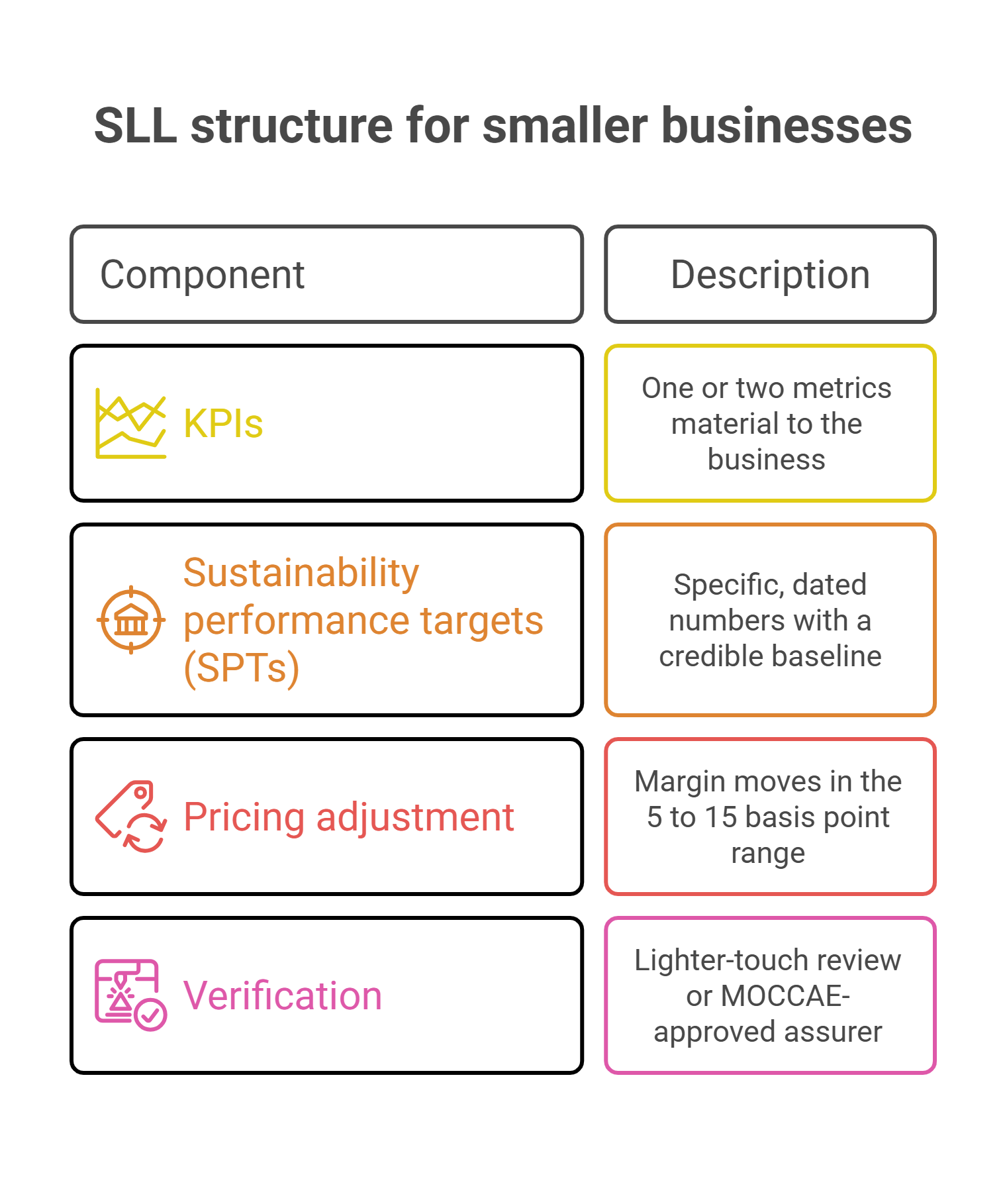
The mechanics are the same regardless of company size, just scaled down:
- KPIs. A large corporate SLL might track five or six metrics across emissions, water, diversity, and supply chain. An SME facility typically works better with one or two, chosen because they’re genuinely material to the business and because the company can actually measure them without hiring a data team. A logistics SME might track fuel efficiency per delivery. A manufacturer might track energy use per unit produced.
- Sustainability performance targets (SPTs). These are the specific, dated numbers attached to each KPI, for example a 15% reduction in energy intensity over three years. They need a credible baseline, which is exactly what emissions measurement under the Climate Change Law will already produce.
- Pricing adjustment. Margin moves are usually small, commonly in the 5 to 15 basis point range on the kind of facility size an SME would take out. It’s a modest incentive, not a dramatic one, and shouldn’t be the sole reason to pursue one.
- Verification. Larger SLLs use full third-party assurance annually. For a smaller facility, some UAE lenders accept a lighter-touch review, or verification tied to the same MOCCAE-approved assurer a business is already using for its climate law reporting, rather than a separate ESG audit process.
Which UAE lenders actually work with SMEs on this
Sustainable finance in the UAE is dominated by large corporate and sovereign deals, but the SME lending environment is broader than it looks:
- First Abu Dhabi Bank, Emirates NBD, Abu Dhabi Commercial Bank, and Mashreq all run dedicated sustainable finance desks and offer SLLs and green facilities, though most of their publicised deals are corporate-scale. It’s still worth approaching them directly. A relationship manager can size a facility down to SME terms even if the headline press releases are all nine-figure sums.
- Emirates Development Bank runs a credit guarantee scheme that covers up to 50% of an SME facility issued through partner banks, with limits up to AED 5 million for larger SMEs and AED 500,000 for smaller ones. It isn’t an SLL product on its own, but it lowers the collateral bar for a business trying to access any structured facility, including a sustainability-linked one.
- Digital and challenger lenders such as Wio Business and RAKBank’s SME banking arm move faster than traditional banks on standard facilities, generally 7 to 21 working days for approval, and are increasingly building ESG-linked options into their SME products as demand grows.
Steps to actually secure one
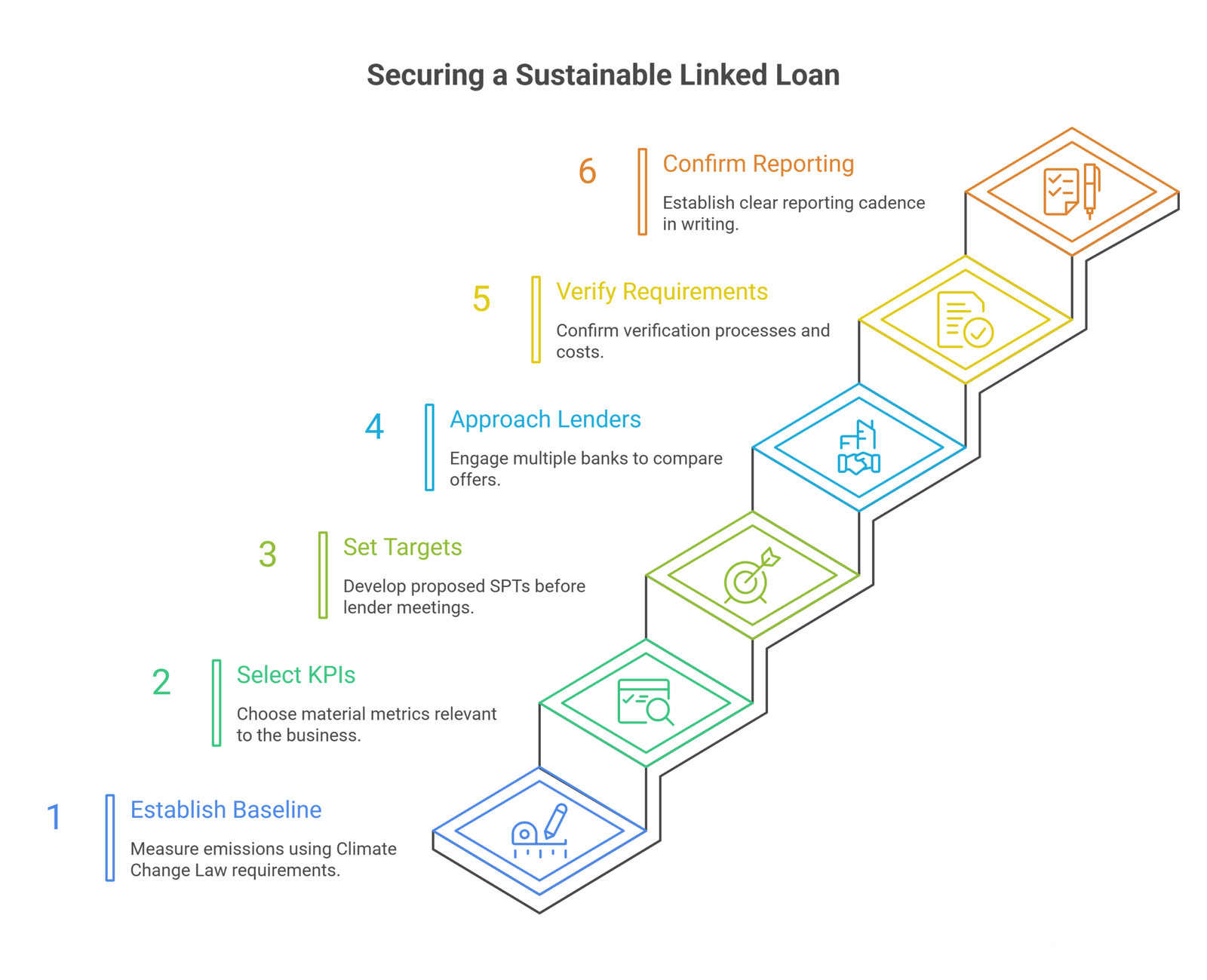
- Start the emissions baseline you likely need anyway. Use the Climate Change Law’s Scope 1 and 2 measurement requirement as the starting point, not a separate exercise. Register on MOCCAE’s national MRV platform if your business has been designated a Source, or build the same data internally if it hasn’t been yet.
- Pick one or two KPIs that are actually material to the business. Resist the pull toward a long list. A single credible metric with a real baseline beats five vague ones a lender’s credit team will pick apart.
- Set targets before the meeting, not during it. Come in with a proposed SPT and the reasoning behind it. Lenders respond better to a business that’s done its own thinking than one asking to be told what to target.
- Approach two or three lenders in parallel. Pricing and KPI flexibility both vary bank to bank. A relationship you already have is a reasonable starting point, but it’s worth a second conversation elsewhere before committing.
- Ask about verification requirements upfront. Find out whether the lender accepts your existing MOCCAE-approved verifier or requires a separate ESG assurance provider. This is often where the real cost of an SLL sits, more than the loan terms themselves.
- Confirm the reporting cadence in writing. Know exactly what you’ll submit, how often, and what happens mechanically if a target is missed, before signing anything.
Where SMEs run into trouble
Two mistakes come up repeatedly. The first is picking KPIs that are easy rather than material, a target so soft it wouldn’t require any real change in the business. Lenders and external reviewers increasingly screen for this, and a weak target can do more reputational damage than not having an SLL at all. The second is underestimating verification cost. For a small facility, the margin saving from hitting a target can be smaller than the cost of the annual verification needed to prove it. Run that math before committing, not after.
Frequently Asked Questions
Is a sustainability-linked loan the same as a green loan?
No. A green loan restricts how the funds are spent, to a specific environmental project. An SLL doesn’t restrict use of funds at all. Instead, the interest rate is tied to whether the company hits agreed sustainability targets.
Do I need a formal ESG strategy to qualify?
No. What matters more is one or two credible, measurable targets with a real baseline. A business already collecting emissions data for UAE Climate Change Law compliance has most of what a lender will ask for.
How much can an SLL actually save an SME?
Margin adjustments on SME-sized facilities typically run 5 to 15 basis points. On a modest facility, that’s a real but not transformative saving. The main value for most SMEs is the financing relationship and reporting discipline it builds, not the discount itself.
What happens if my business misses its sustainability target?
Typically the margin steps up rather than the loan going into default. The exact mechanism is set out in the loan documentation, so confirm it before signing.
Does my business have to be registered on the UAE’s MRV platform before applying for an SLL?
Not necessarily, but having emissions data ready, whether or not formal registration has happened yet, makes the KPI and baseline conversation with a lender far faster.
Can a startup or early-stage company get a sustainability-linked loan?
It’s harder without an operating history to set a credible baseline from. Most UAE lenders will want at least a year or two of data before agreeing to performance-linked pricing. A standard SME facility, potentially through an EDB-guaranteed scheme, is usually the more realistic starting point.
How Oak Business Consultant can help
Getting ready for a sustainability-linked loan and getting ready for the UAE’s climate reporting deadline turn out to be nearly the same task: clean data, a credible baseline, and a realistic plan attached to it. If your business hasn’t mapped out what the Climate Change Law compliance deadline actually requires of it yet, that’s the place to start, since it’s the foundation an SLL application would need anyway.
Not sure whether your business is ready to have that conversation with a lender? Get in touch and we’ll walk through what data you already have and what’s still missing.