Business Plan Basics: What Investors Actually Read Before They Say Yes
Before They Say Yes: What Investors Really Look For in a Business Plan
Most founders treat a business plan like a formality: a document you write once, attach to a funding application, and never open again. That habit is exactly why so many plans fail to do their job. A business plan isn’t paperwork. It’s the tool that forces you to answer the questions an investor, a lender, or your own future self will eventually ask anyway.
Research on this is consistent. Studies covering more than 11,000 companies found that businesses which plan formally grow roughly 30% faster than those that don’t, and founders who write a plan are far more likely to actually launch their business than founders who skip the step. The value isn’t in the document sitting in a drawer. It’s in the thinking the process forces you to do.
This guide walks through what a basic business plan needs, in the order investors and lenders expect to see it, along with the mistakes that most often sink an otherwise solid idea.
What a business plan actually does for your business
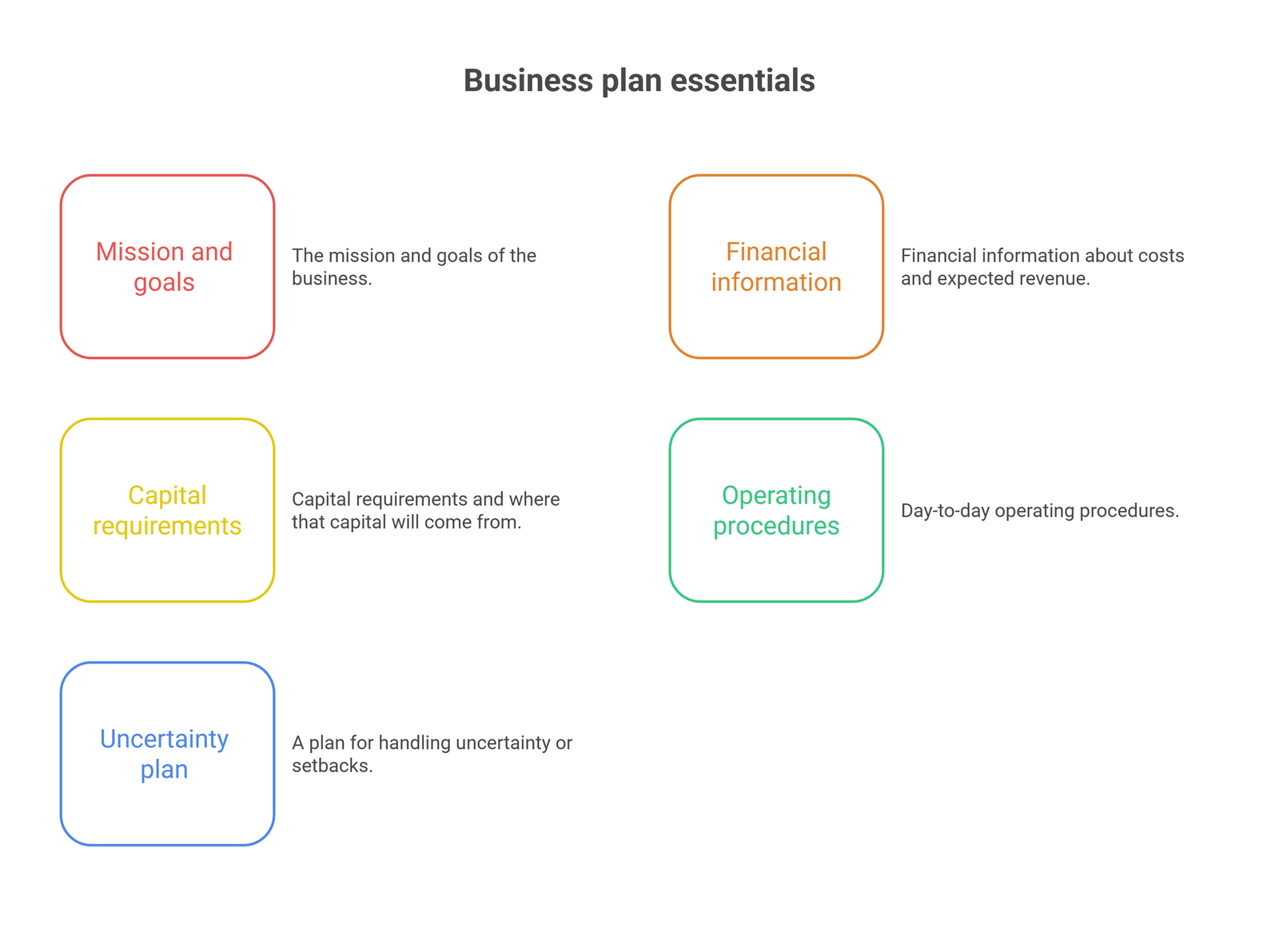
A business plan incorporates the essentials of how your company will run and grow:
- The mission and goals of the business
- Financial information about costs and expected revenue
- Capital requirements and where that capital will come from
- Day-to-day operating procedures
- A plan for handling uncertainty or setbacks
A plan can be a single page or a fifty-page document. What matters is that it makes you more focused and more prepared, and gives outside readers a clear picture of how you think.
Beyond fundraising, a plan works as an internal management tool. Once it exists, you can compare actual results to what you projected, spot problems early, and adjust before small issues become expensive ones. If you’d rather not build one from scratch, Oak’s business plan service covers this end to end.
Traditional plan or lean plan: pick the format that fits
Not every business needs the same kind of plan.
A traditional business plan is the detailed, multi-section document that banks and investors typically request. It runs anywhere from 10 to 50 pages depending on complexity, and it’s the right choice if you’re seeking a loan, courting investors, or want a comprehensive reference document.
A lean or one-page plan strips the same categories down to bullet points and short statements. It’s faster to write, easier to update, and better suited to founders who are still testing an idea or who mainly need an internal roadmap rather than an investor-ready package. Highly innovative startups often do better with a shorter plan precisely because their strategy keeps changing, and a simple plan is one they’ll actually keep updating.
Neither format is more “correct.” The right one is whichever you and your readers will actually use.
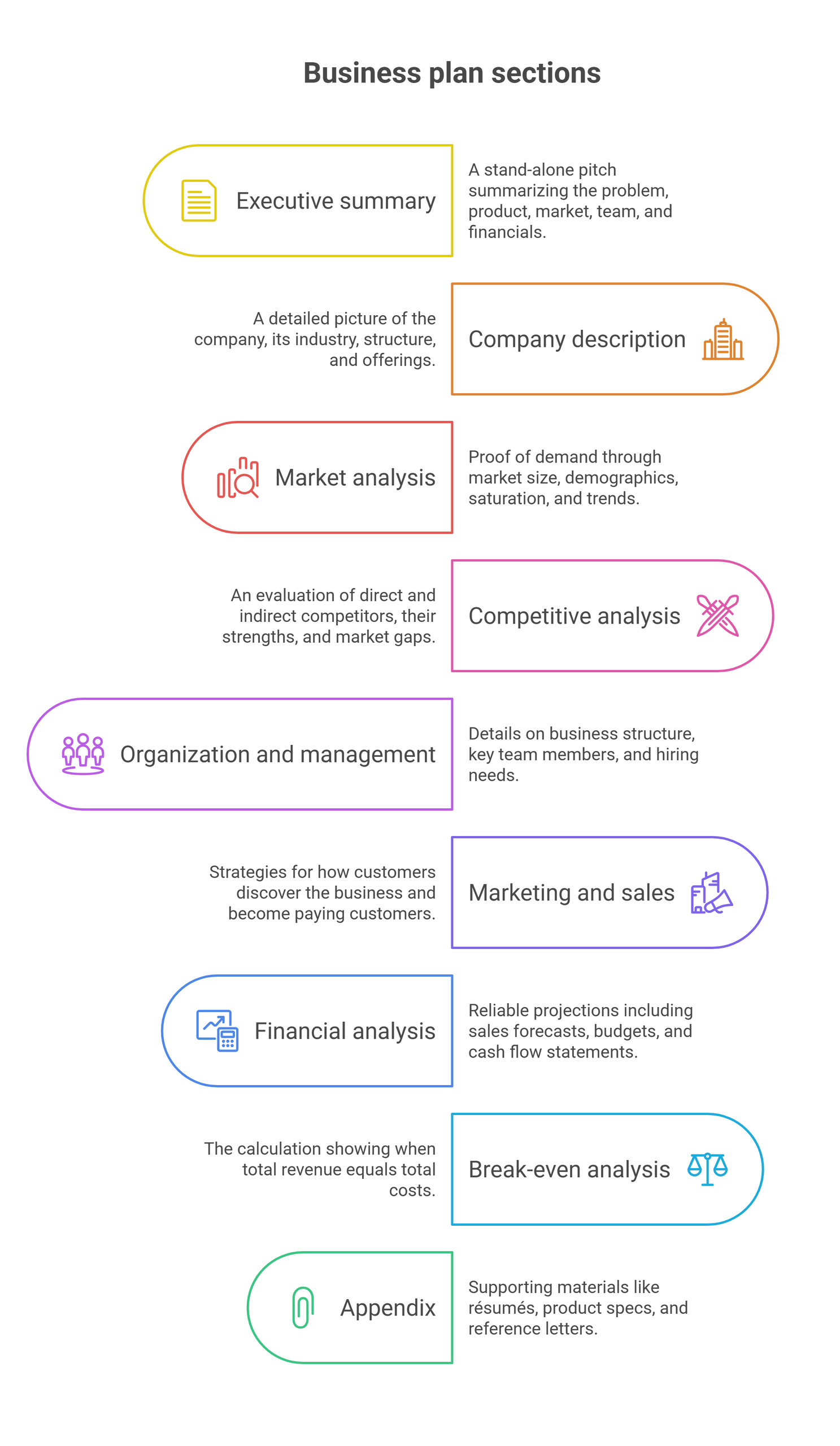
Executive summary: the one page that gets read first
The executive summary sits at the front of the plan but is usually written last, since it summarizes everything else. It’s often the only section an investor reads before deciding whether to request the full document, so treat it as a stand-alone pitch.
A strong executive summary includes:
- The problem you’re solving and for whom
- Your product or service, in plain language
- An overview of your target market
- A short description of your team
- A summary of your financials and, if relevant, how much funding you need
Keep it to one or two pages. If this section feels like the hardest part to get right, Oak’s investor-ready executive summary service builds it around the rest of your plan rather than in isolation.
Company description: showing readers who you are
Right after the summary comes a detailed picture of the company itself. This section should answer the questions readers are quietly asking:
- What do you do, and how do you do it?
- What industry do you serve, and who are your competitors?
- What makes your approach different?
- What’s your legal structure, and who are your key people?
This is also where you list the products or services you offer, along with pricing strategy and expected production or delivery volume. Be specific. Vague descriptions read as unfinished thinking.
Market analysis: proving the demand exists
A business only survives if there’s real demand for what it sells, and this section is where you prove it. A useful market analysis covers:
- Demand and market size. How many potential customers exist, and is that number growing or shrinking?
- Demographics and behavior. Age, income, location, and buying habits of your target customer.
- Market saturation. How many similar options are already available, and at what price?
- Industry and economic trends that could affect demand over the next few years.
A common trap is describing the market as “everyone.” A bakery isn’t selling to everyone with an appetite; it’s selling to a specific set of people in a specific area with specific habits. Narrowing your market makes the rest of the plan sharper, not smaller.
One helpful framework for sizing the opportunity:
| Term | What it measures | Example |
| TAM (Total Addressable Market) | Everyone who could theoretically use what you sell | All small businesses in Pakistan |
| SAM (Serviceable Addressable Market) | The slice you can realistically reach given your model | SMEs in Lahore and Karachi you can service remotely |
| SOM (Share of Market) | What you can realistically capture in the first few years | 2% of that SAM by year three |
If you need help gathering the data behind these numbers, Oak’s guide to secondary market research walks through the free and low-cost sources worth checking first.
Competitive analysis: know what you’re actually up against
Every business has competition, even if it doesn’t look like a direct rival. When cars were new, their competition was horses, not other car companies. The real question is always: how are your customers solving this problem today, without you?
A solid competitive analysis lays out:
- Who the direct and indirect competitors are
- Their strengths, weaknesses, and market share
- Where the gaps or underserved segments sit
- What will actually make a customer choose you instead
This section pairs naturally with your market analysis, since both come from the same research. Treat them as two views of the same picture rather than separate exercises.
Organization and management: the team behind the plan
Investors fund teams as much as ideas. This section should cover:
- Your business structure (sole proprietorship, partnership, LLC, or corporation)
- Who’s involved and what relevant experience they bring
- Any hiring gaps you still need to fill
It’s fine to be upfront about missing pieces. A plan that names the roles you still need to hire often reads as more mature than one that pretends the team is already complete.
Marketing and sales: how customers find you and choose you
Knowing your company is one thing. Investors and lenders want to know how you’ll turn that knowledge into revenue.
Start with a positioning statement: a sentence or two that explains who you serve, what they need, and why they’d pick you over the alternative. From there, separate the two halves of this section:
- Marketing covers how customers discover you: your channels, messaging, and the story that makes them pay attention.
- Sales covers what happens once they’re interested: your pricing, sales process, and how a browser becomes a paying customer.
Sales depends on marketing working first, so describe both honestly rather than assuming demand will simply appear.
Financial analysis: where the numbers have to hold up
This is the section readers scrutinize hardest, and reliability matters more than optimism. A complete financial plan typically includes:
| Statement | What it shows | Why it matters to readers |
| Sales forecast | Expected revenue by product or service line | Tests whether your growth assumptions are realistic |
| Expense budget | Fixed and variable costs, including salaries and overhead | Shows you understand what it actually costs to operate |
| Profit and loss | Revenue minus expenses over a period | Demonstrates a path to profitability |
| Cash flow statement | Cash moving in and out of the business over time | Reveals timing gaps even a profitable business can hit |
| Balance sheet | Assets, liabilities, and equity at a point in time | Gives an overall snapshot of financial health |
A profitable month on paper and a healthy bank balance are not the same thing. A sale booked today can still mean 60 days before the cash actually arrives, which is exactly why the cash flow statement carries as much weight as the profit and loss figures. Oak’s financial analysis service is built specifically to stress-test these assumptions before an investor does.
Also include:
- Planned capital expenditures
- Tax assumptions
- The growth assumptions behind your forecast, stated explicitly
Assume fewer customers show up than you hope, not more. A plan that still works under conservative numbers is far more convincing than one that only works if everything goes right.
Break-even analysis: the number every reader looks for
Before anyone commits money, they want to know when your business stops losing it. The break-even point is where total revenue equals total cost, calculated as:
Break-even point (units) = fixed costs ÷ (price per unit − variable cost per unit)
Running this calculation forces you to catch expenses you might otherwise overlook, and it gives you a concrete sales target rather than a vague hope of “getting profitable eventually.” It’s also a natural companion to a cash burn analysis if you’re pre-revenue; Oak’s guide on why cash burn rate matters covers how to track runway alongside this figure.
Appendix: the supporting material, not the main event
An appendix isn’t required, but it strengthens a plan by showing readers you’ve backed your claims with real detail: reference letters, founder résumés, product specs, or supporting data. Keep the core plan readable on its own; the appendix is there for anyone who wants to dig deeper, not for information the plan can’t do without.
Common mistakes that sink an otherwise good plan
A few mistakes show up more often than the rest:
- Overly optimistic forecasts. Ambition is good; forecasts that only work in a best-case scenario are not.
- Treating the plan as a one-time document. Plans that never get revised stop reflecting reality within a few months.
- Skipping customer validation. Assuming demand exists is not the same as confirming it.
- No defined purpose. A plan written “just to have one” tends to read that way to investors too.
- Inconsistent numbers. If your market analysis and financial forecast don’t agree with each other, readers notice immediately.
Using AI without weakening your plan
AI tools can speed up drafting and help you think through market segmentation or competitive positioning. Recent survey data on small business owners found that a large share are already using AI in their operations, most commonly for writing and marketing tasks, with fewer using it for planning or analysis, and a meaningful portion citing accuracy as their main concern.
Treat AI output the way you’d treat a first draft from a junior analyst: useful as a starting point, not something to submit unchecked. Verify every number, and replace generic language with details specific to your business. A plan full of general statements that could apply to any company is easy for an experienced reader to spot, and it undermines the credibility of everything else in the document.
Review it, don’t shelve it
A business plan is a living document. Once it exists, put a recurring review on the calendar, monthly if possible, and compare actual performance against what you projected. Ask three questions each time: Did you meet your sales goals? Is spending tracking your budget? Has anything played out differently than expected?
This habit is what separates a plan that guides real decisions from one that was written once for a funding application and never touched again.
Frequently asked questions
What is a business plan and why do I need one? It’s a document that lays out your business’s mission, market, operations, and financial projections. Beyond attracting investors or lenders, it works as an internal management tool that helps you track progress and adjust course.
What are the main parts of a business plan? Executive summary, company description, market analysis, competitive analysis, organization and management, product or service line, marketing and sales strategy, financial plan, and an appendix.
How long should a business plan be? It depends on the use case. A traditional plan for lenders or investors typically runs 10 to 50 pages. An internal or early-stage plan can be a single page and still be useful.
What’s the difference between a traditional and a lean business plan? A traditional plan is detailed and comprehensive, built for lenders and investors. A lean plan condenses the same categories into a short, easily updated format, better suited to early-stage ideas or internal use.
How is a business plan different from a pitch deck? A business plan is the full written document. A pitch deck is a condensed, visual summary of that plan, built for presenting to investors in a meeting rather than reading in full.
Can I use AI to write my business plan? Yes, as a starting point for drafting and brainstorming. Verify any numbers or claims it generates, and make sure the final version reflects specifics about your actual business rather than generic language.
How often should I update my business plan? At minimum, review it monthly against actual results. Update the financial sections whenever your assumptions change meaningfully, and revisit the full plan at least once a year.
Start with a plan built to be used, not filed away
A business plan only earns its place if it changes how you make decisions. If you’d rather not build the financial model, market sizing, and forecasts from scratch, Oak’s investor-ready business plan service puts a complete, lender-ready plan together around your numbers and your industry, so you walk into funding conversations with a document that actually holds up under questions.