How CFO Measures Forecast Accuracy?
Why Forecast Accuracy Is the CFO’s Most Important Job
Every strategic decision in a business rests on one foundation: the quality of the financial forecast. Yet most companies treat forecasting as a calendar obligation rather than a discipline. Numbers get submitted, actuals eventually arrive, and the gap between the two is quietly explained away.
The best Chief Financial Officers refuse to let that happen.
Understanding how CFO measures forecast accuracy is not about chasing perfection in prediction. It is about building a system that detects errors quickly, identifies why they happen, and closes the gap between what was expected and what actually occurred, faster than the competition. When that system works, the organization gains financial stability, sharper cash flow management, and the confidence to invest in sustainable growth.
This guide breaks down the exact methods, metrics, and modern tools that high-performing finance leaders use to track, evaluate, and continuously improve their forecasting accuracy.
What Forecast Accuracy Actually Means for a CFO
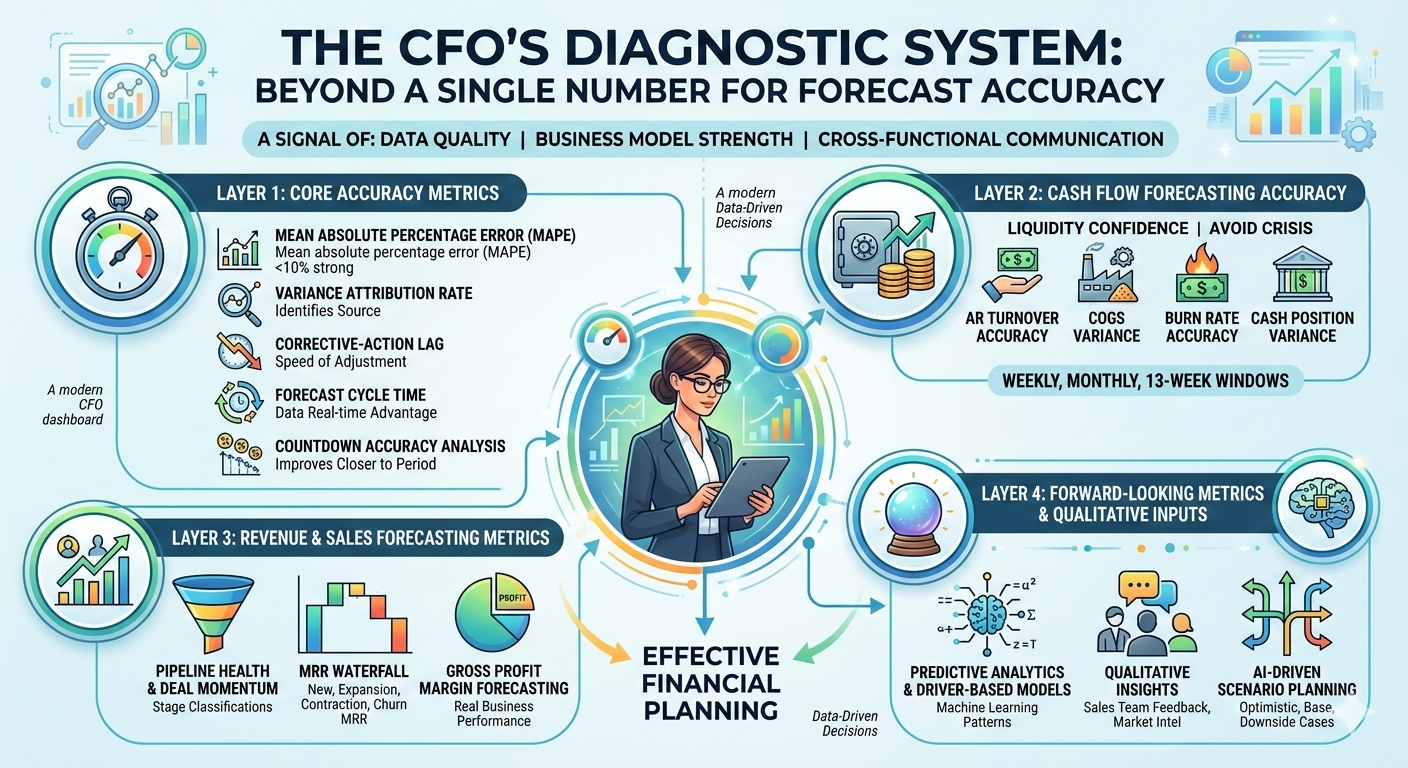
Forecast accuracy is the measured closeness between a financial projection and the actual result. But for a Chief Financial Officer, it means much more than a single number. It is a signal about the quality of data inputs, the strength of the business model assumptions, and the effectiveness of communication between sales teams, operations, and finance.
A forecast that is consistently 30% off on revenue but only 5% off on cash flow tells a story. So does a forecast that is accurate in January and wildly inaccurate in Q3. Forecasting accuracy is not just one metric, it is a diagnostic system.
When finance leaders discuss how CFO measures forecast accuracy, they are really asking three questions:
- How far off was the forecast from actual results?
- Why did the variance happen?
- How long did it take to detect and respond to it?
Each question corresponds to a different layer of measurement, and each layer requires its own set of tools and internal performance metrics.
Layer 1: The Core Accuracy Metrics Every CFO Should Track
Mean Absolute Percentage Error (MAPE)
Mean Absolute Percentage Error is the most widely used benchmark in financial forecasting. It calculates the average absolute percentage difference between forecasted values and actual results. A MAPE below 10% is generally considered strong for most industries.
MAPE is useful for comparing forecast performance across different time periods or business units. However, it has a weakness: it weights all forecast errors equally, regardless of whether they are above or below the actual. CFOs should use it alongside directional accuracy measures to get the full picture.
Variance Attribution Rate
Variance attribution rate goes one step deeper. Rather than simply measuring the size of the forecast error, it identifies the source. Was the variance driven by a shift in market trends? A breakdown in pipeline health? Unexpected customer churn? A spike in variable costs?
When FP&A teams can attribute variances to specific drivers, not just report that revenue came in lower than expected, the organization can act. Variance attribution rate is arguably the most operationally valuable metric in the forecast accuracy tracking toolkit.
Corrective-Action Lag
Corrective-action lag measures how long it takes from the moment a significant variance is detected to the point where the business adjusts its forecast or operational plan. A low corrective-action lag means the finance function is agile. A high corrective-action lag means the business is flying partially blind, reacting to old information long after it has gone stale.
High-performing CFOs treat corrective-action lag as a key internal performance metric, because a perfect forecast with a slow response is nearly as dangerous as a bad forecast.
Forecast Cycle Time
Forecast cycle time measures how long it takes to produce a new forecast from start to finish. Long cycle times mean decisions are being made on older data. Shorter cycle times, especially when enabled by cloud-based ERP systems and automated report generation, give the business a real-time data advantage.
Countdown Accuracy Analysis
Countdown accuracy analysis tracks how forecast accuracy improves (or deteriorates) as the forecast period approaches. For example, a 90-day revenue forecast might carry a MAPE of 18%, a 60-day forecast might drop to 11%, and a 30-day forecast might reach 5%. Tracking this progression helps CFOs understand how far out their forecasting models can be reliably trusted for major financial decisions.
Layer 2: Cash Flow Forecasting Accuracy
Cash flow is where forecasting errors have the most immediate consequences. A revenue miss can be explained. A cash flow miss can trigger a liquidity crisis.
Cash flow forecasting accuracy tracks the variance between projected cash inflows and outflows and the actual cash position at any given point. For any business, particularly a SaaS business with subscription revenue or a product company managing seasonal inventory, cash forecasting accuracy can mean the difference between confident investment and reactive survival.
CFOs should track cash flow forecast accuracy at multiple time horizons: weekly, monthly, and rolling 13-week windows. Each horizon serves a different purpose. Weekly cash flow statements catch short-term timing mismatches. Monthly cash flow management tracks working capital trends. Rolling forecasts capture the medium-term trajectory that affects balance sheet decisions and investor reporting.
Key metrics within cash flow forecasting accuracy include:
- AR turnover accuracy (was collections timing predicted correctly?)
- Cost of goods sold variance (were input costs forecasted accurately?)
- Burn rate accuracy (especially critical for growth-stage companies)
- Cash position variance at week-end versus forecast
Layer 3: Revenue and Sales Forecasting Metrics
Revenue forecasting is where collaboration between finance and sales teams is most critical and where forecast errors are most common. Understanding how CFO measures forecast accuracy in the revenue line requires looking at both the numbers and the inputs behind them.
Pipeline Health and Deal Momentum
Sales pipeline accuracy is one of the primary drivers of revenue forecast errors. If CRM systems are not updated consistently, if account stage classifications are outdated, or if deal momentum is not being tracked, the forecast will be built on unreliable foundations.
CFOs who embed pipeline health reviews into the forecast cycle , not just as a sales exercise but as a finance input, consistently achieve better forecasting accuracy. This means examining not just total pipeline value but weighted pipeline, conversion rates by account stage, and average deal velocity.
MRR Waterfall and Expansion MRR
For subscription and SaaS businesses, the MRR waterfall is one of the most powerful forecasting tools available. It maps new MRR, expansion MRR, contraction MRR, and churned MRR into a complete picture of net revenue movement.
Tracking expansion MRR separately from new customer acquisition MRR helps CFOs understand whether growth is coming from customer acquisition or from deepening existing relationships, a critical distinction for financial planning and Customer Lifetime Value analysis.
Gross Profit Margin Forecasting
Revenue forecasting without gross profit margin forecasting is incomplete. A CFO can hit revenue targets while missing profitability targets entirely, particularly if variable costs, marketing costs, or cost of goods sold shift unexpectedly. Gross profit margin forecast accuracy, tracked alongside revenue recognition timing, gives a much cleaner picture of real business performance.
Layer 4: Forward-Looking Metrics and Qualitative Inputs
Most forecasting frameworks focus on what happened. The best ones also measure how well the forecast captures what is about to happen.
Predictive Analytics and Driver-Based Models
The shift from static, historical data-based models to driver-based models is one of the most important evolutions in modern financial forecasting. Driver-based models connect operational inputs, customer acquisition rates, employees per customer ratios, average revenue per customer, customer profitability metrics, directly to financial outputs.
When paired with predictive analytics and machine learning models, driver-based forecasting allows FP&A teams to update projections in near real-time as business conditions change. Machine learning is particularly powerful in identifying nonlinear patterns in historical data that traditional quantitative analysis would miss.
Qualitative Insights and Market Intelligence
No amount of data analytics replaces human judgment. The best forecasting accuracy frameworks blend quantitative analysis with qualitative insights gathered from sales teams, customer-facing staff, and industry data. A CFO who only reads the numbers and ignores what the sales pipeline is signaling through human communication channels will consistently be surprised by actuals.
AI-Driven Scenario Planning
An AI-driven scenario planner allows CFOs to model multiple futures simultaneously, optimistic, base case, and downside, and assign probabilities to each. This approach transforms forecast accuracy from a backward-looking measurement into a forward-looking management tool. AI strategy is increasingly central to how modern finance leaders build resilient financial planning frameworks.
The Technology Stack That Enables Forecast Accuracy
Understanding how CFO measures forecast accuracy is incomplete without addressing the infrastructure behind it. The most accurate forecasts are built on integrated, real-time data pipelines.
Cloud-Based ERP and CRM Integration
Cloud-based ERP systems connected to CRM systems eliminate the manual data transfer that introduces timing errors and version-control problems into forecasts. When the revenue recognition data in the ERP and the pipeline data in the CRM are talking to each other, the forecast is built on a single version of truth.
Real-Time Dashboards and Automated Variance Detection
Real-time dashboards allow finance teams and business leaders to monitor forecast versus actual performance continuously, not just at month-end. Automated variance detection flags significant deviations as they emerge, reducing corrective-action lag dramatically.
Data Architecture: From Spreadsheets to Data Lakes
Many mid-sized businesses still run forecasts from spreadsheets stitched together with manual exports. This creates data integrity risks and slows forecast cycle time. Moving toward enterprise data architecture, including data lakes and data fabric solutions, gives FP&A teams the ability to run faster, more granular forecasts with greater confidence.
BI Solutions and Predictive Tools
A well-implemented BI solution connects historical data, real-time data, and forecasting models into a single platform. Predictive tools built on machine learning can model thousands of scenarios simultaneously, surfacing the most likely outcomes and quantifying the risk around each.
Building a Forecast Accuracy Culture
The metrics and tools only work if the organization uses them. Stakeholder adoption is one of the most underestimated challenges in improving forecast accuracy.
Sales teams need to understand why pipeline health matters to financial forecasting. Operations leaders need to connect their plans to cash flow forecasts. Senior leadership needs to treat forecast accuracy as a business health indicator, not a finance department scorecard.
The Chief Financial Officer plays a central role in building this culture. Regular forecast reviews, not as blame sessions but as strategic analysis exercises, drive continuous improvement in forecasting accuracy across every function. When business planning becomes a shared discipline rather than a finance-only exercise, forecast reliability improves at every level.
Rolling forecasts, updated monthly rather than locked to an annual cycle, reinforce this culture. They signal that the organization is committed to working with the most current information available, and that operational efficiency depends on getting the forecast as accurate as possible, as early as possible.
Common Forecast Errors and How to Fix Them
Even well-run finance functions make recurring forecast errors. The most common include:
- Over-reliance on last year’s historical data without adjusting for market trends or business model changes
- Ignoring customer churn signals in the revenue forecast
- Failing to account for timing mismatches in the cash flow forecast (revenue recognized vs. cash collected)
- Building forecasts top-down without driver-based inputs from sales, operations, or HR
- Using a single-point forecast instead of a range with an AI-driven scenario planner
Each of these errors shows up in variance attribution analysis. When the same variance drivers appear repeatedly, quarter after quarter, it is a signal that the forecasting model itself needs to be redesigned, not just the numbers adjusted.
Frequently Asked Questions
What is the most important metric for measuring forecast accuracy?
There is no single most important metric, it depends on the business model and decision being made. Mean Absolute Percentage Error is the most common starting point. For cash-intensive businesses, cash flow forecasting accuracy is the most critical. For growth-stage companies, revenue and MRR waterfall accuracy matters most. A comprehensive framework tracks all three layers.
What is a good MAPE for financial forecasting?
A MAPE below 10% is generally considered strong for revenue and cash flow forecasting. However, benchmarks vary by industry, business stage, and forecast horizon. A 30-day forecast should be more accurate than a 90-day forecast, and any countdown accuracy analysis should reflect that progression.
How does machine learning improve forecast accuracy?
Machine learning models can identify patterns in historical data that traditional forecasting models miss, including seasonal inventory effects, customer churn signals, and non-linear relationships between operational drivers and financial outcomes. When used alongside qualitative insights and human judgment, machine learning significantly improves both forecast accuracy and corrective-action lag.
What is corrective-action lag and why does it matter?
Corrective-action lag is the time between detecting a forecast variance and taking a concrete action in response. A business with a high corrective-action lag is consistently making decisions based on outdated information. Reducing corrective-action lag, through automated variance detection, real-time data, and clear escalation protocols, is one of the highest-value improvements a CFO can make to the forecasting process.
How can a CFO improve forecast accuracy without adding headcount?
The most effective lever is better technology: cloud-based ERP systems, CRM integration, automated variance detection, and AI-driven scenario planners all improve forecast accuracy without requiring additional FP&A team members. Improving the quality of inputs, through better pipeline health tracking and driver-based models, also delivers significant accuracy improvements at low cost.
Conclusion
The question of how CFO measures forecast accuracy is ultimately a question about organizational intelligence. Companies that forecast well make better investments, manage cash flow with more confidence, respond to market trends faster, and build stronger financial stability over time.
Forecast accuracy is not a finance department metric. It is a business strategy metric. When the entire organization, from sales teams to senior leadership, treats forecast accuracy as a shared priority, the results show up in every line of the income statement, cash flow statement, and balance sheet.
If your business is struggling with forecast errors, slow corrective-action lag, or a lack of confidence in your financial planning process, working with an experienced fractional CFO can transform your financial decision-making. Oak Business Consultant offers expert CFO services designed to build forecast accuracy systems, implement the right financial forecasting tools, and embed the culture of disciplined financial planning your business needs for sustainable growth. Contact us today and find out how we can help you close the gap between your forecast and your future.