Financial Management in Startups: The Biggest Challenges and Tips
Challenges and Tips for Financial Management in Startups
Starting a business is one of the most exciting things a person can do. You have a vision, maybe a small team, and a real shot at building something meaningful. But here’s the part no one warns you about loudly enough: most startups don’t fail because the idea was bad. They fail because the money ran out.
Financial management is not a back-office task you delegate and forget. In a startup, it’s survival. Understanding how money moves through your business, where it goes, why it leaves faster than expected, and how to keep the engine running long enough to reach profitability, that’s what separates the startups that make it from the ones that don’t.
This guide walks you through the biggest financial challenges startups face and gives you concrete, practical strategies to deal with each one.
What Is a Startup, and Why Does It Matter for Finance?
A lot of people use the word “startup” loosely, but it has a specific meaning that shapes everything about how finances must be managed.
A startup is a business designed to scale fast. It typically has a product, service, or technology that could open up new markets or shake up existing ones. It requires significant outside capital, moves quickly, and takes on high risk in exchange for the possibility of high reward.
A traditional small business, like a local accounting firm, a neighborhood bakery, or a family-run retail shop, is a fundamentally different creature. It may be small, but it’s built for steady profitability and local presence, not hypergrowth. It usually funds itself through loans, personal savings, or modest revenue.
Why does this distinction matter for financial management? Because the rules are different. A startup founder who manages money like a small business owner will eventually run into serious problems. The timelines, the risk tolerance, the funding mechanisms, the burn rate expectations, all of it is different.
The Core Pillars of Startup Financial Management
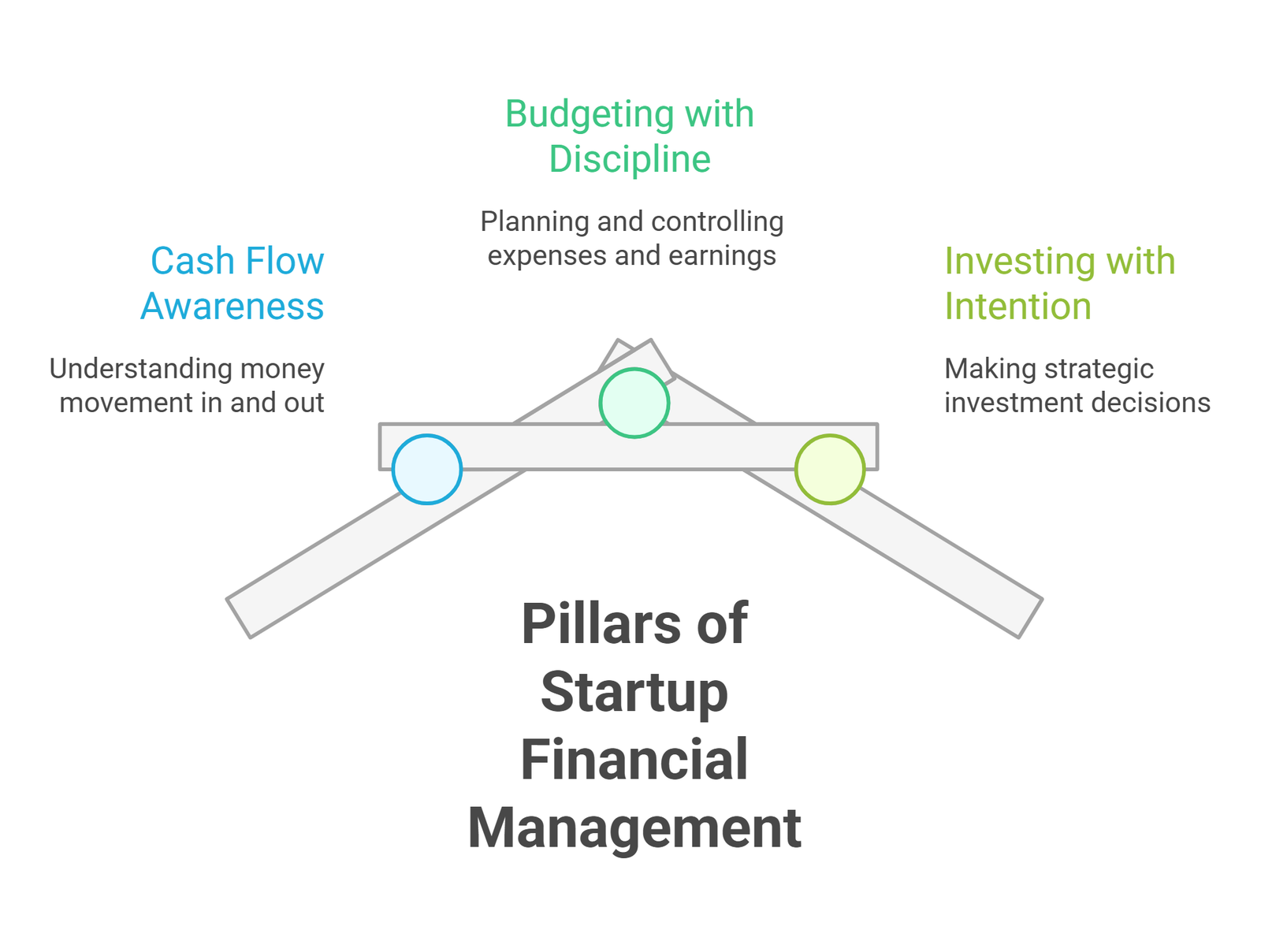
Before diving into challenges, it helps to understand the fundamentals that every startup founder needs to get comfortable with.
1. Cash Flow Awareness
Cash flow is simply the movement of money in and out of your business. Revenue from customers, funding from investors, expenses like salaries and software, tax payments. Understanding when money comes in and when it goes out is the foundation of everything else.
Many early-stage founders focus almost entirely on revenue and ignore timing. But a business can be profitable on paper and still collapse because the money isn’t there when bills are due. Tracking cash flow isn’t just about knowing your bank balance. It’s about knowing your future bank balance.
2. Budgeting with Discipline
A budget isn’t a formality. It’s a decision-making tool. It forces you to be honest about what you’re spending, what you’re earning, and where the gaps are. A good startup budget accounts for both short-term operations and longer-term goals, and it gets reviewed regularly, not just at year-end.
3. Investing with Intention
When you have capital, the temptation to spend it on everything at once is real. New hires, new tools, new marketing channels. But investing without a clear return framework is how startups burn through their runway in months. Every major investment decision should have a rationale, a timeline, and a way to measure whether it worked.
How Startups Differ from Traditional Businesses
Two areas where the differences are most pronounced financially:
Funding. Traditional small businesses usually bootstrap or borrow. Startups often take outside investment, from angel investors, venture capital funds, or accelerators. This isn’t just free money. It comes with expectations around growth, reporting, and sometimes governance. The source of your capital shapes how you must manage it.
Risk. Startups operate in higher-uncertainty environments. The market might not exist yet. The product might need significant iteration. Competitors might emerge overnight. That elevated risk level means financial planning can’t just be conservative, it has to be adaptive. Startups need contingency thinking built into their financial models, not bolted on after something goes wrong.
The Four Biggest Financial Challenges Startups Face
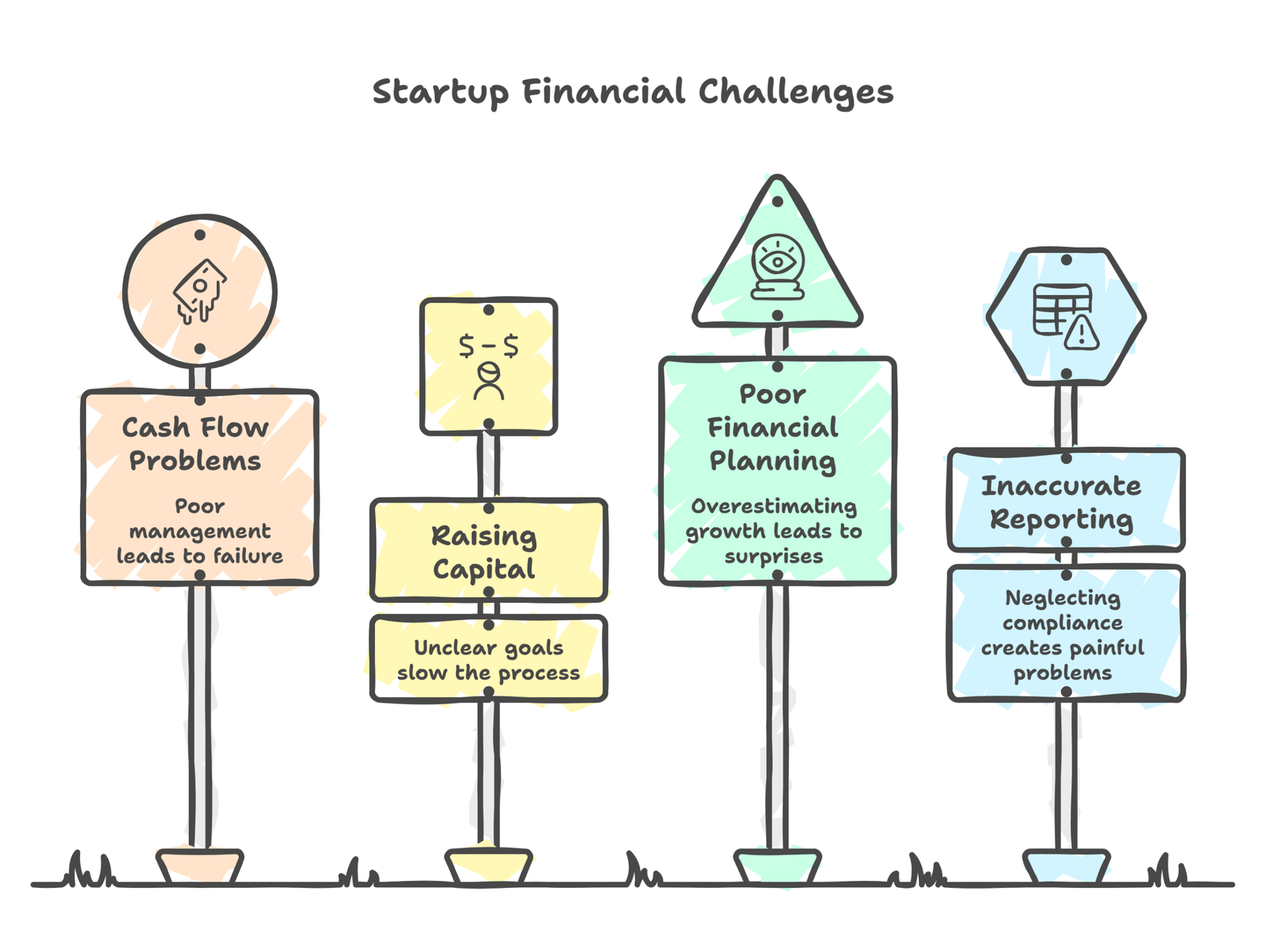
Challenge 1: Cash Flow Problems
This is the single most common reason startups fail. Not lack of revenue. Not bad products. Poor cash flow management.
Here’s why it happens and how to fix it.
Slow-paying customers. B2B startups especially deal with invoices that get paid 60, 90, or even 120 days after delivery. If you’re operating on a tight runway, waiting two months to get paid can be fatal. The fix is to get serious about payment terms upfront. Require payment within 30 days as standard. Offer small discounts for early payment. Send reminders before invoices are due, not just after they’re overdue. Consider requiring deposits for large contracts. Some founders hate these conversations, but late payments are a form of free credit that someone is giving themselves at your expense.
Overspending. This often happens gradually. A subscription here, a new tool there, a team dinner, a conference ticket. None of it looks like much individually, but together it can represent a significant drain on runway. The solution is a real budget with real accountability. Every team member who spends company money should understand the limits and the reasoning behind them. Review expenses monthly, not quarterly. Catch creep early.
Ignoring taxes. Tax obligations are predictable, but many early-stage founders treat them like a surprise. Set aside a portion of revenue for taxes from the beginning. Work with an accountant who understands startup finances, not just personal taxes. Know your filing deadlines. Paying taxes late doesn’t just cost you penalties. It signals poor financial discipline to any future investor who does due diligence.
What good cash flow management looks like in practice. Build a 13-week rolling cash flow forecast. Update it every week. Know exactly how much runway you have at your current burn rate. Make decisions based on that number. If you can see a cash crunch coming three months out, you have time to act. If you only see it when you’re two weeks away, your options are extremely limited.
Challenge 2: Raising Capital
Capital is the oxygen of a startup. Without enough of it, even great companies suffocate. But raising capital is genuinely hard, and many founders make avoidable mistakes that slow the process or kill it entirely.
Unclear goals. Investors don’t just write checks because an idea is interesting. They want to know exactly how their money will be used and what return they can expect. If you can’t articulate what you’ll do with the money and why that plan will generate returns, you’re not ready to fundraise. Before you pitch, have specific answers: How much do you need? What will it be spent on? Moreover, what milestones will it unlock? What happens to the business after those milestones are hit?
Unrealistic valuations. Founders often anchor their valuation to what they wish the company was worth rather than what the market will bear. This is understandable. You’ve poured enormous effort into the business. But investors benchmark against comparable deals, market conditions, and risk-adjusted return expectations. Coming in significantly overpriced either kills the conversation or leads to a painful renegotiation that damages trust. Research comparable valuations in your space and be willing to justify your number with logic, not emotion.
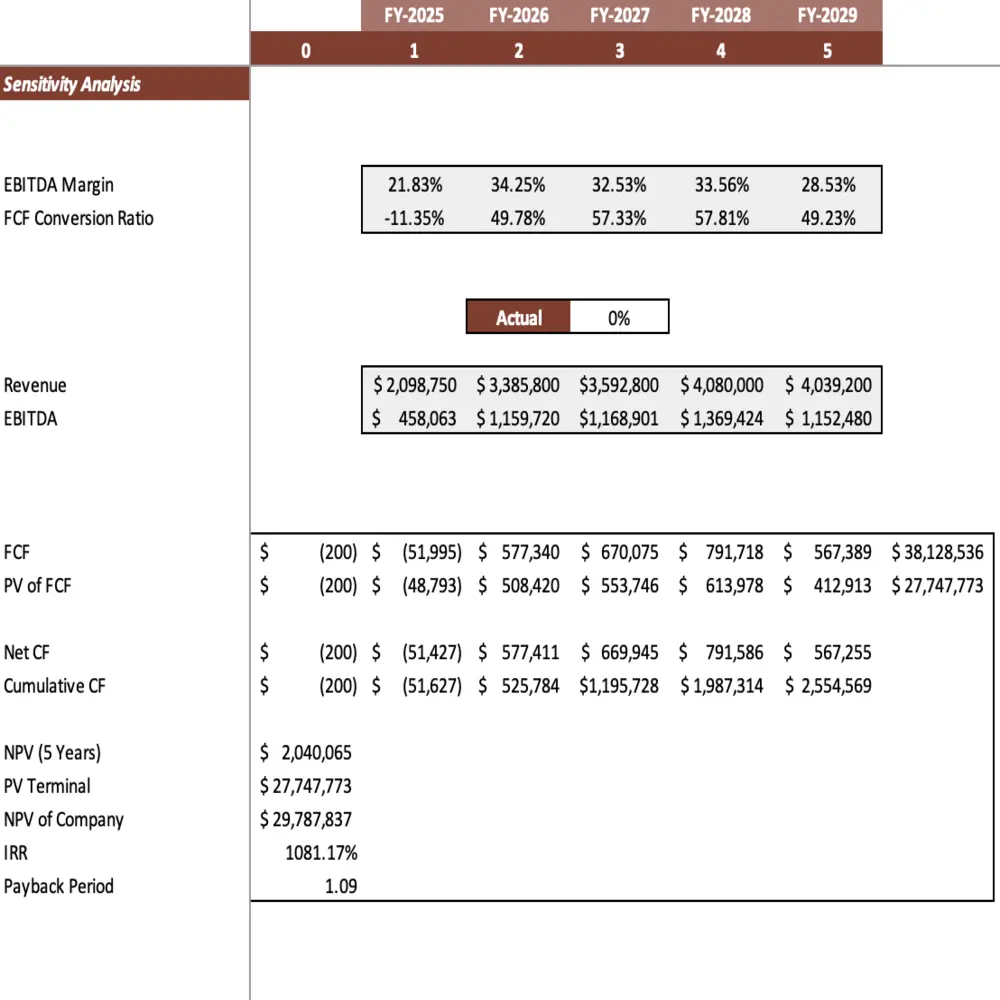
Not having financials ready. Serious investors will ask for your financial model, your historical numbers if you have them, and your projections. If you can’t produce clean, credible financials quickly, it signals operational immaturity. You don’t need a CFO to build a basic model. You do need to understand what’s in it and be able to defend your assumptions.
Challenge 3: Poor Financial Planning and Forecasting
Forecasting feels like guesswork because the future is uncertain. But that’s not an excuse to skip it or do it carelessly. A bad forecast that you understand is far better than no forecast at all.
Not using data. Early-stage startups sometimes have limited data, but you likely have more than you think. Website traffic, conversion rates, sales pipeline velocity, churn from early customers. Use what you have to build your forecast from the bottom up rather than making top-down assumptions. “We’ll capture 1% of a $1 billion market” is not a forecast. “We close 10 deals per month at an average of $5,000 each and grow 15% month-over-month based on current trajectory” is a forecast.
Ignoring key variables. Your forecast needs to account for seasonality if your industry has it, pricing changes, hiring timelines, product launch delays, and market shifts. Founders who model only the upside end up constantly surprised by reality. Build scenarios: base case, optimistic case, and conservative case. Know what happens to your runway in each one.
Overestimating growth. Every founder believes their startup will grow faster than it actually will. This is almost universal. The solution isn’t pessimism, it’s calibration. Look at comparable companies at your stage and build your assumptions around what’s actually typical, then work to beat it. Investors have seen enough pitch decks to spot hockey-stick projections that have no basis in reality.
Challenge 4: Inaccurate Financial Reporting and Compliance
This is the area that most founders neglect the longest, and it often creates the most painful problems down the road.
Bookkeeping that doesn’t get done. In the early days, it’s tempting to keep things informal. You know roughly how much is in the account. You’ll reconcile everything later. But “later” never comes, and when you need to raise a round, close a deal with a major customer, or file taxes, you discover that your records are a mess. Set up proper bookkeeping from day one. Use accounting software. Have someone, whether in-house or a contractor, responsible for keeping records current.
Not understanding your tax obligations. Tax law is complex, and startup-specific situations like equity compensation, R&D tax credits, or sales tax in multiple jurisdictions add additional layers. The cost of getting this wrong can be significant. Hire an accountant who works with startups, not just a generalist. Ask about every tax benefit you might qualify for and every obligation you might be overlooking.
Reporting that’s months behind. Founders sometimes run their business entirely on bank balance and intuition, without looking at a proper profit and loss statement, balance sheet, or cash flow statement. These aren’t bureaucratic documents. They’re the instruments that tell you whether the business is healthy. Review them monthly. Understand what they’re telling you. If you don’t understand them, learn, because no one else can navigate your business’s finances for you.
Practical Tips Every Startup Founder Should Implement Now
- Know your burn rate and runway at all times. These two numbers should be as familiar as your own name.
- Separate personal and business finances from day one. Mixing them creates legal and accounting nightmares later.
- Hire a financial advisor or fractional CFO earlier than you think you need one. The cost is almost always worth it.
- Build a 12-month financial model and update it quarterly. Don’t treat it as a one-time document you create for investors.
- Get serious about collections. Revenue you’ve earned but haven’t collected is not revenue you can use.
- Review your unit economics regularly. Know what it costs to acquire a customer and how much revenue that customer generates over time. If those numbers don’t work, scale won’t save you.
- Keep a cash reserve. The general advice is three to six months of operating expenses, but for startups with unpredictable revenue, more is better.
Frequently Asked Questions
What is the most common financial mistake startup founders make?
Running out of cash because of poor cash flow management is the most common and most fatal mistake. It usually isn’t a sudden event. It builds gradually through slow-paying customers, unchecked expenses, and a lack of forward-looking cash flow forecasting.
When should a startup hire a CFO or financial advisor?
Earlier than most founders think. You don’t need a full-time CFO from day one, but even at the pre-seed stage, having a fractional CFO or experienced financial advisor can save you from costly mistakes. Most startups benefit from professional financial guidance well before their Series A.
What is burn rate, and why does it matter?
Burn rate is the amount of money your startup spends each month, typically measured as net burn (expenses minus revenue). It determines your runway, which is how long you can operate before running out of money. These two numbers should always be top of mind for any startup founder.
How should startups approach fundraising if they don’t have much revenue?
Focus on telling a credible story backed by traction indicators: user growth, engagement metrics, letters of intent from potential customers, or pilot results. Have a clear, well-reasoned financial model that shows how investor capital will be deployed and what milestones it will unlock. Investors at early stages are often betting on the team and the opportunity as much as the numbers.
How often should a startup review its financial reports?
Monthly at a minimum. Weekly cash flow reviews are ideal for early-stage startups with limited runway. Quarterly reviews of the broader financial model and annual reviews with a full accounting reconciliation should also be standard practice.
Conclusion
Financial management in a startup is not a skill you can outsource and forget. It’s something every founder needs to understand deeply, even if they eventually hire people to handle the execution. The stakes are too high for financial blindness.
The good news is that the core principles aren’t complicated. Know where your money is. Know where it’s going. Plan ahead with realistic assumptions. Keep your records clean and current. Raise capital strategically. And build habits around financial review that become part of how you run the business week to week.
Startups that get this right don’t just survive longer. They make better decisions, attract better investors, build more credible teams, and ultimately have a much higher chance of becoming the kind of company they set out to build.
Your idea might be the spark. But financial discipline is what keeps the fire burning.
Your Idea is the Spark. Financial Discipline is the Fuel. Don’t let poor cash flow stop your startup’s momentum. Partner with Oak Business Consultant for expert financial modeling, budgeting, and fundraising support tailored for high-growth startups. Contact us now to schedule a free consultation.