10 Tips and Tricks for Startup Founders
Tips and Tricks, Startup Founders Need to Know
Most startup advice tells founders to “know their customer” and “stay agile.” That advice is not wrong, but it is not specific enough to act on. CB Insights research into failed, venture-backed startups found that running out of cash is one of the most common endpoints, and it is rarely the actual root cause. It is usually the last visible symptom of a founder who never tracked burn rate, priced without checking margins, or scaled before the unit economics worked.
This guide covers ten things that actually move the needle, with the formulas and numbers attached, not just the general direction to point in.
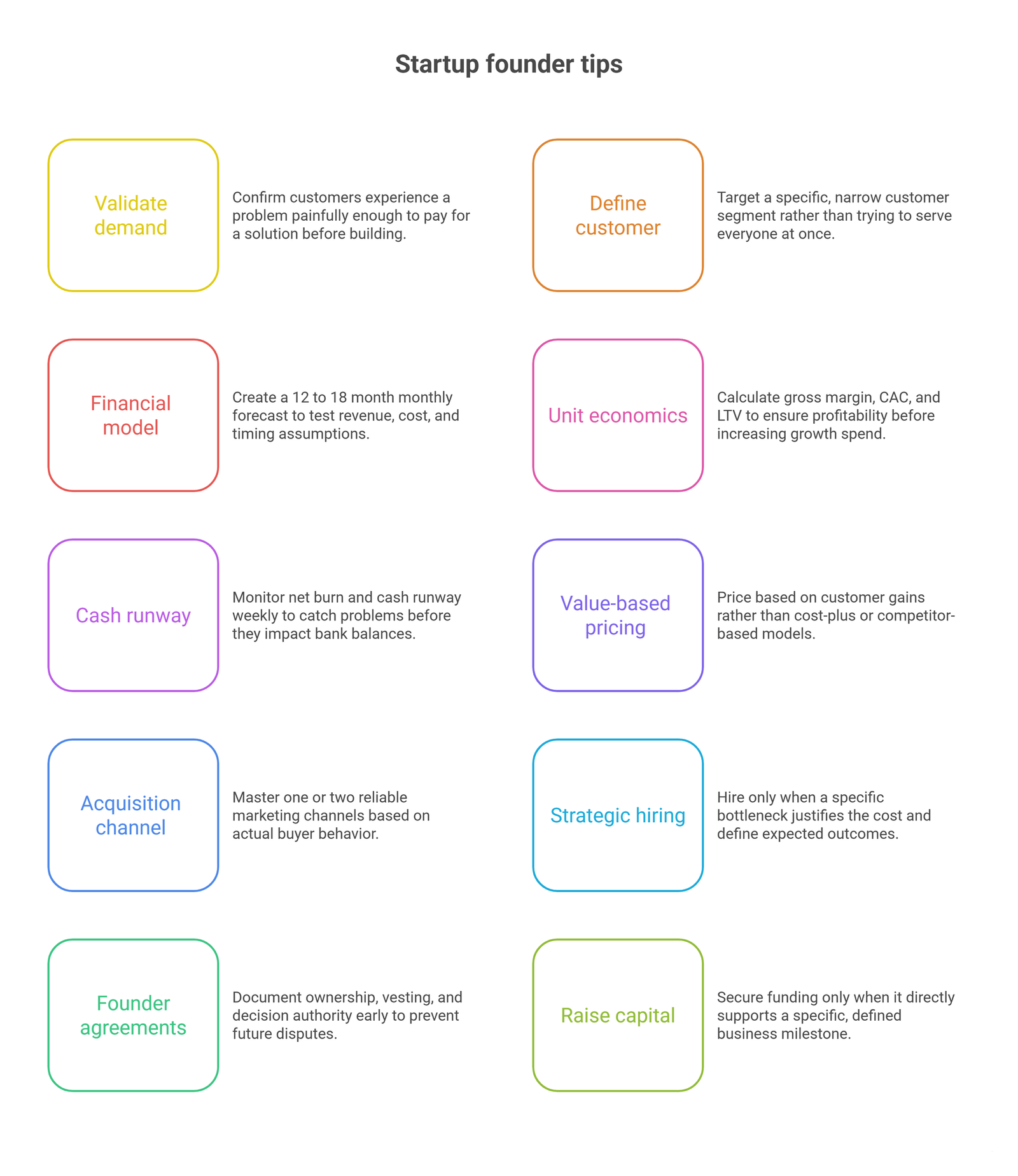
Validate demand before you build
A good idea and a fundable idea are not the same thing. The test is not whether people say they like your concept. It is whether a specific customer experiences the problem often enough, and painfully enough, to pay for a better solution.
Skip the polite questions like “would you use this?” Ask instead how they solve the problem today, what that costs them, and whether they would pay for an early pilot. A signed letter of intent or a paid deposit tells you far more than a friendly nod in a customer interview.
Define one customer before you chase everyone
“Small businesses that need help with X” is not a target market. “Independent dental practices with two to ten locations and no full-time marketing director” is. The narrower description tells you where to find prospects, who controls the budget, and what the problem is actually costing them.
Trying to serve everyone at once usually means serving no one well, and it makes every marketing dollar less effective.
Build a lean financial model, not a static business plan
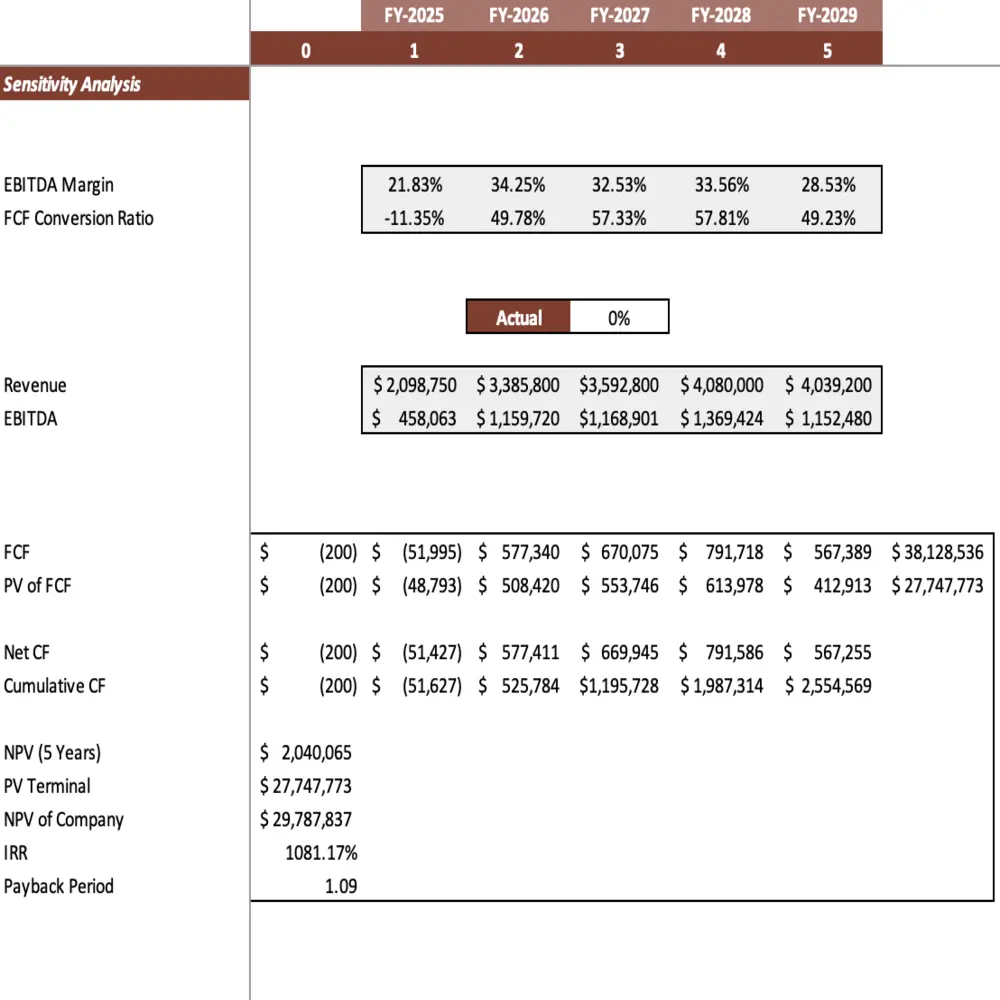
A business plan written once and filed away helps you raise money. It does not help you run the company day to day. A startup financial model does both, because it forces you to write down your actual assumptions about revenue, costs, and timing, and then lets you test what happens when one of those assumptions is wrong.
At the early stage, the model does not need five years of detail. A 12 to 18 month monthly forecast covering revenue, cash in, cash out, and hiring plans is usually enough to make real decisions with.
Know your unit economics before you spend on growth
Revenue growth can hide a business that loses money on every new customer. Before increasing marketing spend or headcount, work out these four numbers:
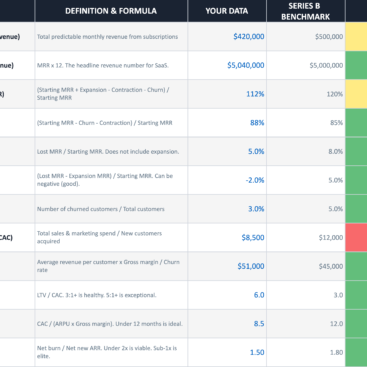
Gross margin = (Revenue − Cost of goods sold) ÷ Revenue. If you bring in $100,000 and direct delivery costs are $35,000, your gross margin is 65%.
Customer acquisition cost (CAC) = Sales and marketing spend ÷ new customers acquired. If you spend $12,000 and land 80 customers, your CAC is $150. Include salaries, ad spend, and commissions, not just the ad budget, or the number will look artificially low.
Customer lifetime value (LTV), in simplified form = (Monthly revenue per customer × gross margin) ÷ monthly churn rate. At $100 monthly revenue, 70% margin, and 5% churn, that is $70 ÷ 0.05, or $1,400.
A healthy LTV to CAC ratio is a useful signal, but check it by customer segment and acquisition channel. A strong blended average can hide one channel that is quietly losing money.
Protect your cash runway like it is the scarcest resource, because it is
Net burn = monthly cash out − monthly cash in. Cash runway = available cash ÷ average monthly net burn. A company with $180,000 in the bank and a $30,000 monthly burn has six months of runway, not a comfortable cushion.
Update this weekly, not quarterly. A rolling 13-week cash forecast that tracks expected customer payments, payroll, and vendor bills catches a cash problem months before the bank balance does. This is exactly the kind of forecasting a fractional CFO builds and maintains for founders who do not have the bandwidth to update it every week themselves, on top of running the company.
Price for value and margin, not a guess
Cost-plus pricing is simple but ignores what the solution is actually worth to the buyer. Competitor-based pricing gives you context but assumes your cost structure matches theirs, which it usually does not.
Value-based pricing starts from what the customer gains. If your product reliably saves a customer $60,000 a year in administrative work, a $12,000 annual price can still be an easy yes, even though your delivery cost is a fraction of that. Test one pricing variable at a time (monthly versus annual, flat rate versus usage-based) so you can actually tell what moved the number.
Build one acquisition channel before you build five
You do not need every marketing channel. You need one or two that reliably bring in the right customer at a cost you can afford. Pick the channel based on how your buyer actually behaves, not on what looks impressive. A B2B software company usually gets more out of founder-led outbound and industry content than paid social. A local service business usually gets more out of local search and referrals.
Track the full funnel from first contact to renewal. A weak conversion rate at one stage tells you exactly where to fix the message, not just to spend more on ads.
Hire only when a specific bottleneck justifies the cost
Before hiring, ask whether the work can be eliminated, simplified, automated, or handled by a freelancer for a defined project. When a role is genuinely needed, write down the outcome it must produce and the 30, 60, and 90 day results you expect, not just a job title.
Remember that salary is only part of the cost. Payroll taxes, benefits, equipment, and management time add up fast, and a wrong hire is expensive to unwind.
Put founder agreements and equity in writing early
Many founder disputes start with “we trust each other, we will sort out the details later.” Trust is necessary, but it does not replace a written agreement. At minimum, put ownership percentages, vesting terms, decision authority, and what happens if a founder leaves in writing before the business has real value at stake. Without vesting, a founder who leaves early can walk away with a large ownership stake while the rest of the team keeps building.
Raise capital only when it funds a specific milestone
Funding is a tool, not proof that the company is working. Before raising, be able to answer exactly what the money buys: a production-ready product, a validated market, a proven retention number, or a specific hire. Match the source to the stage. Customer revenue and founder savings preserve control. Venture capital brings larger checks and real growth expectations attached. A fundraising strategy that is tied to a milestone, rather than a runway number alone, is easier to defend to investors and easier to actually execute against.
Financial checkpoints every early-stage founder should track
| Metric | Formula | Why it matters |
| Gross margin | (Revenue − COGS) ÷ Revenue | Shows what is left to cover salaries, rent, and marketing |
| Customer acquisition cost | Sales and marketing spend ÷ new customers | Reveals whether growth spend is sustainable |
| Customer lifetime value | (Monthly revenue × margin) ÷ churn rate | Tells you whether a customer is worth what you spent to get them |
| Net burn | Monthly cash out − monthly cash in | The number that determines how much time you have left |
| Cash runway | Available cash ÷ average monthly burn | Converts burn into a concrete deadline you can plan around |
| Customer concentration | Revenue from one customer ÷ total revenue | Flags dependence on a single account or platform |
Frequently Asked Questions
What is the single biggest financial mistake first-time founders make?
Scaling spend, hiring, or marketing before checking whether the unit economics actually work. Revenue can grow while the company loses more money on every new customer, and that pattern is invisible unless you track gross margin and CAC separately from top-line revenue.
How often should a founder review cash flow?
Weekly, at minimum, using a rolling cash forecast. Monthly reviews are too slow to catch a runway problem before it becomes a crisis, since payroll, vendor payments, and customer collections can all shift within a few weeks.
When is the right time to hire a CFO or fractional CFO?
Most early-stage startups do not need a full-time CFO, but the need for CFO-level thinking, cash forecasting, fundraising preparation, unit economics, starts well before the company can afford a full-time hire. A fractional or virtual CFO fills that gap.
Should a pre-revenue startup still build a financial model?
Yes. Without revenue, a model is even more important because the company depends entirely on existing cash. It should focus on burn rate, runway, and the milestones needed before the next funding round, not on precise revenue forecasting.
How much of a company’s revenue from one customer is too risky?
There is no universal safe number. Risk depends on cash reserves, contract length, margins, and how quickly a replacement customer could be found. Tracking the percentage is what matters, since a startup can drift into heavy concentration without noticing.
Conclusion
None of these ten practices guarantee a successful startup. What they do is replace guesswork with numbers you can actually check, which is what lets a founder catch a weak assumption while it is still cheap to fix. The founders who survive long enough to find product-market fit are usually not the ones who avoided every mistake. They are the ones who tracked the right numbers closely enough to catch problems early.
If building or maintaining that financial visibility is the part you keep putting off, Oak’s CFO services for startups and startup financial model support cover exactly this: cash forecasting, unit economics, and investor-ready numbers, built and maintained so you can focus on the parts of the business only you can run.