UAE E-Invoicing Deadlines 2027: Who Must Comply, When, and What It Costs
From 1 January 2027, a PDF emailed to a customer will no longer be enough for the UAE’s largest businesses. By 1 July 2027, the same applies to every other business invoicing another business. The UAE’s Electronic Invoicing System replaces invoice documents with structured data, exchanged through accredited providers and reported to the Federal Tax Authority (FTA).
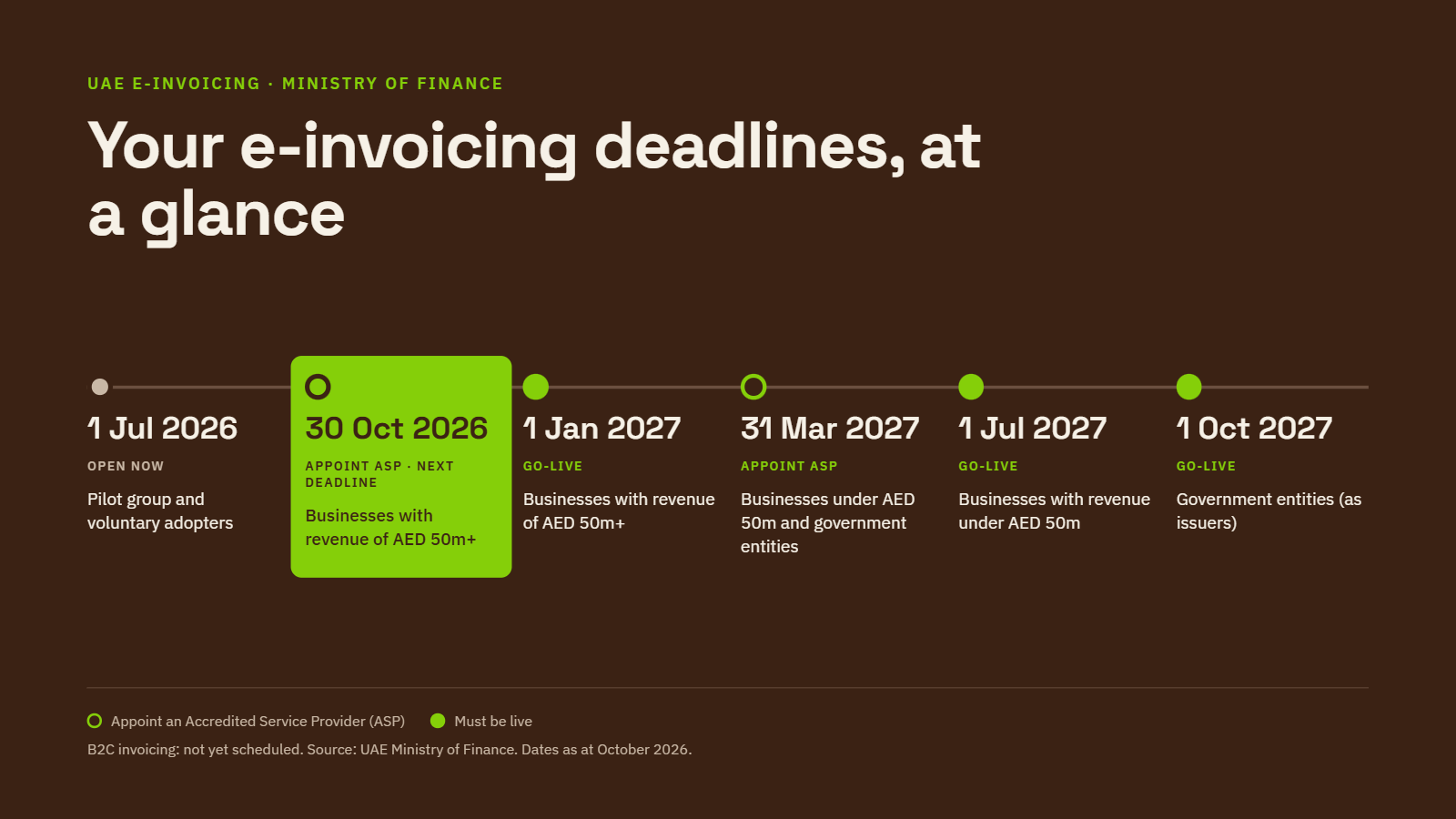
If your revenue is AED 50 million or more, you must appoint an Accredited Service Provider (ASP) by 30 October 2026 and be live by 1 January 2027. If your revenue is below AED 50 million, your dates are 31 March 2027 and 1 July 2027.
In this guide
- UAE e-invoicing deadlines at a glance
- What changes: from PDF to structured data
- How UAE e-invoicing works: the Peppol 5-corner model
- Why e-invoicing matters for your business
- The legal framework
- Who must comply
- What the rules require
- Penalties under Cabinet Decision No. 106 of 2025
- Your readiness plan: two tracks
- Frequently asked questions
UAE e-invoicing deadlines at a glance
| Who | Appoint an ASP by | Must be live by |
|---|---|---|
| Pilot group (invited by the MoF) and voluntary adopters | — | Open since 1 July 2026 |
| Businesses with revenue of AED 50 million or more | 30 October 2026 | 1 January 2027 |
| Businesses with revenue below AED 50 million | 31 March 2027 | 1 July 2027 |
| Government entities (as issuers) | 31 March 2027 | 1 October 2027 |
| Business-to-consumer (B2C) | Not yet scheduled | Not yet scheduled |
The 30 October 2026 date was originally 31 July 2026. Ministerial Decision No. 66 of 2026 moved it; the 1 January 2027 go-live did not move. Some Ministry documents published in June 2026 still show 31 July — the Decision prevails.
What changes: from PDF to structured data
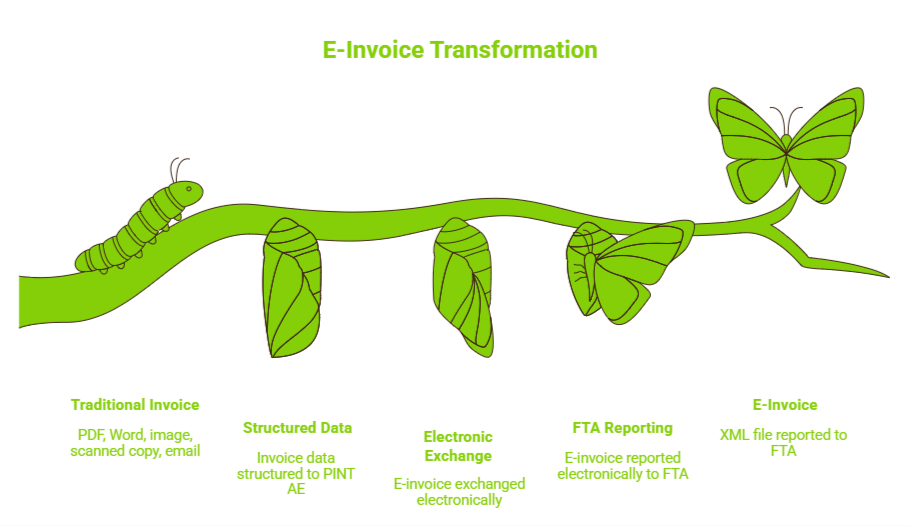
The Ministry of Finance defines an e-invoice as structured invoice data, issued and exchanged electronically between supplier and buyer and reported electronically to the FTA. PDFs, Word documents, images, scanned copies and emails are not e-invoices.
Each invoice becomes an XML file built to PINT AE, the UAE version of the international Peppol invoice specification. If your customer is not yet on the system, you still issue the e-invoice and also send a regular tax invoice, such as a PDF — so the PDF does not disappear overnight; it just stops being sufficient on its own.
How UAE e-invoicing works: the Peppol 5-corner model
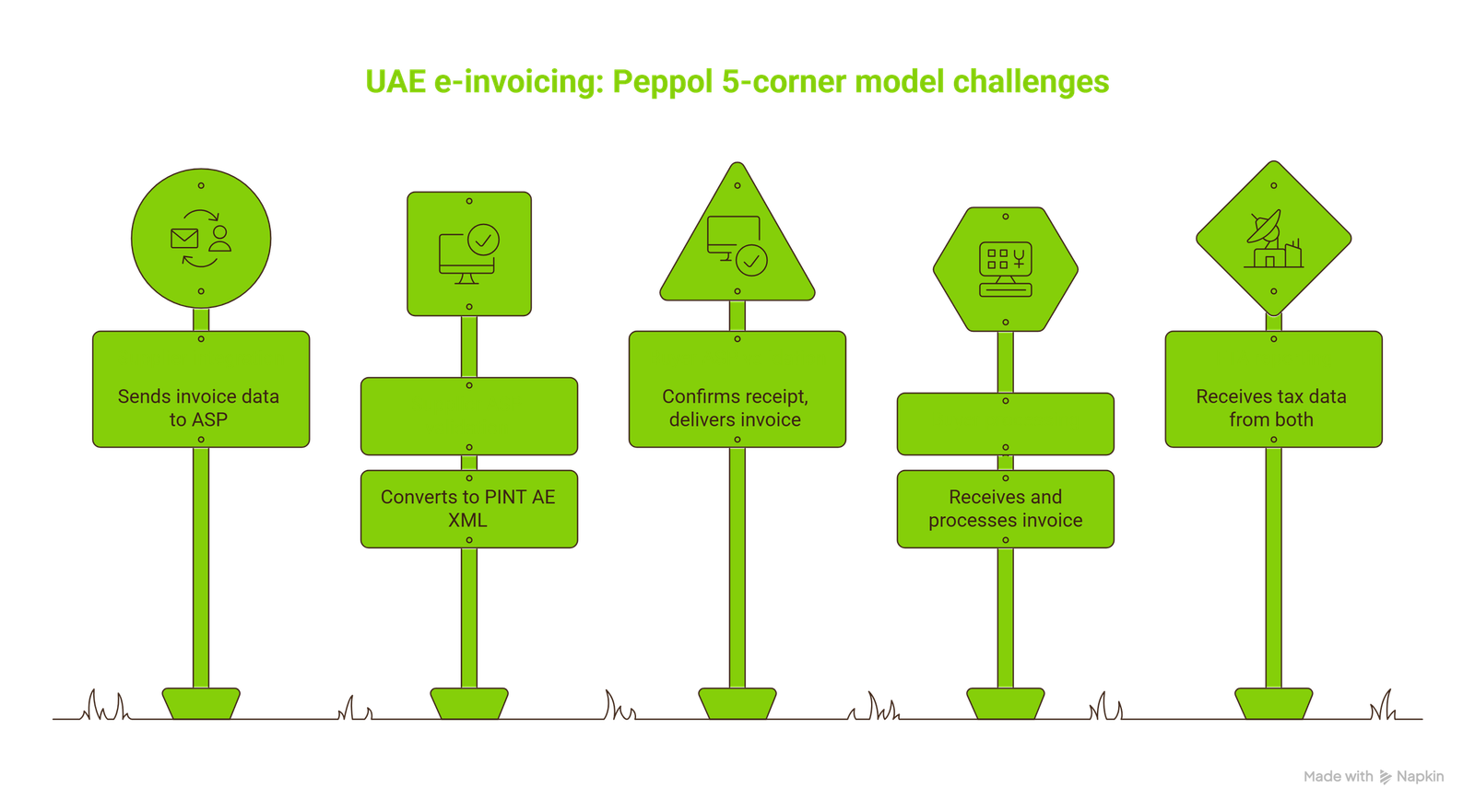
The Ministry calls its model Decentralised Continuous Transaction Control and Exchange. In practice it has five “corners”:
- Corner 1 — Supplier: sends invoice data to its ASP.
- Corner 2 — Supplier’s ASP: validates it, converts it to PINT AE XML, sends it over the Peppol network and reports the tax data to the FTA.
- Corner 3 — Buyer’s ASP: validates it, confirms receipt, delivers it and also reports to the FTA.
- Corner 4 — Buyer: receives and processes the invoice in its own system.
- Corner 5 — FTA: receives the tax data from both sides.
Two differences from Saudi Arabia matter. The FTA does not approve each invoice before it reaches your customer — this is not a clearance model. And UAE e-invoices carry no QR code or barcode.
Why e-invoicing matters for your business
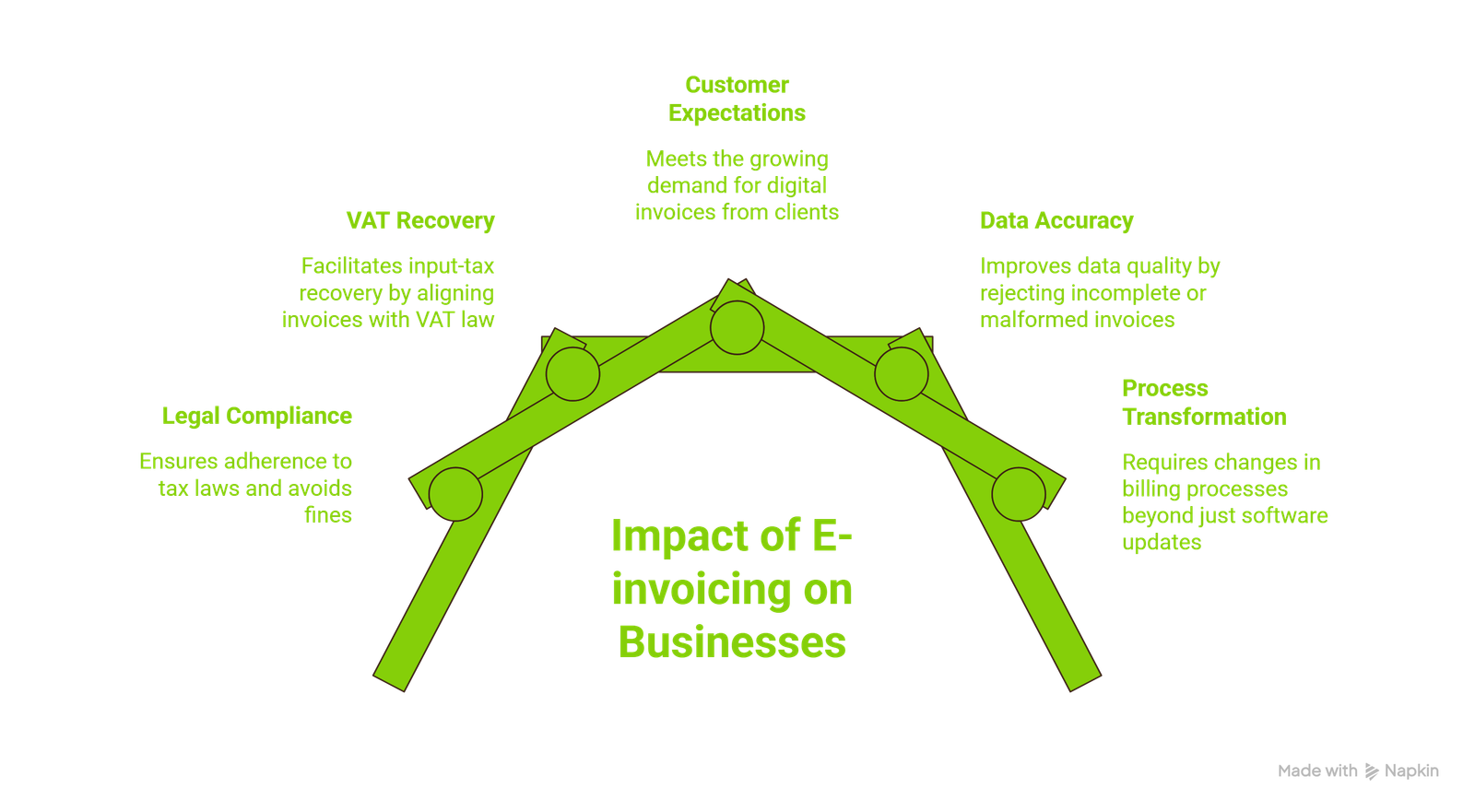
The Ministry and the FTA say the system will cut costs, improve accuracy across the invoicing cycle and strengthen voluntary tax compliance. With both parties’ ASPs reporting every in-scope invoice, the FTA gains a matched, transaction-level view of B2B trade. For your business, five things change:
- It is law, with published fines — from AED 100 per late invoice to AED 5,000 per month for failing to implement the system.
- It is now part of your VAT recovery. The amended VAT Law (Federal Decree-Law No. 16 of 2024) makes the e-invoice the tax invoice for businesses in the system and links input-tax recovery to holding it in line with the system.
- Your customers will expect it. Every in-scope business uses one ASP for sending and receiving, and large buyers go live in January 2027.
- Weak data becomes late payment. Invoices with missing or malformed fields are rejected at validation.
- Processes change, not just software. Recharges, management fees, advance payments and retention billing must all be issued as compliant structured invoices.
The legal framework
| Instrument | What it does | Date |
|---|---|---|
| Federal Decree-Law No. 17 of 2024 (Tax Procedures amendment) | Creates the Electronic Invoicing System | Effective 30 Oct 2024 |
| Federal Decree-Law No. 16 of 2024 (VAT amendment) | Makes e-invoices and e-credit notes the tax invoice and tax credit note | Effective 30 Oct 2024 |
| Ministerial Decision No. 64 of 2025 | ASP eligibility and accreditation | Mar 2025 |
| Ministerial Decision No. 243 of 2025 | Scope, exclusions, obligations, data fields, storage, system failures | Announced 29 Sep 2025 |
| Ministerial Decision No. 244 of 2025 | Pilot, voluntary adoption, phased deadlines | Announced 29 Sep 2025 |
| Cabinet Decision No. 106 of 2025 | Violations and administrative penalties | Announced 8 Dec 2025 |
| Ministerial Decision No. 56 of 2026 | Amends ASP accreditation rules | Effective 1 May 2026 |
| Ministerial Decision No. 66 of 2026 | Moves the large-business ASP deadline to 30 Oct 2026 | Announced 10 May 2026 |
Operational detail sits in the Ministry’s UAE Electronic Invoicing Guidelines V1.1 (1 June 2026) and the Mandatory Fields document (23 February 2026). The Arabic texts of the decisions are authoritative.
Who must comply
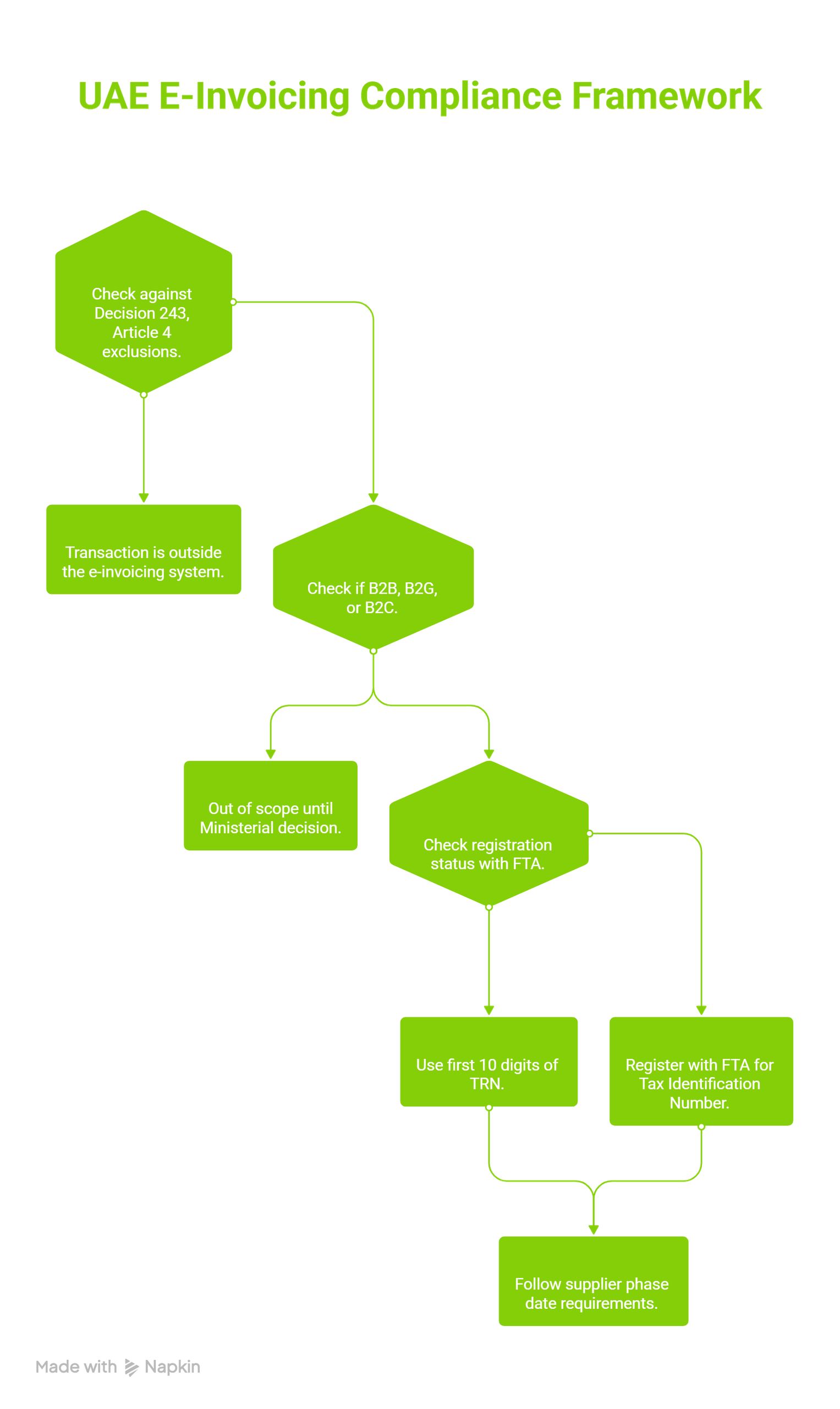
Any person conducting business in the UAE, for every business transaction, unless the person or transaction is specifically excluded (Decision 243, Article 3). That includes mainland and free zone companies, businesses that are not VAT-registered, and non-resident businesses trading here.
- No VAT registration? You must register with the FTA for a Tax Identification Number (TIN). VAT-registered businesses use the first 10 digits of their TRN.
- B2B and B2G are in scope from the supplier’s own phase date. A small supplier selling to a ministry follows July 2027, not the government’s October 2027 date.
- B2C is out of scope until the Minister issues a decision. Businesses selling only to consumers are outside the system for now.
Excluded transactions (Decision 243, Article 4):
- Government entities acting in a sovereign capacity, not in competition with the private sector
- International passenger air transport with an electronic ticket
- Ancillary airline services with an electronic miscellaneous document
- International air cargo with an airway bill — for 24 months from the system’s effective date only
- Financial services that are VAT-exempt or zero-rated under Article 42 of the VAT Executive Regulation
- Any other transaction the Minister determines
Read these narrowly. Standard-rated financial services and domestic reverse-charge supplies stay in scope. A holding company with only passive income is outside, but one recharge brings it in. Transactions inside a VAT group get a 24-month timing grace from 1 January 2027 — still in scope, only later.
How revenue is measured. The AED 50 million test uses gross income for the most recent accounting period, from financial statements prepared under UAE law or other documentation the FTA accepts. The threshold is revenue equal to or above AED 50 million. A newly established company uses projected revenue for the current year.
What the rules require
- Appoint one ASP from the Ministry’s official list — the same ASP for sending and receiving. Onboarding starts from your side through the FTA’s EmaraTax portal.
- Issue on time: within 14 days of the business transaction. VAT-registered businesses follow the VAT Law’s tax invoice timelines.
- Use the standard fields only: 51 mandatory fields for a tax invoice and 49 for a commercial invoice. No custom fields.
- Correct with e-credit notes for cancellations, price reductions, refunds and errors — never by deleting invoices.
- Receive electronically. Recipients must also process and report e-invoices through the system.
- Notify data changes to your ASP in writing within 5 business days.
- Report system failures to the FTA within 2 business days — issuers and recipients separately.
- Store records in line with Article 11 of Decision 243. The Decision says “within the State”; the Guidelines focus on the FTA being able to retrieve records wherever they are hosted. Confirm your arrangement with your ASP.
FTA administrative concessions on paper tax invoices do not carry over to e-invoices.

Penalties under Cabinet Decision No. 106 of 2025
| Violation | Penalty |
|---|---|
| Failing to implement the system, including failing to appoint an ASP on time | AED 5,000 per month or part month |
| Failing to issue and transmit an e-invoice on time | AED 100 per invoice, capped at AED 5,000 per calendar month |
| Failing to issue and transmit an e-credit note on time | AED 100 per credit note, capped at AED 5,000 per calendar month |
| Issuer failing to notify the FTA of a system failure on time | AED 1,000 per day or part day |
| Recipient failing to notify the FTA of a system failure on time | AED 1,000 per day or part day |
| Failing to notify the ASP of changes to registered data on time | AED 1,000 per day or part day |
Penalties start only from your mandatory date; voluntary adopters and pilot participants are exempt until then. They sit on top of existing VAT and tax procedures penalties under Cabinet Decision No. 40 of 2017.
What delay could cost — an illustration. A business that misses go-live by three months faces AED 15,000 for non-implementation alone. If invoice and credit-note penalties also apply, each capped at AED 5,000 a month, exposure could reach AED 45,000 for the quarter before daily fines. Illustrative only: the FTA has not confirmed how these penalty lines combine. The larger cost is usually commercial — rejected invoices and delayed collections.
Not sure which deadline applies to you? Book a 30-minute e-invoicing readiness consultation with Oak Business Consultant: calendly.com/oakbusinessconsultant/30min
Your readiness plan: two tracks
Track A — Revenue of AED 50 million or more (deadline sprint)
By 30 October 2026:
- Confirm the cohort and TIN for every legal entity, including each VAT group member.
- Choose and sign an ASP from the Ministry’s list; prioritise proven integration with your ERP.
- Start onboarding through EmaraTax and obtain your Peppol participant ID (0235 plus your 10-digit TIN).
November to mid-December 2026:
- Map ERP data against the 51 and 49 mandatory fields and close the gaps.
- Clean customer and supplier master data.
- Test end-to-end, including rejections, credit notes, advances and recharges. Consider going live voluntarily early — there is no penalty risk before 1 January.
By 31 December 2026:
- Write the system-failure procedure with a named owner and the 2-business-day FTA notice.
- Assign the 5-business-day data-change notice to your ASP.
- Train finance, sales and procurement teams.
Track B — Revenue below AED 50 million (90 days, finish well before 31 March 2027)
- Weeks 1–2: confirm cohort and TIN; map every invoice flow, including recharges, management fees, advances and credit notes.
- Weeks 3–6: run the data-field gap analysis, clean master data and shortlist ASPs. Compare ERP integration, security, support and pricing; every ASP must offer 100 free e-invoice exchanges a year from contract signature.
- Weeks 7–10: sign, onboard through EmaraTax and test end-to-end.
- Weeks 11–13: write failure and data-change procedures, train teams, and consider voluntary go-live before 1 July 2027.
Five common misconceptions
- “We are not VAT-registered, so this does not apply.” It does, unless you are specifically excluded.
- “30 October is our go-live.” It is the deadline to appoint an ASP; go-live is 1 January 2027.
- “Our accounting software covers it.” Only an accredited ASP can exchange and report e-invoices — check whether your software provider is itself accredited or integrates with one.
- “We only buy, so we can wait.” Recipients must also appoint an ASP and receive through the system.
- “A digital PDF is enough.” Under the Ministry’s definition it is not an e-invoice.
Frequently asked questions
When does e-invoicing start in the UAE? It is mandatory from 1 January 2027 for businesses with revenue of AED 50 million or more, from 1 July 2027 for all other in-scope businesses, and from 1 October 2027 for government entities as issuers. Voluntary adoption has been open since 1 July 2026.
Is e-invoicing mandatory for businesses that are not VAT-registered? Yes. It applies to any person conducting business in the UAE unless specifically excluded. Businesses without a tax registration must obtain a TIN from the FTA.
What is an Accredited Service Provider (ASP)? A provider accredited by the Ministry of Finance to validate, exchange and report e-invoices on your behalf over the Peppol network. Every in-scope business must appoint one, from the Ministry’s official list.
What is PINT AE? The UAE’s e-invoice data standard: an XML format based on the international Peppol invoice specification, with 51 mandatory fields for a tax invoice.
What are the penalties for non-compliance? AED 5,000 per month for failing to implement the system or appoint an ASP on time; AED 100 per late e-invoice or credit note, capped at AED 5,000 a month each; and AED 1,000 per day for late failure or data-change notices.
Does UAE e-invoicing apply to B2C sales? Not yet. Business-to-consumer transactions are outside the system until the Minister issues a decision.
How Oak Business Consultant helps
Oak Business Consultant helps UAE businesses turn e-invoicing from a compliance deadline into a cleaner order-to-cash and procure-to-pay process. Our readiness engagement covers:
- Cohort and scope confirmation for each entity
- Transaction and data-field gap analysis
- ASP shortlisting and selection support
- Master data clean-up and process redesign
- Controls for system failures, data changes and record storage
Book an e-invoicing readiness consultation: calendly.com/oakbusinessconsultant/30min. In 30 minutes we confirm your deadline, map your invoice flows and give you a prioritised action list.
Is your business ready for UAE e-invoicing? 📋
From 1 January 2027, businesses with revenue of AED 50M or more must issue and receive B2B invoices electronically, and appoint an Accredited Service Provider by 30 October 2026. All other businesses follow on 1 July 2027. Each late invoice can cost AED 100, up to AED 5,000 a month.
Take our free 5-minute E-Invoicing Readiness Assessment. Our finance and tax team will review your answers and send you a written gap list with clear next steps.
👉 Start here: Free UAE E-Invoicing Readiness Assessment
Related: UAE VAT registration · UAE VAT return filing · Accounting & bookkeeping in Dubai
This article reflects Ministry of Finance decisions and guidelines published up to 13 October 2026. Some decisions are still pending. It is general information, not tax or legal advice; confirm your position with a qualified adviser or the FTA before acting.