Overcoming Challenges as a First-Time Startup Founder
Introduction
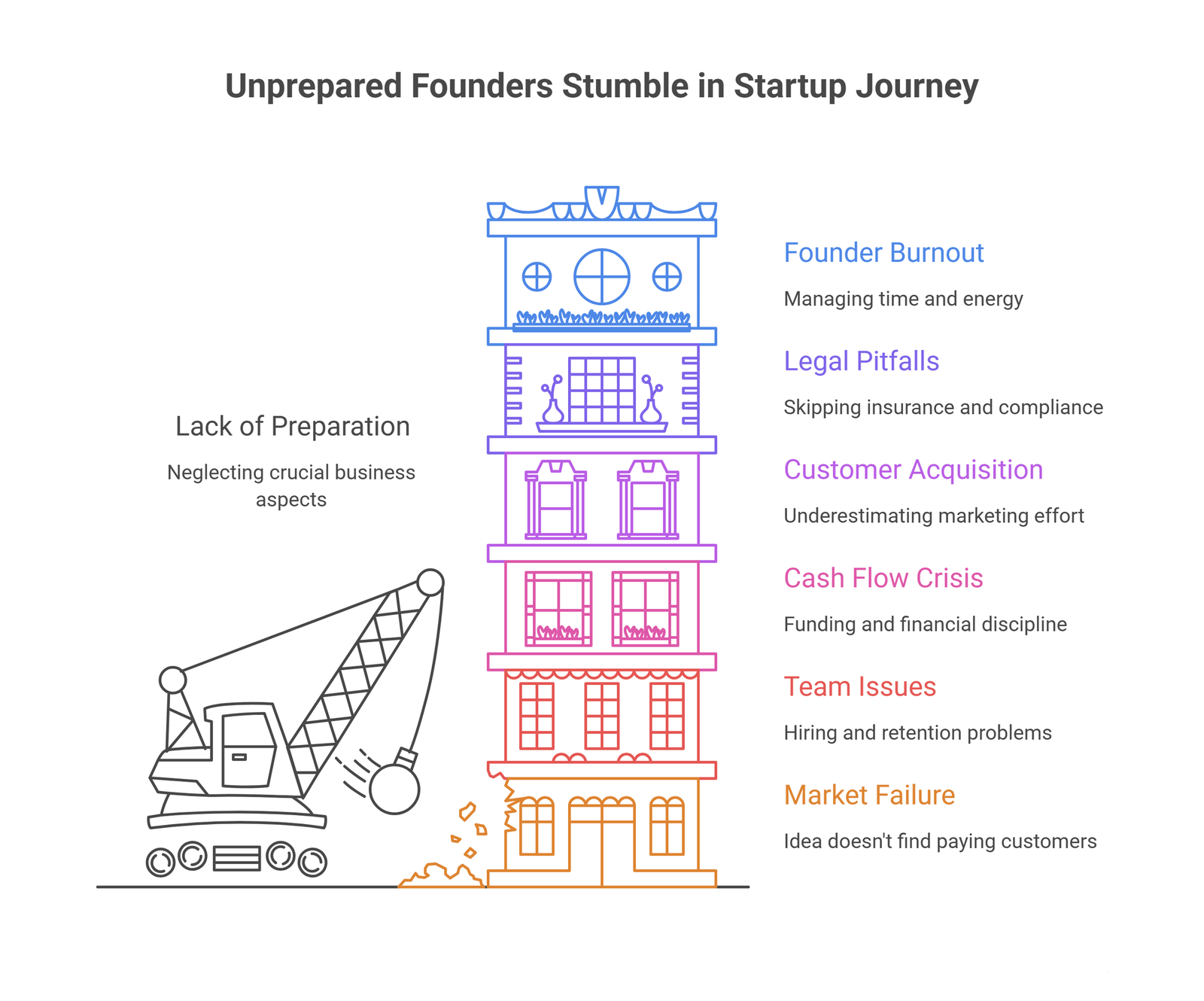
Most first-time founders don’t fail because the idea was weak. They fail because nobody told them how much of the job is finance, logistics, and personal endurance rather than vision. The excitement of launching gives way quickly to a long list of unglamorous problems: who to hire, how to fund it, how to keep cash in the bank, and how to keep showing up when nothing goes as planned. This guide walks through the challenges that catch new founders off guard, and what to actually do about each one.
Finding a market that will pay you
An idea only becomes a business once someone is willing to pay for it, and that gap is where most first-time founders get stuck. It’s tempting to build first and validate later, but that order almost always costs more time and money than it saves.
Validate before you build
Talk to potential customers before writing a line of code or ordering inventory. A basic landing page, a waitlist, or even a handful of paid pilot customers will tell you more about real demand than months of internal debate. If people won’t pay for a rough version, a polished one rarely changes their mind.
Segment before you market
Once you have some signal, break your audience into groups based on need, budget, and buying behavior. A single “everyone is my customer” pitch dilutes both your product decisions and your marketing spend. Pick the segment with the sharpest pain point and the clearest ability to pay, and build for them first.
Building a team that can execute without you
A founder’s vision is only as good as the people who can turn it into a working product, a sale, or a shipped order. Hiring badly in the first year is expensive twice over: once in salary, and again in the time it takes to notice the mismatch and fix it.
Hire for the stage you’re actually in
Early hires need to be comfortable with ambiguity and willing to do work outside their job title. A brilliant hire from a large company doesn’t always translate into a good early-stage hire. Look for people who have built something from nothing before, even if it wasn’t in your industry.
Keep people once you’ve found them
Retention matters more at a startup than almost anywhere else, since replacing someone in month four costs you months of momentum. Clear roles, honest feedback, and a real path for growth do more to keep good people than perks. Equity or performance-based incentives help too, particularly for hires who are taking a pay cut to join you.
Funding the business and keeping cash flow alive
Funding gets the headlines, but it’s cash flow discipline that determines whether a startup survives long enough to use that funding well. This is where a founder’s financial literacy, or lack of it, shows up fastest.
Match the funding source to the stage
Bootstrapping preserves control but limits speed. Angel investment and venture capital bring speed and expertise but dilute ownership and add reporting obligations. Crowdfunding validates demand publicly but takes real marketing effort to pull off. Grants are close to free money but slow and narrow in eligibility. None of these is universally “best”; the right one depends on how fast you need to move and how much control you’re willing to trade for it.
| Funding source | Best suited for | Main trade-off |
| Bootstrapping | Founders who can grow slowly and keep full control | Limited speed and capital |
| Angel investment | Early traction, need for mentorship as well as cash | Some equity dilution, investor involvement |
| Venture capital | High-growth, scalable models needing large capital | Significant dilution, board oversight, growth pressure |
| Crowdfunding | Consumer products with a compelling story | Requires strong marketing, public exposure of numbers |
| Grants | Founders in eligible sectors or regions | Slow, competitive, narrow use restrictions |
Run the numbers like a CFO, even before you can afford one
A well-built financial model does more than impress investors. It tells you, in advance, how many months of runway you actually have and where cash gets tight before it happens. Founders who track burn rate and runway weekly catch problems while there’s still time to fix them; founders who check the bank balance monthly often find out too late. If building and reading that model isn’t your strength, it’s usually cheaper to bring in fractional CFO support early than to learn the hard way what a cash crunch costs.
Winning your first customers without a marketing budget
Even a strong product goes nowhere if nobody hears about it, and most first-time founders underestimate how much deliberate effort customer acquisition takes. Founders who assume the product will “market itself” are usually the ones who run out of cash waiting for word of mouth to kick in.
Start with channels that don’t require a budget: founder-led content, direct outreach to your validated segment, and partnerships with businesses that already reach your audience. Track where each customer actually came from, not where you assume they came from, and double down on whichever channel is working rather than spreading effort evenly across all of them.
Protecting the business: insurance and risk
Insurance rarely makes anyone’s list of exciting founder decisions, which is exactly why it gets skipped until something goes wrong. It’s a smaller line item than most founders expect, and a much bigger problem when it’s missing.
Life insurance protects co-founders, employees, and the business itself if something happens to a key person the company depends on financially. Business insurance, covering liability, property, and workers’ compensation, protects against lawsuits, damages, or accidents that could otherwise wipe out a young company’s cash reserves. Neither is glamorous, but both are cheap relative to the downside they cover.
Getting the legal and regulatory basics right
Legal structure affects liability, taxation, and how easily you can raise money later, which makes it worth getting right from the start rather than fixing retroactively. Sole proprietorships are simple but expose personal assets; corporations and LLCs offer more protection and are usually what investors expect to see.
Intellectual property, trademarks, copyrights, patents, and trade secrets, is worth protecting early, before a competitor or former employee makes it a legal fight instead of a filing. Ongoing compliance, from data privacy to labor law, tends to be industry specific, so a periodic check-in with a legal advisor is worth the cost compared to a penalty later.
Managing your own time and energy
Founders wear every hat in the first year, and the resulting workload is one of the most common reasons promising startups stall, not because the business failed but because the person running it burned out. This challenge gets far less attention than funding or hiring, but it shapes how well a founder handles both.
Prioritize the handful of tasks that actually move the business forward and delegate or defer the rest. Build a support network of mentors, peers, or fellow founders who understand the specific pressure of the role; trying to carry it alone tends to slow decision-making rather than speed it up. Treat rest as part of the job, not a reward for finishing it, since a founder operating on empty makes worse calls than one who’s paced themselves.
Frequently Asked Questions
What is the biggest challenge for first-time startup founders?
Most founders point to funding, but a lack of financial visibility, not knowing burn rate or runway in real time, is often the deeper problem underneath it.
How much runway should a first-time founder have before raising funds?
There’s no universal number, but founders are better positioned when they know exactly how many months of cash they have left before they start fundraising, not after.
Do startup founders need business insurance from day one?
Not necessarily from day one, but it should be in place before you hire employees, sign a lease, or take on clients, whichever comes first.
How do I find the right co-founder or early team members?
Prioritize people who’ve operated in ambiguity before and whose values match your working style, since technical skill is easier to hire for than judgment under pressure.
What legal structure is best for a first-time startup founder?
It depends on liability exposure and fundraising plans; an LLC or corporation is usually preferred once you plan to raise outside capital.
How can a fractional CFO help a first-time founder?
A fractional CFO brings financial modeling, cash flow discipline, and investor-ready reporting without the cost of a full-time hire, which matters most in the exact stage where cash is tightest.
When should a startup founder start marketing?
As soon as you’ve validated demand with a defined segment, not after the product is finished; early marketing efforts also double as additional validation.
Conclusion
None of these challenges disappear once you clear them; market fit, team, funding, customer acquisition, risk, compliance, and your own bandwidth all keep resurfacing in new forms as the business grows. What changes is how quickly you recognize the pattern and how much groundwork you’ve already laid to respond to it. Founders who treat the financial side of the business as seriously as the product side tend to be the ones still standing in year three.
If cash flow, fundraising strategy, or financial planning feels like the part of this list you’re least equipped for, that’s exactly where Oak’s CFO services for startups are built to help, alongside fundraising consulting and investor-ready business plans for founders preparing to raise.