Why Virtual CFO in Education is the future of the Educational Industry?
Virtual CFO for education: budgeting as student numbers fall
A school or college spends money before it earns any. Teachers are hired in spring. Fees arrive in autumn, and sometimes later. If enrollment lands 5% below plan, the payroll does not shrink to match.
That timing problem is now sharper. In the United States, the number of high school graduates peaked at about 3.9 million in 2025. The Western Interstate Commission for Higher Education (WICHE) projects roughly 3.4 million by 2041, a 13% drop, as Fortune reported in August 2026. Other countries have their own demographics, but the planning problem is the same: fixed costs and uncertain intake.
A virtual CFO gives a school, college or training institute senior financial leadership without a full-time executive salary. This guide explains what that person does, which numbers they watch and when to bring one in.
Why education finance is harder than it looks
Education budgets are not like retail or software budgets. Four features make them tricky.
First, costs are front-loaded. Staff, facilities and insurance are committed before the term starts. Second, revenue depends on enrollment, which is only confirmed late. Third, money comes with strings. A donor gift, a government grant and tuition fees each carry different rules. Fourth, boards, regulators and parents all expect clear reporting.
In the US, for example, the Every Student Succeeds Act requires state education agencies to publish school-by-school per-pupil spending. Federal money made up only about 11% of public school revenue in 2020-21, according to NCES data. Most funding comes from other sources that shift with local politics and the economy.
Many institutions still run this with a bookkeeper and a principal or registrar. That works until a funding source changes or enrollment misses forecast.
The enrollment squeeze, in numbers
The decline is uneven. WICHE’s projections, as reported by Higher Ed Dive and others, show sharp regional differences.
| Region or state | Projected change in high school graduates | Period |
| United States (national) | About -13% (3.9M to about 3.4M) | 2025 to 2041 |
| Northeast | About -17% | After the 2025 peak |
| Midwest | About -16% | After the 2025 peak |
| West | About -20% | After the 2025 peak |
| New York | -27% | 2023 to 2041 |
| Illinois | -32% | 2023 to 2041 |
Pressure is already visible. Robert Kelchen, a professor who studies higher education finance, told Fortune that nearly every US college faces some financial strain. A scenario in Education Next found that a 15% enrollment decline over five years would cause 23 additional college closures.
There is a counterweight. WICHE found that raising the college-going rate by just 0.5% a year would offset the shortfall from demographics. Institutions that retain more students, or serve adult and part-time learners, can change their own outcome. Planning for both cases is the CFO’s job.
K-12 schools faced a related cliff when pandemic relief money expired in September 2024, according to Axios. Budgets built on temporary funds had to be rebuilt.
What a virtual CFO does inside an educational institution
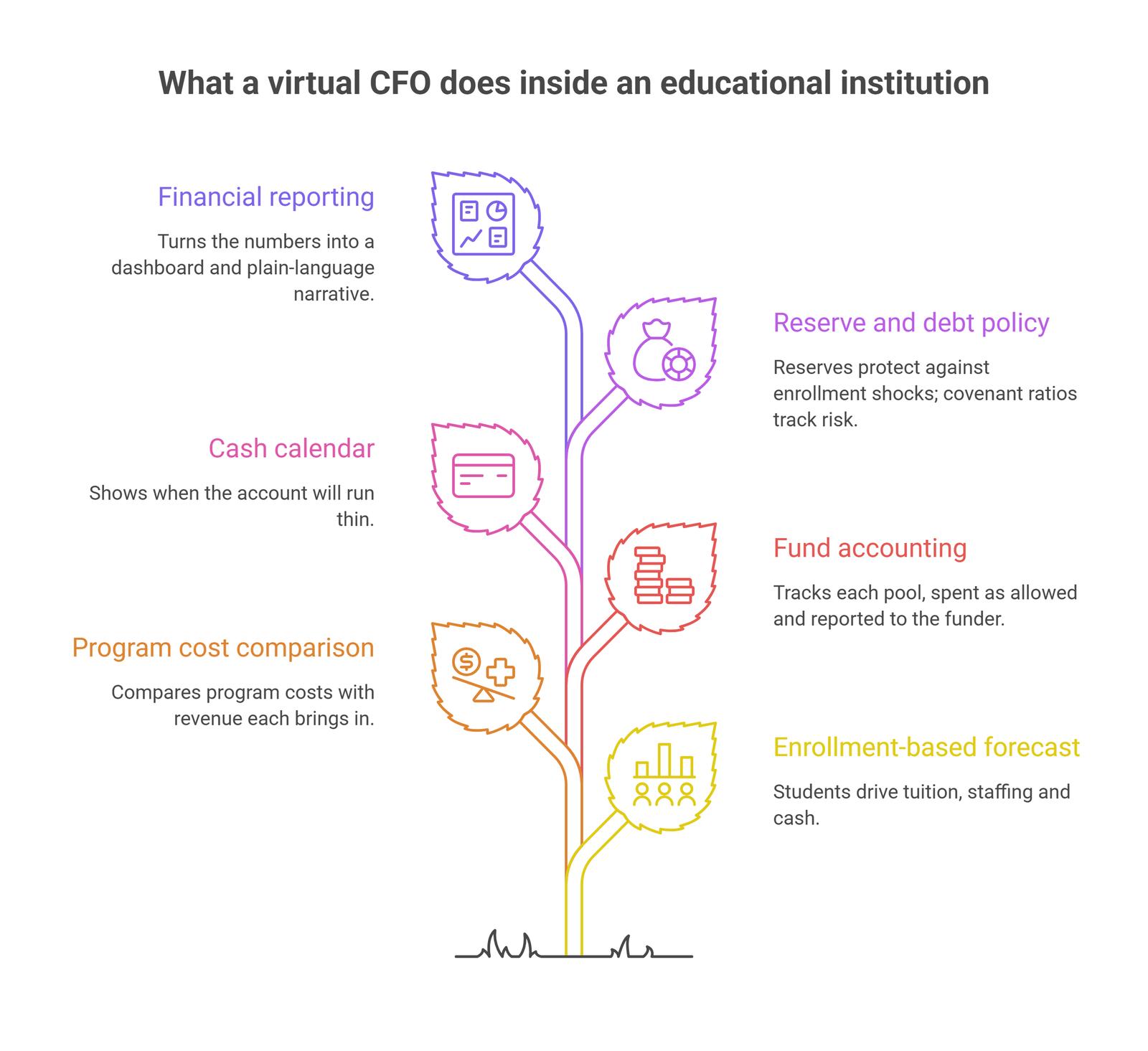
Build an enrollment-based forecast
The forecast starts with students, not dollars. How many will apply, enroll and return next year? Each answer drives tuition, staffing and cash. The CFO builds three scenarios, usually base, downside and recovery, and shows the board what each one costs.
Test whether each program pays for itself
Many institutions do not know which programs lose money. The CFO assigns direct and shared costs to each program, then compares them with the revenue each brings in. That is how a board decides whether to grow, redesign or close a course. Retired programs should be a choice, not a surprise.
Separate restricted and unrestricted money
A grant for a lab cannot pay for payroll. A donor’s scholarship fund cannot cover a roof repair. The CFO sets up fund accounting so each pool is tracked, spent as allowed and reported to the funder. This protects eligibility for future grants.
Manage the cash calendar
Fees and grants arrive in bursts. Payroll and rent do not. A 13-week cash forecast shows when the account will run thin, and the CFO plans around it. That might mean staged fee collection, vendor timing or a short-term credit line arranged early.
Set reserve and debt policy
Reserves protect against enrollment shocks. The CFO sets a target, such as a number of months of operating costs. They also write a rule for when the board can draw on it. For institutions with loans or bonds, they also track covenant ratios so that a bad term does not trigger a breach.
Report to boards, funders and regulators
Board members are often teachers, parents or donors, not finance people. The CFO turns the numbers into a one-page dashboard and a plain-language narrative. Audit-ready records follow from that discipline.
The numbers an education CFO watches
| Metric | What it tells you |
| Net tuition revenue per student | Revenue after discounts and scholarships |
| Discount rate | Share of gross tuition given back as aid |
| Retention rate | How many students return, term to term |
| Cost per program | Whether each course covers its own costs |
| Fee collection rate and receivables age | How quickly fees convert to cash |
| Months of operating cash on hand | Resilience to a bad enrollment year |
| Student-to-staff ratio | Staffing level against intake |
| Debt service coverage | Ability to pay loans from operating surplus |
Oak’s article on chart of accounts and bookkeeping for the education industry shows how to set up the books so these numbers come out cleanly.
Scholarships and pricing: the hardest trade-off
Every institution wants to be accessible. Every institution also has bills to pay. The CFO’s task is to model the trade-off so leaders can decide with open eyes.
For example, a college can test what happens if it raises aid by two points for a target group. Will extra enrollment cover the lost revenue? The model gives a range, not a promise. That is still better than guessing.
A virtual CFO can also advise on fee structures, payment plans and early-payment discounts. These affect both enrollment and cash timing.
Virtual CFO, in-house CFO or business manager
Many schools already have a bursar or business manager. A virtual CFO does not replace that person. The two roles overlap but are not the same.
| Role | Main focus | Typical gap |
| Bursar or business manager | Daily operations, payments, payroll, compliance | Limited strategy and forecasting time |
| Virtual or fractional CFO | Strategy, forecasting, reporting, funding | Not on site every day |
| Full-time CFO | All of the above, in-house | Cost and size of the institution |
Smaller institutions often pair a business manager with a virtual CFO. Oak’s comparison of a virtual CFO and an in-house CFO helps weigh that choice. Oak also explains how fractional CFO services are structured.
Signs your institution needs one
- Enrollment missed forecast by a meaningful margin in the last two years.
- The board gets financial reports late or in a format it cannot use.
- You cannot say which programs make or lose money.
- Grant or donor reporting takes weeks.
- A capital project, new campus or loan is on the table.
- Your finance lead has left, and the replacement search is open.
What the first 90 days can look like
Every engagement differs, but a typical start looks like this.
In the first month, the CFO reviews the books, fee records, payroll and funding agreements. They also interview the head, the board chair and the business manager. In the second month, they build the enrollment-based forecast and a 13-week cash view. In the third month, they present program profitability, reserve targets and a draft board dashboard.
By then, leaders can see where the money goes and what the next two years might look like.
Frequently Asked Questions
What is a virtual CFO for a school or university?
A virtual CFO is a senior finance professional who works remotely and part time for several organizations. They provide budgeting, forecasting, cash management and reporting for the institution.
Is a virtual CFO the same as an outsourced or fractional CFO?
In practice, yes. The terms describe the same model: senior finance leadership on a part-time basis. Some firms use “virtual” to stress remote work.
Can a virtual CFO manage grants and restricted funds?
Yes. Setting up fund accounting, tracking spending against grant terms and preparing funder reports is a core part of the work.
How does a virtual CFO help when enrollment is falling?
They build downside scenarios, test program profitability, plan cash and reserves, and model pricing and aid choices. The goal is to act early, before a shortfall forces cuts.
Does a small private school need a CFO?
Not full time. A virtual CFO for a few days a month is often enough for a school with a few hundred students. The need grows with complexity, such as loans, multiple campuses or large grants.
What should a school look for when hiring a virtual CFO?
Look for education or nonprofit experience, comfort with fund accounting and examples of board reporting. Ask for a clear scope, a fixed monthly fee and named deliverables.
Closing thought
Education leaders rarely lack ideas. They lack time to test whether the ideas are affordable. A virtual CFO gives them that test before they commit. The institutions that come through a decade of smaller cohorts will mostly be the ones that planned early and cut deliberately.
If your institution needs senior finance support, Oak Business Consultant offers virtual CFO services tailored to education. If you are planning a new school, the private school financial model is a good place to begin.