Understanding the Role of CFO: A Basic Guide
The role of a CFO: how the job changes from startup to listed company
A CFO at a 15-person startup and a CFO at a listed company share a title and almost nothing else on a typical Tuesday. One is checking whether payroll clears next month. The other is preparing to certify results to regulators.
Most guides list the same duties and stop there. This one asks a different question: what does the CFO actually decide, answer for, and manage at each stage of a company’s growth? It also explains how the role differs from a controller and a CEO, and where fractional models fit.
What a CFO owns
The CFO is the senior executive responsible for a company’s financial health and for the financial side of its strategy. The CFO reports to the CEO, sits on the executive team, and answers to the board on financial matters.
Deloitte describes the modern CFO through four roles: steward, operator, strategist, and catalyst. The first two protect the numbers and run the finance function. The last two shape direction and push the business to act. Our guide on how a CFO influences strategic decisions covers the strategist and catalyst work in depth.
What the CFO decides, not just what the CFO does
Every guide lists duties. What separates a CFO from an accountant is the judgment behind each one. The day-to-day task list is covered in our guide to what a virtual CFO does. Here is where the judgment sits.
On cash, the principle is simple: profit does not pay suppliers. Cash does. The CFO decides how much cash to hold, which bills to pay early, and when a growth plan has outrun the bank balance. A junior accountant can run a cash report. The CFO decides what to do about it.
On reporting, the CFO is accountable for statements that follow US GAAP or IFRS. The judgment calls are in the gray areas: when revenue counts, how a reserve is sized, and what the board needs to hear first.
On planning, the CFO sets the budget and decides which plan changes are worth making when actuals drift. A forecast is only as good as its track record, which is why we explain how a CFO measures forecast accuracy.
On funding, equity, debt, or retained cash each carry a different cost in ownership and risk. The CFO builds the case for one and tells the CEO what the others would cost.
On risk, the CFO decides which exposures to accept, such as one customer making up a third of revenue, and which to fix first. Internal controls, like separating who approves a payment from who releases it, are the safeguards.
How the CFO role changes by company stage
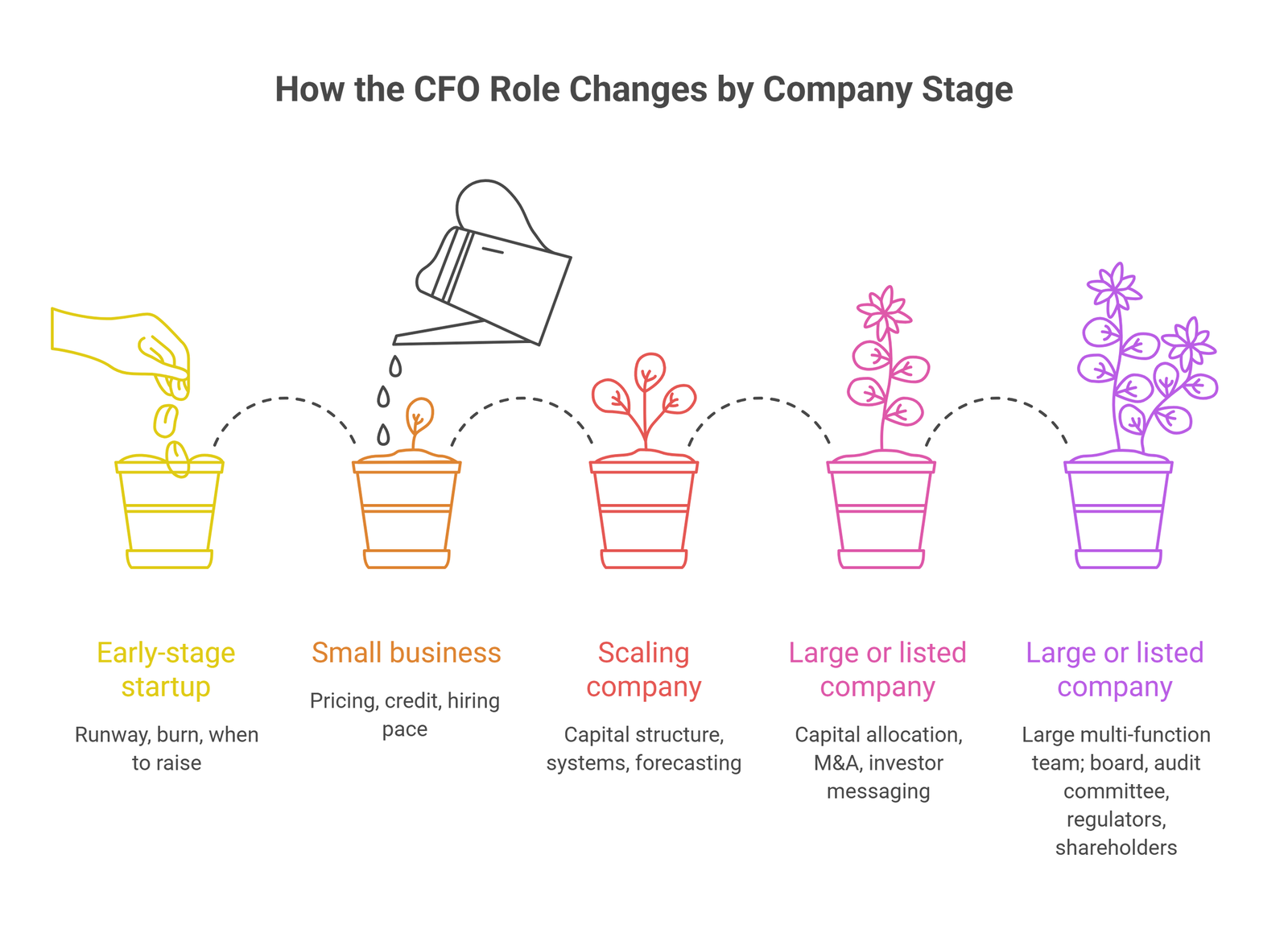
The same title covers very different work. This table shows how decisions, accountability, team, and board involvement shift as a company grows.
| Early-stage startup | Small business | Scaling company | Large or listed company | |
| Main decisions | Runway, burn, when to raise | Pricing, credit, hiring pace | Capital structure, systems, forecasting | Capital allocation, M&A, investor messaging |
| Accountable to | Founders and investors | Owner | CEO, board, lenders | Board, audit committee, regulators, shareholders |
| Finance team | None or one bookkeeper | Bookkeeper and an outside accountant | Controller, FP&A, finance operations | Large multi-function team |
| Board involvement | Informal investor updates | Often none | Regular board packs | Formal reporting and committee oversight |
Early-stage startup
Few startups have a full-time CFO. The founder usually handles finance until the first raise, then brings in a fractional or part-time CFO.
The work is narrow and urgent: how many months of cash remain, what the next round should look like, and whether the model will survive investor questions. There is little process to manage and a lot of judgment to apply. Most startups bring in a CFO only when a raise or a cash squeeze forces the question.
Small and mid-sized business
Here the CFO, or a senior finance lead, works for an owner who often still approves large spending personally. The CFO is closer to a financial adviser than an executive with a large team.
Typical decisions include which customers to extend credit to, whether a price rise will hold, and whether a loan makes sense now. The team is small, so the CFO often works directly with the bookkeeper and an outside accountant. Board involvement is light, so the CFO has to push hard to be heard on important decisions.
Scaling company
Growth changes the job. Spreadsheets break, reporting takes too long, and investors expect better forecasts. The CFO’s focus moves from doing the work to building the finance function.
That means hiring a controller and FP&A staff, choosing systems, and setting up board reporting. The CFO also manages capital structure, since more debt or a new equity round becomes a regular decision. Accountability rises: lenders and board members now expect packs on a fixed schedule.
Large or listed company
At this level, compliance and investor communication take up much of the CFO’s time. In the United States, the Sarbanes-Oxley Act of 2002 requires the CEO and CFO of public companies to certify their financial reports personally. An audit committee of the board oversees the CFO’s work.
The CFO delegates most hands-on accounting and spends time on capital allocation, acquisitions, treasury, and investor relations. The team is large, and the CFO manages leaders more than transactions.
CFO vs controller vs CEO
| Role | Main question | Focus |
| Bookkeeper | Were transactions recorded correctly? | Daily entries, reconciliations |
| Controller | Are the books accurate and closed on time? | Accounting, close, controls |
| CFO | What should the company do with the numbers? | Strategy, capital, forecasting, risk |
| CEO | Where is the company going? | Overall direction and leadership |
For a fuller comparison, see our guide on controller vs CFO.
Full-time, fractional, and virtual CFOs
Not every company needs a full-time CFO. A full-time CFO suits complex operations or heavy investor demands. A fractional CFO works part-time on a retainer, and a virtual CFO delivers the work remotely. Most providers do both.
Complexity matters more than company age. Our guide to what a fractional CFO is explains how the model works and who it suits.
Frequently Asked Questions
What is the main role of a CFO?
The CFO manages a company’s finances and helps shape its strategy. That covers cash, reporting, planning, funding, and risk.
Does a small business need a CFO?
It often needs the work a CFO does, though not always a full-time hire. Cash forecasting, pricing analysis, and fundraising support are the usual reasons small companies bring in a part-time or virtual CFO.
What is the difference between a CFO and a CEO?
The CEO sets overall direction and leads the company. The CFO owns financial strategy and control, and tests whether the CEO’s plans are affordable.
Does a CFO sign off on financial statements?
At US public companies, yes, by law under Sarbanes-Oxley. At private companies the CFO still takes responsibility for accuracy, though no formal certification applies.
How does the CFO role differ in a startup and a large company?
In a startup, the CFO handles cash, fundraising, and the financial model with almost no team. In a large company, the CFO manages leaders and focuses on compliance, capital allocation, and investor relations.
Conclusion
The CFO title describes a function, not a fixed set of tasks. The useful question for a business owner is which of these jobs is not getting done today, and what that costs.
If big financial decisions in your business are made without a senior finance voice, Oak Business Consultant’s CFO services can fill that gap. Contact us to discuss what stage your business is at and what it needs.