How to Start a Hospitality Business
How to start a hospitality business without running out of cash first
Most guides to starting a hospitality business are long on inspiration and short on numbers. They tell you to “conduct market research” and “secure financing” without saying what a liquor license actually costs, what a line cook actually earns, or how many months of working capital you actually need before the doors even open.
This guide keeps the numbers in. Whether you are opening a boutique hotel, a restaurant, a food truck, a tour company, or an event venue, the steps below cover what each one costs, which licenses take the longest to get, and which financial habits separate operators who make it past year one from those who do not.
What you’re actually stepping into
Hospitality is not one industry, it is four: accommodation (hotels, bed and breakfasts, vacation rentals), food service (restaurants, food trucks, catering), tourism and experiences (travel agencies, tour operators, charters), and events (venues, planning services). Each has a different cost structure, a different regulatory path, and a different timeline to profitability, so the first decision that matters is which of these four you are actually building.
The sector remains one of the largest employers in the world and keeps adding jobs, but it is also unusually unforgiving of undercapitalized launches. Thin margins, seasonal demand, and high staff turnover mean that most hospitality businesses fail from a cash problem, not a concept problem. That single fact should shape almost every decision in this guide.
Step 1: Validate the idea before you write a business plan
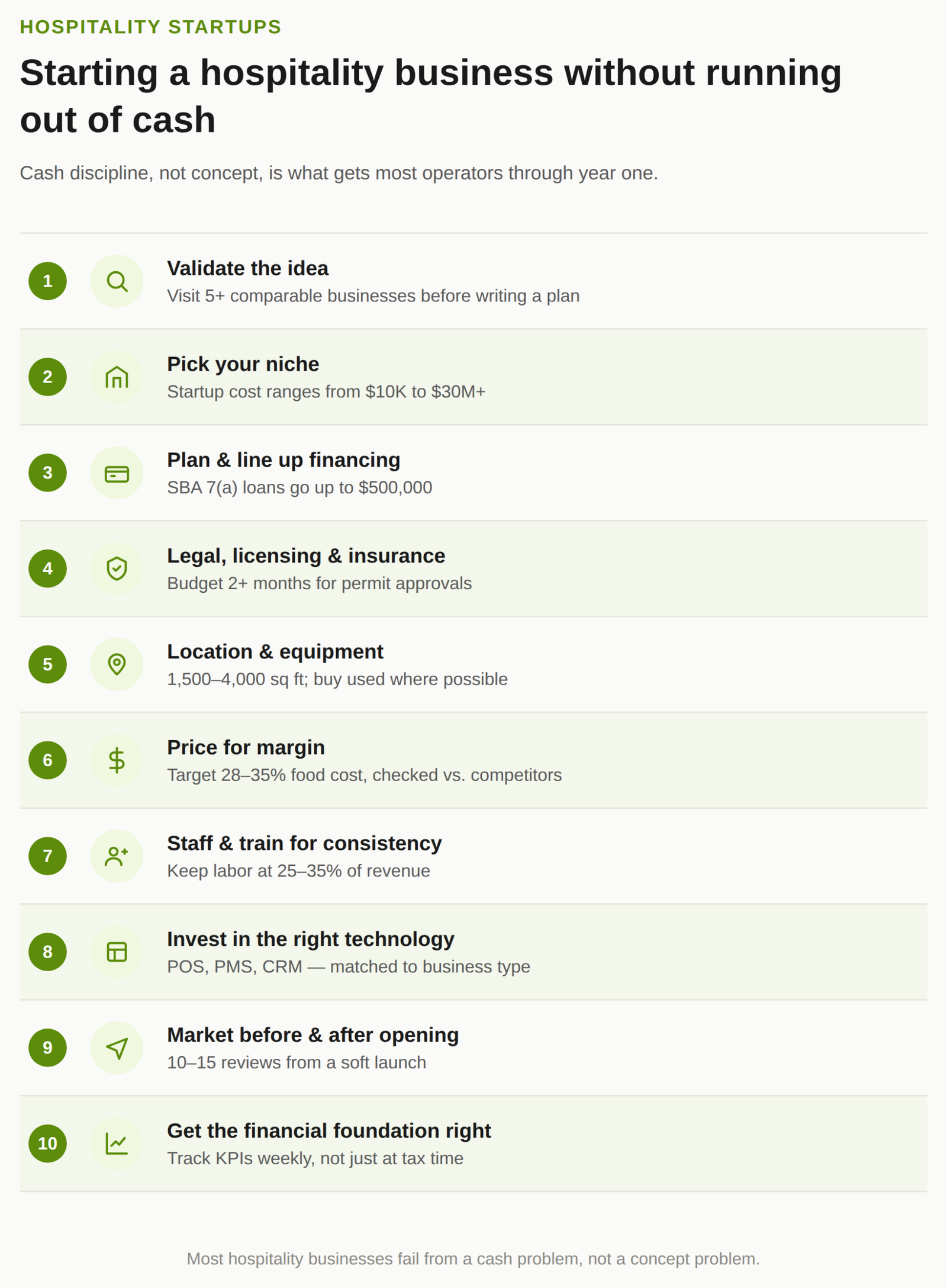
Do not skip straight to the business plan. Visit at least five comparable businesses in your target area, at different times of day and different days of the week, and watch how they actually operate: who walks in, what they order or book, how full they are at peak hours. This on-the-ground observation catches things that industry reports from IBISWorld or Statista never will.
Pair that with structured research: your ideal customer’s demographics, spending capacity, and specific pain points. A business traveler booking a boutique hotel wants something different from a family booking a vacation rental, and a tour company built around fishing charters serves a different customer than one built around city food tours. Get this wrong and no amount of marketing budget fixes it later.
Step 2: Pick your niche and know what it actually costs
Startup costs vary more within hospitality than in almost any other industry, so pin down your segment before you build a budget.
| Business type | Typical startup cost | Main cost drivers |
| Food truck | $50,000 – $200,000 | Vehicle and kitchen build-out, permits, initial inventory |
| Small cafe | $100,000 – $300,000 | Lease and renovation, equipment, working capital |
| Mid-size restaurant | $300,000 – $1,000,000+ | Lease/renovation ($75K–$300K), kitchen and bar equipment ($50K–$175K), 6 months working capital ($50K–$150K) |
| Bed and breakfast | $200,000 – $1,000,000 | Property acquisition or lease, renovation, furnishings |
| Small boutique hotel (10–20 rooms) | $1,000,000 – $5,000,000 | Land, construction or renovation, FF&E |
| Full-service hotel (100+ rooms) | $15,000,000 – $30,000,000+ | Land (~$34K/room), construction (~$220K/room), soft costs (~12% of budget) |
| Travel agency or tour company | $10,000 – $50,000 | Licensing, website, marketing, office setup |
| Event venue | $150,000 – $750,000+ | Space acquisition or lease, buildout, vendor relationships |
Working capital is the line every first-time operator underestimates. Budget six months of payroll, rent, and inventory on top of your startup costs, not instead of them. A lack of working capital, not a lack of customers, is the most common reason new hospitality businesses close within their first year.
Step 3: Build the business plan and line up financing
Your business plan needs an executive summary, a company analysis with your value proposition, an industry analysis, a SWOT-based competitive analysis, and three years of financial projections covering startup costs, monthly operating expenses, revenue, cash flow, and your break-even point. Lenders and investors will read the financial section closest, so it needs to hold up to scrutiny, not just look complete.
On financing, know your real options:
- SBA 7(a) loans are the most common starting point for hospitality, with financing up to $500,000 and interest rates typically in the range of Prime plus 2.25% to 4.75%. Lenders generally want a personal credit score above 680 and a detailed business plan.
- Equipment financing lets you lease kitchen or property equipment instead of buying it outright, freeing up cash for the working capital reserve.
- Angel investors and venture capital fit high-growth concepts (multi-location restaurant groups, hospitality tech-enabled brands) more than a single independent location, since both typically want equity and a growth story.
- Grants, such as those from the National Restaurant Association Educational Foundation, exist but are competitive and rarely cover a meaningful share of startup costs on their own.
Whatever the mix, present it with real numbers. Vague financial projections are the fastest way to lose a lender’s attention.
Step 4: Handle legal structure, licensing, and insurance
Most hospitality owners register as an LLC for liability protection with manageable tax complexity, then apply for a free Employer Identification Number (EIN) from the IRS, which you will need for banking, taxes, and hiring.
License timelines are where new operators lose the most time. Build these into your opening timeline, not as an afterthought:
- Liquor license: 4–6 months, $300 to over $14,000 depending on state and license class.
- Food service license: issued by the county health department, typically $100–$1,000.
- Certificate of occupancy and building permits: timeline varies by jurisdiction, but a delay here can stall your entire opening even if every other permit is ready.
- Industry-specific permits: fishing or coast guard licenses for water-based tour operators, entertainment licenses for event venues, hotel occupancy permits for accommodation businesses.
Build at least a two-month buffer into your project timeline for approvals, since a single delayed permit can push back an entire opening date.
Insurance is not optional and it is not one policy. Budget for:
- General liability: $1 million to $2 million in coverage, with combined property and liability premiums often starting around $3,000–$7,000 a year for a small to mid-size operation.
- Workers’ compensation: legally required once you have employees.
- Liquor liability: required if you serve alcohol, often adding $2,000–$10,000 annually depending on payroll and sales volume.
- Business interruption coverage: usually an affordable rider on your property policy, and the one new owners skip most often, right before a fire, flood, or extended closure makes it the policy that would have saved the business.
Working with an insurer that specializes in hospitality tends to price these risks more accurately than a general commercial agent would.
Step 5: Choose your location and lock in equipment
For food service and accommodation, look for 1,500 to 4,000 square feet in a commercially zoned area, confirmed directly with your local planning department before you sign anything. When negotiating a lease, ask about a Tenant Improvement allowance, a landlord contribution toward build-out costs that can meaningfully reduce your upfront cash outlay.
Tourism and event businesses have more location flexibility. Travel agencies and tour operators can run from lower-cost office space, or remotely, and put the budget into digital presence instead. Event venues need to weigh parking capacity and local zoning for events as heavily as aesthetics.
On equipment, buying everything new is the single most common overspend. Certified used-equipment dealers and restaurant auction houses can cut this budget substantially without sacrificing reliability, and suppliers like WebstaurantStore or Restaurant Depot are reasonable starting points for smallwares and new purchases.
Step 6: Price for margin, not guesswork
Cost-plus pricing is the standard for food and beverage: calculate the exact ingredient cost of a dish, then divide by your target cost percentage. A dish that costs $4 to make, priced against a 33% target food cost, sells for roughly $12. Target 28–35% for food cost, 20–25% for beer, and 35–45% for wine, as a share of the menu price.
Once you have cost-based prices, check them against at least three direct local competitors. Pricing purely on cost, with no read on what the neighborhood will actually pay, is how menus end up too expensive for the location or too cheap to signal quality. For hotels, the equivalent discipline is dynamic pricing tied to demand, season, and local events, monitored through RevPAR (revenue per available room) rather than a flat nightly rate.
Step 7: Staff and train for consistency, not just headcount
Wages vary by role and region, but rough U.S. benchmarks for a mid-size restaurant look like this: General Manager $50,000–$75,000 a year, Head Chef $60,000–$90,000 a year, line cooks $18–$25 an hour, with servers and bartenders typically at minimum wage plus tips. Hotels need front desk, housekeeping, maintenance, and food and beverage staff on similar bands; tour companies need guides and booking coordinators.
Underpaying to save money is the most common staffing mistake in the industry, and it shows up later as turnover, not savings. Keep total labor cost between 25% and 35% of revenue rather than cutting wages to hit an arbitrary number.
Before opening, confirm certification requirements: a Food Handler’s Card (commonly through ServSafe) for food service staff, and an Alcohol Server Certification such as TIPS for anyone serving alcohol. Scheduling software like 7shifts or Homebase helps align staffing levels with sales forecasts once you are open.
Step 8: Invest in the technology that actually earns its cost
Match the tech stack to the business type rather than buying everything available. Hotels need a Property Management System for reservations and check-in/out, plus revenue management software. Restaurants need a modern POS system, kitchen display systems, and inventory management to control waste. Every hospitality business benefits from accounting software, a CRM for guest history, and review management tools, since online reputation now drives bookings as much as location does.
Step 9: Market before you open, and keep marketing after
Claim your Google Business Profile the day you have an address, well before opening. Aim for 10 to 15 honest reviews from a soft launch before your official opening, and respond to every review, positive or negative, within 24 hours. Ignoring negative reviews is one of the fastest ways to lose the trust of prospective guests who are reading them.
Beyond that, the playbook differs by segment: food businesses benefit from local food bloggers and delivery platform visibility; hotels and event venues benefit from partnerships with corporate clients and wedding or event planners; tour operators benefit disproportionately from strong presence on TripAdvisor and similar review platforms, since that is where their buyers actually decide.
Step 10: Get the financial foundation right from day one
This is the step most “how to start a hospitality business” guides skip, and it is usually the one that determines whether the business survives its first hard season. Hospitality runs on hundreds of small financial events every day: guest folios, tip reconciliation, vendor restocks, food and beverage sales, reservation fees. Without a clean chart of accounts and consistent bookkeeping from the first transaction, none of the KPIs below will be trustworthy.
Once the books are clean, track a short list of numbers weekly, not just at tax time:
- Food cost variance: should stay within 2% of your target; a wider variance usually points to portion control problems or waste, not a pricing problem.
- RevPAR for accommodation businesses, tracked alongside occupancy and average daily rate, not in isolation.
- Labor cost as a percentage of revenue, held in the 25–35% band discussed above.
- Table turn time or booking utilization, depending on segment, as a proxy for operational efficiency.
- Online rating and response rate, since a rating drifting below 4.5 stars is an early warning sign that shows up in reviews long before it shows up in revenue.
Many first-time hospitality owners handle this with a lean setup: a bookkeeper for daily transactions and a fractional CFO or specialized restaurant CFO service for the monthly and quarterly view, rather than hiring a full finance department before the business has proven it can support one.
Common challenges and how experienced operators handle them
Seasonal fluctuations. Diversify between leisure and business or corporate customers, build off-season packages, and keep a cash reserve sized for your slowest quarter, not your average one.
Managing online reputation. Build a habit of responding to every review within 24 hours and treat a string of similar complaints as an operational signal, not just a PR problem.
Staffing difficulties. Competitive pay and a genuine growth path reduce turnover more reliably than perks. Cross-train staff across roles for flexibility during call-outs and seasonal swings.
Rising operational costs. Renegotiate vendor contracts annually, invest in energy efficiency where the payback period is under two years, and revisit pricing at least twice a year against both cost and competitor movement.
Changing regulations. Budget for compliance costs explicitly rather than treating them as a surprise, and keep a relationship with a lawyer or consultant who specializes in hospitality, since generic legal advice misses industry-specific requirements.
Frequently Asked Questions
What licenses does a new hospitality business actually need?
At minimum, a general business license and relevant health and safety permits. Food businesses need food service certification; anywhere serving alcohol needs a liquor license, which is usually the slowest to obtain at 4 to 6 months. Accommodation and tour businesses layer on occupancy permits, fire safety inspections, and, for water-based operators, coast guard or fishing licenses.
How much working capital do I actually need before opening?
Plan for six months of payroll, rent, and inventory on top of your startup budget. For a mid-size restaurant, that typically means $50,000 to $150,000 in reserve. Running out of working capital before reaching profitability is the most common reason new hospitality businesses fail in year one, more common than running out of customers.
Do I need prior hospitality experience to start a hospitality business?
It helps, but it is not mandatory. Many successful owners either work in the industry briefly first, hire an experienced general manager or head chef, or bring in a hospitality-specific consultant to cover the operational blind spots that come from being new to the sector.
Is the hospitality industry recession-resistant?
Moderately, not fully. Essential travel and dining hold up reasonably well during downturns, but discretionary spending drops. Businesses built around value pricing, local repeat customers, or essential services tend to weather downturns better than those built purely on premium discretionary spending.
What is the biggest financial mistake first-time hospitality owners make?
Underestimating working capital and skipping proper bookkeeping until tax season. Both are more damaging than a slow opening month, because they compound: bad books hide a cash problem until it is too late to fix cheaply.
Conclusion
Every hospitality business, whether it is a food truck or a full-service hotel, succeeds or fails on the same handful of disciplines: know your real startup and working capital numbers before you sign a lease, price on cost and market data rather than instinct, staff for retention rather than the lowest possible wage, and keep your books clean enough that you can see a cash problem months before it becomes a crisis.
If the financial side of this, the licensing costs, the working capital math, the ongoing bookkeeping, feels like the part you are least prepared for, that is exactly what a fractional CFO is built to handle, so you can spend your time on the guest experience instead of the spreadsheet.