7 Reasons Why Fintech Financial Budgeting is Important
So, What is a Fintech Business?
Most fintech founders don’t fail because their product was bad. They fail because they ran out of cash before the product had time to work. A fintech company carries costs a normal software startup never sees: licensing fees, compliance audits, interchange and banking partner charges, cybersecurity systems that can’t be an afterthought. Skip the budget, and none of that shows up until it’s already a crisis.
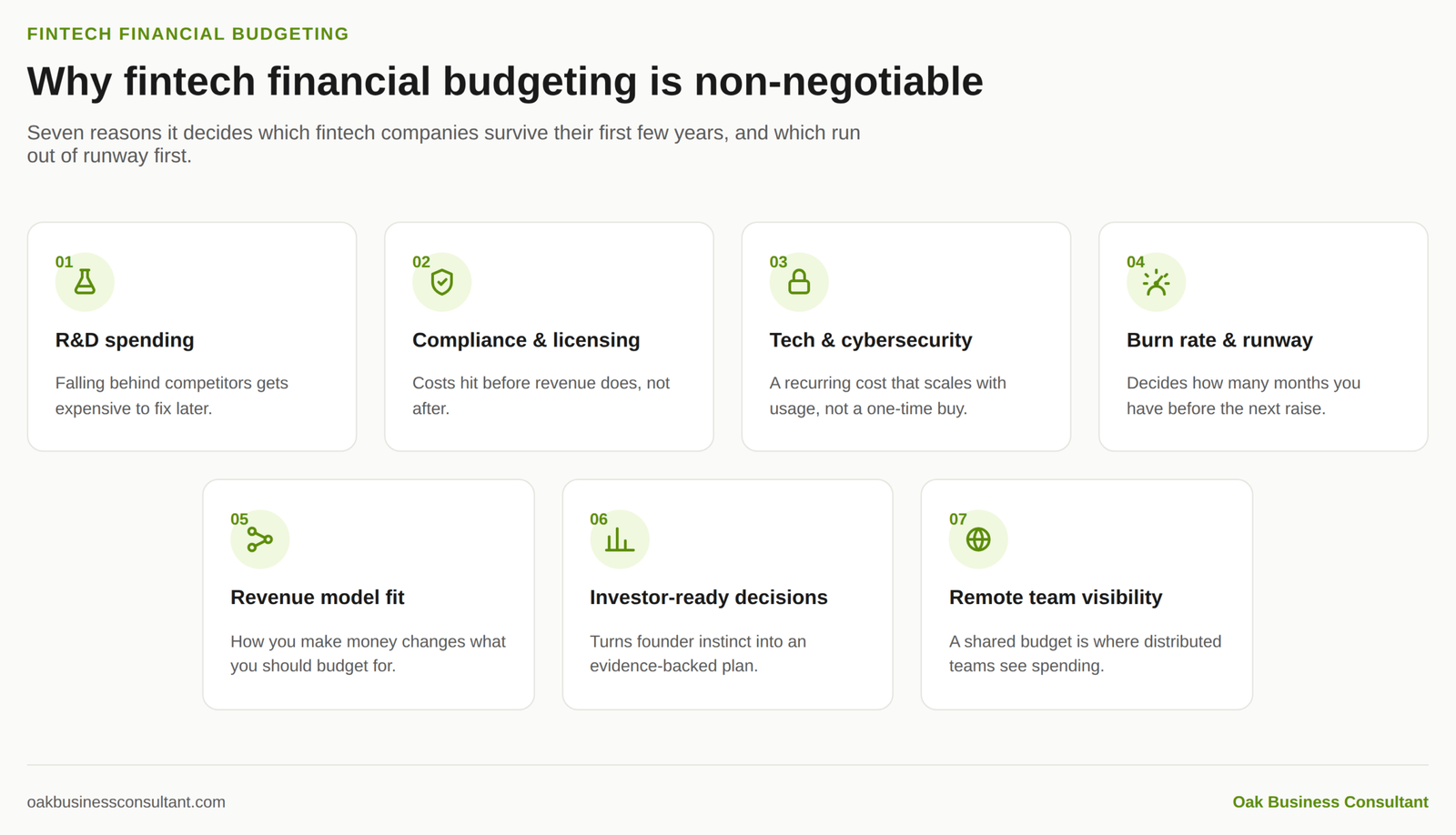
This is why fintech financial budgeting isn’t a back-office chore. It’s the difference between a startup that can absorb a bad quarter and one that can’t. Below are seven reasons budgeting carries more weight in fintech than almost any other sector, followed by a practical guide to building one.
What makes fintech budgeting different from a normal startup budget
A regular SaaS startup budgets for salaries, marketing, and servers. A fintech company budgets for all of that, plus a second layer most founders underestimate: regulatory licensing, ongoing compliance retainers, fraud and cybersecurity infrastructure, and fees paid to banking or payment partners that scale directly with transaction volume. That second layer often grows faster than revenue in the first two years, which is exactly why generic budget templates fall short.
Why is fintech financial budgeting important?
1. Constant R&D spending keeps you from falling behind
Fintech doesn’t reward standing still. Competitors ship new features, tighten fraud detection, and improve onboarding every few months, and a company that pauses R&D to save money usually loses ground it can’t win back cheaply. Budgeting for R&D isn’t about chasing every new idea. It’s about protecting a fixed slice of the budget so product and security improvements keep shipping even when cash gets tight elsewhere.
Without that protected slice, R&D is usually the first line item cut when a quarter goes badly, which quietly compounds into a competitive gap a year later.
2. Regulatory compliance and licensing costs hit early, not later
This is the reason most first-time fintech founders underbudget. Licensing fees alone can range from a few thousand dollars to well over $100,000 depending on the region and the type of financial service offered. On top of that sits an ongoing compliance retainer: legal advice, audit fees, and increasingly a dedicated compliance hire once the company starts processing real volume.
None of this is optional, and none of it is a one-time cost. A fintech that treats compliance as a line item to figure out later usually finds out the hard way, through delayed banking partnerships or a blocked launch.
3. Technology and cybersecurity infrastructure are recurring, not fixed
Fintech businesses run on infrastructure that has to work correctly the first time: cloud hosting, fraud monitoring, encryption, and increasingly AI-driven risk models. None of this is a one-time purchase. Cloud and security costs scale with usage, and a spike in customers can mean a spike in hosting bills before the revenue from those customers has caught up.
Cybersecurity in particular deserves its own budget line rather than getting folded into “technology.” A single breach or compliance failure can cost far more than the security investment that would have prevented it, both in direct remediation and in the trust it takes years to rebuild.
4. Burn rate and runway decide whether you make it to the next round
Fintech startups are often reliant on outside funding, which means the real question a budget answers isn’t “are we profitable” but “how many months of cash do we have left.” Tracking burn rate, the pace at which the company spends its cash reserves, tells a founder exactly how much runway is left before the next raise needs to close.
A company that doesn’t track this closely tends to notice the problem only when it’s already urgent, at which point negotiating leverage with investors is gone. A company that tracks it monthly can adjust hiring, marketing, or infrastructure spend well before that happens.
5. Your revenue model changes what your budget should prioritize
Not every fintech company spends money the same way, because not every fintech company makes money the same way. A transaction-fee business like a payment processor needs to budget heavily for compliance and per-transaction banking costs. A subscription-based personal finance tool needs to prioritize customer acquisition cost and retention spend. A lending platform needs to budget for the interest spread and credit risk buffers that a payments company never touches.
Copying a generic startup budget template without adjusting for your specific revenue model is one of the most common early mistakes, and it usually shows up as a cash shortfall in exactly the category the founder assumed was “handled.”
6. A real budget turns founder instinct into an investor-ready decision
Founders often know intuitively where the business needs to grow next. Investors don’t take intuition at face value, and neither should a founder making a six-figure hiring decision. A working budget, paired with conservative, realistic, and optimistic spending scenarios, gives both the founder and any outside investor a shared, evidence-backed view of what the company can actually afford.
This matters as much for internal decisions as it does for fundraising conversations. A founder who can show exactly how a new hire or a marketing push affects runway is making a very different kind of decision than one who’s guessing.
7. Remote, distributed teams need tighter financial visibility, not looser
Many fintech startups run fully remote from day one, which is a genuine advantage for hiring talent but a real complication for financial oversight. When a team is spread across time zones and there’s no shared office to catch informal budget conversations, the formal budget becomes the only place spending decisions actually get made visible to everyone involved.
A distributed fintech company without a disciplined, documented budget tends to discover overspending weeks after it happened rather than in real time, which is a much harder position to recover from.
Where fintech budgets typically go
| Budget category | What it covers | Why it’s easy to underbudget |
| Compliance and legal | Licensing, audits, legal retainer, compliance hires | Costs start before revenue does and rarely shrink |
| Technology and cybersecurity | Cloud hosting, fraud monitoring, encryption, security audits | Scales with usage, so it grows faster than expected during growth spurts |
| R&D | New features, fraud model improvements, product iteration | First line cut in a bad quarter, hardest gap to close later |
| Customer acquisition | Marketing, onboarding, CAC-driving campaigns | Varies enormously by revenue model, so generic benchmarks mislead |
| Banking and processing fees | Interchange, bank partner platform fees, settlement costs | Scales with transaction volume, so it grows even when margins don’t |
| Payroll | Engineering, compliance, and support salaries | Usually the largest fixed cost and the hardest to reduce quickly |
Your practical guide to building a fintech financial budget
1. Size the budget to your revenue model and stage
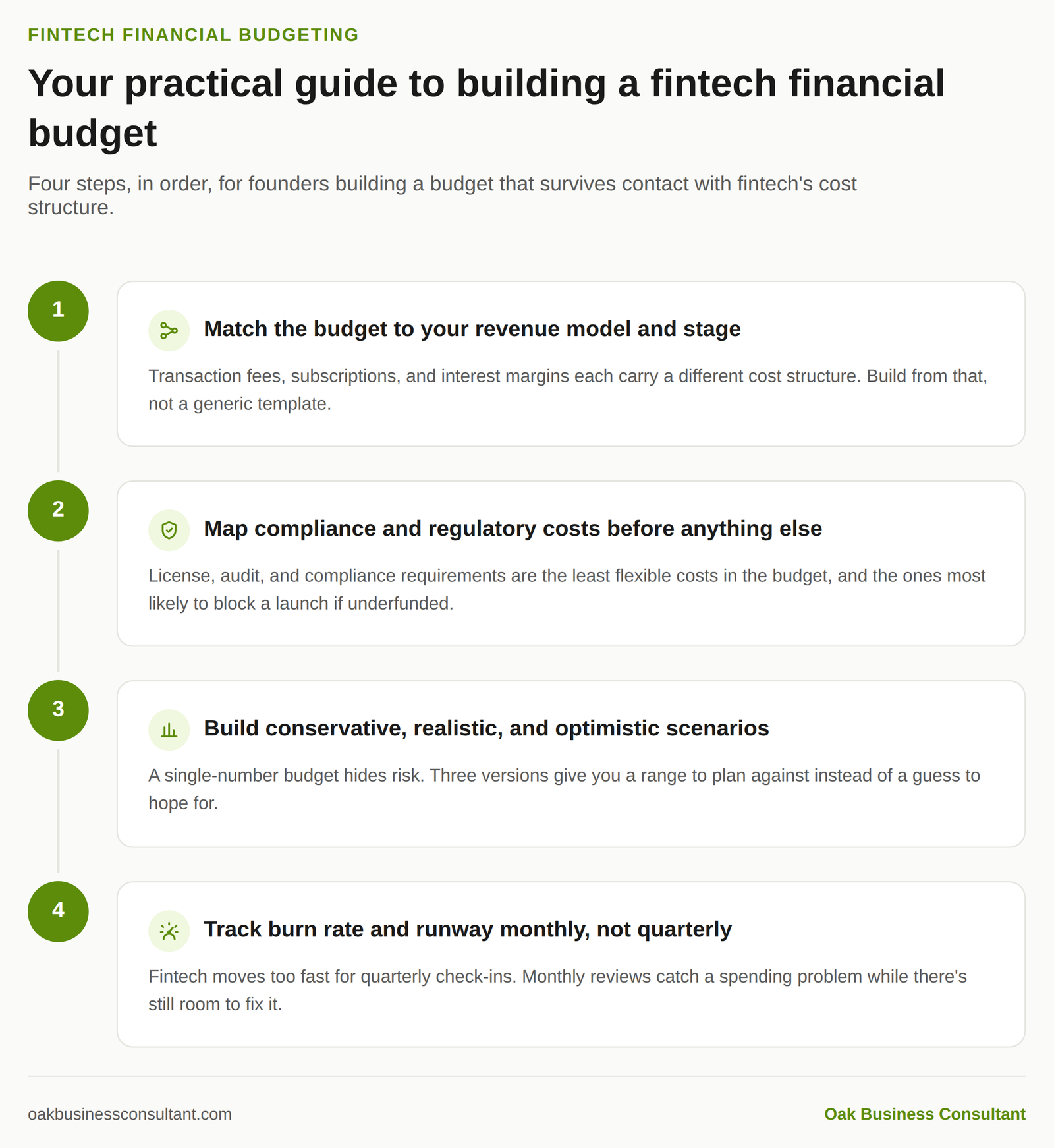
Start by identifying which revenue model your fintech company actually runs on: transaction fees, subscriptions, interest margins, or something else. Each one comes with a different cost structure, so your budget should reflect that from the first draft rather than starting from a generic startup template.
2. Map your compliance and regulatory costs before anything else
Before budgeting for marketing or hiring, map out every license, audit, and compliance requirement your business needs in the jurisdictions where it operates. These costs are the least flexible in the entire budget, and they’re the ones most likely to block a launch or a banking partnership if underfunded.
3. Build conservative, realistic, and optimistic scenarios
A single-number budget hides risk. Building three versions, a conservative one that assumes slower growth and higher costs, a realistic one based on current trends, and an optimistic one for if things go well, gives you a range to plan against instead of a guess to hope for.
4. Track burn rate and runway monthly, not quarterly
Fintech moves too fast for quarterly check-ins to catch a problem in time. Reviewing burn rate and runway every month means spotting a spending problem while there’s still room to fix it, rather than after the next funding round is already at risk.
Frequently Asked Questions
What’s the biggest budgeting mistake fintech founders make?
Underestimating compliance and cybersecurity costs. Founders often budget generously for product and marketing, then treat compliance as something to figure out once the company is bigger, which usually means finding out the real cost during a banking partnership delay or a failed audit.
How often should a fintech startup update its budget?
Monthly, at minimum. Fintech companies move too fast for quarterly reviews to catch a cash problem while there’s still time to fix it.
Do all fintech companies need the same budget structure?
No. A payments company, a lending platform, and a subscription-based personal finance app have different cost structures because they make money differently. Budgets should be built around the specific revenue model, not a generic template.
What is burn rate, and why does it matter so much in fintech?
Burn rate is the pace at which a company spends its cash reserves. In fintech, where outside funding is common and margins can take time to materialize, tracking burn rate closely is what tells a founder how many months of runway remain before the next raise needs to close.
Should an early-stage fintech startup hire a full-time CFO?
Not usually. Most early-stage fintech companies get more value from a fractional CFO, who brings the same budgeting and compliance expertise at a fraction of the cost of a full-time hire.
How much should a fintech startup budget for compliance in year one?
It varies widely by jurisdiction and license type, from a few thousand dollars for a narrow license to well over $100,000 for a fully regulated payment or lending license. The right number comes from mapping the specific licenses and audits your business needs, not from an industry-wide average.
Conclusion
The fintech companies that survive their first few years aren’t always the ones with the best product. They’re usually the ones that knew exactly how much runway they had at any given moment and adjusted before the number got scary. A fintech financial model built around your actual revenue model, combined with monthly tracking of the fintech financial metrics that matter for your business, does more for your odds of survival than almost any other single decision in year one.
If you’re not sure where your budget has gaps, that’s exactly what a fractional CFO for fintech businesses is built to find. You can also read more on how capital budgeting techniques apply to major fintech investment decisions like new infrastructure or market expansion.