Pricing Analysis Methods The Guide to Smarter, Profitable Pricing
Pricing Analysis Methods You Should Know
Set your price too high and customers walk. Set it too low and you fund your competitors’ growth while quietly starving your own margin. Most businesses don’t get this wrong because they’re careless. They get it wrong because they never built a repeatable process for it, so every price decision starts from scratch and leans on gut feel.
Pricing analysis is that process. It’s the systematic study of how prices should be set, how customers actually respond to them, and how they compare against market conditions and competitor strategies. Done well, it gives you three things: a clear read on where you sit relative to competitors, real data on what customers will pay, and a defensible reason for every number on your price list.
This guide walks through the core methods, when to use each one, and how to combine them into a pricing process that holds up under pressure.
What pricing analysis actually measures
Price analysis evaluates whether a price is fair, competitive, and sustainable, often without digging into your underlying cost structure at all. Pricing analysis is the broader discipline: studying how prices get set, how demand responds, and how your numbers stack up against the market.
A structured approach gives you:
- A clear picture of where your prices stand relative to competitors
- Real data on customer perceptions and willingness to pay
- Evidence to support profit decisions instead of defending them after the fact
- A foundation you can revisit as costs, competitors, and demand shift
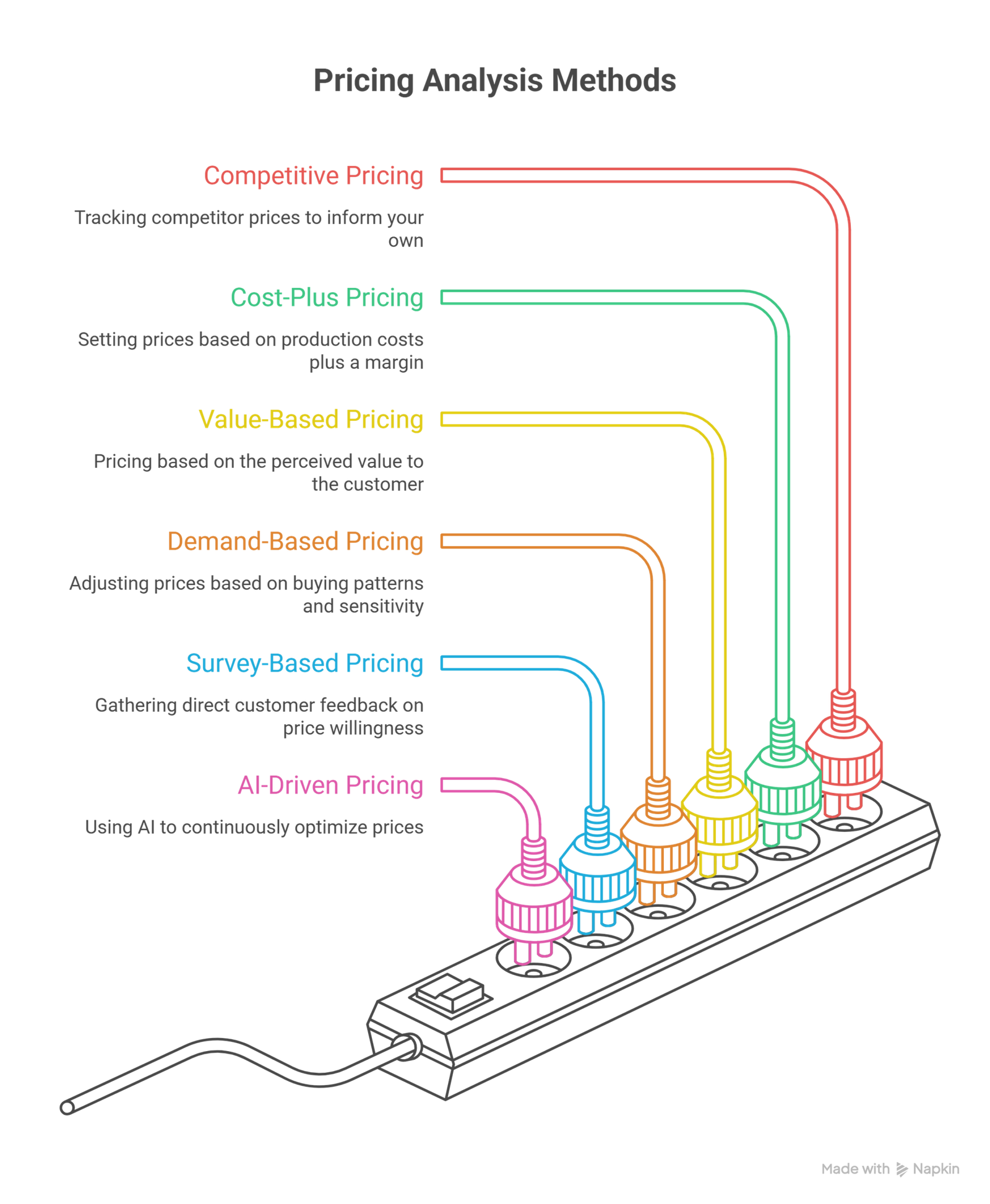
There’s no single best method. The right combination depends on your industry, your data, and how much you already know about your customers. Most businesses that price well use several of the approaches below together, not just one.
Competitive pricing analysis: know who you’re actually competing with
Competitive pricing analysis means systematically tracking what competitors charge for comparable products or services. It’s one of the most widely used methods, especially in retail, SaaS, and manufacturing, because competitor prices are usually visible and easy to collect.
Before you start monitoring, separate your competitors into two groups. Direct competitors sell essentially the same product and will fight you on price directly, so they deserve the closest tracking. Indirect competitors sell a different solution to the same underlying problem. A customer who can’t afford your service might go to an indirect competitor instead of walking away entirely, so ignoring that group can leave you blind to where demand is actually leaking.
The process typically includes:
Competitor price monitoring. Track prices across your competitive set on a regular cadence, manually, through monitoring software, or via pricing data feeds where available.
Price index calculation. Divide your price by the average market price to get a quick read on positioning. Above 1.0 means you’re priced at a premium. Below 1.0 means you’re priced more aggressively than the market.
Reading the strategy, not just the number. Are competitors running dynamic pricing that shifts with demand? Using loss leaders on certain items to pull in volume? The logic behind a competitor’s price often matters more than the price itself.
At the far end of matching competitors is going-rate pricing, common in markets like fuel or commodities where products are nearly identical and businesses cluster tightly around a shared market price rather than compete on it directly.
Competitive analysis should inform your positioning, not dictate it. Matching every competitor move is a fast way to erode margin without ever building a pricing identity of your own.
Cost analysis and cost-plus pricing
Cost analysis breaks down everything it costs you to produce and deliver a product or service, then uses that breakdown to set a floor for pricing. Cost-plus pricing is the simplest version: calculate your true cost, add a target margin, and that’s your price.
Here’s what that looks like with real numbers. Say a bakery’s specialty cake costs 18 dollars to produce once you account for ingredients, labor, and a share of overhead. If the bakery wants a 40 percent margin, the math is straightforward: 18 divided by (1 minus 0.40) equals 30 dollars. Sell below that and the margin target quietly disappears, even if the cake still “feels” profitable on the surface.
Getting the cost side right starts with knowing what actually belongs in “cost.” Direct costs are the obvious ones: materials, labor, packaging. Indirect costs cover overhead like rent, utilities, and management time. Intangible costs, easy to skip past, include things like regulatory compliance work or the internal cost of a slower process. And opportunity costs capture what you give up by choosing one option over another, which matters most when you’re deciding between building, renting, or buying something. Missing any of these categories is the most common reason a “profitable” price turns out not to be.
A few refinements worth knowing:
Activity-based costing (ABC) assigns overhead based on what each product actually consumes, rather than spreading it evenly across everything you sell. This is especially useful once you have more than a handful of SKUs or service lines, since flat overhead allocation tends to hide which offerings are genuinely profitable.
Marginal analysis looks specifically at the cost of producing one more unit of what you already sell, or of adding a new line altogether. It answers a narrower but often more useful question than total cost analysis: what’s the minimum revenue this next unit needs to generate to be worth making at all.
Contribution margin analysis looks at revenue minus variable costs for each product or customer segment, which shows you where a price change will move the needle most. This connects directly to broader financial ratio analysis, since margin ratios only mean something once you know which products are actually driving them.
Target return pricing works backward from a specific goal: decide on the rate of return you need on the investment behind a product, then set the price at the level required to hit it over an expected sales volume. This is common in capital-intensive businesses where the investment amount is known well before the first sale happens.
The limitation of cost-plus pricing, and its variants above, is that they tell you the floor, not the ceiling. They ignore what customers are actually willing to pay, which is where the next two methods come in.
Value-based pricing
Value-based pricing flips the question. Instead of “what does this cost us,” you ask “what is this worth to the customer.” A software feature that saves a client 10 hours a month is worth far more to them than its build cost suggests, and value-based pricing is how you capture that gap instead of leaving it on the table.
This approach takes more upfront research: you need to identify which specific benefits your customers actually value, put a number on that value, and price against it rather than against your own cost sheet. It typically produces stronger margins and better customer satisfaction than cost-plus pricing, because customers who understand the value rarely argue about the price.
Demand-based, dynamic, and psychological pricing
Demand-based pricing sets prices using data on buying patterns and price sensitivity, aiming to maximize revenue as conditions shift. Dynamic pricing takes this further, adjusting prices in near real time based on inventory, timing, competitor moves, or customer segment. Airlines and ride-share platforms have run on this model for years, and more B2B and SaaS companies are adopting versions of it now that the tooling has caught up.
A concept worth naming explicitly here: price elasticity of demand measures how much demand shifts when price changes. If a 10 percent price increase causes a 25 percent drop in sales, demand is elastic and you have limited room to raise prices without losing volume. If that same increase barely moves sales, demand is inelastic and there’s likely margin sitting on the table. Every method in this guide is, in some way, an attempt to estimate this number for your specific product before you find out the hard way.
A few pricing structures worth knowing by name, since they get lumped together in casual conversation but behave very differently:
Penetration pricing enters the market at a low price to build share fast. It works when customer acquisition matters more than early margin, but it’s risky if raising prices later proves harder than expected.
Bundle pricing packages multiple products or services together at a discount versus buying separately. It raises average order value and can move slower-selling items alongside popular ones.
Psychological pricing uses how people perceive numbers rather than what the numbers literally mean. Charm pricing (ending a price in .99), anchoring against a higher reference price, and decoy pricing (a deliberately unattractive middle option that makes another option look better) all fall here. None of these change your costs, but they measurably change conversion.
Price skimming does the opposite of penetration pricing: launch high, then lower the price gradually as competition catches up or the early-adopter segment gets saturated. It suits genuinely differentiated products with limited competition at launch, less so commodity categories where a high opening price just hands the sale to whoever’s priced normally.
High-low pricing sets a higher list price and relies on frequent, visible discounts and promotions to drive urgency, a pattern common in seasonal retail. It moves inventory quickly but can erode a brand’s perceived value if the “discount” becomes the expected price.
Geographic pricing adjusts prices by location to account for shipping costs, local taxes, or regional purchasing power. It’s most relevant for e-commerce and multi-region service businesses, where a single national price either overcharges some markets or underprices others.
Survey-based pricing research methods
When you need primary data on what customers will actually pay, rather than inferring it from sales history, survey-based methods are the standard tools.
Van Westendorp Price Sensitivity Meter. Asks four questions: at what price is this too cheap to trust, a bargain, starting to feel expensive but still acceptable, and too expensive to consider. Plotting the responses reveals an acceptable price range and an optimal point where the fewest people feel the price is wrong in either direction. Strong for new product launches and repositioning.
Gabor-Granger technique. Shows customers a product at different price points and asks how likely they are to buy at each. This builds a demand curve directly, making it useful for finding the revenue-maximizing price and estimating elasticity within a segment.
Conjoint analysis. Goes further by testing price against product features simultaneously, asking respondents to choose between different configurations. This produces importance scores for each attribute, including price, and can simulate market share under different pricing scenarios. It’s the most powerful of the survey methods but also the most resource-intensive to run well.
Monadic price testing. Shows each respondent group a single price, rather than multiple prices to the same person, which avoids the anchoring bias that comes from seeing several numbers back to back. Considered one of the cleanest methods for unbiased price feedback.
Brand price trade-off (BPTO). Has respondents repeatedly choose between brands as their preferred option’s price rises, revealing how much premium a brand can command before customers switch.
Concept testing. Presents a full product concept, features, benefits, and a proposed price, and gauges reaction and purchase intent before anything is built. This is the method to reach for when you need to validate the price alongside the product idea itself, not after it’s already locked in.
Numeric price entry. Simply asks respondents to type the exact price they’d be willing to pay, rather than reacting to prices you supply. It’s the most direct read on willingness to pay available, though it’s also the easiest for respondents to answer unrealistically, so it works best alongside one of the other methods rather than alone.
For a new product launch, Van Westendorp and conjoint analysis together tend to produce the most actionable read: Van Westendorp gives you the acceptable range quickly, and conjoint shows how price interacts with the features customers actually care about.
Price optimization, analytics, and the role of AI
Price optimization pulls together cost data, market research, competitor monitoring, and demand signals into a single model that recommends prices by product, segment, and channel. This used to require a dedicated analytics team. It increasingly doesn’t.
AI-driven pricing tools can now process transaction history, inventory levels, and competitor signals to suggest price adjustments continuously rather than on a quarterly cycle. This matters most in fast-moving categories like SaaS, e-commerce, and subscription services, where a growing company’s pricing needs often outgrow spreadsheet-based tracking faster than founders expect. The tradeoff is transparency: customers increasingly notice and resent price changes that feel arbitrary, so any automated pricing system needs a clear, defensible logic behind it, not just an algorithm optimizing for short-term revenue.
Two applications worth watching for:
Segment pricing. Different customer segments have different willingness to pay. Optimization models let you price accordingly without triggering the kind of arbitrage that undermines the whole structure.
Spotting unbalanced pricing. Analytics frequently surface products priced well out of line with their actual cost or value. Correcting these is often the single highest-return fix in a pricing review, precisely because nobody had looked closely enough to notice.
Comparing the methods at a glance
| Method | Best for | Data required | Main limitation |
| Competitive pricing analysis | Fast-moving, easily compared markets | Competitor price data | Can pull you into a race to the bottom |
| Cost-plus, marginal, and target-return pricing | Setting a pricing floor and hitting a return target | Internal cost data | Ignores what customers will actually pay |
| Penetration, skimming, high-low, and geographic pricing | Market entry, launch timing, and regional variation | Competitor and demand context | Wrong choice can undercut margin or brand value fast |
| Value-based pricing | High-differentiation products or services | Customer value research | Requires real upfront research investment |
| Demand-based and dynamic pricing | Fluctuating demand or inventory | Sales and demand history | Needs live data infrastructure |
| Van Westendorp / Gabor-Granger | New product launches | Customer survey data | Sensitive to how questions are framed |
| Conjoint analysis | Feature-price trade-off decisions | Larger, well-designed survey | Time-consuming and costlier to run |
| Price optimization / AI models | Ongoing pricing at scale | Integrated cost, sales, and market data | Needs transparent logic to maintain trust |
A practical framework for putting it together
The most effective pricing programs don’t lean on one method. Here’s how to sequence them across a pricing cycle:
- Discovery. Use Van Westendorp and Gabor-Granger to establish an initial acceptable price range and demand curve for a new product or market entry.
- Competitive benchmarking. Build a price index and map your direct and indirect competitors to understand where your intended price positions you.
- Cost validation. Confirm the price clears your cost floor using cost-plus and, where relevant, activity-based costing.
- Value alignment. Use conjoint analysis or value-based pricing research to confirm the price reflects what customers actually perceive.
- Optimization and monitoring. Deploy analytics tools for ongoing price tracking and adjustment as conditions shift.
- Behavioral refinement. Apply psychological pricing and framing principles to how the price is presented, not just what the number is.
Common mistakes in pricing analysis
Relying only on cost-plus pricing. It ignores customer value and competitive dynamics entirely. Useful as a starting point, dangerous as a strategy.
Treating competitive pricing as a mandate to match everyone. This destroys margin over time. Competitive data should inform your position, not dictate it.
Skipping price elasticity entirely. Businesses that never test elasticity often leave real margin on the table simply because they never learned how much room they actually had.
Ignoring segment-level price sensitivity. A single price rarely optimizes across every customer type. Segmented pricing backed by real research consistently outperforms one-size-fits-all.
Treating pricing as a one-time decision. Costs, competitors, and customer expectations all move. Pricing needs review on a set schedule, not just when something breaks.
Frequently Asked Questions
What’s the difference between price analysis and pricing analysis?
Price analysis checks whether a specific price is fair and sustainable, often without examining cost structure. Pricing analysis is the broader, ongoing discipline of studying how prices are set and how the market responds to them.
How is price elasticity of demand actually calculated?
Divide the percentage change in quantity demanded by the percentage change in price. A result greater than 1 means demand is elastic (sensitive to price changes); less than 1 means it’s inelastic. This single number should shape how aggressively you can move price without losing volume.
Is penetration pricing the same as value-based pricing?
No, and confusing the two is a common mistake. Penetration pricing deliberately prices low to win market share fast. Value-based pricing prices according to what the customer perceives the product is worth, which is often higher than a penetration price, not lower.
What’s the difference between skimming and penetration pricing?
They’re opposites. Skimming launches high and lowers the price over time, suited to differentiated products with little early competition. Penetration launches low to win share fast, which works when acquisition matters more than early margin but risks getting stuck if raising prices later proves harder than expected.
How does AI actually change pricing decisions?
AI tools process transaction, inventory, and competitor data to suggest price adjustments continuously rather than quarterly. The upside is speed and precision. The downside is that customers notice unexplained price movement, so the underlying logic still needs to be defensible, not just automated.
How often should a business review its pricing?
At minimum, annually. In fast-moving markets like retail, SaaS, or commodities, quarterly or monthly reviews make more sense. Trigger-based reviews should also happen whenever costs, competitors, or market conditions shift meaningfully.
Conclusion
Pricing is never just a number on a page. It reflects your costs, your competitive position, and what your customers genuinely believe you’re worth. Businesses that treat pricing as an ongoing discipline, testing elasticity, validating against cost and value, and revisiting the numbers on a schedule, consistently outperform the ones pricing by instinct.
If your business is approaching a stage where pricing decisions start carrying real financial weight, that’s usually a sign the process needs more rigor than a spreadsheet can offer. At Oak Business Consultant, our fractional CFO services help businesses build the financial frameworks and pricing discipline needed to compete on price without guessing. Connect with our CFO team to talk through where your pricing stands today.