7 Reasons to Hire a Virtual CFO
7 reasons to hire a virtual CFO, what it costs, and when to start
Most business owners do not hire a virtual CFO because they read an article about it. They hire one after missing a cash flow problem until it became a crisis, or after an investor asked for a financial model they did not have. By then the need is obvious and the delay has a cost.
A virtual CFO gives you senior-level financial leadership without a full-time salary or a long recruiting search. This guide covers seven reasons to hire one, what it costs next to a full-time hire, the signs that it is time, and the situations where it is still too early.
What you get when you hire a virtual CFO
A virtual CFO is an experienced finance professional who provides CFO-level strategy and planning remotely, usually part time. The core work is budgeting, forecasting, cash flow management, fundraising support, and financial reporting. The day-to-day detail is in the guide to what a virtual CFO does.
“Fractional CFO” means almost the same thing. Virtual describes remote delivery, and fractional describes a share of a full workweek. Most providers offer both at once. If you are comparing roles, the guides to controller services vs virtual CFO services and virtual CFO vs in-house CFO go deeper.
| Virtual or fractional CFO | In-house CFO | Outsourced controller | |
| Time | Part time, scalable | Full time | Part time, ongoing |
| Cost basis | Monthly retainer, hourly, or project | Salary plus benefits | Hours and transaction volume |
| Focus | Strategy, forecasting, fundraising, risk | The same, plus leading a finance team | Accurate books, reporting, close process |
| Best for | Growing businesses that need strategy without a full-time seat | Larger companies with continuous, complex needs | Businesses that need clean books more than strategy |
7 reasons to hire a virtual CFO
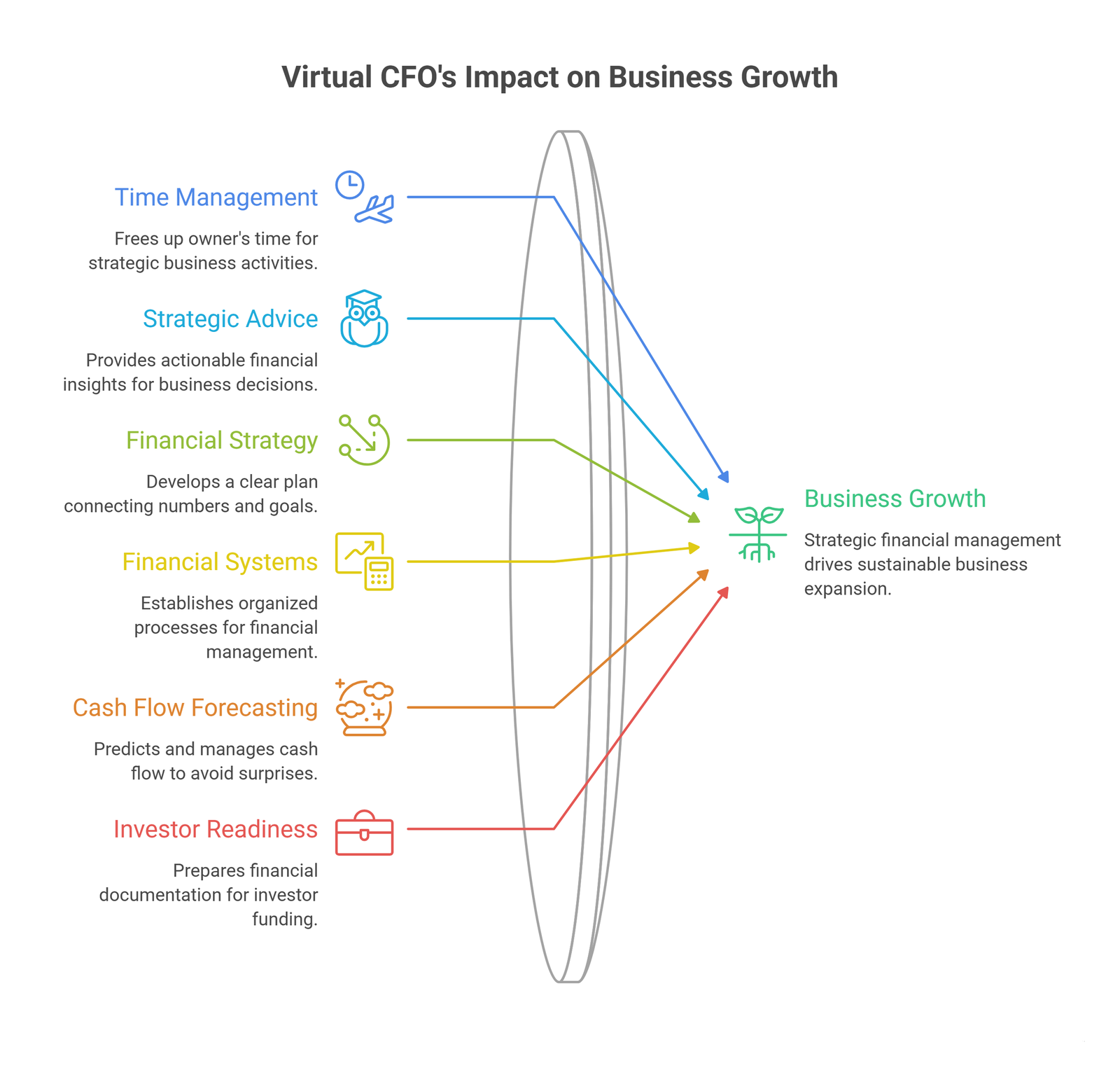
1. You manage the finances yourself, and it costs you time you do not have
Every hour spent reconciling spreadsheets is an hour not spent on product, sales, or hiring. Owners who handle their own finances often decide on gut feel instead of current numbers, and that habit is hard to break once the business gets more complex. A virtual CFO takes the financial workload and gives you back time for what grows the business.
2. Your accountant keeps the books but cannot tell you where to take the business
Accountants and bookkeepers handle accuracy and compliance. A virtual CFO takes the same numbers and turns them into a recommendation: raise prices, cut an underperforming service line, or delay a hire by a quarter. Because a virtual CFO usually works with several companies, they bring an outside view your internal team cannot. Many also have a network of specialists, from tax advisers to deal advisers, for when you need one.
3. You have a set of habits, not a financial strategy
A financial strategy connects your numbers, your goals, and your budget into a plan you can execute. Without one, growth happens by accident, and so do the mistakes. A virtual CFO builds the plan with you and adjusts it as conditions change. That beats finding out about problems from the bank balance.
4. You need financial systems as well as advice
Advice fades. Systems stay. A virtual CFO sets up the processes that keep your finances organized after any single conversation: tracking income and expenses, monitoring invoices and payments, and fixing a reporting calendar. Because they work remotely, they can also support teams across time zones.
5. Cash flow keeps catching you off guard
Cash flow trouble is one of the most common reasons growing businesses struggle, and it is rarely a surprise in hindsight. A virtual CFO builds a rolling forecast so you can see a shortfall coming.
Here is an illustrative example. A 13-week forecast shows cash dipping $40,000 below payroll needs in week 9, because two large customers pay on 60-day terms. Seeing that in week 1 gives you eight weeks to act. You can negotiate shorter terms, delay a purchase, or arrange a credit line while the business still looks healthy to lenders. Seeing it in week 9 leaves you with a scramble for a bridge loan.
6. You want to raise capital without investor-ready numbers
A pitch deck does not close a funding round on its own. Investors and lenders want clean financial statements, realistic projections, and a plan built on defensible assumptions. A virtual CFO prepares that documentation and can support the process directly, including due diligence questions. That matters more at the negotiating table than a well-designed slide.
7. You cannot see where the risk sits
Most owners only notice risks that have already caused a problem. A virtual CFO looks for exposure earlier, such as a compliance gap, a customer who accounts for too much revenue, or a new market entered without a cost model. They also build the mitigation plan alongside the warning.
What a virtual CFO costs
Pricing depends on scope, hours, and industry complexity. Oak Business Consultant’s fractional CFO cost guide puts retainers at about $3,000 to $15,000 per month, with most small and mid-sized businesses paying $3,000 to $10,000.
| Engagement type | Typical range | What it usually covers |
| Hourly work | About $200 to $500 per hour | One-off reviews, second opinions, specific questions |
| Project work | About $5,000 to $30,000 per project | A fundraising model, a systems review, a due diligence package |
| Early-stage retainer | From about $3,000 per month | Monthly reporting, budgeting, cash flow oversight |
| Growth-stage retainer | About $8,000 to $12,000 per month | Investor reporting, forecasting, fundraising preparation |
| Major transitions | Up to about $15,000 per month | Acquisitions, systems overhauls, active fundraising |
Compare that with a full-time hire. The US Bureau of Labor Statistics reports a median annual wage of $161,700 for financial managers in May 2024. That category includes controllers and treasurers, and a CFO at a growing company usually earns more. The figure also excludes benefits, payroll taxes, and recruiting costs. The cost guide above puts base pay for a mid-market CFO at $200,000 to $400,000.
As a simple comparison, a $5,500 monthly retainer comes to $66,000 per year, which is about 40% of that median salary. Your numbers will differ, but the gap is typically large.
Signs it is time to hire
Revenue alone is a poor guide. Complexity is a better one. It is usually time when:
- Decisions are outpacing your financial visibility.
- You are preparing for a funding round, acquisition, or sale.
- Cash flow has surprised you more than once in the past year.
- People without CFO-level training are making CFO-level decisions.
- You are entering a new market or product line and need a real cost model first.
For startup timing, see when a startup should hire a CFO, and for small businesses, why and when to hire CFO services. The article on which businesses need a virtual CFO shows how these triggers play out across 12 business types.
When it is too early
Not every business needs one yet. Wait if:
- Your books are months behind. Fix the record keeping first, because a CFO builds on clean data.
- You have no budget to act on advice. A forecast is only useful if you can respond to it.
- Your only need is tax filing. That is an accountant’s job.
You can also start small, with a one-off project such as a cash forecast or a financial review, then expand if it proves its worth.
What the first 90 days look like
In the first month, expect access setup, a review of recent statements, and a baseline cash forecast. By month two, reports should arrive on a fixed schedule and the first budget review should be done. At 90 days, check whether you are making decisions differently and spending less of your own time on finance. The step-by-step guide to choosing a virtual CFO covers how to set this up, and the guide to what to look for in a virtual CFO helps you vet candidates.
Frequently Asked Questions
Is a virtual CFO the same as a fractional CFO?
Almost always, yes. “Virtual” refers to remote delivery and “fractional” refers to part-time hours. Most providers who use either label do both at once.
How much does a virtual CFO cost per month?
Retainers typically run from about $3,000 to $15,000 per month, and most small and mid-sized businesses pay $3,000 to $10,000. Hourly work runs about $200 to $500 per hour.
When should a small business hire a virtual CFO?
Common triggers include preparing for a funding round, repeated cash flow surprises, and entering a new market without a clear cost model. Complexity matters more than a revenue threshold.
Can a virtual CFO replace my accountant or bookkeeper?
No. Accountants and bookkeepers handle compliance, tax filing, and record keeping. A virtual CFO uses the same data to build strategy, forecasts, and decisions. Most businesses need both.
How many hours does a virtual CFO work each month?
It varies with scope. Hours usually rise during fundraising, audits, or year-end close, then fall again afterward.
Is it worth hiring a virtual CFO before raising funding?
Often, yes. Investors respond better to founders who can answer financial questions with real numbers. A virtual CFO can build that foundation before you ask for a check.
What is the biggest difference between a virtual CFO and a full-time CFO?
Cost and commitment. A full-time CFO means a salary, benefits, and a long-term hire. A virtual CFO delivers similar strategic leadership on a flexible schedule and a flexible budget.
Hire for the problem you have today
Hiring a virtual CFO is not an admission that you cannot manage your own finances. It is a recognition that strategic financial leadership is a specialized skill. Paying for it part time is usually cheaper than the mistakes made without it.
Oak Business Consultant provides virtual CFO services for startups and growing businesses. Book a call with the team to talk through what virtual CFO support would look like for your business.