


Case Study: From Complexity to Confidence: A UAE Free Zone Corporate Tax Turnaround
Client overview
Our client is a fast-growing EdTech company operating from a UAE Free Zone, serving learners in more than 100 countries. Most of their revenue comes from software and platform licensing income tied to their learning platform. Since 2023, UAE Corporate Tax rules have added a layer of complexity that companies like this cannot afford to get wrong, because how licensing income is classified determines whether a Free Zone entity keeps its 0% Qualifying Free Zone Person (QFZP) status.
Challenges of the EdTech client
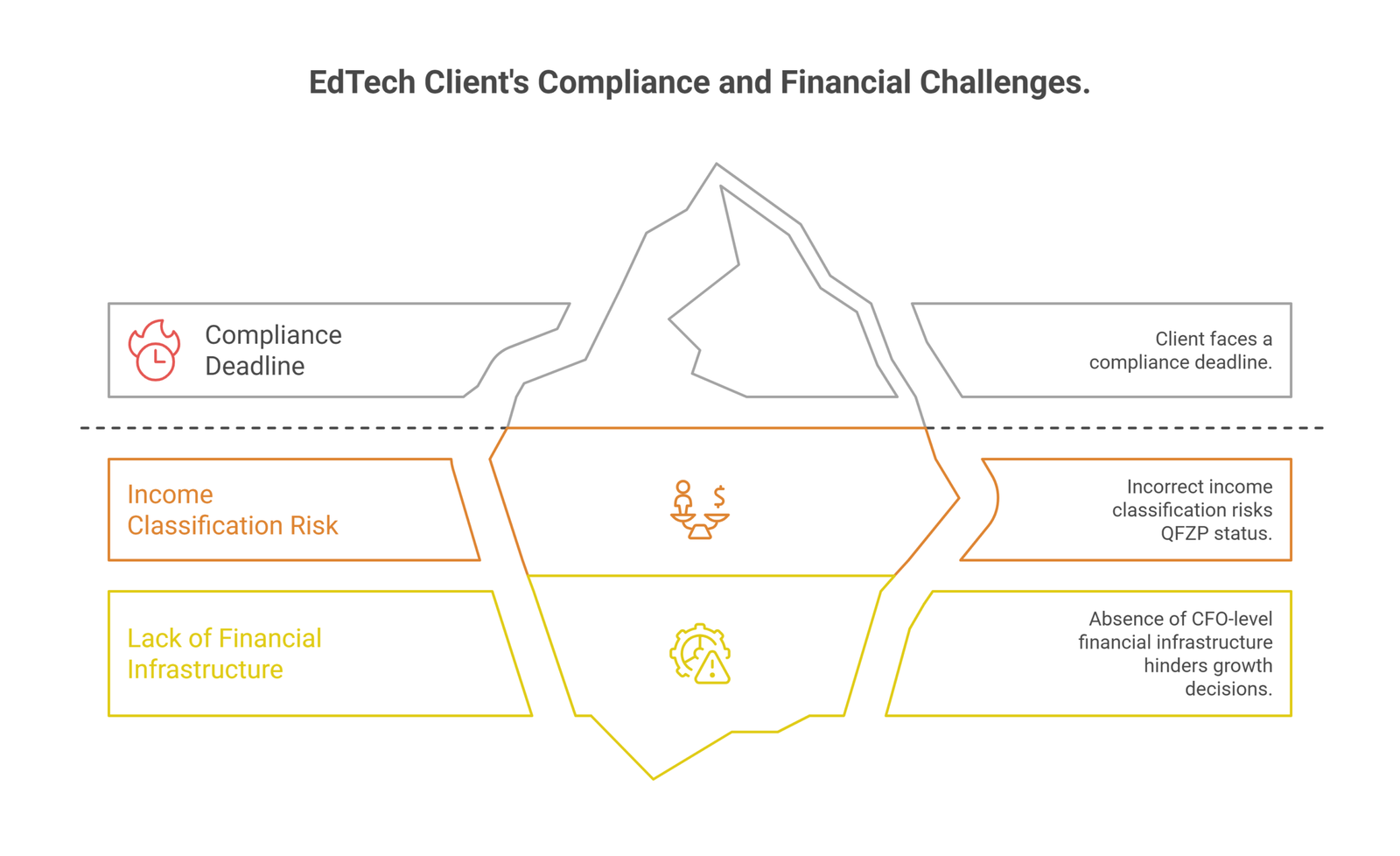
The client came to us carrying more than a compliance deadline. They faced two connected problems that needed to be solved together, not one after the other.
Income classification risk under Cabinet Decision No. 100 of 2023
Cabinet Decision No. 100 of 2023 draws a sharp line between qualifying and non-qualifying income for Free Zone Persons. Licensing income from copyrighted software sits on one side of that line. Trademark and brand royalty income sits on the other. Getting this classification wrong, even unintentionally, could put the client’s entire QFZP status at risk and expose a multi-million-dirham revenue stream to standard corporate tax.
No CFO-level financial infrastructure
The client needed real-time financial visibility, the kind a full-time CFO would normally provide, but without the cost of a full-time hire. Without it, leadership was making growth decisions without a clear, current picture of cash flow, departmental performance, or profitability.
UAE Free Zone Corporate Tax Solutions provided
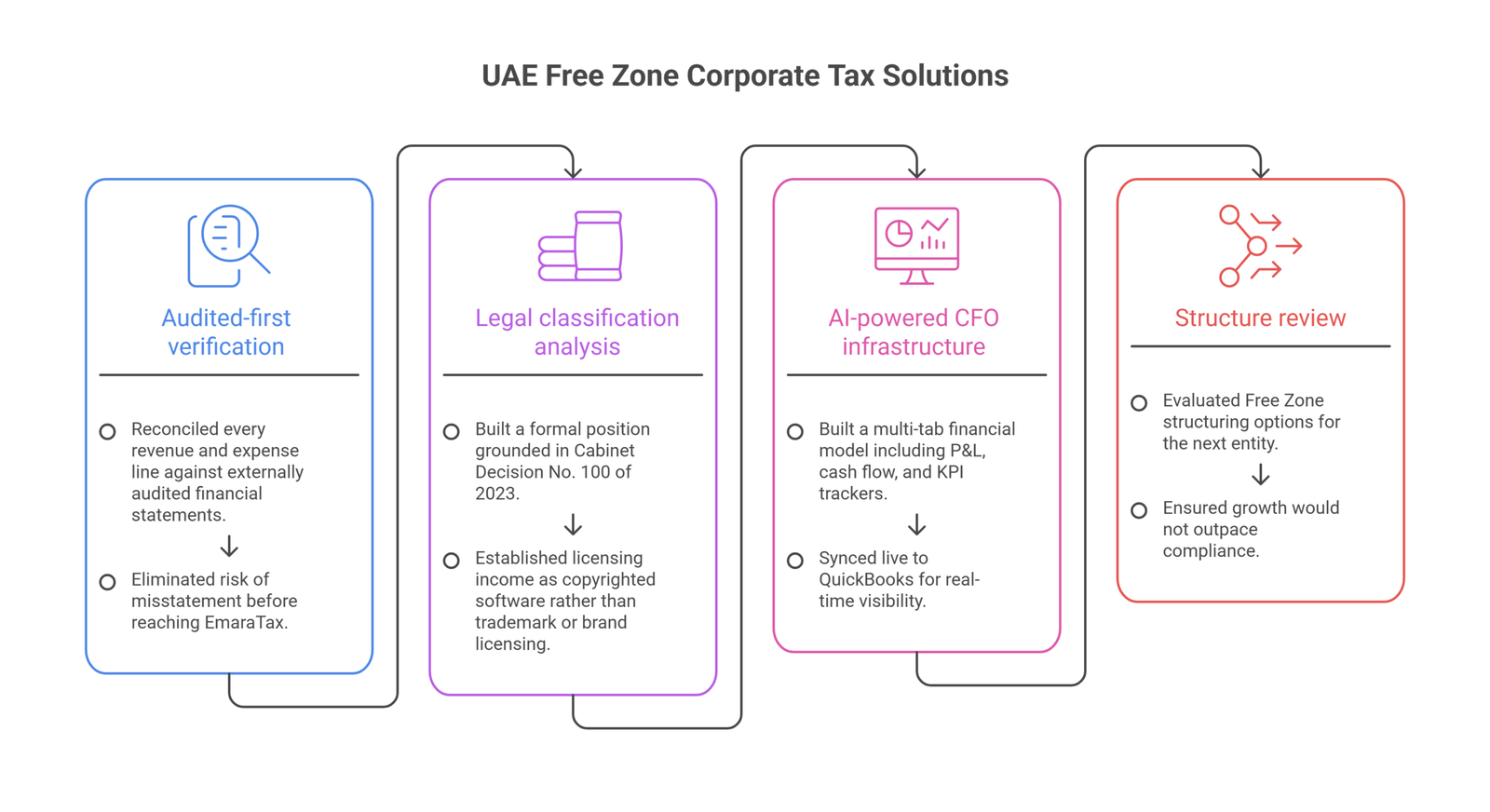
We treated this engagement as forensic work, not a form-filling exercise.
Audited-first verification
Every revenue and expense line was reconciled against externally audited financial statements, not internal ledger data, across multiple rounds of review. This eliminated any risk of misstatement before a single figure reached EmaraTax.
Legal classification analysis
We built a formal position, grounded in Cabinet Decision No. 100 of 2023, establishing that the client’s licensing income was properly income from copyrighted software, their learning platform, rather than trademark or brand licensing. That single distinction protected the client’s qualifying income status.
AI-powered CFO infrastructure
We built a multi-tab financial model covering a P&L tracker, cash flow forecast, department KPI tracker, and a dedicated SDG Impact Dashboard, synced live to QuickBooks. This gave leadership the kind of real-time visibility usually reserved for companies with a full-time CFO on payroll.
Structure review
As the client prepared to expand, we evaluated Free Zone structuring options for their next entity, so growth would not outpace compliance.
Outcome
- AED 0 corporate tax liability, with QFZP status fully confirmed
- Multi-million-dirham licensing income correctly classified as qualifying income
- Real-time financial visibility through a live AI CFO model
- A one-time engagement that became an ongoing AI CFO retainer
What this work supports
This engagement connects to the UN Sustainable Development Goals we build our practice around:
- SDG 4 (Quality Education): protecting the financial stability of a company expanding access to education globally
- SDG 8 (Decent Work and Economic Growth): sound financial infrastructure that supports sustainable growth and jobs
- SDG 9 (Industry, Innovation and Infrastructure): AI-powered financial tooling replacing manual, legacy reporting
- SDG 10 (Reduced Inequalities): supporting a platform whose mission is broadening access
- SDG 17 (Partnerships for the Goals): an advisory relationship built to last, not a one-off transaction
What’s in it for you?
If you run a Free Zone entity, especially one earning software, platform, or licensing income, you’re likely facing the same questions this client faced. Without a defensible classification position and real financial visibility, your business may run into:
- Misclassified income, putting your 0% QFZP status at risk without you realizing it
- Reactive tax filing, where numbers are reconciled at the last minute instead of verified against audited statements
- No real-time visibility, making it hard to plan expansion or spot cash flow problems early
- Structuring gaps, where a new entity or new revenue line outpaces your existing tax position
How can you overcome these challenges?
- Get a formal classification position, grounded in Cabinet Decision No. 100 of 2023, before you file
- Reconcile against audited financials, not internal ledgers, to remove misstatement risk
- Build CFO-level infrastructure, even without a full-time CFO, through a live financial model synced to your accounting system
- Review your structure before you expand, not after
Ready to strengthen your tax position and financial visibility?
At Oak Business Consultant, we specialize in UAE Corporate Tax classification, financial modeling, and AI CFO advisory for Free Zone companies. Book a free consultation and let’s build a defensible position for your business, backed by the financial visibility to grow with confidence.
Frequently asked questions (FAQs)
Why does income classification matter under UAE Corporate Tax?
Cabinet Decision No. 100 of 2023 separates qualifying income from non-qualifying income for Free Zone Persons. Misclassifying licensing income, for example treating copyrighted software income as trademark royalty income, can put your entire 0% QFZP status at risk.
What counts as qualifying income for a Free Zone Person?
Income from copyrighted software licensing generally qualifies, while trademark and brand royalty income does not. The correct classification depends on the specific nature of the intellectual property and how the income is generated, which is why a formal legal position matters.
Do I need a full-time CFO to get real-time financial visibility?
No. A live financial model synced to your accounting system, covering P&L, cash flow, and KPI tracking, can give you CFO-level visibility without the cost of a full-time hire.
Why reconcile against audited financials instead of internal ledgers?
Audited statements have already been independently verified, so reconciling against them before filing removes the risk of misstatement that can come from relying on internal ledger data alone.
When should I review my Free Zone structure?
Before you expand, not after. Reviewing structuring options ahead of a new entity or new revenue stream keeps your compliance position ahead of your growth, rather than catching up to it.
Conclusion
This engagement protected a multi-million-dirham revenue stream, confirmed QFZP status at AED 0 corporate tax liability, and gave the client real-time financial visibility they didn’t have before. Compliance was the starting point, not the finish line. If your Free Zone entity is navigating Corporate Tax classification, or you’re ready for CFO-level insight without CFO-level headcount, contact Oak Business Consultant today.


