

Client Overview
Our client is a fast-growing EdTech platform operating from a UAE Free Zone. It serves learners in more than 100 countries. Revenue comes mainly from software and platform licensing income. The company also runs a complex intercompany structure spanning the UAE and the US. Like a lot of scaling businesses, it had a lean finance team and no dedicated CFO. We stepped in to prepare and file the company’s UAE Corporate Tax return, correct errors sitting in the general ledger, and build the financial infrastructure the business needed to keep growing without a full-time hire.
Challenges in free zone corporate tax compliance
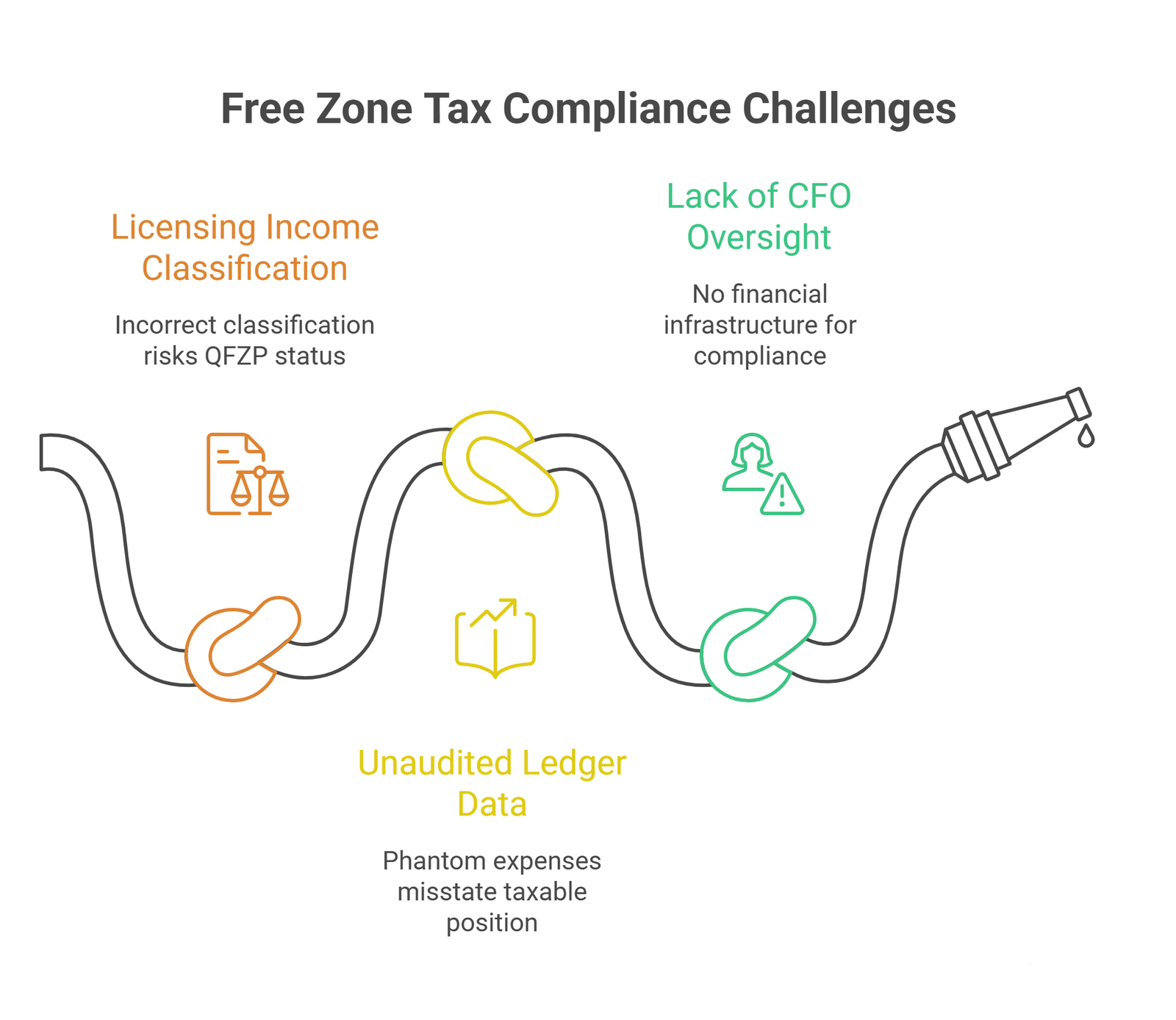
Our client faced several issues. Left unresolved, they could have cost far more than a late filing.
- Licensing income classification: under Cabinet Decision No. 100 of 2023, licensing income from copyrighted software qualifies for the 0% Corporate Tax rate. Licensing income from trademarks or brand names does not. Getting this wrong, even unintentionally, could put the company’s entire Qualifying Free Zone Person (QFZP) status at risk. It could also generate an unexpected CT liability of over AED 1,400,000.
- A ledger built on unaudited data: the client’s initial CT workbook was built from raw pre-audit general ledger data. It contained a phantom royalty expense of over AED 5,500,000. Left uncorrected, that single mis-coding would have materially misstated the company’s taxable position.
- No CFO-level oversight: the business needed real financial infrastructure. Budget tracking, cash flow forecasting, KPI visibility, all without the cost of a full-time CFO.
These challenges needed to be resolved before a single figure reached the EmaraTax portal, not after.
Our approach
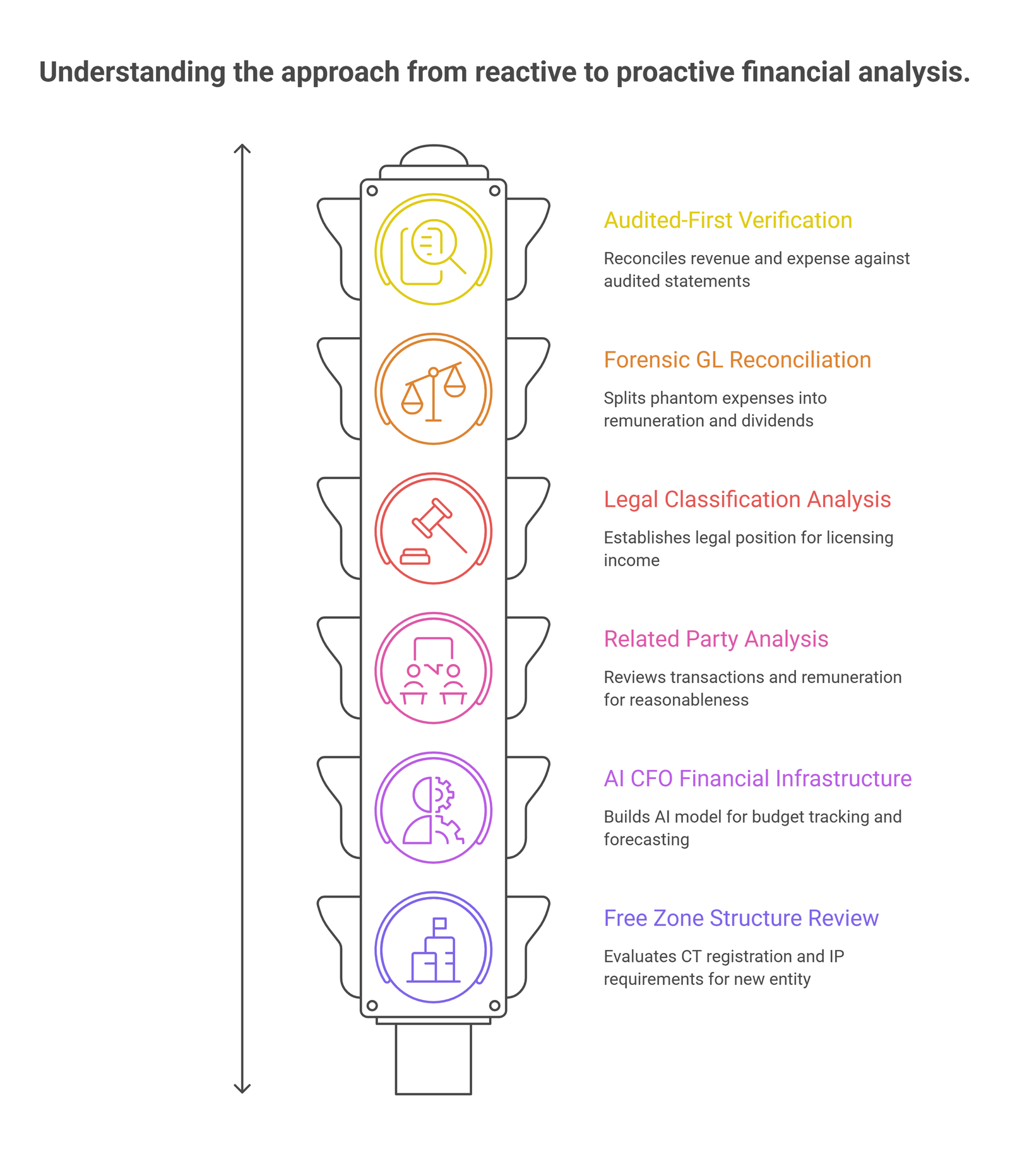
We treated this as forensic work, not a form-filling exercise.
Audited-first verification
Every revenue and expense line was reconciled against externally audited financial statements, not internal ledger data. This happened across multiple rounds of review. Net profit was corrected from an understated figure to the audited amount. It now reconciles exactly to the client’s audited financial statements.
Forensic GL reconciliation
Through forensic accounting analysis, the AED 5,500,000+ phantom royalty expense was split into two components. Part was managerial remuneration, reclassified to salaries and wages. Part was shareholder dividends, moved below the line as a non-deductible distribution. That reclassification is the difference between a correct filing and one that misrepresents the entity’s financial position.
Legal classification analysis
We built a formal legal position, grounded in Cabinet Decision No. 100 of 2023. It established that the client’s licensing income came from copyrighted software, its learning platform, CMS, and LMS, rather than trademark or brand licensing. That classification confirmed QFZP status and protected the 0% Corporate Tax rate.
Related party and connected persons analysis
We reviewed Articles 34, 35, and 36 of UAE CT Law in full. Related party transactions came in below disclosure thresholds. Connected persons’ remuneration was assessed for Article 36 reasonableness. No transfer pricing study was required. We prepared an arm’s length documentation note regardless.
AI CFO financial infrastructure
We built a seven-tab AI CFO financial model synced live to QuickBooks. It includes a P&L budget-versus-actual tracker and a rolling 12-month cash flow forecast. There’s a department KPI tracker spanning finance, product, content, enterprise, and community. An SDG impact dashboard tracks 25+ KPIs across five UN goals. An executive scorecard and a single assumptions engine tie it all together, alongside a QuickBooks integration guide built on Coupler.io’s no-code sync.
Free zone structure review
The client was preparing to migrate to a new Free Zone entity. We evaluated CT registration, QFZP eligibility, and IP licence agreement requirements for that new entity. This way, compliance was in place from day one instead of fixed after the fact.
The outcome
- Corporate tax payable: AED 0
- QFZP status: confirmed
- Licensing income: correctly classified as qualifying
- GL errors corrected: 6 material errors identified and resolved
- Phantom royalty removed: AED 5,500,000+ forensically reclassified
- Net profit: reconciled exactly to audited financial statements
- Related party disclosure: below the AED 40M threshold, no transfer pricing study needed
- AI CFO model: live, connected to QuickBooks
- Engagement type: started as one-time compliance work, evolved into an AI CFO retainer
- Filing: submitted on EmaraTax, 57 days before deadline
The engagement also touches five UN Sustainable Development Goals worth naming. SDG 4, quality education, by protecting the tax position of a platform serving 1.2 million learners in 106 countries. SDG 8, decent work and economic growth. SDG 9, industry, innovation and infrastructure, through AI-powered reporting that replaced manual, error-prone tracking. SDG 10, reduced inequalities, by supporting a platform built around access to education. And SDG 17, partnerships for the goals.
SDG alignment
This engagement also touches five UN Sustainable Development Goals.
SDG 4, quality education. The client’s platform serves 1.2 million learners in 106 countries. Protecting its tax position protects that reach.
SDG 8, decent work and economic growth. Sound financial infrastructure supports job creation and steadier operations as the business scales.
SDG 9, industry, innovation and infrastructure. The AI CFO model replaced manual, error-prone reporting with live financial tracking.
SDG 10, reduced inequalities. The platform’s core mission is widening access to education. Its financial stability supports that mission directly.
SDG 17, partnerships for the goals. The engagement itself reflects a long-term advisory relationship built on transparency, not a one-off filing.
What’s in it for you?
Maybe you run a UAE Free Zone business. Maybe you have licensing income, a cross-border structure, or no dedicated finance lead. If so, you’re likely facing some version of these same risks:
- Misclassified licensing income, which can quietly disqualify you from QFZP status and trigger a Corporate Tax bill you didn’t plan for.
- GL errors that never get caught, because nobody reconciles the ledger against audited financials before filing.
- No real-time visibility into cash flow, budget variance, or department KPIs, because building that infrastructure feels like a CFO-sized problem.
- Related party transactions with no documentation, even when they’re below the disclosure threshold. Article 34 still applies.
- A Free Zone migration or restructuring where nobody has checked whether QFZP eligibility and IP licensing carry over cleanly.
How can you overcome these challenges?
- Reconcile against audited financials before you file. Not against raw GL exports.
- Get a legal read on your licensing income. Do this before you assume it qualifies for the 0% rate.
- Document related party arrangements. Do this even when you’re comfortably below the AED 40M threshold.
- Build financial infrastructure that runs on live data. Errors should surface before they reach a tax return.
- Review QFZP eligibility whenever you restructure or migrate entities. Not after the fact.
Ready to get your Corporate Tax position right? At Oak Business Consultant, we handle Corporate Tax UAE filing, forensic GL review, and Virtual CFO infrastructure for Free Zone businesses. Book a free consultation and let’s look at your filing before it becomes a problem.
Frequently Asked Questions
What is a Qualifying Free Zone Person (QFZP)?
A QFZP is a Free Zone entity that meets the conditions under UAE Corporate Tax law to pay 0% tax on its qualifying income. Non-qualifying income is taxed at the standard 9% rate.
Why does licensing income classification matter so much?
Cabinet Decision No. 100 of 2023 treats copyrighted software licensing and trademark or brand licensing differently. Only the former counts as qualifying income. A wrong classification can cost a company its QFZP status entirely, not just the tax on the misclassified income.
What is forensic GL reconciliation, and why not just file from the ledger?
It means checking every ledger entry against externally audited financial statements. You don’t just trust the raw general ledger. Ledgers commonly contain mis-codings, like the phantom royalty expense in this case. They look fine until someone traces them back to source documents.
Does the arm’s length requirement apply below the disclosure threshold?
Yes. Articles 34 and 35 set a disclosure threshold. But the arm’s length obligation under Article 34 applies regardless of whether you cross it.
What does the AI CFO financial model actually include?
A seven-tab model synced live to QuickBooks. It covers budget-versus-actual tracking, a rolling cash flow forecast, department KPIs, an SDG impact dashboard, an executive scorecard, and a single assumptions sheet feeding all of it.
Conclusion
This engagement started as a single Corporate Tax filing. It turned into an ongoing AI CFO retainer. That’s usually how it goes when the underlying problem isn’t the filing itself but the data behind it. Correct classification protected the client’s 0% rate. Forensic reconciliation caught a AED 5.5 million error before it reached EmaraTax. And the financial model that came out of it now runs the business day to day, not just at tax time.
Strengthen your free zone’s corporate tax position
Oak Business Consultant works with Free Zone entities, SMEs, and growing businesses. We handle UAE Corporate Tax compliance, forensic accounting, AI CFO financial modeling, and free zone structuring. Book a free consultation to get started.