Creating a Financial Budget – A Holistic Guide
How to create a financial budget you’ll actually stick to
Most business budgets fail for a boring reason: they get built once in January and never opened again. That’s expensive. Research from U.S. Bank found that 82% of businesses that fail cite cash flow problems as a primary cause, and a missing or neglected budget is usually the thread running underneath that statistic.
A financial budget isn’t a spreadsheet exercise you complete and file away. It’s a living decision-making tool that tells you where your money is coming from, where it’s going, and whether your business can absorb a bad quarter without a scramble. This guide walks through what a budget actually contains, how to build one, which budgeting method fits your situation, and how to keep the whole thing from going stale by March.
What a financial budget actually is
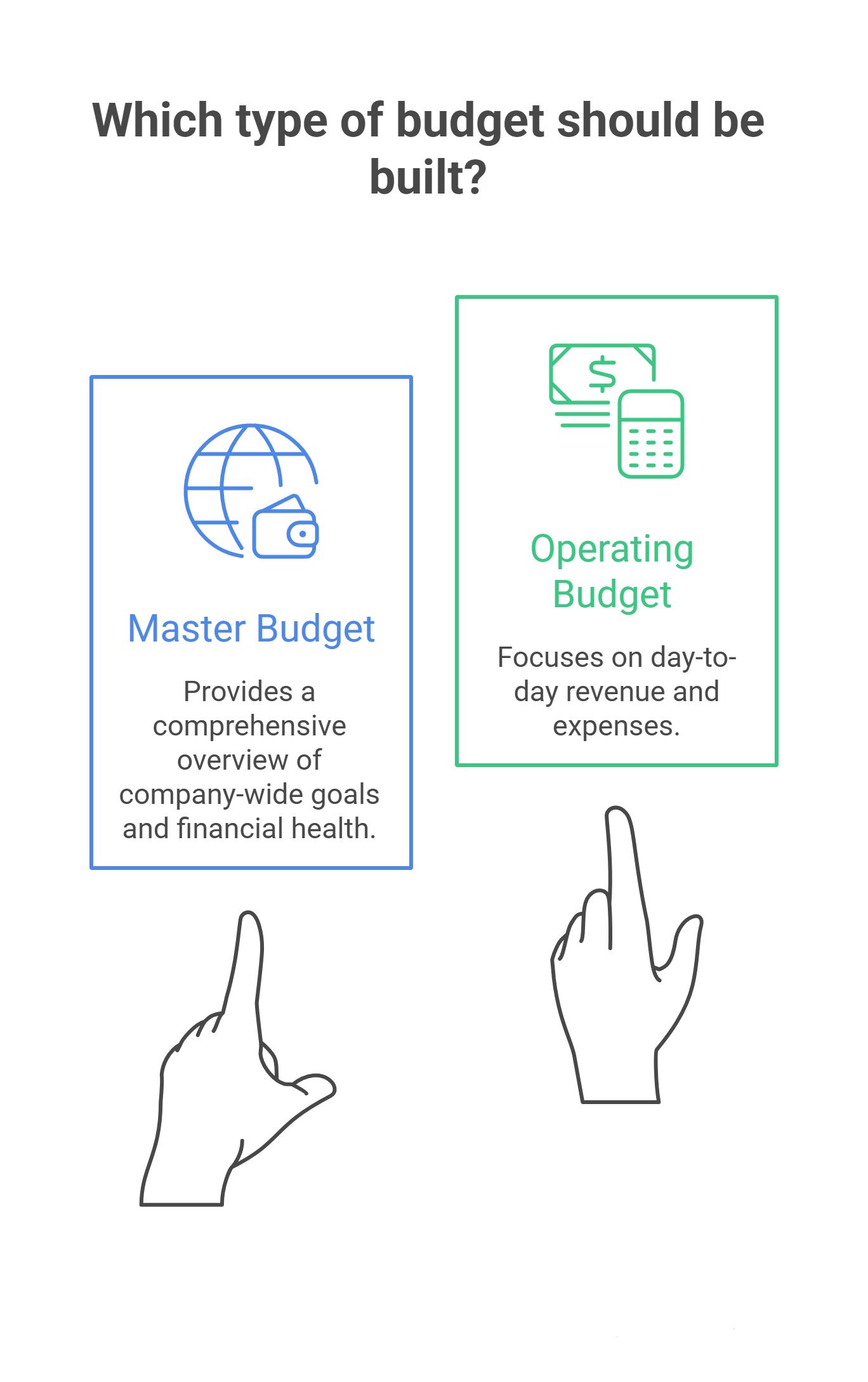
At the simplest level, a business budget is a financial plan that estimates your revenue, expenses, and profit over a set period, usually monthly, quarterly, or annually. But most growing businesses actually work with two layers of budget, and conflating them is a common source of confusion.
A master budget pulls together every financial statement, cash forecast, and departmental plan into one comprehensive document. It’s the big-picture tool leadership uses to track progress toward company-wide goals. An operating budget is narrower: it covers projected revenue and day-to-day expenses, essentially a forward-looking profit and loss statement, and it typically excludes large capital expenditures. Most businesses live inside their operating budget month to month, while the master budget gets revisited quarterly or annually.
Knowing which one you’re building changes what belongs in it, so it’s worth deciding upfront rather than discovering the confusion three months in.
The building blocks every budget needs
Regardless of industry or company size, a complete budget contains the same seven elements. Skip any one of these and the budget will look complete while quietly missing a piece that matters.
| Component | What it covers |
| Estimated revenue | Realistic income projection built from historical sales, current contracts, and seasonal patterns |
| Fixed costs | Rent, core salaries, insurance, loan payments: costs that don’t move with sales volume |
| Variable costs | Materials, shipping, commissions, contract labor: costs that rise and fall with activity |
| One-time expenses | Equipment purchases, a website redesign, a legal fee tied to a specific project |
| Cash flow | The actual timing of money moving in and out, distinct from profit on paper |
| Profit target | A stated gross and net profit goal, not just whatever is left over |
| Budget-vs-actual tracker | A running comparison of projected numbers against real results, reviewed monthly |
That last line is the one most small business budgets skip, and it’s arguably the most important. A budget that’s never compared against actuals is a forecast, not a management tool.
Examining your current financial situation
Before you can set a realistic target, you need an honest read on where the business stands today.
Know your numbers. This means a full picture of cash flow, debt, assets, and expenses, backed by financial statements that are actually current. Businesses running on last quarter’s numbers are budgeting against a picture that no longer exists.
Evaluate performance against history. Compare this period’s actuals to past trends and to whatever was previously budgeted or forecasted. This is where you spot the categories that consistently run over and the months where cash gets tight, patterns that are easy to miss if you’re only looking at one period at a time.
Assess your risk exposure. Market shifts, policy changes, and external shocks (a key client leaving, a supply disruption) all affect how much cushion your budget needs. This step is often skipped because it’s uncomfortable, but it’s the difference between a budget that survives a bad month and one that collapses at the first surprise.
Setting SMART goals for your budget
Once you know where you stand, the next step is setting goals that are specific, measurable, achievable, realistic, and time-bound. Vague goals like “spend less” don’t translate into a budget line; “reduce marketing spend by 10% over Q3” does.
Break large goals into smaller, trackable increments. A target to save $1 million by year-end is easier to hit, and easier to course-correct on, when it’s expressed as roughly $83,000 a month rather than one distant annual number. The same logic applies to expense reduction targets: track monthly against the goal, not just at the finish line.
Choosing a budgeting method
This is the step most budgeting guides skip entirely, and it’s often the reason a budget stops getting used. The method you choose should match your business stage, not just whatever template you found first.
Incremental budgeting starts with last year’s numbers and adjusts them up or down. It’s fast and works well for stable businesses with predictable costs, but it quietly carries forward any inefficiency that was already baked into last year’s spending.
Zero-based budgeting starts every period at zero. Every expense has to be justified from scratch, which surfaces spending that no longer earns its place, but it takes real time to build and isn’t something most teams want to redo every single month.
Activity-based budgeting ties costs to specific business activities rather than starting from a top-line expense list. It gives detailed insight into what’s actually driving spend, which makes it useful for businesses with complex or fluctuating operations, though it takes more work to set up than the other methods.
Flexible (or rolling) budgeting adjusts automatically as actual revenue comes in: variable costs scale up when sales are strong and contract when they’re not. This is the method to reach for when your income is seasonal or genuinely hard to predict, and it’s also what to switch to during a stretch of real economic uncertainty, when a fixed annual budget stops reflecting reality within a few weeks.
Most established businesses end up running a hybrid: incremental for stable fixed costs, zero-based for discretionary spending like marketing or software. There’s no prize for picking the most sophisticated method; the right one is whichever you’ll actually keep updated.
Building the budget step by step

Establish a timeline. Break the goal into milestones you can hit within weeks or a month, not just a single year-end target. Smaller, visible wins keep the process from feeling abstract.
Identify what each step requires. Time, money, and people all need a rough estimate before you commit to a plan, or you’ll discover the gap mid-execution instead of before you start.
Assemble a profit and loss projection. Pick a reporting period, total your expected revenue, subtract the cost of goods sold to get gross profit, then subtract operating expenses, interest, taxes, and depreciation to arrive at projected net income. This single document is what turns a list of line items into an actual forecast of whether the business makes money.
Track progress on a set schedule, not whenever it happens to come up. Monthly check-ins catch a variance while it’s still a small problem; waiting until the annual review means finding out in December that revenue has been running 15% under budget since March.
Why creating a financial budget matters
A budget does more than keep spending in check. It sets a benchmark you can measure actual performance against, which is what lets you catch an inefficient cost before it becomes a pattern rather than after. It also builds credibility with lenders: a business that can show a realistic, maintained budget has an easier time accessing financing than one operating on instinct.
The gap between disciplined budgeting and none shows up clearly at scale. Amazon’s long-running discipline around cash flow management, prioritizing reinvestment over short-term profit, is widely credited as part of how it funded growth without losing control of its finances. Kodak is the inverse case: a market leader in photography for decades that failed to adjust its financial planning fast enough when digital photography reshaped the industry, and it filed for bankruptcy protection in 2012 despite its scale and brand strength. Being big and well known doesn’t substitute for a budget that reflects where the market is actually heading.
Profit isn’t cash: the distinction that sinks budgets
A business can show a profit on its income statement and still fail to make payroll. This happens when revenue is real but tied up in unpaid invoices, or when expenses land before the cash to cover them arrives. Cash flow and profit measure different things, and a budget that tracks only one of them is missing half the picture.
Monitor cash flow weekly, or at minimum monthly, with particular attention to the gap between when you pay suppliers and when customers actually pay you. If that gap is wide, a profitable month on paper can still be a cash-short month in the bank.
How to adjust your financial budget when necessary
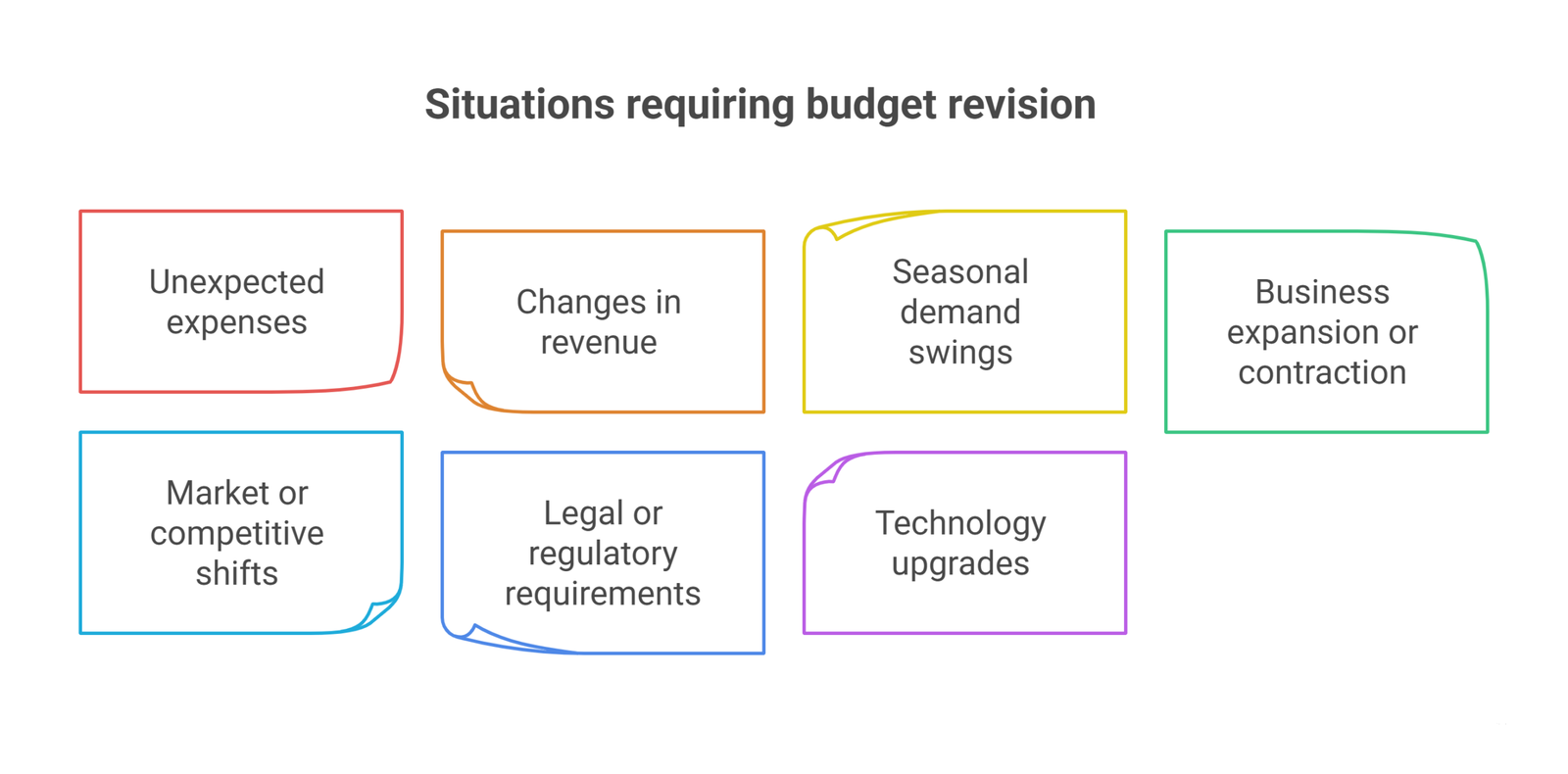
A budget should never be treated as static, but adjustments shouldn’t be impulsive either. The situations that typically call for a real revision:
- Unexpected expenses, like an unplanned equipment purchase. Decide whether it’s genuinely necessary or can be delayed before amending anything.
- Changes in revenue, up or down. A drop calls for immediate cost discipline; a jump calls for a deliberate decision about where the extra funds go, not just letting spend creep up to match.
- Seasonal demand swings, which need advance planning rather than a reactive fix once the slow month has already arrived.
- Business expansion or contraction, which changes staffing and equipment costs enough to require a real budget rework, not a minor tweak.
- Market or competitive shifts that require a fast response, such as a competitor’s move that demands a marketing reaction.
- New legal or regulatory requirements, particularly around compliance spending that isn’t optional.
- Technology upgrades that are necessary to stay competitive but need to be planned for rather than absorbed as a surprise.
After any adjustment, stick to it: set milestones with owners and deadlines, track actual spend against the revised plan, and check in with stakeholders regularly so the update doesn’t quietly drift back to old habits.
Budgeting for growth and economic uncertainty
Scaling a business requires a different budgeting posture than running steady-state operations. One useful framework: allocate roughly 70% of income to daily operations, 20% to new opportunities, and 10% to long-term growth, adjusting the split as the business matures. Automating the transfers into savings or growth funds helps this stick instead of becoming an aspiration that quietly gets skipped.
During periods of real economic uncertainty, a standard annual budget can become outdated within weeks. Shifting to a rolling 90-day plan, one that gets updated regularly rather than revisited once a quarter, gives a business the flexibility to respond to a supply disruption or a revenue dip without waiting for the next scheduled review. Pair that with a clear list of which costs are must-haves versus nice-to-haves, so the cuts (if needed) are decided in advance rather than under pressure.
Controlling costs without cutting morale
Cost discipline and employee morale aren’t actually in tension if the conversation is honest. Start by asking staff directly what they value, rather than assuming; this surfaces which perks are worth the line item and which ones nobody would miss. From there, look for lower-cost substitutes: discounted or free community events instead of pricey outings, an internal skill-share instead of an external training budget line, flexible spending accounts that let employees direct pre-tax dollars toward benefits that matter to them individually.
Automation tools and expense-tracking software also free up budget indirectly, by cutting the labor cost of managing the budget itself and flagging overspending before it compounds. None of this requires a large recreation or perks budget to execute well; it requires knowing what the team actually values before deciding what to cut.
Taking control of your budget with Oak Business Consultant
Having the right financial strategy in place is the foundation of everything else a business does. Oak Business Consultant works with founders and finance teams on the financial modeling, accounting and bookkeeping, and ongoing budgeting support that turns a one-time spreadsheet into a system the business actually uses. If you want to understand how budgeting differs from broader financial planning before you start, our guide on budgeting versus financial planning is a useful companion read.
Frequently Asked Questions
What is the difference between a master budget and an operating budget?
A master budget is the comprehensive, company-wide financial plan that combines every department’s numbers, cash forecasts, and capital plans. An operating budget is narrower: it covers projected day-to-day revenue and expenses, similar to a forward-looking profit and loss statement, and usually excludes major capital expenditures.
What are the main components of a business budget?
Seven elements: estimated revenue, fixed costs, variable costs, one-time expenses, cash flow tracking, a stated profit target, and a budget-vs-actual tracker to compare projections against real results.
How much should I set aside for a contingency fund?
Most financial guidance recommends setting aside 5-10% of your total budget as a contingency reserve for unexpected costs, separate from any savings earmarked for planned one-time purchases.
What is zero-based budgeting?
A method where every expense must be justified from scratch each period, rather than starting from last year’s budget and adjusting it. It surfaces unnecessary spending effectively but takes more time to build than incremental budgeting.
Can a business be profitable and still run out of cash?
Yes. Profit is an accounting measure that can include revenue tied up in unpaid invoices; cash flow tracks the actual timing of money moving in and out. A business can show a profit on paper and still be unable to make payroll if cash is tied up in accounts receivable.
How often should I review my budget?
Monthly at minimum, with a deeper quarterly review to catch bigger trends. During periods of economic uncertainty or highly variable revenue, a rolling 90-day review cycle works better than sticking to a fixed annual schedule.
Conclusion
Creating a financial budget isn’t about producing a perfect document in January. It’s about building a system you’ll actually return to: the right components, a budgeting method that matches how predictable your revenue really is, and a review rhythm that catches problems while they’re still small. The businesses that get this right aren’t the ones with the most detailed spreadsheet; they’re the ones that treat the budget as something to argue with monthly, not file away.
If you’re ready to build a budget that holds up past the first quarter, talk to Oak’s budgeting consultants about a plan tailored to your business.