A Complete Guide to Virtual CFO vs. In-Person CFO
Virtual CFO vs. In-Person CFO
A company’s financial components, such as financial performance, cost management, financial budgeting, financial analysis, and other business actions that influence the company’s financial state, are overseen by the Chief Financial Officer (CFO). When firms consider employing a CFO, they frequently choose between hiring a virtual CFO or an in-person CFO.
Regardless of what type of CFO services your firm hires or contracts with, their general responsibilities and administrative functions are almost the same:
- Modeling and forecasting financial performance
- Preparing and analyzing financial statements
- Budgeting and cash flow management
- Reporting (e.g., taxes, relevant compliance efforts)
- Monitoring investments
- Preparing financial models
- Preparing Business Plans
- Supervising Bookkeeping
This article will discuss some ideal scenarios and the benefits of choosing between a virtual and an in-person CFO.
Benefits and Ideal Scenarios for Hiring a Virtual CFO
Virtual CFOs work independently, entering your business with a fresh perspective on the issues you’re attempting to resolve. Following are some of the benefits and ideal scenarios of hiring a virtual CFO:

Cost Effective
Hiring a virtual CFO to work at your firm will be less expensive than an in-person CFO. Moreover, smaller firms and startups typically do not have a large sum of money lying around. Therefore, a virtual CFO or outsourced CFO services will only cost you based on the time and deliverables required by your company. Depending on your requirements, this may be as little as a few hours weekly.
High Level of Expertise
Virtual CFOs have a distinct benefit in terms of concurrently working with and learning from numerous industries. Although virtual CFO services you engage with would most likely give you a CFO with substantial expertise in your industry, they also have worked in other sectors. This diversified industry experience can give your business insights and networks that would not be possible otherwise.
Flexibility
Virtual CFO services enable you to set your company’s appropriate time and cost conditions. It is up to you whether you require a virtual CFO to work full-time or part-time. Working hours can be adjusted to meet the changing demands of your company. With a virtual CFO, the service continues regardless of what happens to just one virtual team member. Any change will go smoothly and will not affect your workflow.
Adaptability
Virtual CFOs with a long track record imply that they have already raised funding and addressed challenges for other firms. An expert virtual CFO will employ tried-and-tested methods and tactics to help your business. Virtual CFOs also have an extensive network of people that might potentially assist your business in expanding. They understand how to blend in with a finance team as an executive without intruding on or injuring any business egos. As a result, there will be no issues or stepbacks when it comes to managing or assigning work.
Ability to Handle Challenges
Virtual CFOs are prepared to manage any difficulty your business may face, thanks to their extensive expertise in addressing the financial demands of multiple firms across several disciplines. They have most likely worked with firms of all sizes and have encountered many difficulties. Even when faced with a new situation, they may draw on the cumulative knowledge of a team of CFOs to give you a feasible solution to any problem.
Technological Integration
A professional virtual CFO service incorporates cutting-edge technology, such as artificial intelligence and advanced data analytics, into its procedures to manage and assure accounting compliance and generate reliable financial predictions. Moreover, it assists in integrating technology with a financial mechanism of a company.
Benefits and ideal Scenarios of Hiring an In-person CFO
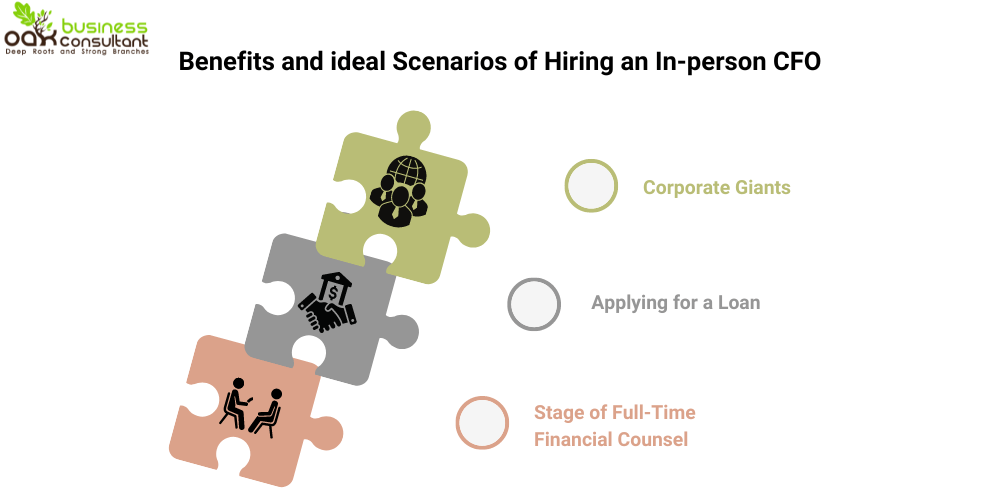
An in-person CFO is ideal in a condition where companies are looking for a permanent CFO to hire. Usually, large companies with high budgets hire in-person CFO. However, if you are a huge corporation or a firm dealing with consultants, auditors, or government authorities, communication may be challenging, and they may not understand you. An in-house CFO’s function is critical in this situation. The in-house full-time CFO will communicate with you, which will assist them in grasping your plan.
Obtaining a loan in several areas is a complex task for a developing corporation. An in-house full-time CFO will keep track of your company’s commitments and devise debt and risk management methods.
Hiring an in-house CFO makes sense if your company has reached the stage where it requires full-time financial counsel. Having an in-house CFO guarantee, they are familiar with your company and can provide full-time financial guidance and assistance. However, outsourcing your CFO services is the most practical choice if your company has not yet reached this position.
Virtual CFOs are Becoming Common
The growth of accounting software and startups or other internet enterprises has increased the demand for virtual CFOs in recent years. In addition, accounting and payroll software systems have automated many of the number-crunching processes that used to take CFOs many hours to complete.
With continually advancing from fingers to abaci to calculators to software platforms and outsourcing, one CFO can accomplish much more in much less time.
Virtual CFOs assist in providing critical counsel while lowering expenditures, which is especially important for startups that run as clearly as possible. Depending on the size of your firm, you may want a few hours of their experience and efforts every week.
Ideal Time to Outsource CFO Services
When the firm is moving at a breakneck pace, and suddenly your CFO abruptly departs, then you need to outsource CFO services. Secondly, you may need to outsource CFO services when it is tough to find a new CFO in a short period of time. It is not easy to locate someone with the same expertise as your previous CFO, who was intimately familiar with your financial situation.
Recruiting a CFO may be a difficult task. However, recruiting the wrong person may also be disastrous and costly. In these cases, outsourcing your CFO services will simplify your work and offer you more time to choose the ideal one.
A lack of a CFO for a short length of time might be devastating to your business. Interim CFO fills the gap between the retirement of your present CFO and the start date of the new one.
Businesses usually recruit CFO services when:
- More capital is needed
- Working on a new project
- Mismanagement in cash balances
- Want to benefit from interim CFO
- Rebuilding a company and need financial assistance
At OAK Business Consultant, we can supply your company with outsourced CFO services, a cost-effective option for receiving strategic and financial assistance from an experienced CFO.
Emphasize IT Security when Hiring a Virtual CFO
Many firms have already shifted to remote workforces, necessitating a rethinking of information security. Such safeguards give employees secure access to the systems, apps, and resources they need to carry out their duties. When hiring a virtual CFO, the same caution must be exercised.
You’ll need to provide a virtual CFO with remote access to your network and financial data. Because financial information is often subject to many of the data privacy and security rules that apply to enterprises of all sizes, you will need to adopt suitable safeguards, such as:
- Firewalls
- VPN
- Multi-Factor Authentication
Assume that inadequate IT security results in a data breach that compromises your financial records. In such a situation, you might only need to engage a CFO to determine how to pay the high fines.
Wrapping Up
As your company expands, so does the need for organized financial planning, cash flow tracking, and formulating long-term growth strategies based on the firm’s financial status. So a CFO is essential for managing the financial aspects of a business. They aid in financial budgeting and preparing the financial model of a company.
OAK Business Consultant provides end-to-end financial process support, allowing CFOs to carry out their responsibilities more efficiently and effectively while supporting corporate development with solid decision-making abilities. We specialize in offering CFO services to firms. With our service, you can get your company’s finances in order and watch it thrive!
Contact us to schedule a free consultation today!