CEO Vs CFO Meaning: What’s The Difference?
Introduction:
Every company—startup or enterprise—runs on two engines: strategic direction and financial control. The CEO drives vision. The CFO drives fiscal discipline. Confuse the two, or leave one vacant, and growth stalls. This guide breaks down what each role actually means, where their responsibilities diverge, and how the two must work in lockstep to build a resilient business.
What Is a CEO?
The Chief Executive Officer (CEO) is the highest-ranking executive in any organization. The CEO holds ultimate accountability for the company’s performance, direction, and public identity. Every department head—including the CFO—reports upward to the CEO, either directly or through the organizational structure.
The CEO’s mandate is broad by design. They translate the board’s expectations into operational reality, make the calls that define market positioning, and serve as the primary point of contact between the company and the outside world—investors, regulators, partners, and the press.
In a small business or startup, the CEO is often the founder. In larger organizations, the board of directors appoints the CEO through a formal selection process. Regardless of company size, the expectations are consistent: lead decisively, communicate a compelling vision, and hold the organization accountable to results.
What defines a strong CEO:
- Sets the long-term strategic direction and communicates it clearly across the company
- Builds and maintains relationships with the board of directors and major shareholders
- Makes high-stakes decisions on market expansion, acquisitions, partnerships, and pivots
- Is the face of the company in investor relations, media, and industry conversations
- Recruits and leads the executive team, including the CFO, COO, CTO, and CMO
- Cultivates company culture and sets the leadership standard for the organization
The CEO does not need to be a financial expert. What they need is strategic clarity, communication strength, and the judgment to know when to act and when to delegate. That is precisely why the relationship with the CFO is so critical.
What Is a CFO?
The Chief Financial Officer (CFO) is the senior executive responsible for every financial function inside the company. Where the CEO thinks in terms of markets and strategy, the CFO thinks in terms of numbers, risk, and capital efficiency.
A CFO is not just an accountant with a bigger title. The role spans financial modeling, investor relations, treasury management, regulatory compliance, and strategic financial planning. In high-growth environments, the CFO is one of the most consequential hires a company makes.
The CFO reports to the CEO and is typically the second most senior executive in the company. At the board level, the CFO regularly presents financial performance, risk assessments, and capital allocation plans. In many organizations, the CFO works directly with the audit committee of the board.
What defines a strong CFO:
- Owns all financial reporting, including income statements, balance sheets, and cash flow statements
- Leads financial planning and analysis to support strategic decision-making
- Manages cash flow, working capital, and treasury operations
- Oversees risk management—identifying, quantifying, and mitigating financial exposure
- Drives capital structure decisions: debt vs. equity, dividend policy, reinvestment strategy
- Leads fundraising efforts and manages relationships with lenders and institutional investors
- Ensures compliance with tax regulations, financial reporting standards, and audit requirements
- Evaluates the financial viability of new business initiatives before the CEO commits
For growing businesses that cannot yet justify a full-time hire, fractional CFO services offer access to this expertise on a part-time basis—an increasingly common approach among scaling SMEs and startups.
CEO vs CFO: Who Holds More Power?
The CEO holds organizational authority over the CFO. In the corporate hierarchy, the CFO reports to the CEO. This means that on matters of financial strategy, the CFO advises and recommends—but the CEO makes the final call, and owns accountability for outcomes.
That said, framing this purely as a power question misses the point. The CEO needs the CFO. A CEO without sound financial counsel is flying blind. A CFO without executive buy-in cannot implement anything. The most effective leadership structures treat this as a partnership, not a hierarchy.
In practice, the CFO functions as the CEO’s most trusted operational peer. When the CEO considers a major acquisition, the CFO models the deal economics. When the CEO promises investors a growth target, the CFO builds the roadmap to achieve it. The authority flows downward; the intelligence flows upward.
CEO Responsibilities: A Deep Dive
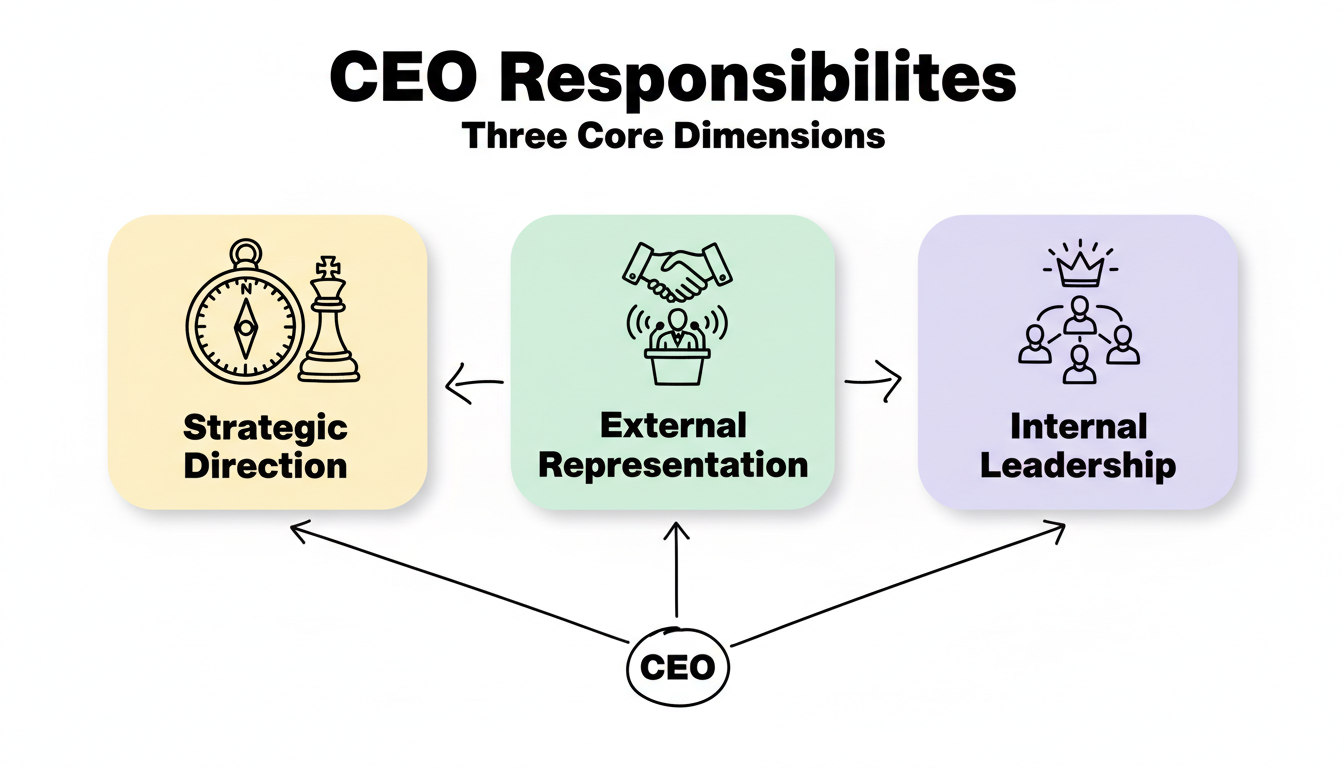
Understanding the CEO role means understanding how it functions across three dimensions: internal leadership, external representation, and long-term strategy.
Internal Leadership
The CEO sets the organizational tone. They establish culture—whether that means a culture of accountability, innovation, or efficiency—and they cascade that culture through the executive team. The CEO resolves cross-functional conflicts, allocates resources between departments, and ensures the operating model supports the strategy.
External Representation
The CEO represents the company to boards, investors, regulators, media, and strategic partners. They pitch the company’s vision to capital markets, negotiate high-value partnerships, and manage the company’s public reputation. In a crisis, the CEO is expected to lead the response—publicly and internally.
Strategic Direction
The CEO defines where the company is going and why. They translate market opportunities into strategic priorities, allocate capital to the highest-impact initiatives, and make the organizational changes necessary to execute. A well-structured business plan is as much a CEO artifact as a CFO one—it reflects the CEO’s ambition and the CFO’s discipline working in concert.
Core CEO responsibilities in summary:
| Function | Description |
| Corporate Strategy | Sets and communicates long-term direction |
| Board Relations | Serves as the primary liaison between operations and the board |
| Capital Allocation | Decides where organizational resources are invested |
| Talent Leadership | Recruits and develops the executive team |
| External Relations | Manages investor, partner, regulator, and media relationships |
| Culture | Defines and drives the organizational culture |
| Crisis Management | Leads the company through operational and reputational crises |
CFO Responsibilities: A Deep Dive
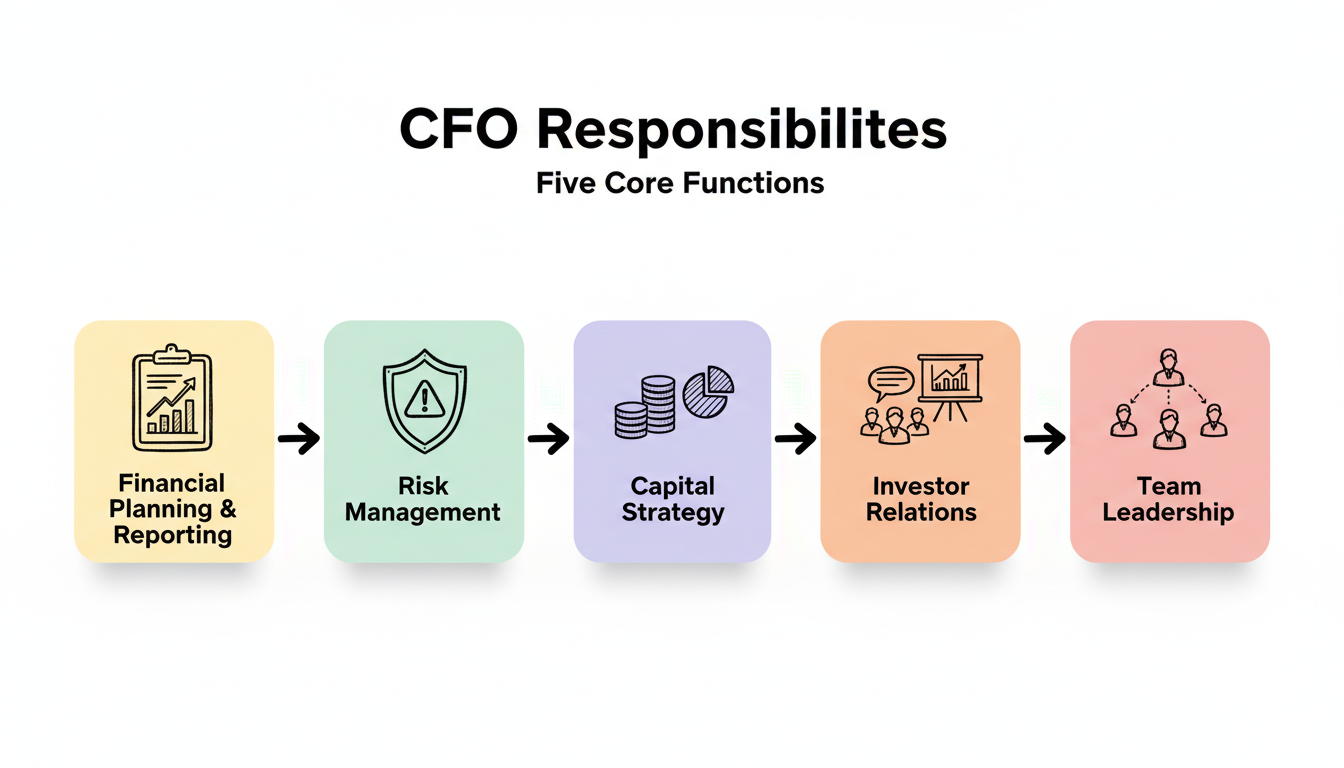
The CFO’s scope is narrower than the CEO’s in domain—but no less demanding in complexity. Every dollar the company earns, spends, borrows, or invests passes through the CFO’s purview.
Financial Planning and Reporting
The CFO produces and owns the financial statements that tell the company’s story to external stakeholders. More importantly, they use internal financial data to plan ahead—building forecasts, scenario models, and budget frameworks that allow the executive team to make evidence-based decisions.
Understanding the basics of financial modeling is non-negotiable for a CFO. It is the foundation on which capital decisions are made.
Risk Management
The CFO identifies what could go wrong—financially—and builds mitigation strategies. This includes credit risk, currency exposure, interest rate risk, regulatory compliance risk, and operational risk. The CFO is the early warning system for financial threats to the business.
Capital Strategy
How should the company fund growth? Debt, equity, or retained earnings? The CFO analyzes the cost of capital, the company’s risk tolerance, and market conditions to recommend the optimal capital structure. This directly affects shareholder value.
Investor Relations
In companies with external investors or public listings, the CFO manages those relationships. This includes preparing investor presentations, quarterly earnings calls, and responding to due diligence requests during fundraising rounds. A CFO who communicates financial performance clearly and credibly is a major competitive asset.
For companies actively raising capital, the CFO works alongside capital raising consultants to prepare financial models, investor-ready materials, and defensible valuations.
Team Leadership
The CFO leads the finance function—controllers, accountants, financial analysts, and treasury staff. Understanding the distinction between bookkeeping and accounting is foundational: bookkeeping records transactions, accounting interprets them, and the CFO turns that interpretation into strategic intelligence.
Core CFO responsibilities in summary:
| Function | Description |
| Financial Reporting | Owns P&L, balance sheet, and cash flow statements |
| Budgeting & Forecasting | Builds annual budgets and rolling financial forecasts |
| Risk Management | Identifies and mitigates financial risks |
| Capital Structure | Recommends debt/equity mix and manages treasury |
| Investor Relations | Manages communication with investors and lenders |
| Compliance | Ensures adherence to accounting standards, tax law, and audits |
| Finance Team Leadership | Directs controllers, analysts, and accountants |
CEO vs CFO: Key Differences at a Glance
| Dimension | CEO | CFO |
| Primary Focus | Strategy, vision, and growth | Financial performance and control |
| Reporting Line | Reports to the Board of Directors | Reports to the CEO |
| Scope | Entire organization | Finance and accounting function |
| Decision Type | Strategic and operational | Financial and risk-based |
| Key Metrics | Revenue growth, market share, EBITDA | Cash flow, burn rate, gross margin, WACC |
| External Face | Investors, press, partners, regulators | Investors, auditors, lenders |
| Background | Business, strategy, operations (varied) | Finance, accounting, economics |
| Accountability | Company performance and culture | Financial accuracy and capital efficiency |
| Evaluation Criteria | Market position, organizational health | Return on capital, budget adherence, risk exposure |
| Time Horizon | 3–10 year strategic view | 12-month operational + multi-year financial model |
Responsibility
The CEO is responsible for the entire enterprise. That includes culture, talent, customer relationships, product direction, and market strategy. The CFO is responsible for the financial engine that powers those pursuits—without which none of the CEO’s ambitions are achievable.
Scope
The CEO operates across every function in the business. The CFO’s scope is deep rather than wide—covering every financial dimension of the business with rigor and precision. A skilled CFO will influence decisions far beyond finance, but their authority derives from financial expertise rather than organizational authority.
Accountability
The CEO answers to the board and shareholders for the company’s overall performance. The CFO answers to the CEO—and in regulated environments, to the audit committee—for the accuracy and effectiveness of the company’s financial management.
Background
CEOs come from diverse professional backgrounds: operations, sales, technology, marketing, and consulting. What matters is leadership acuity and strategic thinking. CFOs, by contrast, almost always come from a finance background. Deep fluency in financial analysis, accounting standards, and capital markets is the baseline requirement.
How CEO and CFO Work Together
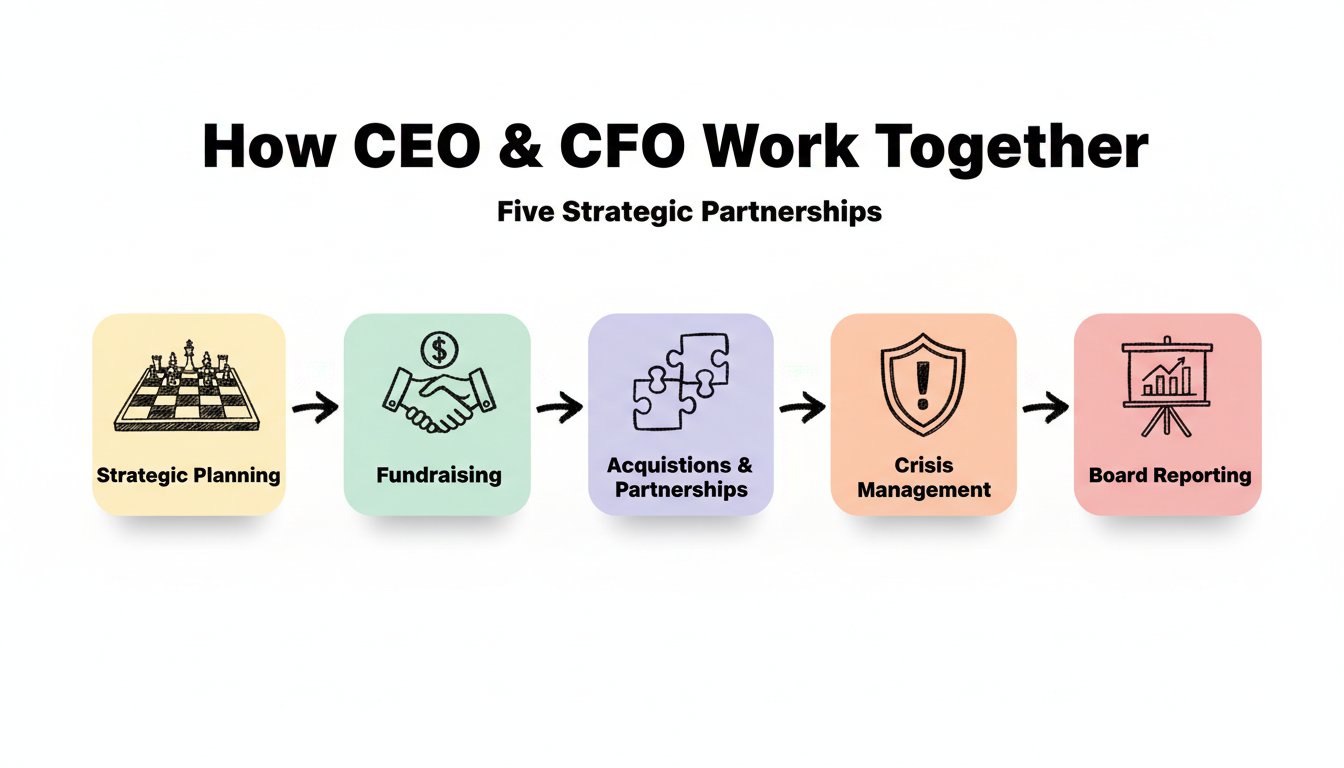
The most effective CEO-CFO relationships function as strategic partnerships. The CEO brings ambition; the CFO brings discipline. The CEO identifies opportunity; the CFO sizes the risk and defines what’s fundable.
Here is how that partnership plays out in practice:
Strategic Planning: The CEO articulates the strategic goals. The CFO builds the financial plan to support them, identifying where capital must be allocated and what returns are required to justify each investment.
Fundraising: The CEO leads relationship-building with potential investors. The CFO prepares the financial model, the valuation, and the financial narrative. Neither succeeds without the other.
Acquisitions and Partnerships: The CEO identifies targets and negotiates terms. The CFO models the deal economics, stress-tests assumptions, and conducts financial due diligence.
Crisis Management: When revenues fall short or costs spike, the CEO manages internal and external communication while the CFO rapidly recalibrates forecasts, identifies cash conservation opportunities, and recommends corrective actions.
Board Reporting: The CEO presents company performance and strategic direction. The CFO presents financial results, forecast accuracy, and risk posture. Together, they give the board the complete picture.
Does Your Startup Need Both?
Most early-stage startups cannot afford—or do not yet need—both a full-time CEO and a full-time CFO. In the earliest stages, the founder typically functions as CEO while a part-time bookkeeper or accountant handles basic financial administration.
The inflection point typically comes when:
- The company raises a significant funding round and investors require board-level financial reporting
- Revenue exceeds $1–2M annually and financial complexity outpaces the founder’s capacity
- The company is planning an M&A transaction, secondary raise, or debt facility
- Operational cash flow management becomes critical to survival
At that point, the question is not whether to bring in CFO-level expertise, but how. For many growing businesses, the answer is a virtual CFO or interim CFO—providing senior financial leadership without the cost of a full-time executive. As the business scales further, the move to a full-time CFO becomes justified.
The CEO role, by contrast, is needed from day one. Someone must own strategy, direction, and external relationships. In early-stage companies, that is almost always the founder.
Can a CFO Become a CEO?
Yes—and it happens more often than many expect. CFOs who ascend to the CEO role typically bring three advantages: financial discipline, investor credibility, and data-driven decision-making. In industries where capital allocation is the primary driver of value creation—private equity, financial services, infrastructure—the transition is particularly natural.
What CFOs must develop to make this transition:
- Broader operational fluency: Revenue generation, product development, and marketing strategy fall outside the traditional CFO playbook
- Organizational leadership skills: Managing a finance team is different from leading an entire enterprise with diverse functional cultures
- External communication: CEOs must inspire confidence in customers, employees, and the public—not just in investors and auditors
- Comfort with ambiguity: CFOs are trained to quantify uncertainty; CEOs must often decide without the luxury of complete information
The best route from CFO to CEO typically involves taking on broader P&L ownership, leading cross-functional initiatives, and demonstrating commercial acumen beyond the finance function.
When Should You Hire a CFO?
This question comes up constantly in growing businesses. The right timing depends on the company’s stage, complexity, and strategic priorities.
Hire CFO-level expertise when:
- You are preparing for a fundraising round and need investor-grade financial models and reporting
- Cash flow management is critical and you lack visibility into your financial runway
- You are entering a new market or making a significant capital investment
- Your accounting function has grown beyond what a bookkeeper can manage
- You are navigating a merger, acquisition, or exit process
- Revenue is scaling and you need a financial architecture to support it
Signs you waited too long:
- You do not know your gross margin, burn rate, or customer acquisition cost
- Your financial statements are consistently late or inaccurate
- You have made major capital decisions without a rigorous financial model
- Investors or lenders are asking financial questions you cannot answer credibly
For businesses not ready for a permanent hire, fractional CFO services provide the same level of strategic financial leadership at a fraction of the cost—ideal for businesses generating $500K–$10M in annual revenue who need CFO-level thinking without CFO-level overhead.
Frequently Asked Questions
Does the CFO report to the CEO?
Yes. In virtually all corporate structures, the CFO reports directly to the CEO. The CFO may also have a reporting relationship with the board’s audit committee on matters related to financial controls and external reporting.
Can a company have a CEO but no CFO?
Yes, and many early-stage companies do. However, as complexity grows—through funding rounds, revenue scale, or operational expansion—the absence of a CFO creates real financial risk. The solution for growing businesses is often a fractional or virtual CFO engagement before hiring full-time.
Is the CEO or CFO more important?
Both are essential, and neither can fully succeed without the other. The CEO without a strong CFO may pursue growth that destroys value. The CFO without a visionary CEO has no strategy to support. In practice, the CEO carries more formal authority, but the best-run companies treat the relationship as a genuine partnership.
What is the difference between a CFO and a Controller?
A Controller is primarily focused on accounting operations—recording transactions, producing financial statements, and ensuring compliance with accounting standards. A CFO uses that financial data to make strategic decisions. The Controller looks backward at what happened; the CFO looks forward at what should happen next.
At what revenue stage should a startup hire a CFO?
There is no universal threshold, but many businesses find that CFO-level engagement becomes critical somewhere between $1M–$5M in annual revenue, or at the point of raising a significant funding round. The complexity of the business matters as much as revenue size—a capital-intensive business at $500K may need a CFO sooner than an asset-light SaaS business at $3M.
Conclusion
The CEO and CFO are not interchangeable—and understanding the distinction is one of the most practical things a business leader can do. The CEO owns the vision and the organization. The CFO owns the financial engine that determines whether that vision is achievable. Together, they form the core of any well-run executive team.
For growing businesses, the decision is not simply whether to have both roles filled, but how. Fractional, virtual, and interim CFO models have made it possible for businesses of every size to access the financial leadership they need—without waiting until they can justify a full-time hire.
At Oak Business Consultant, we have spent 16 years helping founders, CEOs, and boards build the financial infrastructure to execute their ambitions. Whether you need a fractional CFO to prepare for your next raise, a financial model that holds up under investor scrutiny, or a strategic partner to sit alongside your CEO and own your company’s fiscal health—we are built for exactly that.
Ready to strengthen your financial leadership? Book a free consultation with our team to explore how our CFO services can align your financial strategy with your growth objectives.