GRI vs TCFD vs ISSB: Which ESG Framework Does Your Business Actually Need
GRI vs TCFD vs ISSB: Which ESG Framework Does Your Business Actually Need
If a bank, a large customer, or an investor has asked your company for “ESG data” in the last year, you’ve probably run into three acronyms that don’t mean the same thing: GRI, TCFD, and ISSB. Most guides to this topic treat all three as equally current. They aren’t. One of them was formally shut down in 2023. Here’s what each framework actually covers, where things stand today, and which one applies to your business.
What each framework is for
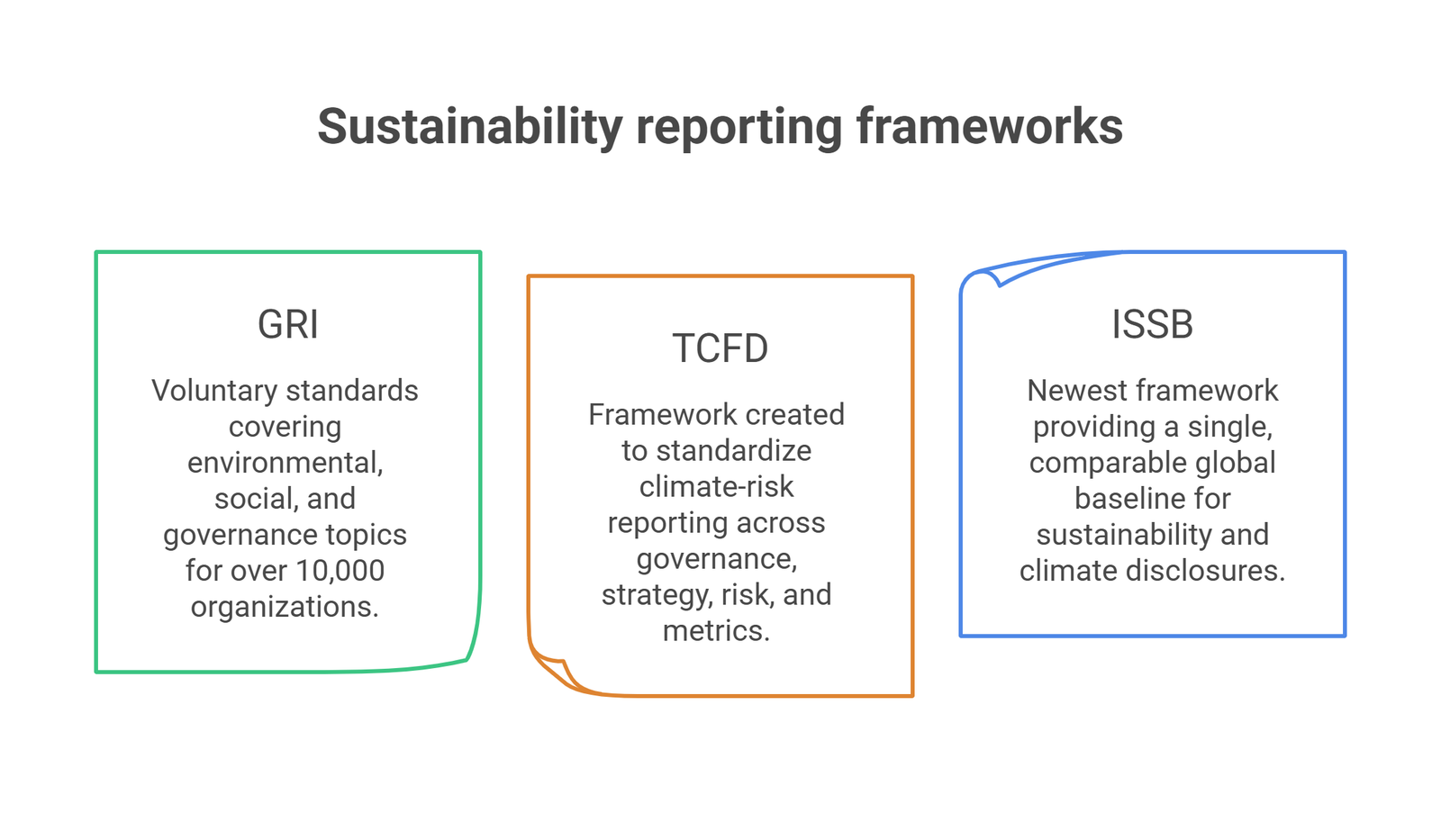
GRI (Global Reporting Initiative) is the oldest and broadest of the three. Established in 1997, it’s a voluntary set of standards covering environmental, social, and governance topics, used by more than 10,000 organizations worldwide. GRI asks a company to report its impact on the world: emissions, labor practices, community effects, supply chain conditions, and more.
TCFD (Task Force on Climate-related Financial Disclosures) was created in 2015 by the Financial Stability Board to standardize climate-risk reporting. It organized disclosures around four pillars: governance, strategy, risk management, and metrics and targets. Many companies still refer to “TCFD-aligned reporting” today, but the task force itself no longer exists (more on that below).
ISSB (International Sustainability Standards Board) is the newest of the three and the one regulators are increasingly pointing to. Formed under the IFRS Foundation, it published its first two standards, IFRS S1 and IFRS S2, in June 2023: general sustainability disclosures and climate-specific disclosures respectively. ISSB was built to give investors a single, comparable global baseline instead of a patchwork of voluntary frameworks.
The status of each framework right now
This is where a lot of published comparisons go stale, so it’s worth being precise.
TCFD was formally disbanded on October 12, 2023. The Financial Stability Board handed ongoing monitoring of climate disclosures to the IFRS Foundation, and TCFD’s four pillars were folded directly into IFRS S2. The TCFD website is still online but hasn’t been updated since November 2023. A company can still choose to structure a report around the TCFD recommendations voluntarily, but there’s no longer an active body maintaining or updating them. The live standard that replaced it is IFRS S2.
ISSB adoption has moved fast. As of April 2026, 28 jurisdictions have adopted IFRS S1 and S2, with 12 more in progress, up from 21 at the start of the year. The list includes the UK, Australia, Japan, Canada, Brazil, and Qatar.
The US and the UAE, the two markets most relevant to Oak’s clients, sit at different points on this curve. The US has not adopted ISSB at the federal level, and the SEC’s own climate disclosure rule is currently headed toward rescission rather than enforcement. The real driver for US companies right now is California: SB 253 requires any company (public or private) doing more than $1 billion in California revenue to report Scope 1 and 2 emissions by its 2026 deadline, with Scope 3 following in 2027. SB 261 requires a separate TCFD-style climate risk report, though enforcement is currently stayed pending appeal. Neither law names ISSB directly, but CARB’s own guidance points companies toward ISSB and GHG Protocol methodology to fill the gaps.
The UAE has moved further, though still short of a blanket ISSB mandate. DFM-listed companies have had mandatory ESG reporting since FY 2023, and the DFM’s own guide recommends 32 metrics aligned with GRI, ISSB, and TCFD. ADX has issued ESG guidance aligned with IFRS S1 and S2. ADGM applies a comply-or-explain framework for companies above certain size thresholds, accepting GRI, ISSB, TCFD, or CDP. On top of the exchange rules, the UAE’s federal Climate Law now requires all public and private entities, including free zone companies, to measure and report Scope 1 and 2 emissions.
GRI hasn’t seen the same disbanding drama, but it’s still evolving. GRI 101, its updated Biodiversity standard, took effect January 1, 2026. Two more revised standards, covering Climate Change and Energy, are scheduled for January 2027. GRI remains entirely voluntary, unlike ISSB, which is being written into law jurisdiction by jurisdiction.
The real difference: what each one measures
Beyond the history, the single clearest distinction between these frameworks is what kind of materiality they use.
GRI applies impact materiality: how does the company affect the economy, environment, and people around it? ISSB applies financial materiality: how do sustainability issues affect the company’s own enterprise value, cash flow, and access to capital? TCFD, before it folded into ISSB, applied financial materiality too, specifically for climate risk.
This is why a company can produce a GRI report and an ISSB-aligned report on the same underlying activities and get two different documents. GRI asks what your operations do to the world. ISSB asks what the world (climate risk, resource scarcity, regulation) is likely to do to your bottom line.
| Framework | Status | Materiality focus | Who typically requires it |
| GRI | Active, voluntary | Impact materiality | Investors, NGOs, supply chain partners wanting broad ESG context |
| TCFD | Disbanded Oct 2023, folded into IFRS S2 | Financial materiality (climate) | Legacy references only; superseded by ISSB |
| ISSB (IFRS S1/S2) | Active, being adopted into law | Financial materiality | Regulators, banks, capital markets in adopting jurisdictions |
Which one does your business actually need
For most small and mid-sized businesses, the honest answer is: it depends on who’s asking.
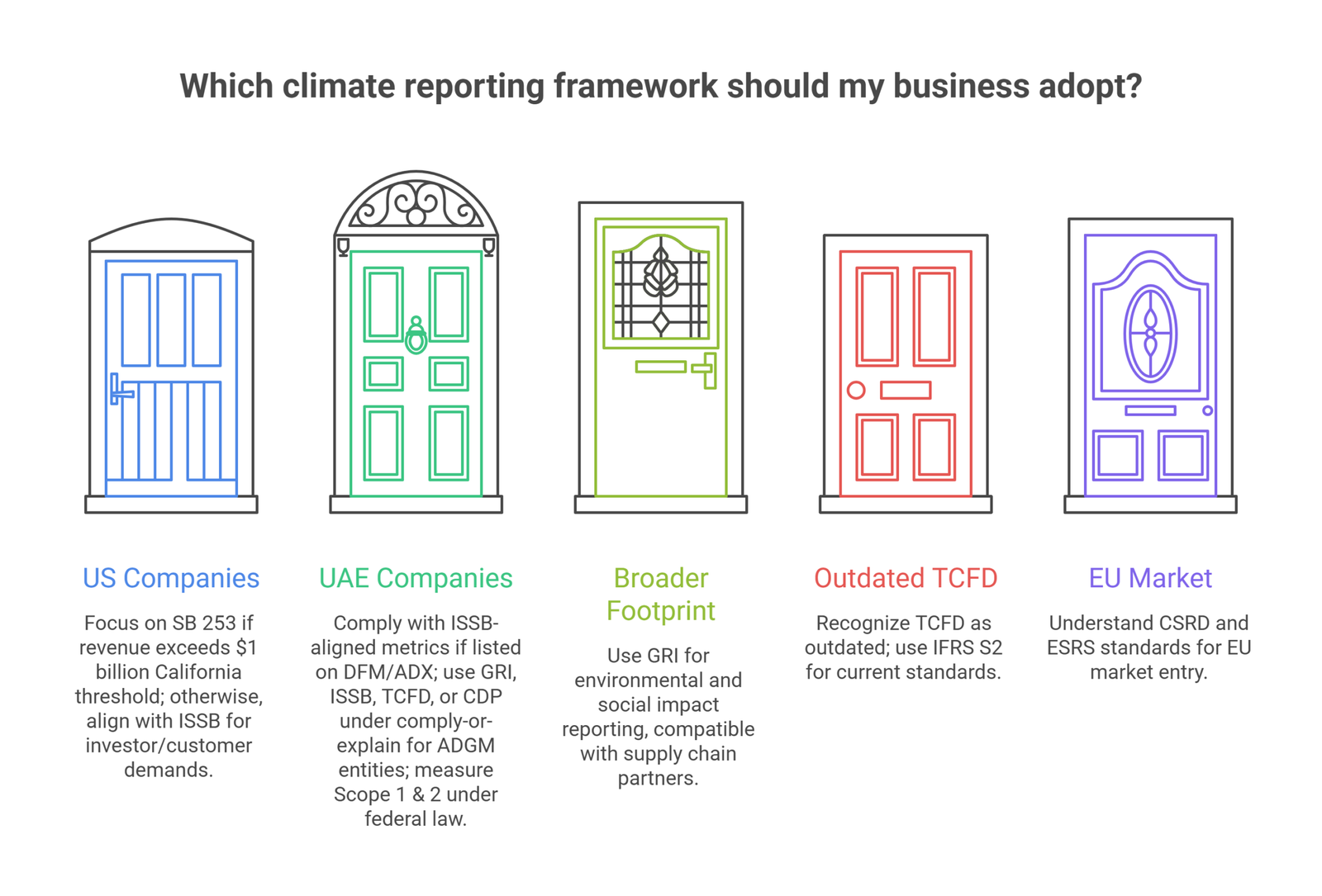
If you’re a US company over the $1 billion California revenue threshold, SB 253 is the concrete deadline to plan around, not ISSB directly. Below that threshold, the driver is usually a bank, investor, or larger customer asking for climate data voluntarily, and they’re increasingly framing that ask in ISSB terms because that’s what international capital markets now expect.
If you’re a UAE company, the answer depends on where you’re listed. DFM and ADX-listed companies already have mandatory reporting obligations tied to ISSB-aligned metrics. ADGM entities above the size threshold need a globally recognized framework, GRI, ISSB, TCFD, or CDP, under a comply-or-explain model. Every UAE business, listed or not, now has a baseline Scope 1 and 2 measurement obligation under the federal Climate Law, separate from any framework choice.
If a large customer, NGO, or certification body wants a broader picture of your environmental and social footprint rather than a financial-risk lens, GRI is still the most widely recognized voluntary framework for that purpose, and a GRI report tends to be compatible with what most supply chain partners expect.
If a document you’re reviewing cites “TCFD reporting” as a current, active standard, treat that as outdated. The content is now IFRS S2. That’s a useful way to spot whether an advisor, template, or competitor’s guidance has actually been updated since 2023.
In practice, most SMEs preparing for external scrutiny (loans, larger customers, investors) start with whichever framework their specific stakeholder is asking for, rather than picking one in the abstract. A company selling into the EU market will also run into CSRD and its ESRS standards, which is a related but separate compliance layer worth understanding before choosing a reporting approach.
Frequently Asked Questions
Is TCFD still a valid framework to report under?
The task force itself no longer exists. Its recommendations were absorbed into IFRS S2 in 2023. A company can still voluntarily structure a report around the original TCFD pillars, but for anyone reporting to a regulator or bank, IFRS S2 is now the live standard.
Do I need to follow GRI, TCFD, or ISSB if I’m a small business?
It depends entirely on who’s requesting the data. There’s no universal legal requirement for most SMEs yet, but that’s changing fast as more jurisdictions adopt IFRS S1/S2 into law.
What’s the difference between GRI and ISSB in one sentence?
GRI reports how your business affects the world; ISSB reports how sustainability issues affect your business’s financial value.
Does the US require ISSB reporting?
Not federally. The SEC’s climate disclosure rule is currently headed toward rescission rather than enforcement. The concrete US deadline right now is California’s SB 253, which requires large companies doing business in California to report Scope 1 and 2 emissions in 2026, regardless of whether they’re publicly traded.
Is ISSB mandatory in the UAE?
It depends on your listing. DFM and ADX-listed companies already have mandatory sustainability reporting tied to ISSB-aligned metrics. ADGM companies above certain size thresholds must report under a comply-or-explain model using GRI, ISSB, TCFD, or CDP. Every UAE entity, public or private, also has a baseline Scope 1 and 2 measurement duty under the federal Climate Law.
Can I use more than one framework at once?
Yes, and many companies do. It’s common to see a GRI report for broad stakeholder communication alongside ISSB-aligned disclosures for investors and regulators, since the two serve different audiences and materiality questions.
Where do Scope 1, 2, and 3 emissions fit into these frameworks?
All three frameworks reference the GHG Protocol’s scope categories for emissions reporting, though they weight and disclose them differently. If you haven’t mapped your own emissions yet, that’s usually the first practical step before choosing a reporting framework.
Does choosing a framework require an in-house sustainability team?
Not necessarily. Many SMEs handle this alongside their existing financial reporting function, particularly when the driver is a bank or investor request rather than a full regulatory mandate.
Getting your reporting ready
Frameworks aside, the businesses that handle ESG requests smoothly are usually the ones with clean financial reporting discipline already in place. If you’re fielding these requests for the first time, or trying to work out which framework actually applies to your situation, Oak’s financial reporting services and fractional CFO support can help you get the underlying numbers in shape before you commit to a specific framework. Schedule a consultation to talk through what your bank, investor, or customer is actually asking for.