Virtual CFO in Healthcare: Why do You Need One to Enhance Your Services
Virtual CFO for healthcare: close the gap between care and cash
A clinic delivers care today and gets paid weeks later, after a claim passes through a payer. In the gap, rent, payroll, and supplies come due on schedule. That timing difference is the main reason healthcare finance is harder to manage than finance in most other small businesses.
A virtual CFO is a senior finance professional who provides CFO-level planning, forecasting, and cash management remotely, usually part time. For healthcare, that means someone who can forecast cash around slow payers and model the cost of adding a provider. They also keep reporting clean enough for lenders and investors. This guide covers what that looks like for clinics, medical practices, and mental and behavioral health providers.
Why healthcare finance is different
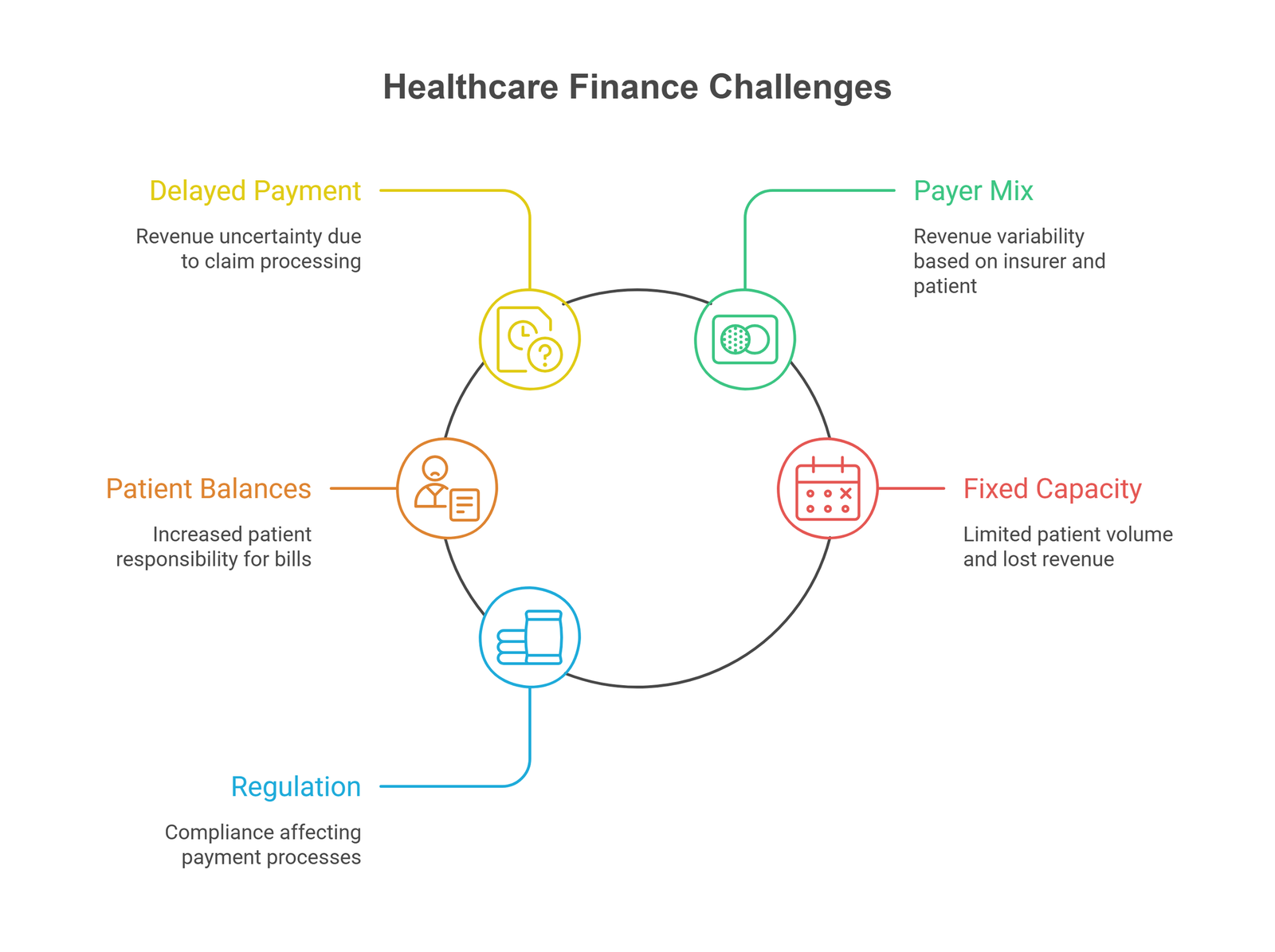
Five features set healthcare apart.
- Delayed, uncertain payment. Revenue depends on claims that can be paid, adjusted, or denied weeks after the visit.
- Payer mix. Each insurer, plan, and self-pay patient pays a different amount for the same service, so revenue per visit varies.
- Patient balances. Plans with high deductibles shift more of each bill to patients, who pay on a different timeline from insurers.
- Fixed capacity. A clinician can only see so many patients. Empty slots and cancellations cannot be recovered.
- Regulation. Billing rules, privacy requirements, and credentialing all affect when and how you get paid.
Most small practices handle this with a bookkeeper and a part-time accountant. That keeps records accurate, but it does not answer forward-looking questions such as: Can the practice afford a second location? What happens to cash if the largest payer slows down?
What a virtual CFO does for a clinic or medical practice
The work falls into eight areas. Each one has a number worth watching.
| Area | What the CFO does | Metric to track |
| Cash flow | Builds a rolling forecast around payer timing and seasonal dips | Weeks of cash on hand |
| Revenue cycle oversight | Reviews how claims move from visit to payment (billing itself stays with your billing team) | Days in accounts receivable, claim denial rate |
| Payer mix | Compares what each payer actually pays and models what happens if a contract changes | Revenue per visit by payer |
| Overhead | Breaks costs into staff, space, supplies, equipment, insurance, and IT | Overhead as a share of collections, cost per visit |
| Provider compensation | Designs pay models and tracks each provider’s profitability | Contribution per provider |
| Capacity and productivity | Tracks how fully each schedule is used | Utilization, no-show rate |
| Growth modeling | Models a new provider, location, or service line before you commit | Break-even point, payback period |
| Reporting | Produces monthly packs for owners, lenders, and investors | Margin by service line |
A CFO does not replace your billing company or your accountant. The CFO reads the numbers they produce and turns them into decisions. For how that line works in practice, see what a virtual CFO does.
Insurance receivables and patient receivables are different problems
Days in accounts receivable is the average number of days it takes to collect payment after billing. Claim denial rate is the share of claims rejected on first submission. Both move cash, and both hide problems when everything sits in one number.
A useful report splits receivables in two:
- Insurance receivables, aged by payer. This shows which insurers pay slowly or deny often, and which claims need follow-up before they pass a payer’s filing deadline.
- Patient receivables. These need their own process: statements that go out on time, payment plans set up at the visit, and consistent follow-up.
Collection work belongs to your billing staff. The CFO’s job is to show where cash is stuck and whether the fixes are working.
Provider compensation and partnership planning
Provider pay is often the largest cost in a practice, and it is often set by habit. A virtual CFO helps compare common models, such as collections-based pay, productivity pay measured in relative value units (RVUs), salary, or a hybrid. The goal is a structure that is fair to providers and still leaves the practice profitable.
The same modeling covers bigger decisions: adding a physician, a partnership buy-in or buyout, and succession planning. Each one needs projections for salary, benefits, overhead share, and expected ramp-up time before the first dollar of profit. Your attorney and tax adviser handle the legal and tax side of these deals.
Virtual CFO for mental health and behavioral health practices
Mental health practices have finances with quirks of their own.
Revenue is session based and sensitive to cancellations. A therapist’s day has a fixed number of slots. When a client cancels late, that hour is gone. Small changes in the cancellation rate move monthly revenue noticeably.
New clinicians cost money before they earn it. Payers usually need to credential a new clinician before they pay for that person’s sessions. That process often takes weeks to months. During that time the practice pays salary and overhead with little or no insurance revenue.
Here is an illustrative example:
| Illustrative figure | Value |
| Session slots per clinician per week | 25 |
| Sessions attended | 18 |
| Utilization | 72% |
| Average paid per session | $110 |
| Approximate monthly revenue per clinician | $8,500 |
| Monthly cost of a clinician (pay plus overhead share) | $6,500 |
| Credentialing delay | 8 weeks |
| Cost carried before first insurance payment | About $13,000 |
At 72% utilization, the clinician contributes about $2,000 a month after costs. A two-month credentialing gap costs about $13,000, so it takes more than six months of normal operation to earn that back. A CFO models this before the hire and sets a cash cushion for it. Afterward, the CFO tracks whether the clinician reaches target utilization.
Other questions a CFO helps mental health practices answer:
- How should session types be priced, such as intake, individual, and group?
- Is it cheaper to pay clinicians as employees or as contractors, once taxes and obligations are counted? (Your tax adviser confirms the legal classification.)
- How much self-pay revenue is needed to offset slow insurance payments?
- What happens to margins if telehealth shifts the mix of sessions?
Before you add a location or buy equipment
Growth is where healthcare practices most often run short of cash. A new site means rent, equipment, and staff. Patient volume starts low during the ramp-up, and claims from the first visits take weeks to pay.
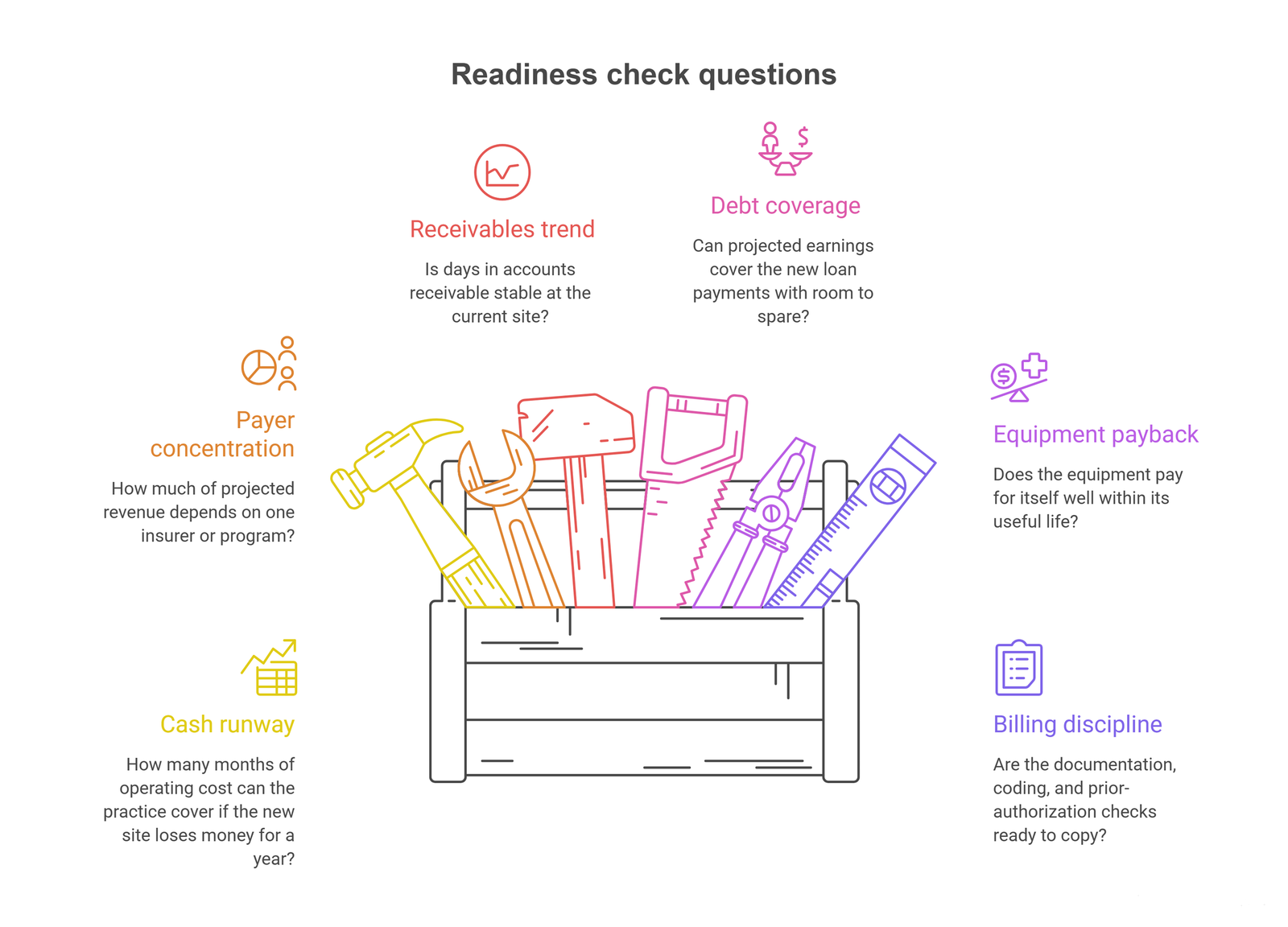
A CFO can run a readiness check before you commit. Six questions cover most of it:
- Cash runway. How many months of operating cost can the practice cover if the new site loses money for a year?
- Payer concentration. How much of projected revenue depends on one insurer or program?
- Receivables trend. Is days in accounts receivable stable at the current site? A new site will usually start slower.
- Debt coverage. Can projected earnings cover the new loan payments with room to spare?
- Equipment payback. Does the equipment pay for itself well within its useful life? Lease versus buy changes the answer.
- Billing discipline. Are the documentation, coding, and prior-authorization checks that work at the current site ready to copy?
Set your own thresholds with your CFO and lender. Rules of thumb vary by specialty and market. The point is to answer the six questions with numbers before signing a lease.
Value-based care vs fee-for-service
Fee-for-service pays for each item delivered, such as a visit, a test, or a procedure. Value-based care ties payment to quality and cost. The Centers for Medicare & Medicaid Services (CMS) describes its value-based programs as a shift toward paying providers for the quality of care instead of the quantity.
For a practice, the shift changes what the finance team must watch. Under fee-for-service, volume drives revenue. Under value-based arrangements, quality scores, cost per patient, and care coordination affect payment too.
A virtual CFO helps by:
- Modeling revenue under both payment types, so you can see what a contract change would do.
- Tracking the quality measures that carry financial weight.
- Reading payer contracts to see which ones carry performance risk.
Most practices will keep a mix of both for some time, so the model needs to handle both.
Compliance and data: what to ask before sharing records
A virtual CFO who sees billing files, claim records, or patient-level data handles protected health information (PHI). The U.S. Department of Health and Human Services (HHS) explains the rule: covered entities need a business associate agreement with vendors that create, receive, maintain, or transmit PHI for them.
So before the first data transfer, ask three things:
- Will you sign a business associate agreement (BAA)?
- Do you need patient-level data at all? Much CFO work, such as forecasting and KPIs, can use summary reports.
- Who on your team will see our data, and how is access removed when the engagement ends?
This is general information, not legal advice. Your compliance officer or healthcare attorney should review the agreement.
What a virtual CFO costs
Pricing depends on scope and hours. Oak Business Consultant’s fractional CFO cost guide puts retainers at about $3,000 to $15,000 per month, with most small and mid-sized businesses paying $3,000 to $10,000. A single-location practice with simple needs sits toward the lower end. A multi-site group preparing an acquisition sits toward the higher end.
Some providers bundle bookkeeping with lighter CFO work, so compare what each quote includes. For a comparison with a full-time hire, see the guide to hiring a virtual CFO.
Signs your practice is ready for one
- Cash runs tight even though patient volume is healthy.
- Receivables are aging, or denials are rising.
- You plan to add a provider, a location, or a service line.
- A lender, investor, or buyer asks for statements or a forecast you cannot produce.
- Provider pay feels arbitrary, and nobody can show who is profitable.
- Your bookkeeper and accountant are accurate but cannot tell you whether to expand.
Practices sit among the 12 types of business that benefit most from a virtual CFO.
How to choose a healthcare virtual CFO
Use the same scorecard you would for any CFO, with these healthcare checks added. The guide on what to look for in a virtual CFO has the full list.
- Ask which healthcare clients they have served, and which specialties and payers.
- Ask how they track receivables by payer and what they do when denials rise.
- Ask how they would model a new provider joining your practice.
- Ask for a BAA before you share data.
- Ask who covers when they are unavailable.
What the first 90 days look like
- Weeks 1 to 2: access to your systems, with data limited to what the CFO needs, plus a review of the last 12 months.
- Weeks 3 to 4: a baseline cash forecast and a short list of metrics, such as days in accounts receivable by payer, denial rate, and utilization.
- Month 2: monthly reporting on a fixed schedule and the first growth or compensation model.
- Month 3: a review of whether cash visibility and decisions are improving, with scope adjusted if needed.
Frequently Asked Questions
What does a CFO do in a hospital?
A hospital CFO leads the finance function: budgeting, revenue cycle, capital planning, financial reporting, and reporting to the board. Large hospitals employ a full-time CFO and a finance team. A virtual CFO more often serves clinics, practices, and smaller providers, where a full-time executive does not fit.
Is a virtual CFO worth it for a small clinic?
It can be, if the practice faces cash gaps, plans to grow, or needs reporting for a lender or investor. A short project, such as a cash forecast or a growth model, is a low-risk way to start.
Does a virtual CFO need to sign a business associate agreement?
If they handle PHI on your behalf, yes. Ask for the agreement before any data is shared, and ask whether summary data would be enough.
Can a virtual CFO work with a mental health practice?
Yes. Mental health practices benefit from forecasting around cancellations and insurance timing, modeling new clinicians, and pricing by session type. Look for a CFO who has worked with session-based practices.
How is a virtual CFO different from a medical billing company?
A billing company submits and follows up on claims. A virtual CFO uses your financial data, including billing results, to forecast cash, plan growth, and advise on decisions. Many practices use both.
Can a virtual CFO help with provider pay or a partnership buy-in?
Yes. A CFO can model pay structures and the financial effect of a new partner, a buy-in, or a buyout. Your attorney and tax adviser handle the legal and tax terms.
Choose a CFO who understands how healthcare gets paid
Healthcare finance rewards practices that see payment delays, payer changes, and capacity limits coming. A virtual CFO gives a clinic or practice that view without a full-time salary.
Oak Business Consultant provides virtual CFO services for healthcare practices and other growing businesses, including cash flow forecasting, budgeting, and fundraising support. Book a call with the team to discuss what your practice needs.