Companies for Good 2031: What the UAE’s New CSR Strategy Means for Your Business
The UAE’s Companies for Good 2031 Strategy, Explained for Business Owners
If your company holds a mainland trade license in the UAE, you likely already owe a filing. It’s called an Impact Declaration. You file it with Majra, the UAE’s federal CSR fund. That requirement has existed since 2018.
What changed is the structure around it. In July 2026, the UAE launched the Companies for Good 2031 Strategy. It’s a national framework. It asks the private sector to deliver more than Dh20 billion in verified sustainability projects by 2031. And it’s tracked through an actual scoring system, not voluntary goodwill.
This article breaks down what the strategy contains. Who has to comply. How the Impact Seal and Impact Declaration work. What counts as a qualifying project. And what to do in the next few months to get ahead of it.
What is Companies for Good 2031?
Companies for Good 2031 is a UAE federal strategy. Sheikh Mansour bin Zayed Al Nahyan launched it. He’s Vice President, Deputy Prime Minister, and Chairman of the Presidential Court. Majra hosted the launch event at Qasr Al Watan in Abu Dhabi.
The strategy sets one clear national target. Private companies in the UAE are expected to collectively deliver more than Dh20 billion in verified, sustainability-linked contributions by 2031.
It isn’t a brand-new idea. Majra first previewed the framework at Impact Summit 2025 in November. Officials there described a “Strategic Compass Approach” for governance, measurement, and reporting. The July 2026 launch turned that preview into an operating strategy, with a fixed target date and a public scoreboard.
The strategy sits inside the UAE’s broader development plan. It’s aligned with the We the UAE 2031 vision and the UAE’s National Priorities. Majra also positions it as the private sector’s main channel toward the country’s UN SDG commitments. For the national context behind this strategy, Oak’s breakdown of UAE performance across all 17 SDGs covers where the country currently stands.
The baseline the target is measured against
The Dh20 billion figure isn’t arbitrary. It’s built from a real starting point. In 2025, the UAE’s private sector contributed Dh3.23 billion in CSR activity. That came from 191 participating companies. Majra’s own workshop materials describe the roadmap as growing that figure to Dh20 billion. The plan is to pull in contributions from companies of every size, not just the large corporates that have historically driven CSR spend.
That framing matters for SMEs specifically. The strategy is designed to widen participation well beyond the handful of major players that already publish sustainability reports. That’s also why Majra built a dedicated SME category into its recognition system. Companies aren’t all scored against the same large-corporate benchmark.
The Impact Declaration: the part most companies already owe
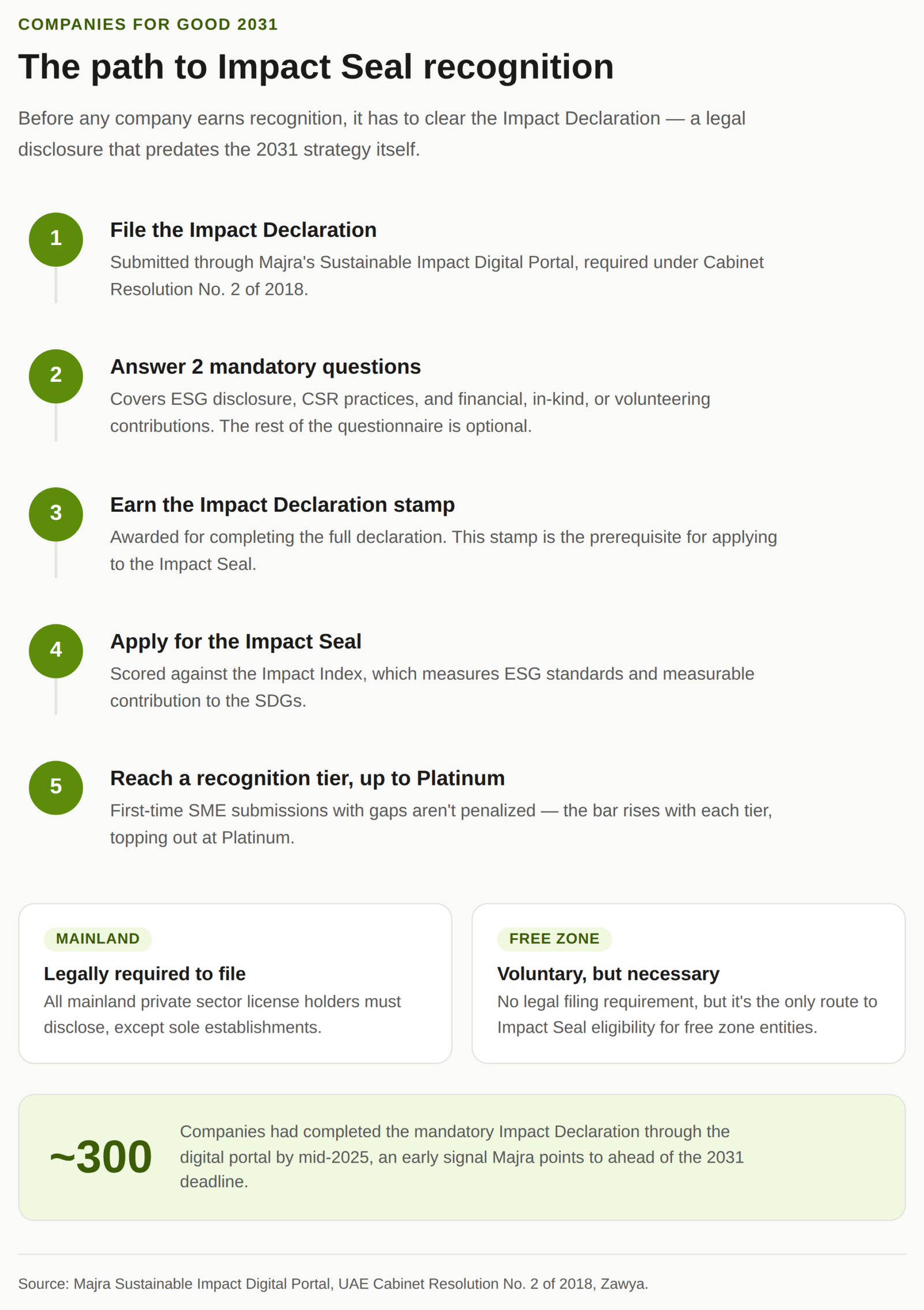
Before any company can be recognized under Companies for Good 2031, it has to complete an Impact Declaration. That happens through Majra’s Sustainable Impact Digital Portal. This isn’t new paperwork created for the 2031 strategy. It comes from UAE Cabinet Resolution No. 2 of 2018 on Corporate Social Responsibility. Under that resolution, mainland private sector license holders, aside from sole establishments, are legally required to disclose their CSR activity.
A few practical details matter here:
- The Impact Declaration is a structured questionnaire. It covers ESG disclosure, CSR practices, and the company’s actual contribution to the UAE, whether financial, in-kind, or through employee volunteering.
- Two questions on the declaration are mandatory. The rest are optional. Completing the full declaration is what earns the “Impact Declaration” stamp. That stamp is a prerequisite for applying to the Impact Seal.
- Free zone companies aren’t legally required to file. Majra accepts voluntary declarations from them anyway, and doing so is the only way a free zone entity can qualify for Impact Seal recognition.
- SMEs that can’t provide complete answers on their first pass aren’t penalized for the gaps. The bar for a first submission is lower than the bar for a Platinum-tier award.
By mid-2025, close to 300 companies had completed the mandatory declaration through the digital portal. Majra frames that figure as an early signal. It shows how seriously the private sector is engaging with the framework ahead of 2031.
The Impact Seal: how recognition actually works
The Impact Seal is the UAE’s highest federal recognition for CSR and sustainability performance. Majra awards it based on the Impact Index. That’s a scoring system measuring ESG standards and a company’s measurable contribution to the SDGs. It comes in three tiers: Platinum, Gold, and Silver. It’s also split into two tracks: one for large organizations, one for SMEs, aligned with the UAE’s National SME Agenda.
The 2025-2027 cycle was announced at the same event that launched Companies for Good 2031. It gives a sense of scale. Platinum Tier recipients included major national players like ADNOC, TAQA, DP World, the Emirates Group, and Majid Al Futtaim Holding. It also included SMEs and academic institutions such as Ajman University, GoMbok, and Strategic Design Atelier. Gold Tier recognized a much wider band. That ranged from banks like FAB, Emirates NBD, and ADCB to professional services firms including EY and PwC, plus dozens of SMEs in recycling, sustainability consulting, and healthcare. Silver Tier included companies like Aramex and Network International, alongside a long list of smaller SME winners.
That range across tiers is the point. A large listed company and a five-person sustainability consultancy can both hold an Impact Seal. They land at different tiers, but they’re scored against the same Impact Index methodology.
Qualifying activity: what actually counts
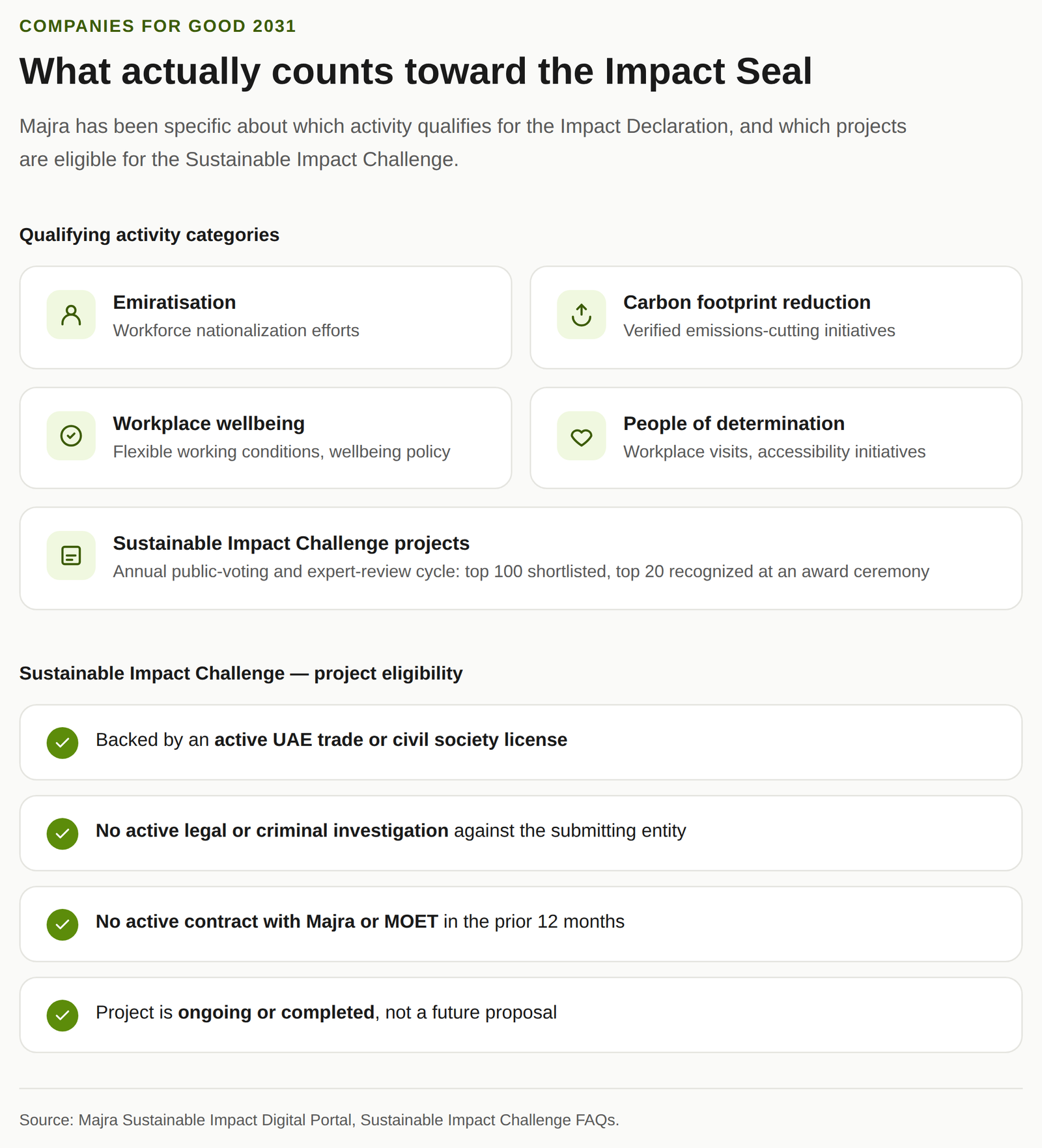
Majra has been specific about what counts toward a company’s Impact Declaration and Impact Seal application. Confirmed qualifying categories include:
- Emiratisation programs and workforce nationalization efforts
- Carbon footprint reduction initiatives
- Flexible working conditions and workplace wellbeing policies
- Support for people of determination, including workplace visits and accessibility initiatives
- Verified projects submitted through Majra’s Sustainable Impact Challenge, an annual public-voting and expert-review cycle that shortlists the top 100 submitted projects and recognizes the top 20 at an award ceremony
Project eligibility for the Sustainable Impact Challenge has specific rules. The project needs an active UAE trade or civil society license behind it. There can be no active legal or criminal investigation against the submitting entity. There can be no active contractual relationship with Majra, or with the Ministry of Economy and Tourism, in the prior 12 months. And the project has to be ongoing or already completed, not a future proposal. Majra excludes new or upcoming projects. That rules out submitting a plan rather than a delivered result.
Companies for Good 2031 at a glance
| Element | What it means for your business |
| National target | Dh20 billion-plus in verified sustainability projects by 2031 |
| 2025 baseline | Dh3.23 billion in CSR activity from 191 participating companies |
| Legal foundation | Cabinet Resolution No. 2 of 2018; mandatory Impact Declaration for mainland companies |
| Recognition tiers | Impact Seal: Platinum, Gold, Silver, each with a large-company and SME track |
| Prerequisite | Completed Impact Declaration via Majra’s Sustainable Impact Digital Portal |
| Qualifying activity | Emiratisation, carbon reduction, flexible work policies, accessibility, verified projects |
| Who must file | All mainland trade license holders, excluding sole establishments |
| Who can voluntarily file | Free zone companies, to qualify for Impact Seal recognition |
| Where to register | Majra’s Sustainable Impact Digital Portal, uaemajra.ae |
Why this matters beyond compliance
It’s tempting to treat this as a reporting task and nothing more. But the strategy is built around goals the UAE has flagged as national priorities. SDG 6, clean water, and SDG 13, climate action, are two of the three goals the country calls its hardest to reach. SDG 12, responsible consumption, is the third. A carbon-reduction project or a water-efficiency initiative doesn’t just tick a Majra checklist. It lines up with where the government itself says private sector help is most needed.
There’s a competitive angle too. The Impact Seal has become a visible marker in UAE business circles. Platinum-tier recognition sits alongside names like ADNOC and DP World in Majra’s public announcements. For a mid-sized company or SME, holding an Impact Seal signals credibility, even at Silver tier. That’s true with regulators, banks, and larger corporate partners. Many of them now ask about ESG posture during procurement and lending decisions.
Frequently Asked Questions
Is Companies for Good 2031 mandatory?
Filing the Impact Declaration is mandatory for mainland UAE companies, aside from sole establishments, under Cabinet Resolution No. 2 of 2018. Pursuing an Impact Seal itself isn’t mandatory. But it’s the main way a company gets formally recognized under the strategy.
Does my free zone company need to participate?
No. Free zone companies aren’t legally required to file an Impact Declaration. Doing so voluntarily is the only route to Impact Seal eligibility. So free zone companies that want the recognition, or the credibility it signals, need to opt in through Majra’s portal.
How does a small business get involved without a big CSR budget?
Majra’s SME track exists for exactly this reason. Qualifying activity doesn’t require large-scale spending. Emiratisation hiring, flexible working policies, and accessibility initiatives for people of determination all count. SMEs also aren’t penalized for incomplete first submissions the way large companies are.
Where do I actually register or submit a project?
Everything runs through Majra’s Sustainable Impact Digital Portal at uaemajra.ae. It handles Impact Declarations, Impact Seal applications, and Sustainable Impact Challenge project submissions in one place.
What happens if my company doesn’t file the Impact Declaration?
Majra’s own guidance frames the declaration as a legal requirement for mainland companies under the 2018 Cabinet Resolution. That’s separate from whether a company chooses to pursue an Impact Seal. Businesses unsure of their filing status should treat this as a compliance question, not just a reputational one.
How Oak Business Consultant can help
Companies for Good 2031 asks businesses to report sustainability activity as structured data, not as a values statement. That’s where most companies stumble. The data has to be accurate. It has to be documented. And it has to match the company’s actual legal and financial position, or the declaration creates more risk than it resolves.
Oak Business Consultant works with UAE businesses on exactly this foundation. If your UAE company registration or licensing structure isn’t fully documented, that needs fixing before you file an Impact Declaration. Majra’s questionnaire assumes a clean legal record sits behind the numbers. Our regulatory compliance services map exactly which obligations apply to your license type. That includes CSR disclosure rules, which are easy to miss when you’re focused only on VAT and corporate tax deadlines.
Planning an Emiratisation push, a carbon-reduction initiative, or a workplace policy change to qualify for the Impact Seal? Our corporate tax advisory and financial planning team can model the real cost and return before you commit budget. That way, the project you submit to Majra is one you can actually sustain through 2031. And where a business needs help coordinating with government entities during filing and verification, our PRO services team handles the liaison work directly. Your internal team stays focused on core operations, not paperwork.
Not sure whether your company already owes an Impact Declaration? Not sure where to start on a submission that will hold up under Majra’s review? Oak Business Consultant can walk through your licensing setup and flag exactly what’s needed before the 2031 deadline gets closer.