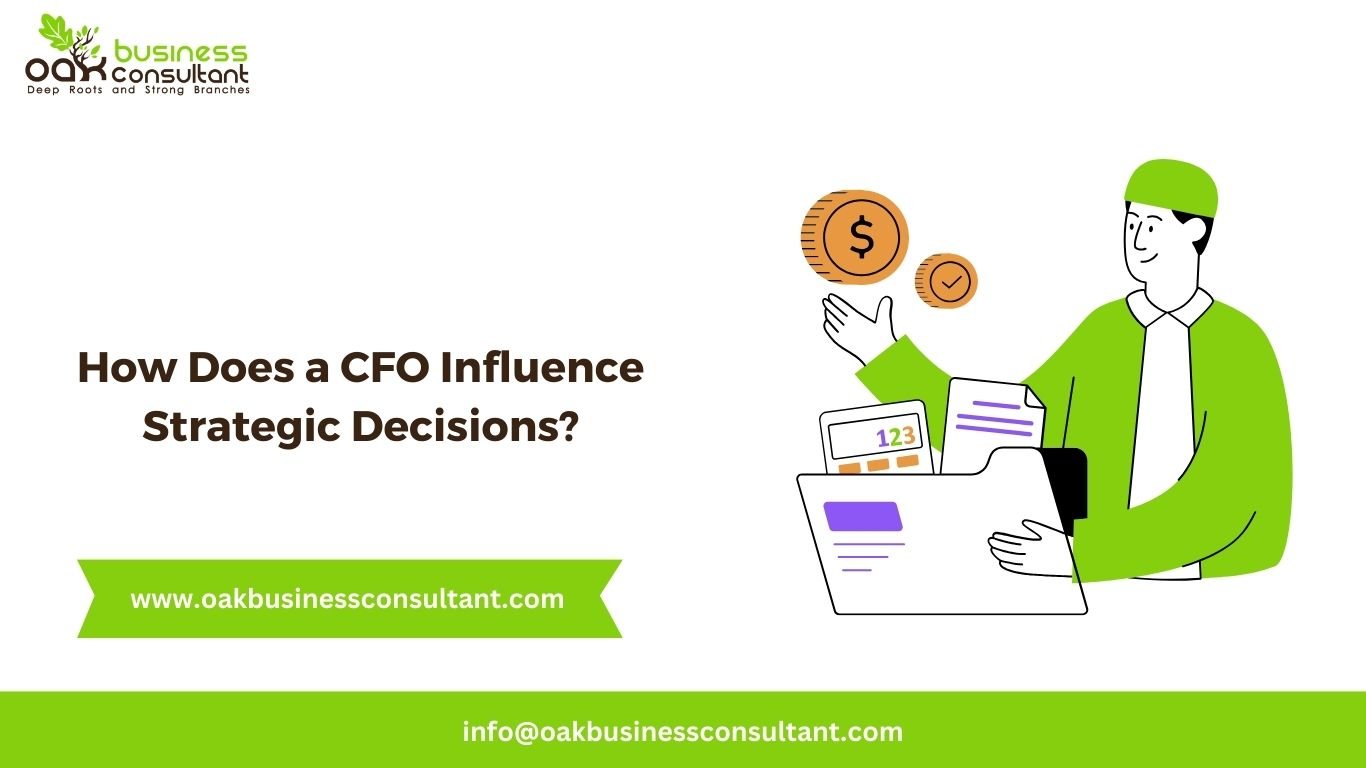
How Does a CFO Influence Strategic Decisions?
How a CFO influences strategy: five decisions the numbers change
A founder wants to open a second location. Revenue at the first site is growing, the lease is available, and everyone in the room is excited. Then the CFO asks what each extra customer actually costs to serve, and the plan changes.
That moment is what CFO influence looks like in practice. It is rarely a dramatic veto. It is a question that moves a decision from “this feels right” to “this is what it costs and what it returns.” This guide covers where that influence is real, how it is earned, and where it breaks down.
The foundation: four roles behind CFO influence
Deloitte’s well-known framework describes four roles for the modern CFO: steward, operator, strategist, and catalyst. Each one affects strategy differently.
The steward keeps the books accurate and protects company assets. The operator runs the finance function, including planning, treasury, tax, and reporting. The strategist helps decide direction, from financing to M&A. The catalyst pushes the organization to act, including on cost discipline when that is uncomfortable.
Most strategic influence comes from the last two. But those two only work when the first two are solid. A board will not act on a forecast built on unreliable historical data. A “strategic CFO” hire changes little if the foundation is weak.
For a plain description of the full job, see our guide to the role of a CFO.
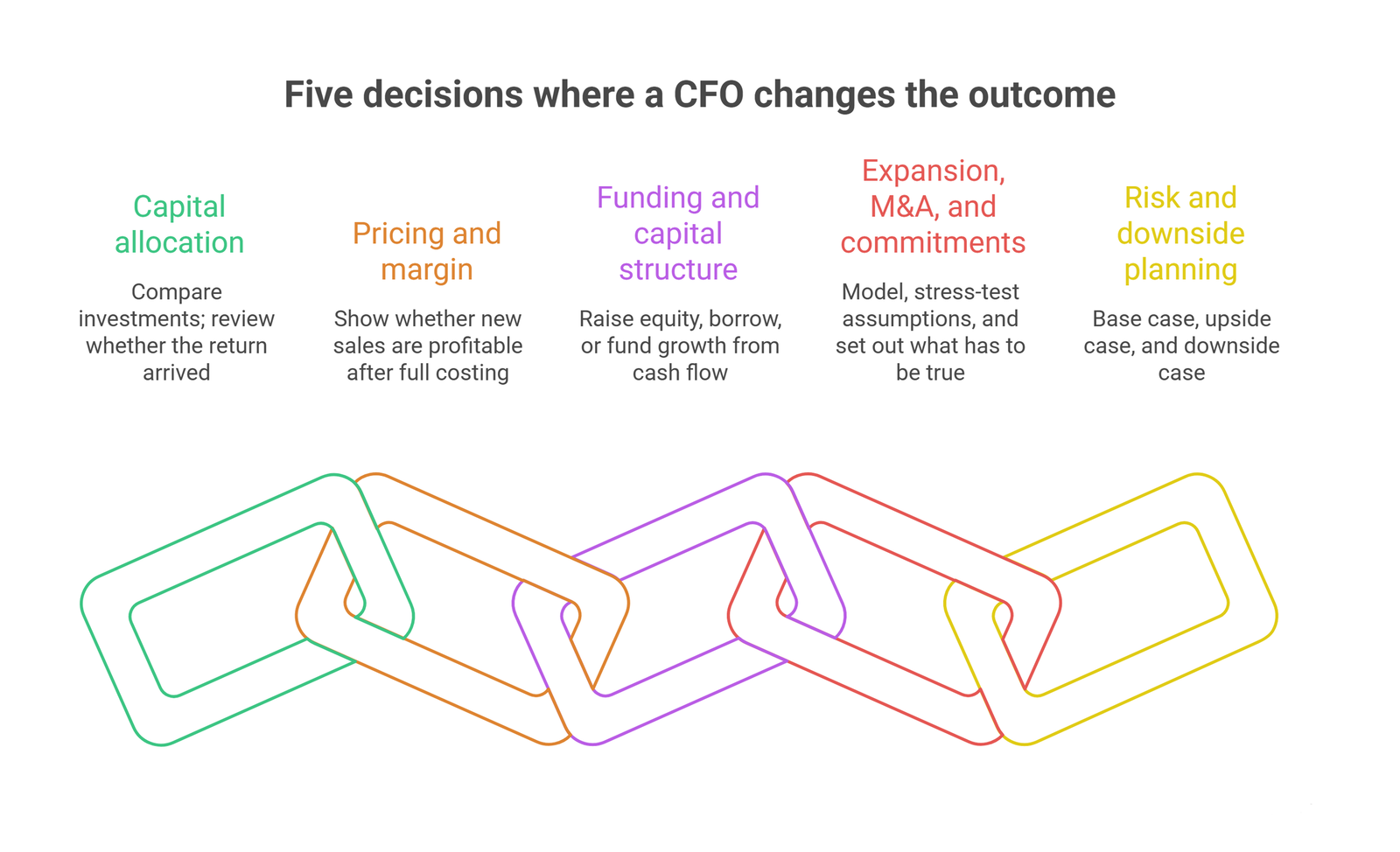
Five decisions where a CFO changes the outcome
1. Capital allocation
Every dollar spent on a hire, a product line, or an acquisition is a dollar not spent elsewhere. Capital allocation is where CFO influence is strongest, because the CFO usually runs the comparison.
Strong CFOs bring structure to it: a hurdle rate that new projects must clear, a standard way to appraise investments, and a review after the money is spent to see whether the return arrived. Our guide on capital budgeting techniques covers the main methods.
2. Pricing and margin
Revenue growth can hide a margin problem. A CFO who knows the marginal economics of the business can show whether new sales are profitable after full costing, or whether growth is subsidized by squeezed margins elsewhere.
This is the second-location question from the opening. A revenue chart cannot answer it. A cost model can.
3. Funding and capital structure
Should the company raise equity, borrow, or fund growth from cash flow? Each choice changes ownership, risk, and flexibility.
The CFO models the options, tests them against covenants and dilution, and tells the CEO what each path costs. Investors and lenders also judge the company through the CFO’s numbers.
4. Expansion, M&A, and big commitments
Entering a new market, buying a competitor, or signing a long lease all carry financial consequences that last years. The CFO builds the model, stress-tests the assumptions, and sets out what has to be true for the deal to work.
The same discipline applies to a decision to walk away. A good financial model gives leadership a defensible reason to say no.
5. Risk and downside planning
Before a major initiative starts, a good CFO has already modeled what happens if it underperforms. The board then makes an informed bet instead of an act of faith.
That means building a base case, an upside case, and a downside case, then setting triggers for what the company does if the downside arrives. Our financial modeling services are built around this kind of scenario work.
What each decision needs from the CFO
| Decision | Question the CFO asks | Main tool |
| Capital allocation | Does this beat our next-best use of cash? | Hurdle rate, payback, post-investment review |
| Pricing and margin | Is this revenue profitable after full cost? | Unit economics, contribution margin |
| Funding | What does each source cost us in ownership and risk? | Financing scenarios, dilution analysis |
| Expansion and M&A | What must be true for this to work? | Financial model, sensitivity analysis |
| Risk | What happens if we are wrong? | Scenario planning, cash runway |
Data matters, but judgment still decides
It would be neat to say CFO influence comes entirely from data. It does not.
A 2015 global survey of more than 1,500 finance decision makers, commissioned by Epicor, found that 46 percent of CFOs relied on gut feel when they lacked fast access to accurate internal data. The survey is dated, but the point still holds. Judgment fills the gap where data is missing or late.
The lesson is not that gut feel is bad. Experienced CFOs recognize patterns from earlier decisions, and that experience has real value. The lesson is to be honest about which part of a recommendation is model output and which part is judgment, and to fix the data gap so judgment is needed less often.
How a CFO earns influence
Technical skill alone does not give a CFO influence in the room. Three habits matter more.
Speed comes first. An answer that arrives after the decision is made has no influence. CFOs with real-time reporting and a working financial model can answer a strategic question in days instead of weeks.
Clarity comes next. The CFO translates ratios and forecasts into a specific recommendation. “Margins fell two points” is a report. “Pause this product line until we fix delivery costs” is a recommendation.
Posture comes last. A CFO who only says no loses the executive team’s trust. One who consistently brings the cost and the likely return of each option gets invited into decisions earlier.
Where CFO influence breaks down
Influence fails for predictable reasons.
The numbers are not trusted, usually because the close is slow or the data comes from disconnected spreadsheets. The CFO is brought in after the decision is made, to find the money. Or the forecast has been wrong often enough that nobody uses it. That last problem is measurable, and we explain how in how a CFO measures forecast accuracy.
Smaller companies run into a different problem. They need strategic finance input but cannot yet justify a full-time executive. This is the gap fractional and virtual CFO arrangements fill.
Frequently Asked Questions
How does a CFO influence strategic decisions in a crisis?
In a crisis, attention shifts to liquidity. The CFO tightens the cash forecast, identifies which initiatives can pause, and shows leadership how many weeks of runway remain before harder choices arrive.
What is the difference between a CFO who reports numbers and one who shapes strategy?
A reporting CFO describes what already happened. A strategic CFO uses the same information, plus judgment from experience, to recommend a path and show the cost of each alternative. The data is the same. What gets done with it differs.
Do small companies benefit from CFO input on strategy?
Often more than large ones. A wrong capital decision is harder to absorb without a deep balance sheet. This is why fractional CFO services exist: to bring senior judgment to companies that cannot yet hire a full-time executive.
Does a CFO make strategic decisions, or only advise?
The CEO and board make the final call in most companies. The CFO shapes the decision by defining what is affordable, modeling the options, and setting the conditions for success. In practice, a well-built financial case is hard to ignore.
How does technology change a CFO’s influence?
Technology removes the delay between a question and an answer. Real-time reporting and better financial models let a CFO respond in days, which matters when a market shift will not wait. It does not replace judgment.
When should a business bring in a strategic CFO?
When decisions involving money are being made on instinct alone: a second location, a large hire, a funding round, an acquisition. Stage-by-stage signals for startups are in our guide on when to hire a CFO.
Conclusion
CFO influence is built from the work most people never see: reliable numbers, fast answers, and a habit of testing ideas before the money moves. The title does not grant it. Trust earned decision by decision does.
If your business is making major decisions without a financial partner in the room, Oak Business Consultant’s CFO services are built to close that gap. Contact us to talk through what strategic financial leadership would look like for your business now.