Why SMEs Are Not Too Small for Greenwashing Fines
SMEs Are Not Exempt From Greenwashing Rules
Most small business owners assume greenwashing enforcement is a big-company problem. Walmart pays $3 million for a bamboo claim. A fashion label gets sued over a recycled-fabric campaign. The story ends there, or so the assumption goes. That assumption is getting more expensive by the month. Regulators in the US, UK, and EU are not writing rules that carve out small and medium-sized businesses. Several of the newest rules apply the moment a company makes any environmental claim, regardless of headcount or revenue. If your marketing uses the word “eco-friendly,” “sustainable,” or “green” anywhere, you are inside the scope of these rules. That includes a label, a website, or a product name, and it’s true whether you meant to be or not.
This matters more for SMEs than for large corporations, not less. A big company has a legal team that reviews claims before they go to print. An SME usually has a founder, a marketing hire, and a deadline. That gap between capability and exposure is exactly where regulators say the risk sits.
What greenwashing actually means
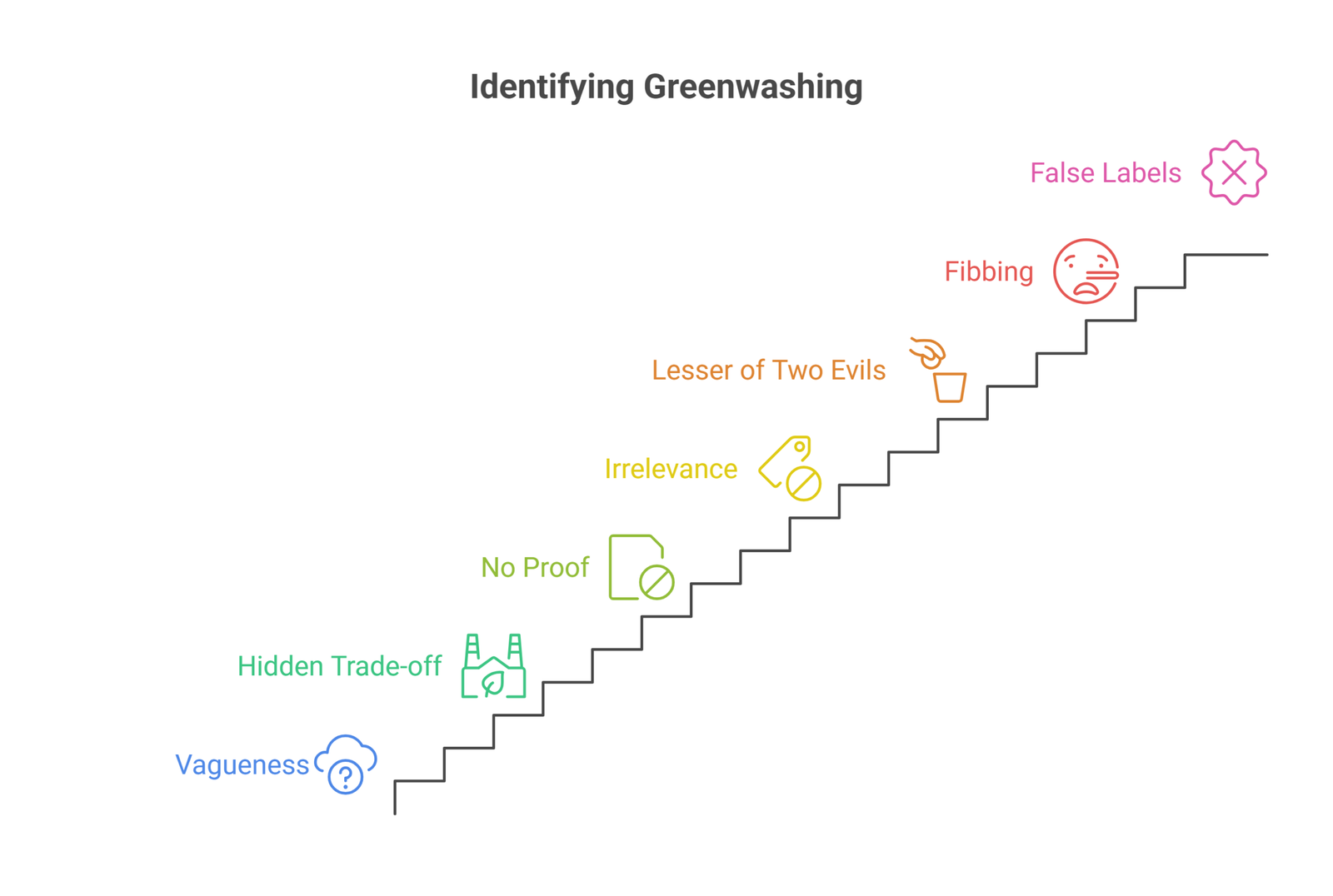
Greenwashing is any environmental claim that overstates, oversimplifies, or cannot be backed up with evidence. The environmental marketing firm TerraChoice identified seven recurring patterns back in 2009. Those patterns still describe most violations found today:
- Vagueness: words like “natural” or “eco-friendly” with no defined standard behind them
- Hidden trade-off: highlighting one green attribute while ignoring a bigger environmental cost elsewhere
- No proof: a claim with no accessible evidence or certification
- Irrelevance: a technically true claim that adds no real information, like advertising a product as free of a substance that was already banned
- Lesser of two evils: a valid comparison within a harmful category, like “the greenest disposable option”
- Fibbing: an outright false claim
- False labels: a made-up seal or certification mark designed to look official
A claim does not need to be dishonest to be a problem. It just needs to create an impression your evidence cannot support.
The regulatory landscape SMEs are now inside
Three jurisdictions have moved from guidance to active enforcement, and each applies to businesses of any size that market to their consumers.
| Jurisdiction | Governing rule | Who enforces | Maximum penalty | Applies to SMEs? |
| United States | FTC Green Guides (16 CFR Part 260) | Federal Trade Commission | Up to $53,088 per violation under Penalty Offense Authority | Yes, no size threshold |
| United Kingdom | Digital Markets, Competition and Consumers Act (DMCCA) | Competition and Markets Authority (CMA) | Up to 10% of global turnover, enforced directly without a court order | Yes, since April 2025 |
| European Union | Green Claims Directive / EmpCo (Directive 2024/825) | National consumer authorities in each member state | Up to 4-5% of annual turnover, confiscation of revenue | Mostly yes, with limited exceptions below |
The EU is the only jurisdiction that gives smaller businesses any real breathing room, and even that relief is narrower than most owners assume. Under the Green Claims Directive, micro-enterprises are exempt unless they choose to participate voluntarily. That exemption covers businesses with under 10 employees and under €2 million in turnover. SMEs above that threshold are not exempt. They simply get an extra 12 months to reach full compliance. The broader EmpCo directive bans specific deceptive practices outright. It applies to any business marketing to EU consumers with no size carve-out at all, and it takes effect on September 27, 2026.
In the US and UK, there has never been a size exemption. The FTC’s Green Guides apply the same standard to a five-person online shop as they do to a multinational retailer. The CMA’s new direct-fine power has been in force since April 2025. It shortens enforcement timelines for exactly the kind of claim an under-resourced marketing team is most likely to publish without review.
What enforcement actually looks like
The clearest signal for SME risk comes from watching what regulators are penalizing, not just what the statutes say. Enforcement tracking published by ecoappraise.com has recorded hundreds of greenwashing-related enforcement actions globally within a matter of months. Those actions span the US, UK, EU, Canada, Australia, and India. The pattern behind those numbers matters: regulators have shifted from investigating broad sustainability strategy to scrutinizing individual words. Terms like “eco-friendly,” “sustainable,” and “carbon neutral” are now assessed claim by claim for whether they can be substantiated. Intent no longer factors into the review.
That shift is bad news for smaller businesses specifically, because it turns enforcement from a resource-intensive investigation into a fast, repeatable process. The UK’s Advertising Standards Authority has moved to AI-driven monitoring that scans digital ads for misleading claims proactively, without waiting for a complaint. A five-word tagline on a product page is now as visible to regulators as a national ad campaign.
The headline cases so far involve large companies because that is where the biggest fines make news. Walmart and Kohl’s paid a combined $5.5 million in 2022 for marketing rayon products as bamboo. Tyson Foods settled a “climate smart” beef lawsuit in late 2025 with a five-year ban on similar claims. But the legal mechanism behind those cases applies identically to a company with two employees. That mechanism includes the FTC’s Penalty Offense Authority and the Lanham Act’s private right of action. A competitor, not just a regulator, can sue over a misleading environmental claim under the Lanham Act. That means SME risk does not only come from government enforcement. It can come from the business down the street that wants the market share back.
The five mistakes SMEs make most often
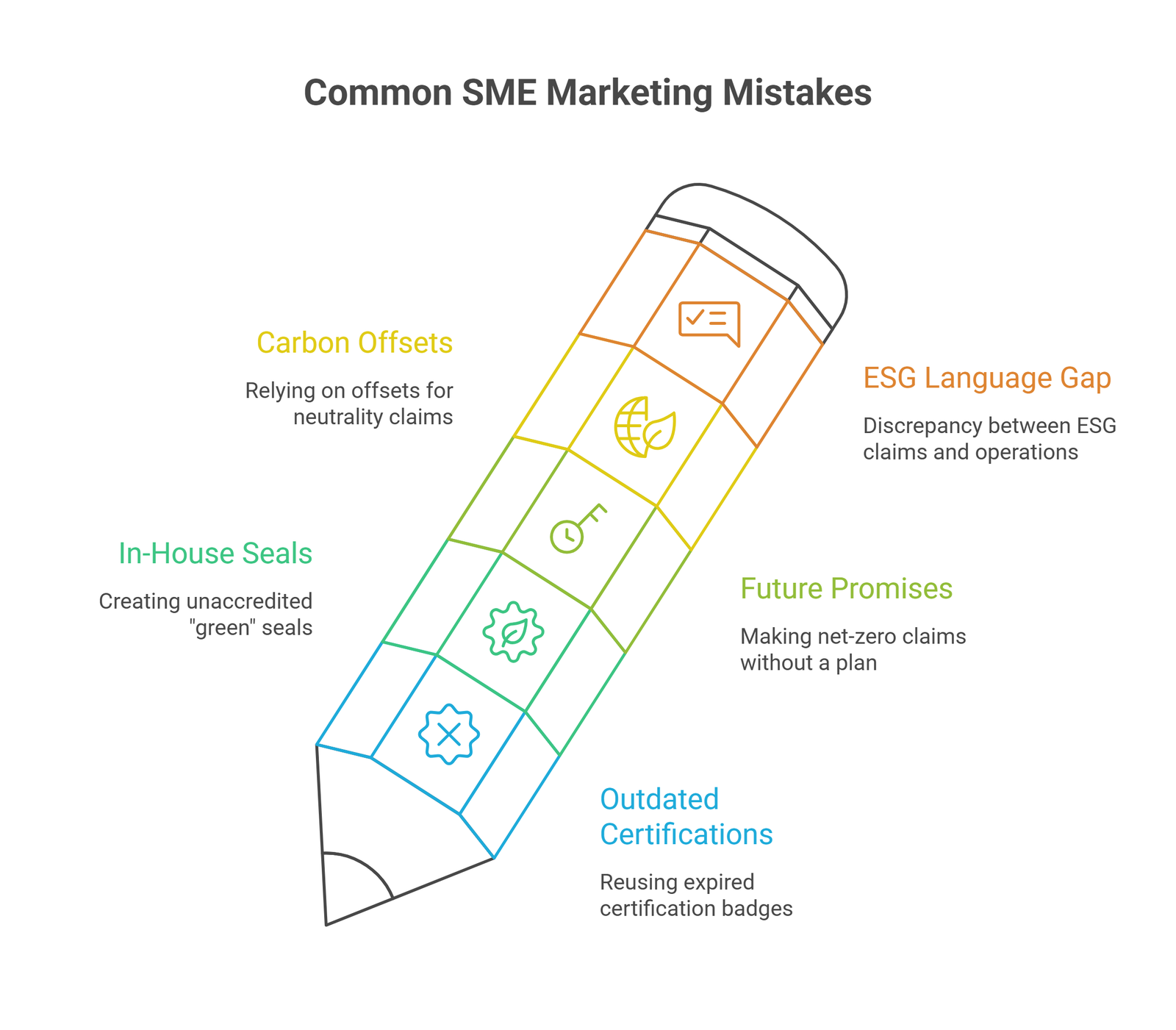
- Reusing a certification badge without checking if it still applies. Certification marks tied to a specific product line get copied onto the whole website. Under the EU’s new black-list rules, this is a problem. Presenting a claim about an entire business when it only applies to one product or component is now a prohibited practice. No case-by-case defense is available.
- Designing an in-house “green” seal. A leaf icon and the word “certified” with no accredited scheme behind it is one of the oldest violations in the book. It is now explicitly banned under EmpCo regardless of intent.
- Making a future promise with no plan behind it. A “net zero by 2030” claim is treated as misleading under the new EU framework. It needs to be backed by a public, time-bound implementation plan with third-party verification. A slogan is not a plan.
- Leaning on carbon offsets to claim neutrality. Offset-based neutrality claims for products are now categorically prohibited in the EU, and the FTC has signaled similar scrutiny in the US.
- Treating ESG language as a marketing shortcut rather than an operational fact. This is where the gap between claim and evidence usually starts. It is also where a business’s own governance and reporting practices need to catch up with what the marketing team is promising.
Building compliance without a legal department
Most SMEs cannot hire outside counsel to review every product description. What actually reduces risk is a repeatable internal process, not a bigger budget.
Start with an audit of every environmental claim currently in use, across the website, packaging, social media, and even the business name itself. The EU’s expanded definition of an “environmental claim” now covers marketing names, brand names, and visual identity, not just advertising copy. A name like “GreenBox Logistics” is itself inside scope if the company cannot support the implication.
Replace vague language with specific, checkable claims. “Eco-friendly packaging” becomes “60% post-consumer recycled cardboard, verified by [certifying body].” If a business cannot fill in that level of detail, the claim needs to come down. It should stay down until it can be rewritten with real evidence behind it.
Keep the evidence where a regulator, or a customer, can actually find it. A sustainability claim buried in a 40-page report that nobody downloads does not meet the substantiation bar in any of the three jurisdictions above. This is also where the discipline overlaps with good financial and operational risk management. The same documentation habits that protect a business in an audit protect it in a greenwashing review.
Budget for compliance the way you budget for any other operating risk. A single enforcement action, even a modest one, can cost more than years of proper claim substantiation would have. Tightening cash flow is often the real reason claims review keeps getting deprioritized. A clearer view of where the money is actually going often changes that calculation faster than a compliance memo does. Oak’s cash flow analysis work with SME clients regularly turns up exactly this kind of postponed, high-consequence risk.
Finally, put someone in charge of the review, even if it is a part-time responsibility layered onto an existing role. Regulators are not asking small businesses to build a compliance department. They are asking for evidence that claims were checked before they were published.
Frequently Asked Questions
Can a small business really get fined the same as a large corporation?
In the US and UK, yes. The FTC’s Green Guides and the UK’s CMA rules apply the same substantiation standard regardless of company size. The CMA can fine up to 10% of global turnover directly, without going to court. For a small business, that can still represent a serious financial hit even though the absolute dollar figure is smaller than a corporate case.
What is the difference between the EU’s Green Claims Directive and EmpCo?
EmpCo (Directive 2024/825) bans specific deceptive practices outright and applies to virtually every business marketing to EU consumers starting September 27, 2026. The Green Claims Directive is a separate, more detailed framework requiring independent verification of voluntary environmental claims. It includes the SME timeline extension and micro-enterprise exemption described above.
Is it safe to use terms like “sustainable” or “eco-friendly” at all?
Generic terms are not automatically banned. Under the new EU rules, they can only be used if the business can demonstrate a recognized, excellent environmental performance level behind them. That typically means a standard like the EU Ecolabel or another ISO 14024-compliant certification. In the US and UK, the same terms need to survive a “compared to what, verified by whom” test or they are considered unsubstantiated.
Can a competitor sue an SME over a greenwashing claim, separate from regulators?
Yes. In the US, the Lanham Act gives competitors a private right of action against misleading claims about a product’s nature or characteristics. That right exists independent of any FTC enforcement. Consumers can also bring class actions under state deceptive-practices laws.
The cost of waiting is no longer theoretical
Greenwashing risk used to be a reputational conversation. It has since become a line item, with real fines, real deadlines, and enforcement actions accumulating steadily across every major market. SMEs that treat claims review as a one-time marketing task are the ones most likely to get caught. Those are exactly the rules regulators wrote with that gap in mind. Oak Business Consultant’s regulatory compliance services help growing businesses build the kind of claim-by-claim discipline regulators are now checking for. That discipline is easier to build before an enforcement letter forces the issue.