12 Golden Rules of Budgeting and Financial Management for NPO
The Art of Financial Mastery: Budgeting and Management Decoded
Most budgeting advice online is written for for-profit companies. It gets repackaged for nonprofits by swapping “profit” for “mission” and calling it done. That approach misses what actually makes nonprofit budgeting different. Restricted funds, board fiduciary duty, donor scrutiny, and a public Form 990 that anyone can read.
These 12 rules are built around those realities, not around generic budgeting advice with a nonprofit label stuck on top.
Why nonprofit budgeting is not business budgeting with a different label
A for-profit business tracks revenue and expenses. A nonprofit has to track that too, plus a layer most businesses never touch. Funds arrive restricted or unrestricted, meaning some can only be spent on what the donor specified. Expenses have to be split by function, not just by category. A program cost and an administrative cost are never lumped together. And the whole picture becomes public once a year, through Form 990. Donors and watchdog groups can see exactly how the money moved.
Skip any of that, and even a well-run budgeting process can look mismanaged from the outside.
12 golden rules of nonprofit budgeting and financial management
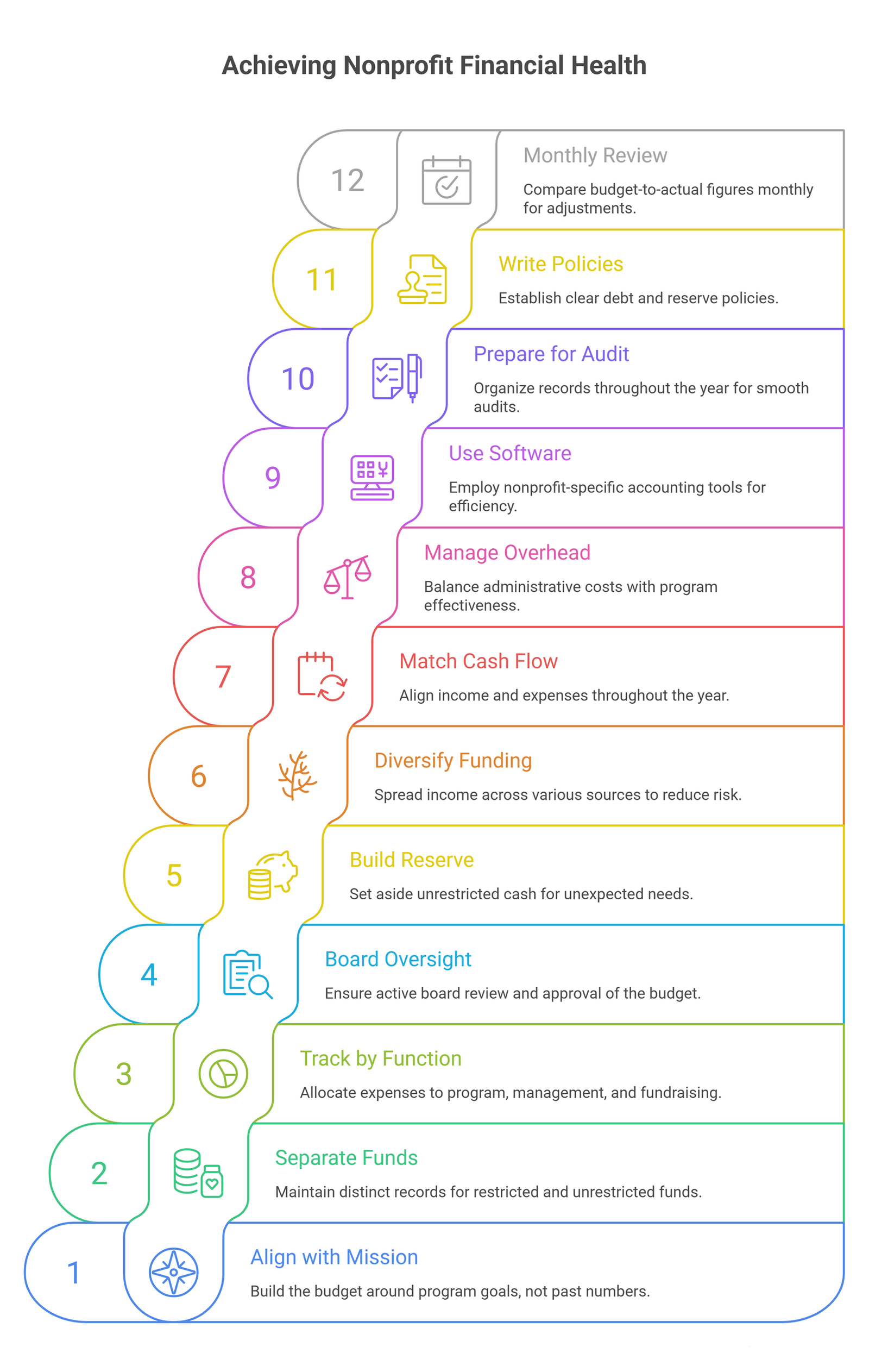
1. Build the budget around your mission, not last year’s numbers
Copying last year’s budget with small tweaks is the fastest way to fund the wrong priorities. Start from your program goals for the year. Then work backward into what each one actually costs. If a line item does not connect to a program, a grant requirement, or core operations, question it.
2. Separate restricted funds from unrestricted funds, and never mix them
Restricted funds come with donor conditions attached. They can only be spent on what the grant or gift specified. Mixing them with general operating funds is one of the fastest ways to lose donor trust. Track them separately in your books, not just in a spreadsheet note.
3. Track expenses by function, not just by category
Nonprofit accounting splits every dollar into three functions: program, management and general, and fundraising. This is not optional bookkeeping detail. It is what feeds your Form 990 and your program expense ratio. That ratio is the number most donors look at first.
4. Give your board real oversight, not a rubber stamp
Your board carries fiduciary responsibility for the budget. That means real review, not a five-minute vote at the end of a meeting. Build in time for board members to ask about unusual expenses and challenge assumptions. They should formally approve the final version before the fiscal year starts.
5. Build and protect an operating reserve
An operating reserve is unrestricted cash set aside for cash flow gaps, not deficits. The widely used benchmark is 3 to 6 months of average operating expenses. Most guidance says never exceed roughly two years, and never fall below one full payroll cycle. Cash flow analysis should factor your reserve target in from the start, not treat it as leftover money.
6. Diversify your funding so one grant can’t sink you
A nonprofit that depends on one grant or donor for most of its budget is one decision away from a crisis. Spread income across grants, individual donors, earned revenue, and events where possible. When you assess potential funding sources, weigh reliability as heavily as size.
7. Match cash flow timing to your grant and fundraising calendar
Grants rarely pay out evenly across the year, and neither does individual giving, which often spikes in December. A budget that looks balanced annually can still leave you short in March. That happens when cash does not arrive when the bills do. Forecast month by month, not just annually.
8. Treat the overhead ratio as one number, not the whole story
Donors and watchdog groups still look at the percentage spent on administration and fundraising. Charity Navigator generally credits organizations spending 70% or more on programs. The BBB Wise Giving Alliance sets its ceiling at 35% for combined overhead. But the sector’s own watchdogs jointly warned in 2013 that this ratio alone is a poor measure of effectiveness. Track it, explain it to your board and donors, and do not starve your infrastructure just to move the number.
9. Use nonprofit-specific accounting software and a real chart of accounts
Generic small business accounting tools were not built to separate restricted funds or track functional expenses. They also can’t generate the reports your Form 990 needs. Nonprofit-specific platforms handle this natively. A chart of accounts built for fund accounting from day one saves months of reclassification work later.
10. Prepare for your audit and Form 990 all year, not just before
Waiting until audit season to organize records guarantees a scramble and a more expensive audit. Reconcile accounts monthly, document restricted fund usage as it happens, and keep functional expense allocations current. Your auditor’s job gets easier, and so does yours.
11. Put debt and reserve policies in writing before you need them
Nonprofits sometimes take on debt to bridge a funding gap or finance a capital project. Without a written debt policy, one bad year can turn manageable debt into a structural problem. The same goes for reserve policies. Put the target, the funding source, and the withdrawal rules in writing before a crisis forces the decision.
12. Review budget-to-actual monthly, and adjust without waiting for year-end
A budget is a plan, not a contract. Compare actual income and expenses against the budget every month, not just at the annual board meeting. Small adjustments made in March are far less painful than the correction you are forced to make in November.
Nonprofit financial statements at a glance
| Statement | What it shows | Who typically asks for it |
| Statement of financial position | Assets, liabilities, and net assets at a point in time | Board, auditors, lenders |
| Statement of activities | Revenue and expenses over a period, by fund restriction | Board, major donors |
| Statement of functional expenses | Costs split into program, management, and fundraising | Form 990, watchdog groups |
| Statement of cash flows | Cash moving in and out of the organization | Board, budgeting consultants |
Common budgeting challenges for nonprofits
- Multiple income sources with no central view. Grants, donations, and earned revenue often live in separate spreadsheets. Centralize them into one system everyone can access.
- Thin finance staff. Many nonprofits run finance with one part-time person or a volunteer. Automating recurring tasks and outsourcing complex reporting frees up that capacity.
- Unbudgeted expenses. Equipment failures and unplanned events happen every year. A contingency line in the budget absorbs them without derailing programs.
Frequently Asked Qustions
What is the difference between restricted and unrestricted funds?
Restricted funds must be spent on what the donor specified, such as a particular program or time period. Unrestricted funds can be used for any legitimate organizational purpose, including operating reserves.
How much should a nonprofit keep in reserve?
Most guidance points to 3 to 6 months of average operating expenses. The upper limit sits around two years, with a floor of one full payroll cycle.
What is a good program expense ratio for a nonprofit?
Charity Navigator generally credits 70% or more spent on programs. The BBB Wise Giving Alliance sets 65% as its minimum. Most well-run nonprofits land between 65% and 80%.
Is a low overhead ratio always better?
No. Major watchdog groups jointly stated in 2013 that overhead ratios alone are a poor measure of nonprofit effectiveness. Underinvesting in staff, technology, and financial management to chase a lower ratio often weakens the organization.
Who is responsible for approving a nonprofit’s budget?
The board holds fiduciary responsibility for approving the annual budget. Finance staff and program leads typically build it together first.
Does a small nonprofit need a CFO?
Not necessarily full-time. Many nonprofits use fractional or outsourced financial support to get budgeting, forecasting, and reporting expertise without a full-time salary.
Final thoughts
Nonprofit budgeting carries real weight. A mistake does not just cost money. It can cost donor trust, grant renewals, and program continuity. Building these 12 rules into your process from the start protects all three.
If your organization needs help turning these rules into a working budget, our financial analysts can help.