UAE Green Bonds and Sukuk, Explained for Businesses
Raising Capital the Green Way: UAE Green Bonds and Sukuk Explained
Most business owners who hear “green bond” picture ADNOC, DP World, or a sovereign wealth fund signing a nine-figure deal at a COP side event. That picture is accurate, and it’s also the reason most mid-sized UAE companies assume this market has nothing to do with them.
It isn’t quite that simple. The UAE has spent the past three years building one of the most active green and sustainable debt markets in the Middle East. The rules, the incentives, and the smaller instruments underneath it all matter to businesses well below the billion-dollar bracket too. This article breaks down what a green bond or green sukuk actually is. It covers how the UAE regulates the market, who’s realistically eligible, and what to have in place before that first conversation with a bank.
What green bonds and green sukuk actually are
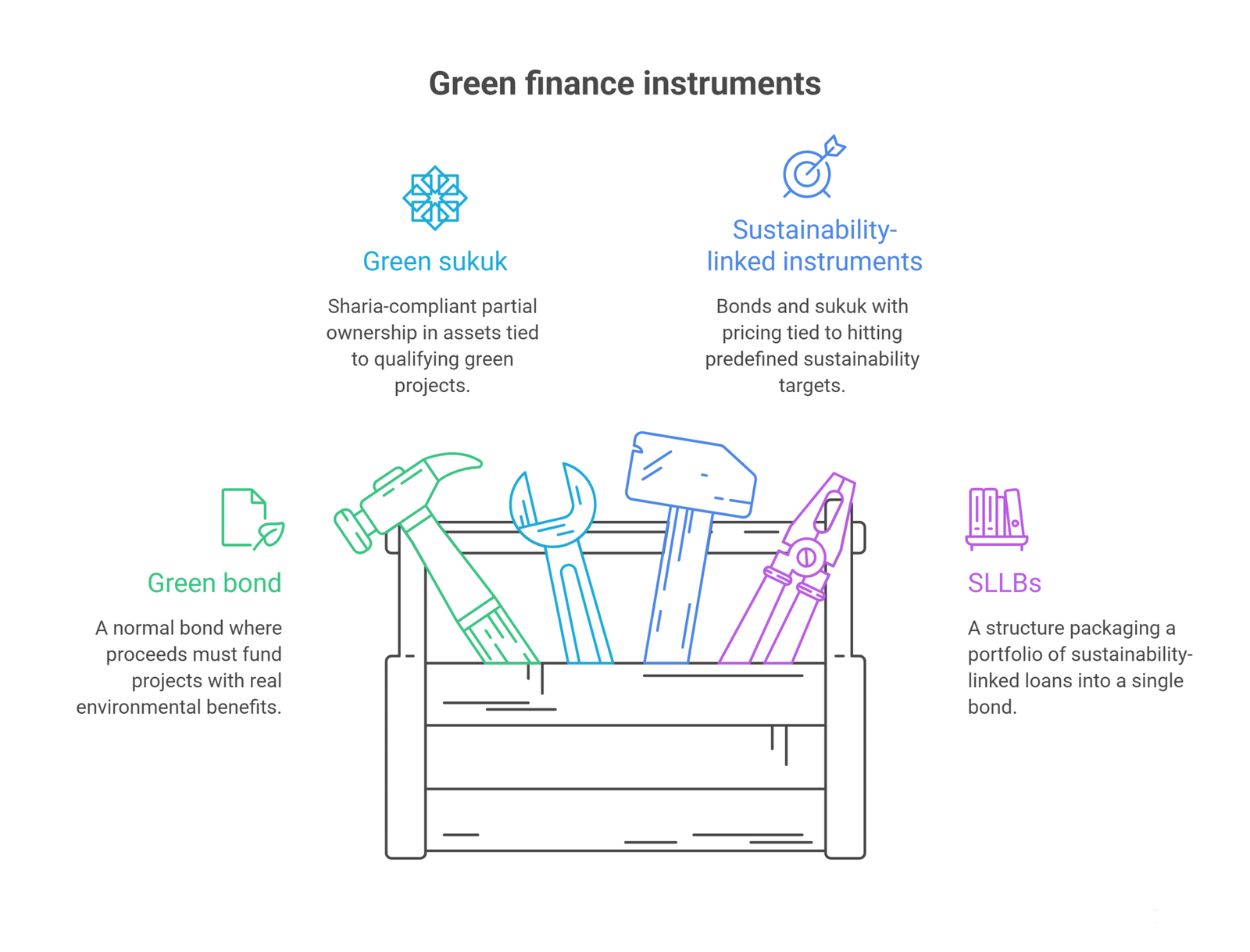
A green bond is a normal bond with one condition attached: the money raised has to go toward projects with a real environmental benefit. That covers things like renewable energy, energy-efficient buildings, clean transport, water and waste management, and pollution control. The issuer still pays interest and repays the principal like any other bond. The only difference is what the proceeds are allowed to fund.
A sukuk works differently at a structural level. Instead of a debt obligation, it represents partial ownership in an underlying asset or project. That’s what makes it Sharia-compliant. A green sukuk is the same idea with the same environmental condition attached: the underlying assets, or the use of proceeds, has to tie back to a qualifying green project. In the UAE and the wider Gulf, sukuk aren’t a niche alternative to bonds. They’re often the primary instrument, and green sukuk issuance from the region now makes up a meaningful share of the entire global green sukuk market.
There are two related instruments worth knowing before you go further:
- Sustainability-linked bonds and sukuk don’t restrict how the money is spent. Instead, the pricing is tied to whether the company hits predefined targets by set dates, things like emissions reduction or Emiratisation benchmarks. Miss the target, and the cost of the debt usually goes up.
- Sustainability-linked loan financing bonds (SLLBs) are a newer structure. Guidance for them arrived in mid-2024. They let a bank package a portfolio of sustainability-linked loans into a single bond. Emirates Islamic issued the region’s first SLLB sukuk in 2025.
The distinction matters because a company that can’t point to a specific green project, but does have a credible sustainability plan, still has a route into this market.
Why the UAE has become a regional hub for this
The UAE has led the region’s green bond issuance for several years running. Total green bond sales reached roughly USD 10.7 billion in 2023, about 45% of everything issued across the Middle East and North Africa that year. Debut issuers that year included the Sharjah government and Mubadala, alongside repeat issuers like DP World, TAQA, and Emirates NBD.
That growth hasn’t slowed. Regional forecasts put Middle East sustainable bond issuance at close to USD 25 billion for 2026, with sukuk making up a growing share of that total. On the banking side, the UAE’s financial sector committed at COP28 to mobilizing AED 1 trillion, roughly USD 272 billion, in sustainable finance by 2030. The Central Bank of the UAE has backed that target with its own climate-related financial risk guidance for banks.
Nasdaq Dubai is one of the region’s main listing venues for this activity. Its total ESG-classified debt listings have passed USD 25 billion, split across green bonds and green sukuk from issuers including ADIB, Majid Al Futtaim, Sobha Realty, and OMNIYAT. The exchange’s green sukuk listings alone now run into the tens of billions of dollars.
The regulatory framework a business has to satisfy
The Securities and Commodities Authority (SCA) sets the core rules for green and sustainability-linked bonds and sukuk issued in the UAE. The framework rests on four requirements, borrowed from the International Capital Market Association’s Green Bond Principles:
- Use of proceeds. For a green instrument, funds have to go entirely to qualifying environmental projects. For a sustainability-linked instrument, the funds are unrestricted, but pricing depends on hitting the stated targets.
- Project evaluation and selection. The issuer has to clearly explain the environmental objective behind the project and how it screens out material risks, in line with ICMA’s principles.
- Management of proceeds. Funds have to sit in a separate sub-account, with any unallocated balance disclosed to investors rather than left unexplained.
- Reporting. Issuers report on where the money went and what environmental impact it had, including semi-annual disclosures to the SCA.
Alongside the SCA, the Dubai Financial Services Authority regulates listings on Nasdaq Dubai. The Abu Dhabi Global Market runs a parallel regime for entities structured there. Both work from broadly the same ICMA-aligned principles. A company doesn’t face contradictory standards depending on which free zone or exchange it uses.
There’s also a direct financial incentive. The SCA has waived registration fees for green and sustainability-linked bond and sukuk listings, calculated at 0.01% of the issue value up to a cap of AED 30,000. That waiver applied through 2023 and 2024. The SCA reviews it annually, so businesses planning an issuance should confirm current-year status with their advisor rather than assume it still applies.
Green bond vs. green sukuk vs. sustainability-linked debt vs. green loan
| Instrument | Structure | What proceeds fund | Typical issuer size |
| Green bond | Conventional debt | Restricted to specific green projects | Large corporates, government entities |
| Green sukuk | Asset-backed, Sharia-compliant | Restricted to specific green projects | Large corporates, government entities |
| Sustainability-linked bond/sukuk | Debt or Sharia-compliant, pricing tied to targets | Unrestricted, general purposes | Large and mid-sized companies with an established sustainability plan |
| Green loan / sustainability-linked loan | Bank facility, not publicly listed | Restricted (green loan) or unrestricted with pricing incentives (SLL) | SMEs and mid-sized companies |
Who can actually access this market
Here’s where most coverage of this topic stops short. Every well-known green sukuk deal in the UAE comes from a large, already-rated corporate with an in-house treasury function, think DP World’s USD 1.5 billion listing or Sobha Realty’s USD 750 million green sukuk. That’s not an accident. A public listing on Nasdaq Dubai or the Dubai Financial Market brings disclosure obligations, external review costs, and a minimum scale that puts it out of reach for most SMEs.
The DFSA did set up a Growth Market on Nasdaq Dubai in 2020 specifically to give SMEs a lighter-touch listing route. It has no fixed minimum market capitalization, and the regulator has case-by-case flexibility to work with smaller applicants. In practice, no SME has used it for a listing yet. For a growing UAE business, the public capital markets side of this story isn’t the realistic entry point today.
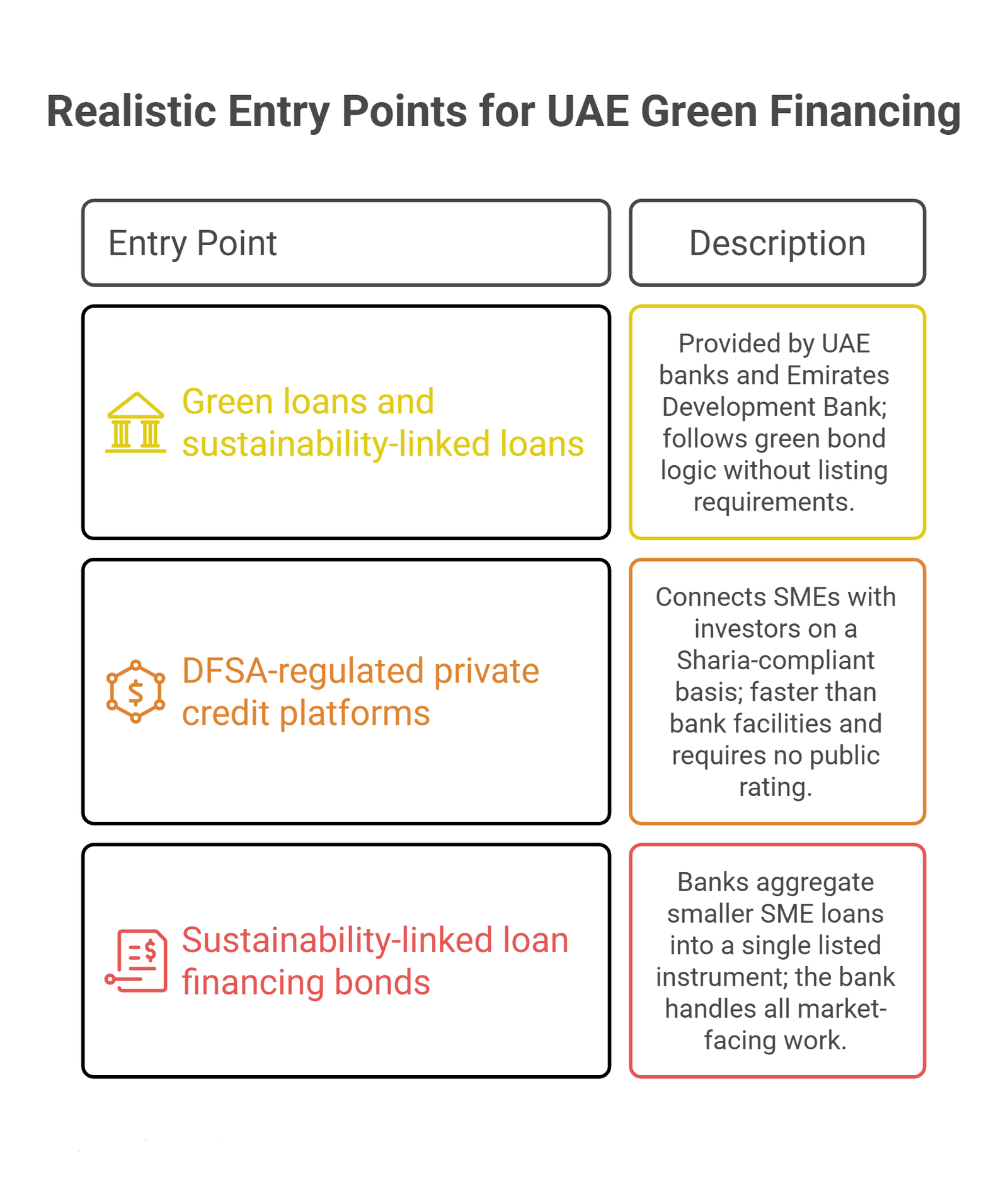
The realistic entry points sit one level down, in bank and private credit markets rather than public listings:
- Green loans and sustainability-linked loans from UAE banks and the Emirates Development Bank, which lists renewable energy and industrial energy efficiency as a stated lending focus. These follow the same use-of-proceeds or KPI-linked logic as a green bond, minus the listing requirements.
- DFSA-regulated private credit platforms, which connect established SMEs directly with institutional and individual investors on a Sharia-compliant basis. These are often faster than a bank facility and don’t require a public rating.
- Sustainability-linked loan financing bonds, where a bank aggregates smaller sustainability-linked loans, including ones made to SMEs, into a single listed instrument. The SME never lists anything itself. The bank does the market-facing work.
For most businesses below the large-corporate bracket, this is the honest picture: direct sukuk issuance is a multi-year goal, not a next-quarter option, but green and sustainability-linked lending is already accessible now.
What to have in place before this conversation
Whether the eventual route is a bank facility or a future listing, the preparation looks the same:
- A defined eligible project or a measurable sustainability target. “We care about sustainability” doesn’t satisfy a lender or an external reviewer. A solar retrofit, an EV fleet transition, a water-efficiency upgrade, or a specific, dated KPI does.
- Clean legal and financial documentation. A green or sustainability-linked facility gets underwritten the same way any other facility does. Unclear licensing, inconsistent financials, or an unresolved tax position will stall things before sustainability even enters the conversation.
- A basic sustainable finance framework. Even an informal one works. It should set out what qualifies as an eligible project, how proceeds will be tracked, and how reporting will happen. Larger issuers publish full frameworks reviewed by an external party. A smaller borrower can start with a shorter internal version that a bank’s sustainability team can assess.
- A realistic reporting plan. Semi-annual or annual reporting on where the money went and what it achieved isn’t optional once funds are drawn. Businesses that haven’t budgeted the time or cost for this tend to find out too late.
Frequently Asked Questions
What’s the difference between a green bond and a sustainability-linked bond?
A green bond restricts how the money can be spent, it has to go to a defined environmental project. A sustainability-linked bond doesn’t restrict the use of funds at all. Instead, the interest rate moves depending on whether the company hits agreed sustainability targets by set dates.
Does a green sukuk have to fund a brand-new project?
No. Proceeds can finance or refinance eligible projects, including ones already underway or completed, as long as they meet the environmental criteria set out in the issuer’s framework.
Are there cost incentives for issuing green debt in the UAE?
Yes. The SCA has waived registration fees for green and sustainability-linked listings, calculated at 0.01% of issue value up to AED 30,000, though businesses should confirm the waiver’s current-year status before planning around it.
What happens if a company doesn’t hit its sustainability targets on a sustainability-linked loan or bond?
Typically the cost of the debt increases, through a step-up in the interest or profit rate, rather than a default being triggered. The exact mechanism is set out in the loan or bond documentation.
Do free zone companies have the same access as mainland companies?
Broadly yes. The regulatory frameworks from the SCA, DFSA, and ADGM apply based on where the entity and the listing venue sit, not on mainland versus free zone status. What matters more is which exchange or lender the company is working with.
How Oak Business Consultant can help
Getting a green loan or sustainability-linked facility off the ground takes the same groundwork as any other financing round: clean documentation, a credible financial model, and a structure a lender can actually underwrite. That’s exactly the kind of financial model and investor documentation work a bank or external reviewer will want to see before they say yes.
Not sure whether your business is ready for a green or sustainability-linked facility? Get in touch and we’ll walk through what’s already in place and what still needs fixing.