TAM, SAM, and SOM for ESG-Focused Startups
Market Sizing for ESG Startups: TAM, SAM, and SOM Done Right
Most market-sizing advice assumes a straightforward category: people who buy project management software, people who order meal kits. ESG-focused startups don’t get that luxury. “Sustainability” touches every industry. That makes it tempting to quote a headline figure like “the global ESG market is worth trillions” and call the TAM slide done. Investors have seen that slide too many times. Greenwashing scrutiny has also made them actively suspicious of inflated sustainability claims, in a pitch deck as much as in a product label. For an ESG startup, a sloppy TAM doesn’t just look lazy. It looks like the exact pattern regulators and investors are now trained to distrust.
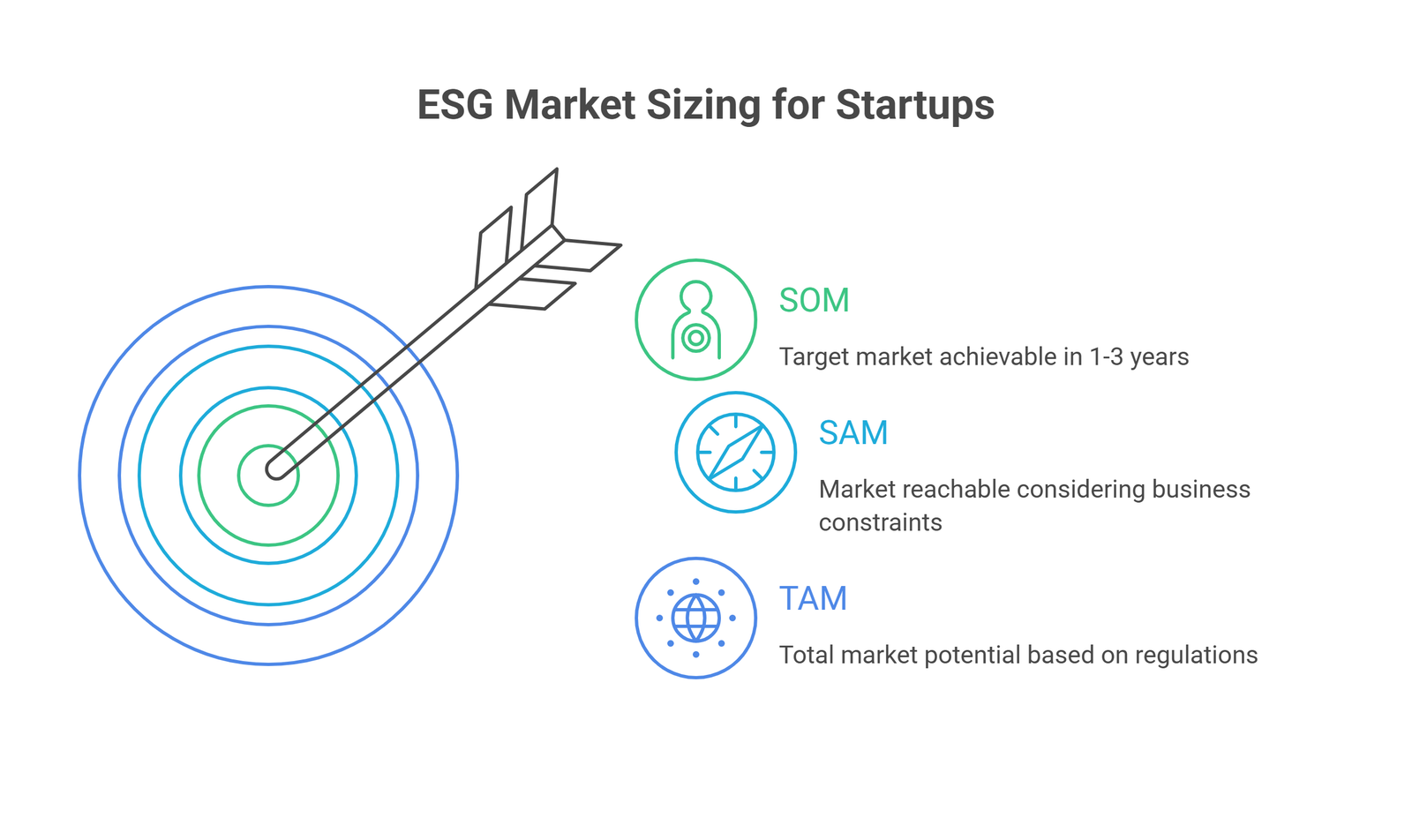
Getting TAM, SAM, and SOM right for an ESG business means treating the sustainability angle as a filter on the numbers, not a substitute for them.
Why ESG Market Sizing Breaks the Standard Playbook
Standard market sizing assumes a fairly clean product category. ESG breaks that assumption in two ways.
First, ESG is horizontal, not vertical. A carbon accounting platform could theoretically sell to any company with emissions, which is every company. That’s not a market size. It’s a description of the entire economy. The fix is the same discipline any market analysis needs: define the actual buyer specifically enough that someone could recognize them, not the theoretical universe of companies that could someday care about sustainability.
Second, ESG demand comes from two different sources that behave nothing alike: regulatory mandate and voluntary commitment. A company buying carbon accounting software because a disclosure law requires it is a much more defensible, countable customer. A company buying it because sustainability is “on the roadmap” is not. Conflating the two inflates the market and weakens the market analysis section of the plan. Investors will ask which dollars are guaranteed and which are aspirational.
Build TAM From Regulation, Not Sentiment
The single best defense against an inflated ESG TAM is to anchor it in something countable. Use the number of companies legally required to act, not the number of companies that might want to.
Frameworks like the EU’s Corporate Sustainability Reporting Directive and California’s Climate Corporate Data Accountability Act, SB 253, define a specific, published population of companies that must comply. SB 253’s first Scope 1 and 2 reporting deadline is set for August 10, 2026. That population is a real, citable number.
Two caveats are worth building into the model. California’s companion law, SB 261, is currently unenforced and voluntary under a court order. The SEC’s own 2024 climate disclosure rule, once floated as a similar US-wide anchor, has been stayed pending litigation, and the agency voted in March 2025 to stop defending it. Neither is a reliable basis for a regulatory count right now. “Every company that will eventually care about sustainability” was never a number to begin with.
A bottom-up TAM built this way looks like this: the number of companies in scope of a given regulation, multiplied by the average annual spend on the category of service or software that helps them comply. That calculation survives a follow-up question. A top-down TAM borrowed from a market-research report on “global ESG investing” usually doesn’t. It mixes asset flows, corporate spend, and consumer behavior into one number that has little to do with what the startup actually sells.
Narrow SAM to What the Business Can Actually Reach
SAM is where the regulatory-versus-voluntary distinction matters most. Two companies with the same TAM can have very different SAMs, depending on how much of that regulated population the business can realistically serve today.
| Factor | Narrows SAM | Example |
| Geography | Yes | A carbon accounting tool built for EU CSRD compliance can’t yet serve companies only regulated under a different framework |
| Company size served | Yes | A platform priced and built for mid-market manufacturers isn’t a fit for a Fortune 500’s in-house sustainability team |
| Vertical specificity | Yes | Emissions tracking for supply chains looks different in apparel than in heavy industry, and generic tooling underperforms specialized tooling in both |
| Compliance deadline | Yes | Companies facing a 2026 filing deadline are active buyers now; companies facing one in 2030 are not |
Each row is a real constraint, not a hedge. A SAM that ignores these differences ends up close to the inflated TAM it was supposed to narrow.
Ground SOM in a Defensible Sales Motion
SOM should answer one question. Given the team, the budget, and the sales cycle this business actually has, how many of the SAM’s buyers will it close in the next one to three years? For ESG startups selling into compliance-driven demand, this is often easier to defend than in a purely voluntary market. The buyer’s timeline is set by a filing deadline, not by discretionary budget cycles.
A useful gut check: if the regulated population within SAM is 8,000 companies, and the sales team can realistically run 200 qualified sales conversations a year at a 15% close rate, that’s 30 new customers a year. It’s not a percentage pulled from a template. Tie the SOM to the actual go-to-market capacity, and be ready to show the math behind it, not just the resulting figure.
Common Mistakes ESG Startups Make in This Slide
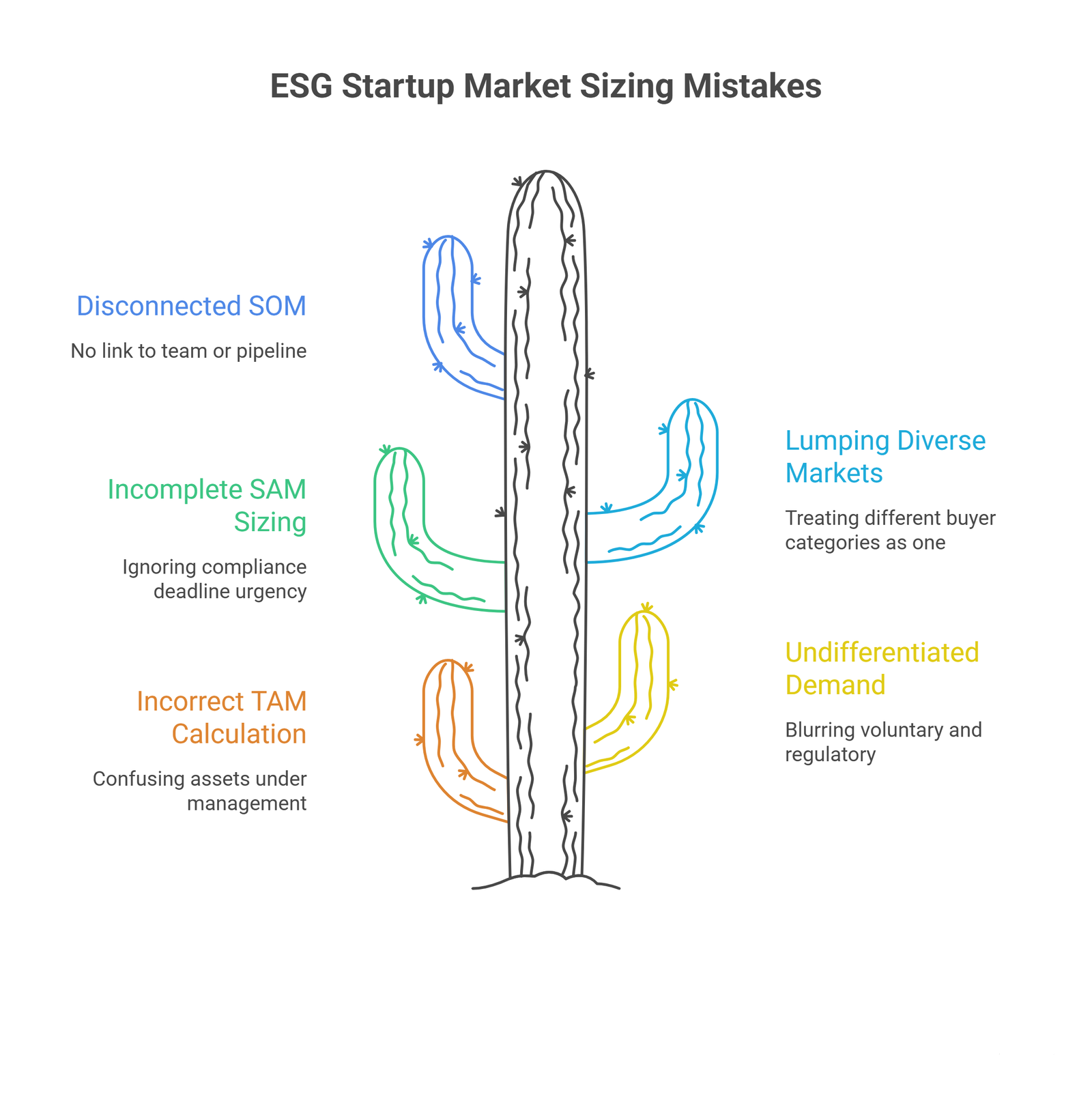
- Quoting a global ESG assets-under-management figure as TAM when the business sells software or services, not investment products.
- Treating “voluntary sustainability commitments” and “regulatory compliance mandates” as one undifferentiated demand pool.
- Sizing SAM by geography or industry alone, without accounting for which companies face a near-term compliance deadline versus a distant one.
- Failing to distinguish between the market for ESG data and reporting tools, decarbonization technology, and advisory services. These are three genuinely different buyer categories often lumped together as “the ESG market.”
- Presenting a SOM with no visible connection to team size, sales cycle length, or actual pipeline capacity.
Frequently Asked Questions
What’s a Realistic TAM for an ESG Compliance Software Startup?
It depends entirely on which regulation the product serves and how the product is priced. A defensible approach multiplies the number of companies in scope of a specific disclosure law by the average annual spend companies allocate to that compliance category. That beats citing an industry-wide sustainability market figure.
Should Voluntary ESG Commitments Count Toward TAM at All?
They can, but they should be shown as a separate, clearly labeled segment rather than folded into the regulatory-driven number. Voluntary demand is real but far less predictable, and investors will want to see the split.
How Do Investors Evaluate an ESG Startup’s Market Size Differently From Other Startups?
They apply extra scrutiny to whether the number reflects real, countable buyers or a broad sustainability narrative. A market slide that reads like a greenwashed marketing claim, technically true but disconnected from actual paying customers, gets challenged harder in an ESG pitch than in most other categories right now.
Does a Shrinking Regulatory Window (Like a Compliance Deadline) Affect SOM?
Yes, significantly. A near-term compliance deadline compresses the buyer’s decision timeline. It often increases willingness to pay quickly too, which can justify a higher first-year SOM than a comparable non-regulated market would support.
How Often Should an ESG Startup Revisit Its Market Sizing?
At least annually, and immediately after any material regulatory change. Disclosure rules and their scope have moved quickly, and a TAM built on last year’s regulatory landscape can go stale fast.
The Market Slide Is Where ESG Credibility Gets Tested First
For most startups, an inflated TAM slide is a rookie mistake. For an ESG startup, it’s a credibility risk that echoes the exact pattern regulators and investors are already primed to distrust. A market analysis built on a countable, regulation-anchored population, with SAM and SOM narrowed to what the business can actually reach and close, reads differently. It reads as a team that understands its own sector’s scrutiny, rather than one hoping nobody checks the math.
Oak Business Consultant has built financial models for ESG-focused startups and offers investor-ready business plan services for founders who need their market sizing to hold up under exactly this kind of scrutiny.