Crafting a winning business pitch: what actually gets investors to say yes
What does a winning business pitch have
Most founders spend weeks polishing slides and almost no time researching who they’re pitching to, and it shows. Research published in the Harvard Business Review found that venture capitalists’ interest in a startup often comes down more to perceived character and trustworthiness than to judgments of competence alone. A polished deck matters, but it rarely saves a pitch aimed at the wrong investor with the wrong story. This guide covers both: the research and targeting most founders skip, and the deck structure and delivery that make the rest of the pitch land.
A business pitch is a presentation an entrepreneur gives to potential investors, partners, or customers to explain the business plan and win funding, buy-in, or a sale. Done well, it’s the bridge between an idea and the resources needed to build it.
Start with one sentence before you build a deck
Before writing any slides, distill the business into a single sentence: “My company, [name], is developing [offering] to help [audience] [solve a specific problem], with [what makes it different].” Founder Institute calls this the one-sentence pitch, and it’s a useful gut check. A vague version (“a revolutionary social utility to help consumers find deals faster”) signals you haven’t thought it through. A specific version (“an ecommerce site helping women 18 to 25 shop for baby products at wholesale prices, with automated reordering of diapers and other staples”) signals the opposite. If you can’t get specific in one sentence, you’re not ready to build a full deck yet.
Types of business pitches
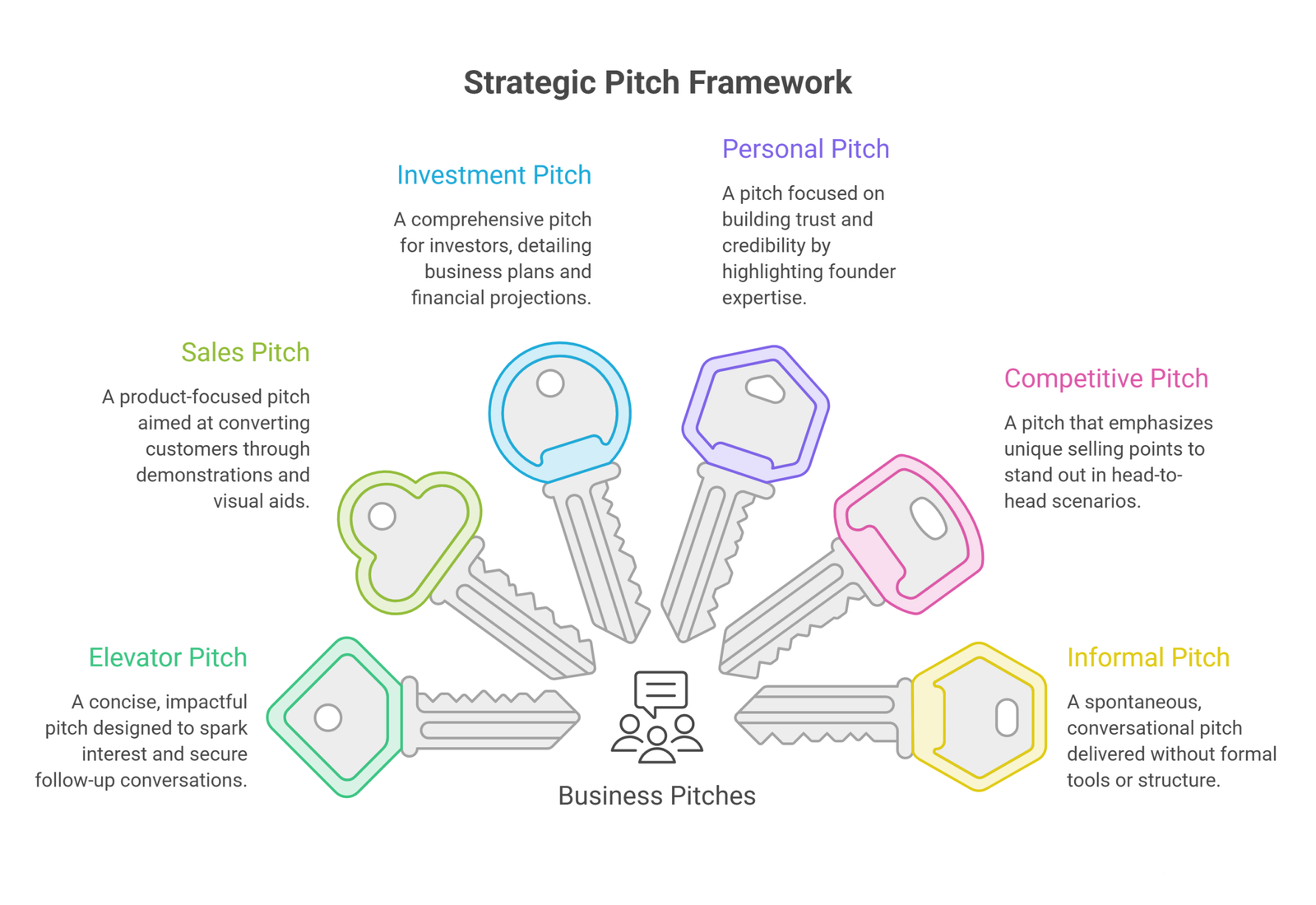
Not every pitch looks the same, and matching the type to the situation matters as much as the content itself.
- Elevator pitch. Thirty seconds to a minute, the time it takes to ride an elevator. The goal isn’t to close a deal, it’s to spark enough interest to earn a follow-up conversation.
- Sales pitch. Focused on a specific product or service, aimed at converting a customer rather than an investor. Usually includes a demo or visual walkthrough.
- Investment pitch. The most detailed version, built for investors and covering the business plan, market opportunity, revenue model, financial projections, and team background.
- Personal pitch. Selling yourself and your credibility, not just the business, useful in networking settings where trust in the founder matters as much as the idea.
- Competitive pitch. Used in competitions or head-to-head scenarios where you need to explain what sets your business apart from named alternatives.
- Informal pitch. Unstructured and conversational, delivered anywhere from a coffee shop to a chance meeting, without slides or formal tools.
For investment pitches specifically, length matters as much as type. Plan for three versions: a 30-second to one-minute elevator version, a short-form version of three to ten minutes for a first meeting, and a long-form version for when you get real time with an investor. Most professional pitch decks run 10 to 14 slides. Prepare all three lengths in advance rather than trying to compress one on the fly.
Why a business pitch matters
A pitch is often the first detailed introduction of your business to an outsider, and first impressions carry real weight in a competitive funding environment. Beyond opening the door to capital, building one forces a level of discipline that pays off on its own:
- Clarity. Breaking your business into its core components (problem, solution, market, model, team) often surfaces gaps in your own thinking before an investor ever points them out.
- Validation. Presenting your idea in a structured format is a real test of whether it holds up outside your own head.
- Feedback. Investors, mentors, and even people who pass on the deal often give feedback that’s more valuable than the funding itself.
- Networking. Pitch settings put you in a room with people who can open doors well beyond the specific check they’re deciding on.
- Market understanding. Preparing a pitch typically means doing real market research you wouldn’t have otherwise prioritized this early.
Get expert help building your pitch deck if you want a second set of eyes before you’re in front of investors.
Before you write a single slide: research your investor
Most guides to writing a pitch start with the deck. That’s a mistake. Sending the same generic pitch to 20 investors you know nothing about wastes everyone’s time, including yours. Before you draft anything, answer three questions about each investor or firm you’re approaching:
- What do they actually invest in? Some firms specialize by sector (fintech, healthtech, climate) and stage; others are generalists. A firm that only writes checks for Series A companies won’t fund your pre-seed round, no matter how good the pitch is.
- What stage do they fund? Angel investors, seed funds, and growth-equity firms operate at completely different points in a company’s life. Match your ask to the stage the investor actually plays in.
- What’s their track record? Look at their portfolio, how they’ve supported founders, and whether their reputation matches how you want to be treated as a partner, not just funded.
This research changes what you emphasize in the pitch itself. An investor with a strong track record in your exact sector needs less market education and more depth on your specific differentiation; a generalist investor needs more context on why the space itself is attractive.
What a winning pitch deck actually includes
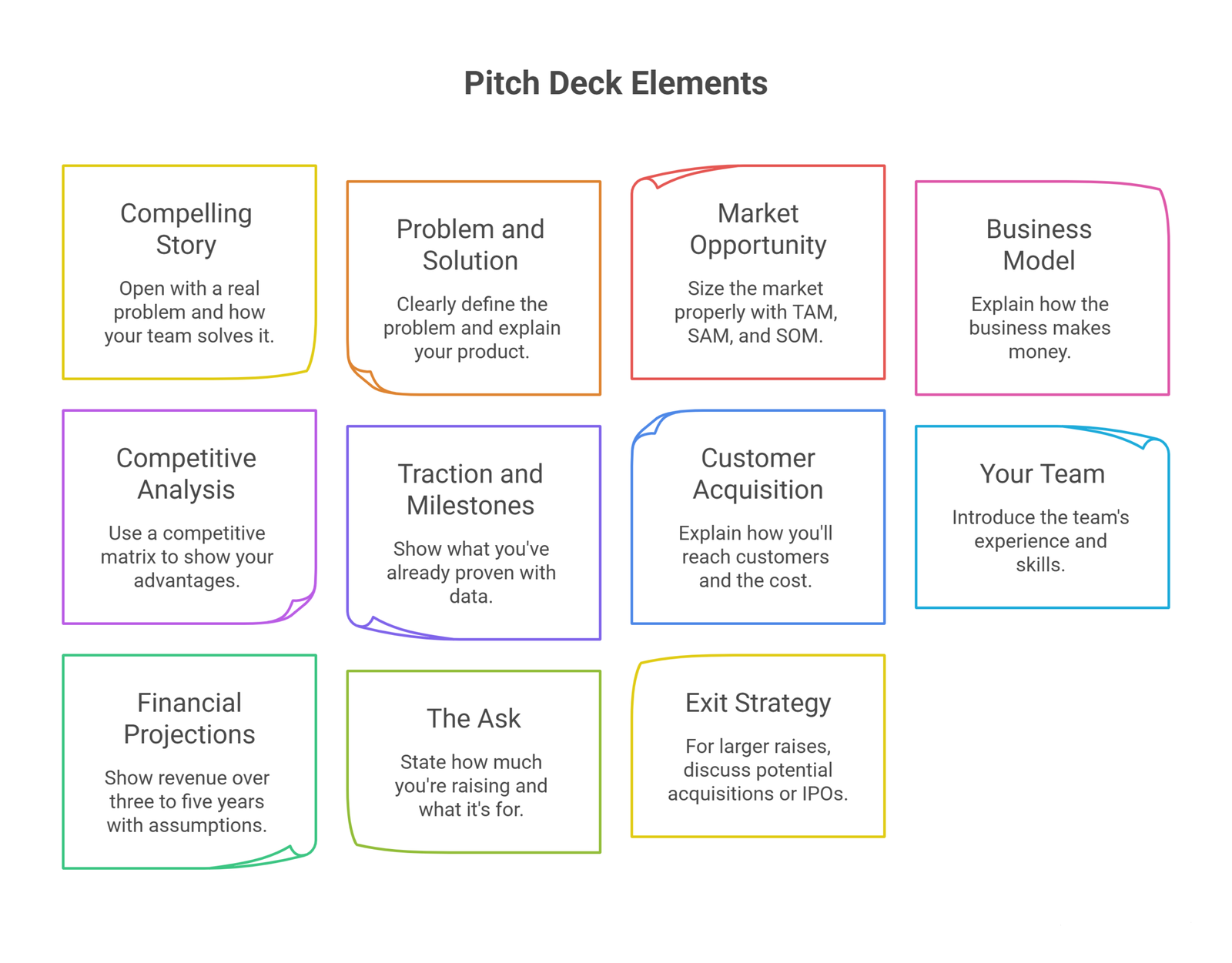
A pitch deck is a visual, narrative case for your business built for a specific, time-limited audience. The elements below are what consistently show up across strong pitches, in roughly the order they should appear.
A compelling story, not just facts.
Open with the real problem a real customer faces, ideally a specific scenario rather than an abstract statistic. Reeling off facts alone is forgettable; a story is what an investor remembers and repeats to their partners afterward. Build the story around something concrete: how your team came together to solve the problem, how a real customer actually uses the product, or the specific way it changes someone’s day-to-day. Weaving in your own vision and ambition for where the business goes gives investors something to buy into beyond the current numbers, since a funding decision is ultimately a bet on the future, not just the present. If you can show the product rather than only describe it, a short demo or a clear visual beats a paragraph of explanation every time.
A clearly defined problem and solution.
State the problem in concrete terms before explaining your product. Avoid vague claims; specific, believable statements build more credibility than sweeping ones.
Market opportunity, sized properly.
Don’t claim “everyone” is your market. Break the opportunity into total addressable market (TAM), serviceable addressable market (SAM), and serviceable obtainable market (SOM) so investors see both the ceiling and the realistic near-term target. Where possible, describe a specific customer persona rather than a broad demographic.
Your business model.
Explain exactly how the business makes money: pricing, channels, customer segments, and the reasoning behind your pricing strategy (land-and-expand, premium, or somewhere in between). This is often the slide investors scrutinize hardest.
Competitive analysis.
Never claim you have no competition, doing so signals you haven’t done the research. Instead, use a competitive matrix: list competitors down one side, key features or benefits across the top, and show where you win. A visual comparison lands better than a paragraph of claims.
Traction and milestones.
Show what you’ve already proven: sales, signed contracts, key hires, pilot results, or product launches. This is your credibility slide, and it’s one of the most commonly under-developed sections in early-stage pitches.
Customer acquisition strategy.
Explain specifically how you’ll reach customers, which channels you’ll invest in, and what it costs to acquire one. This section gets skipped more than almost any other, and its absence is an easy way for an investor to poke a hole in an otherwise strong pitch.
Your team.
Investors back people as much as ideas. Introduce the team’s relevant experience and be upfront about the skills you’re still missing, rather than pretending the team is complete. Team composition sends its own signal too: a slide where every founder looks the same can read as a lack of range in perspective, so a genuinely diverse founding or leadership team is worth highlighting, not downplaying.
Financial projections.
Show revenue by product over three to five years, and be ready to explain the assumptions behind the numbers, not just the numbers themselves. If your chart shows sharp upward growth, be ready to explain exactly what causes the inflection points.
The ask.
State plainly how much you’re raising, what you’ll use it for, and what milestones that funding gets you to. If prior rounds exist, disclose how much has already been raised and from whom.
Exit strategy (for larger raises).
For rounds above roughly $1 million, investors will often want to know your thinking on an eventual acquisition, merger, or IPO, even if it’s early-stage reasoning rather than a firm plan.
The four questions your deck needs to answer
Before you finalize anything, check the whole deck against four questions investors run through in their own heads while listening, popularized by Mint.com founder Aaron Patzer:
- Does it solve a real problem?
- Does it solve that problem in a big enough market?
- Does it have a real, defensible advantage over alternatives?
- Can the business actually make money?
If any of the four is unclear after someone reads your deck cold, that’s the gap to close before you present it, not something to explain away verbally in the room.
Build two versions of the deck
Most founders are surprised to learn they need two decks, not one. A “reading” version is detail-heavy enough to stand on its own when an investor asks to see it before agreeing to a meeting, which happens often. A “listening” version is the streamlined one you present in person, with less text and more visuals, so the room spends its attention on you rather than reading slides over your shoulder. Build the reading version first, then edit it down for the live presentation.
Delivering the pitch
Writing the deck is half the job. A few practices separate pitches that land from ones that don’t:
- Practice out loud, repeatedly. Knowing your business isn’t the same as being able to explain it fluently in 10 minutes. Rehearse until you can speak to every slide without reading it.
- Avoid jargon your audience won’t know. Simplicity reads as confidence; unnecessary technical language reads as a founder trying to obscure something.
- Anticipate questions rather than deferring them. If you tell an investor you’ll answer something “later,” you signal you weren’t prepared for the conversation to move at their pace, not yours.
- Bring backup material. Have your full business plan and executive summary ready to share after the meeting. The goal of the pitch is often to earn the request for more detail, not to cram every detail into the room.
- Build rapport, not just a case. Investors are backing a person as much as a business, and a genuine personal connection, shared interests, common connections, honest curiosity about them, often matters as much as the numbers in whether they say yes.
After the pitch
Whatever the outcome, ask for feedback (if the investor seems open to giving it) and use it to sharpen the next version. Note where you stumbled, which slide caused hesitation, and which questions caught you off guard. A pitch is rarely perfect on the first attempt, and the founders who improve fastest treat every meeting, funded or not, as a data point for the next one.
Frequently Asked Questions
How long should a pitch deck be?
Most professional investor decks run 10 to 14 slides. Keep the version you present short, and hold your full financials and detailed backup material in an appendix or a separate document you share afterward.
What’s the difference between a business pitch and a business plan?
A pitch is the persuasive, time-limited case for your business, built to generate interest. A business plan is the full underlying research and financial detail. Everything in a strong pitch should trace back to a plan you could hand over on request.
Should I mention my competitors?
Yes. Claiming you have no competition raises more doubt than it removes. A competitive matrix showing where you outperform named alternatives is far more persuasive than a vague claim of uniqueness.
Do I need an exit strategy in my pitch?
For smaller, early-stage raises, it’s often optional. For larger rounds, generally above $1 million, most investors will expect at least early thinking on how they’ll eventually see a return, whether through acquisition, merger, or IPO.
What’s the biggest mistake founders make when pitching?
Pitching the wrong investor with a generic deck. Time spent researching an investor’s sector focus, stage, and track record changes what you should emphasize, and skipping that research is one of the most common reasons pitches fall flat before the content is even evaluated.
How much detail should I include on financial projections?
Enough to justify your numbers, not so much that you lose the room. Show revenue by product over three to five years, and be ready to explain your assumptions verbally. Save the full model for follow-up.
Do I need one deck or two?
Plan for two. A detailed “reading” version you can send ahead of a meeting, and a lighter, more visual “listening” version for the live presentation itself. Sending a bare-bones deck when an investor requests one ahead of time often costs you the meeting before you get the chance to present it.
What’s the simplest way to know if my pitch is ready?
Check it against four questions: does it solve a real problem, in a big enough market, with a real advantage, and can it make money? If an outsider can’t answer all four after reading your deck cold, it’s not ready yet.
Conclusion
A winning pitch is a research problem before it’s a design problem. Know your investor, prove your traction, size your market honestly, and back all of it with a real financial model. Oak Business Consultant helps founders build the financial plan and pitch materials that hold up under investor scrutiny, from ROI figures to full pitch deck design.
Reach out to Oak Business Consultant to start building a pitch investors take seriously.