


5 Best Financial Analysis Companies
5 best financial analysis companies for small and mid-sized businesses
If you search for “best financial analysis companies,” most of what comes back today is a list of software: dashboards, forecasting tools, and Excel add-ins. That is useful if you already have a finance team and just need better reporting. It is a different answer if what you actually need is a person, or a firm, to sit down with your numbers and tell you what they mean.
This article covers the second kind: financial analysis companies that provide the analysis itself, not just the tool for doing it yourself. We look at five firms, including our own, and where each one fits.
Disclaimer
This list is not ranked. The company at number one is not better than the company at number five, and Oak Business Consultant’s inclusion at number five is not a claim that we beat the other four. We focused on firms serving small and mid-sized businesses in the US and Canada, and we would rather you judge the fit for your own situation than take our word for it.
Financial analysis: the short version
Financial analysis is the process of reviewing a company’s financial statements to judge its performance, stability, and solvency, and to guide decisions about where the business goes next. It looks at past and current data to answer a forward-looking question: is the current strategy working, and if not, what should change?
The main techniques are ratio analysis, cash flow analysis, trend analysis, budgeting, break-even analysis, return on investment analysis, and capital structure review. Each one answers a slightly different question, and a good financial analysis engagement usually draws on several at once rather than just one.
Financial analysis company vs. financial analysis software
Before the list, it is worth being clear about what you are actually shopping for, because the two options solve different problems.
Software (think Fathom, DataRails, or QuickBooks reporting) is built for teams that already understand their numbers and want faster, cleaner ways to see them. You are buying a tool. Someone on your team still has to interpret the output, catch what it misses, and decide what to do about it.
A financial analysis company sells the interpretation itself. You hand over statements, and a person with the relevant background tells you what is going on: where cash is leaking, whether your pricing supports your margins, what a lender will see when they review your file. For a business without an in-house CFO or controller, that judgment is usually the harder thing to build than the dashboard.
Some businesses need both. A software tool that flags a variance is only useful if someone can explain why it happened and what to do next.
What financial analysis companies typically offer
Most firms in this space provide some combination of:
- Financial modeling and forecasting
- Strategic business planning and management consulting
- Due diligence support and audit preparation
- Data analytics for internal tracking and external benchmarking
- Risk assessment for M&A, credit, and regulatory situations
The specifics vary a lot by firm size and industry focus, which is why it is worth reading past the marketing page before you commit to one.
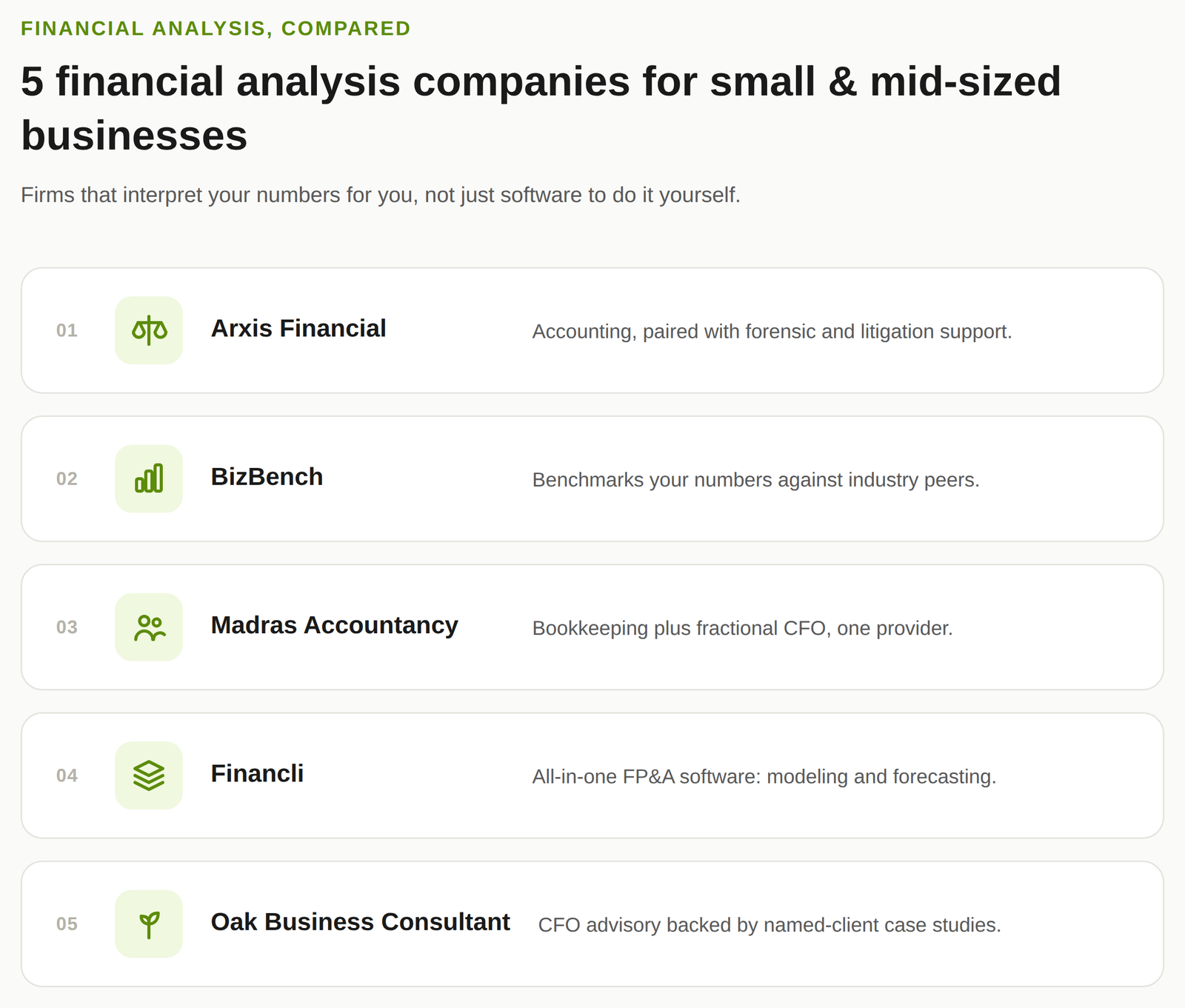
1. Arxis Financial
Arxis built its practice around three services: accounting, litigation support, and management consulting.
On the accounting side, the firm handles bookkeeping, tax preparation, and financial statement analysis, plus audit preparation for clients who need to show a clean set of books to an outside auditor. This suits companies that need ongoing financial oversight but do not have the budget for a full internal accounting department.
Where Arxis stands out is litigation and forensic accounting: business valuation, fraud investigation, and expert witness testimony for contract disputes, breach-of-contract claims, and shareholder disputes. That is a less common pairing for a financial analysis firm, and worth knowing about if legal exposure, a buyout dispute, or a fraud concern is part of what you are trying to manage alongside the numbers.
Its consulting work centers on the same base: helping business owners understand what their financials show before a dispute, an audit, or a valuation event, rather than a general growth-strategy practice.
2. BizBench
BizBench takes a different angle: benchmarking. It is a platform, owned by Universal Accounting, that compares a business’s financial performance against hundreds of thousands of others in the same NAICS industry code, using 51 financial metrics pulled from the income statement and balance sheet.
That comparison is the whole point. Instead of only looking at your own trend line, you see where you sit relative to peers, which makes it easier to tell whether a soft quarter is a company problem or an industry-wide one. Reports come with an executive summary ranking strengths and weaknesses against industry averages, built for use in a live consultation rather than as a document you read alone.
In practice, BizBench is mostly sold to accountants and consultants, who then run the benchmarking for their own clients. If you want that comparison, the more direct route is usually to ask your accountant or a firm like the others on this list whether they use it, rather than subscribing to it yourself.
3. Madras Accountancy
Madras Accountancy is a US small-business accounting and advisory firm, part of the BDO Alliance USA network, that pairs day-to-day bookkeeping with fractional CFO work rather than treating them as separate purchases.
Its core services include outsourced accounting, controller-level oversight, tax preparation and planning, audit and assurance, payroll, and fractional CFO support covering cash flow forecasting, financial modeling, KPI tracking, and investor-readiness prep. The pitch is straightforward: most small businesses do not need a full-time CFO, but they do need someone translating the bookkeeping into decisions about pricing, hiring, and runway.
This one suits a business that wants a single ongoing partner for both the compliance side and the strategic side, rather than hiring a bookkeeper and a separate analysis firm.
4. Financli
Financli positions itself as an all-in-one financial planning and analysis platform: modeling, forecasting, risk management, and reporting in a single system rather than several disconnected tools.
Its core offerings include:
- Financial modeling for balance sheets, income statements, and cash flow statements
- Risk management covering liquidity and credit exposure
- Cash flow planning and cost optimization tools
- Data visualization for complex financial data
- Performance analysis against KPIs and profitability margins
This one sits closer to the software end of the spectrum than the other firms on this list, but it is included here because Oak’s clients often ask about it specifically as a way to reduce the number of separate tools they are paying for. The tradeoff is the same as with any all-in-one platform: convenience in exchange for depth in any single feature.
5. Oak Business Consultant
We will keep this section short and let the rest of the site make the case, since a firm grading its own homework is not worth much on its own.
Oak works across retail, healthcare, real estate, transportation, and IT, and our services span financial planning, CFO advisory, and financial performance reviews. We publish case studies with named clients rather than anonymized composites, on the view that you should be able to check our claims against real outcomes before hiring us.
What we would ask you to verify, rather than take from us directly: whether our industry experience matches yours, whether the case studies show the kind of problem you actually have, and whether a call with our team feels like it is going somewhere useful.
How to choose between them
A short table is more useful here than more prose. This is a starting point, not a complete comparison, since pricing and scope vary by engagement for every firm on this list.
| Firm | Best fit for | Engagement style |
| Arxis Financial | Businesses needing accounting plus litigation, fraud, or valuation support | Ongoing retainer or project-based |
| BizBench | Accountants and consultants who want an industry-benchmarking add-on for clients | Database subscription (usually via your accountant) |
| Madras Accountancy | Businesses wanting bookkeeping and fractional CFO from one partner | Ongoing retainer |
| Financli | Teams wanting one platform instead of several point tools | Software subscription |
| Oak Business Consultant | Businesses wanting a CFO-level review across planning, modeling, and advisory | Project-based or fractional CFO |
Beyond fit, a few questions are worth asking any firm before you sign:
- Do they have direct experience in your industry, or are they generalists?
- Will you get a named analyst or advisor, or does work get spread across a rotating team?
- Are their case studies attached to real, checkable clients?
- Is the engagement a fixed project, an ongoing retainer, or a software subscription, and does that match how often you actually need analysis done?
- What do they need from you to get started, and how long does the first useful output take?
Frequently Asked Questions
Do small businesses really need a financial analysis company, or is software enough?
It depends on whether someone in-house can already interpret the numbers software produces. If not, the software just moves the same blind spot to a nicer dashboard.
How much does a financial analysis engagement typically cost?
Pricing varies widely by scope, from a single project like a valuation or a due diligence report, to an ongoing fractional CFO retainer. Most firms, including Oak, price based on the specific work involved rather than a flat rate, so ask for a quote tied to your actual situation.
Can a financial analysis company help with fundraising?
Yes. Firms that build financial models and pitch materials, including Oak’s investor documents work, routinely support fundraising by preparing the numbers investors expect to see.
How is due diligence different from regular financial analysis?
Regular financial analysis looks at your own business over time. Due diligence looks at a specific transaction, usually an acquisition or investment, and checks the target company’s numbers for accuracy and risk before the deal closes.
Should I choose a firm based only on price?
Not on price alone. A cheaper engagement that misses a cash flow problem or a bad assumption in a model can cost far more later than the fee difference would have.
What should I have ready before a first call with a financial analysis company?
Your recent financial statements, a plain description of the decision you are trying to make, and any deadline attached to it (a lender’s request, a fundraising round, or a board meeting). That lets the firm tell you quickly whether they are a fit.
Conclusion
The clearest way to pick between these five is to separate what you are actually buying. If you need judgment applied to your numbers on an ongoing basis, look at Arxis, Madras Accountancy, or Oak, depending on whether legal exposure, day-to-day bookkeeping, or strategic planning matters more to you. Additionally, if you want an industry benchmark, ask your accountant about BizBench. If you want fewer tools rather than more advice, Financli covers that ground.
Whichever direction fits, the honest test is the same: can the firm point you to a real client outcome that looks like the problem you have right now?
Talk to our team about your specific numbers, and we’ll tell you plainly whether Oak is the right fit or whether one of the other firms on this list would serve you better.


