The Most Needed Education Financial Models
Education financial models: costs, enrolment and break-even for 5 businesses
A nursery, a language school and a martial arts studio look alike from the street. Each sells time with a teacher to people who pay monthly. Their cash flow behaves very differently.
One needs a licence and strict staff ratios. One sells by the word. One lives or dies on how many students sign up for a fixed-size room.
This guide covers five education businesses and what each financial model must include. It gives typical cost ranges, a worked break-even example where the data supports one, and the assumption that tends to break each forecast first. Most figures are US data. Where a number comes from a vendor or a single example, the text says so.
The five models at a glance
| Business | Revenue unit | Typical startup range | Input that breaks the model first |
| Nursery or daycare | Enrolled child per month | $10K to $50K (home), $50K to $250K+ (center) | Enrolment against licensed capacity |
| Language school | Student per course | $10K to $75K | Student retention |
| Editorial services | Word or hour | Under $500 for a solo editor | Words edited per week |
| Martial arts school | Member per month | $30K to $150K, up to $300K for large sites | Member churn |
| Virtual classroom | Learner per cohort | $1K to $10K for a small online program | Customer acquisition cost |
These ranges are starting points for your own quotes. Prices change, so refresh them before you commit money.
What every education model shares
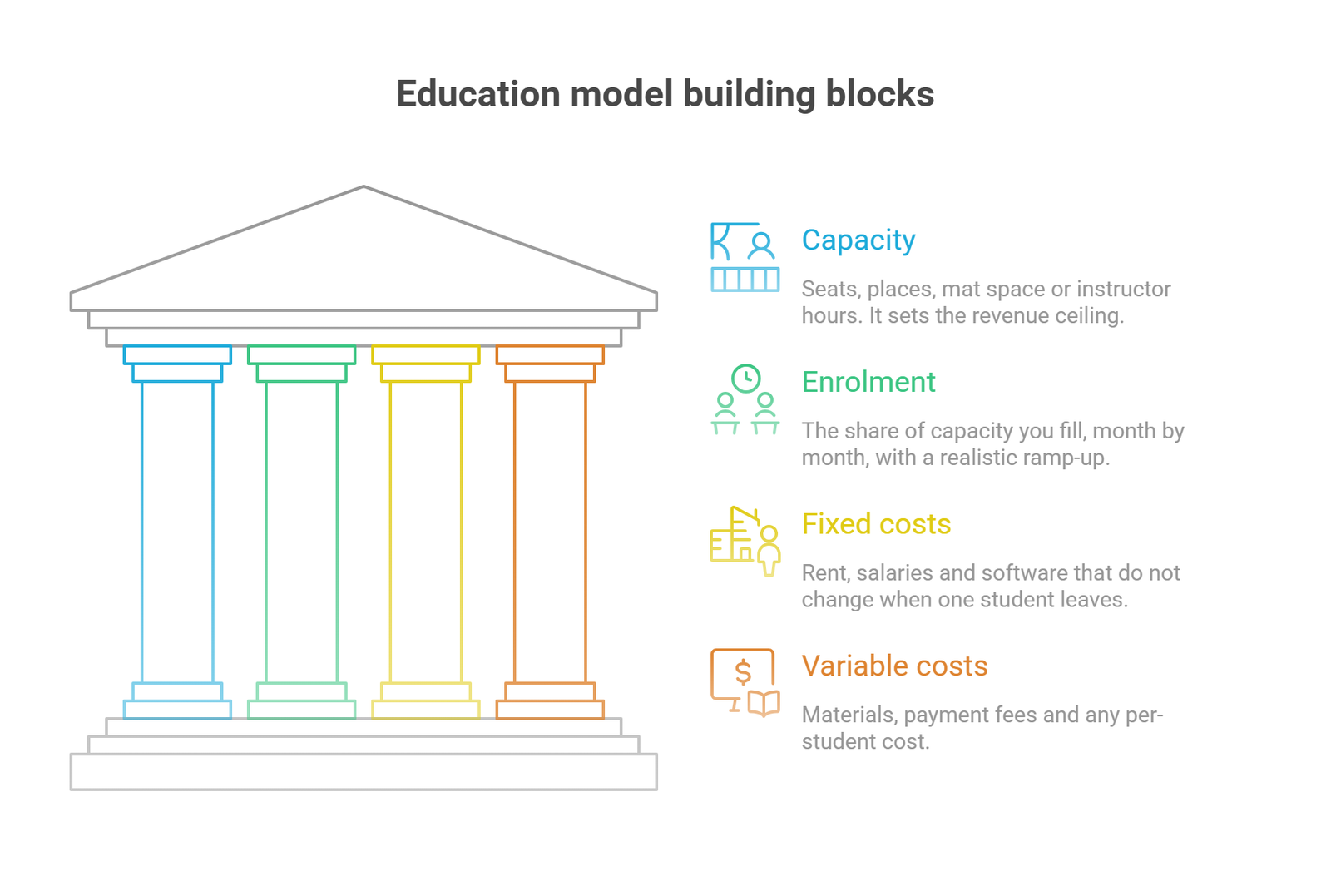
Four building blocks appear in all five businesses.
- Capacity: seats, places, mat space or instructor hours. It sets the revenue ceiling.
- Enrolment: the share of capacity you fill, month by month, with a realistic ramp-up.
- Fixed costs: rent, salaries and software that do not change when one student leaves.
- Variable costs: materials, payment fees and any per-student cost.
Break-even is the point where revenue covers both fixed and variable costs. The simple formula is fixed costs divided by the contribution per student, which is price minus variable cost. Oak’s guide on how to calculate fixed and variable costs walks through the split in detail.
1. Financial Model for Nursery School | Education Financial Model

A nursery is a staffing business with a building attached. Licensing and ratios, not marketing, set the economics.
Every US state requires a licence and sets staff-to-child ratios. Startup costs depend on the format. A home daycare runs $10K to $50K. A center runs $50K to $250K or more. A small center can cost $50K to $100K to open and then $15K to $25K a month to run. Six to 12 months of runway is a sensible cushion.
Testimony from ten Vermont centers shows where the money goes. Staffing was 77% of expenses, with classroom staff alone at 57%. Occupancy was 10%. The same testimony noted that infant and toddler care is subsidized by preschool revenue. Infant ratios need more adults per child. Operator guidance calls a center healthy at 70% to 90% of licensed capacity.
Illustrative break-even example
These numbers are made up to show the method. Suppose a center has 40 licensed places, charges $1,000 a month per child, and spends $28,000 a month in total.
- Break-even: $28,000 divided by $1,000 is 28 children, or 70% of capacity.
- A ratio change requires one extra teacher at $3,500 a month. Costs become $31,500.
- New break-even: 32 children, or 80% of capacity.
One staffing rule moved the break-even by ten points of occupancy. That is why the model needs a ratio-driven staffing schedule, not a flat salary line.
Oak’s nursery school Excel financial model is a good place to start. Link staffing to enrolment so this effect shows up automatically.
2. Financial Model for Language School | Education Financial Model

A language school sells a schedule. Classes run whether or not every seat is full. The margin depends on how well you fill them and how long students stay.
Startup costs run $10K to $75K. The largest lines are usually rent, teacher salaries and marketing before the first cohort pays.
A small example shows the risk. A school has $16,250 in monthly revenue, $8,750 in salaries and $5,000 in fixed costs. It keeps $2,500. Now 20% of students leave. Revenue falls, the costs stay, and the school loses $750 a month. A fifth of the students turned a profit into a loss.
That is the lesson for your model. Include these lines:
- Class sizes and the number of classes per teacher
- Course length, so you can see when revenue ends and renewal begins
- Retention or re-enrolment rate by level
- Marketing cost per new student
- Seasonality, since many schools see a dip in summer
Oak’s language school Excel financial model has a break-even sheet you can use to run the 20% loss scenario on your own figures.
3. Financial Model for Editorial Services | Education Financial Model

Editing is the leanest of the five. A solo editor can start for under $500, because the main assets are skills and a laptop. The challenge is turning time into income at a steady rate.
Rates follow the type of work. The Editorial Freelancers Association (EFA) publishes median rates. They give a useful range for fiction:
| Service | Median rate per word |
| Proofreading | 1.2 to 2.0 cents |
| Copyediting | 2.0 to 2.7 cents |
| Line editing | 2.7 to 3.5 cents |
| Developmental editing | 3.0 to 3.5 cents |
Nonfiction copyediting runs 3 to 4 cents a word, or $40 to $50 an hour. Hourly rates across the EFA ranges run $35 to $65. Rush work pays more. An 8-hour delivery can cost about 2.5 times the standard rate. Check the latest EFA rate chart before you quote a client.
Illustrative income example
A 5,000-word job at 3 cents a word earns $150. To earn $60,000 a year at that rate, an editor must handle 2 million words. That is about 38,500 words every week. Few people can edit that much and keep quality high.
The model should include a realistic weekly word cap, unpaid admin time and unbilled weeks. If you grow beyond one person, add contractor payments, software and a client pipeline. Oak’s editorial services Excel financial model handles both a solo setup and a small team.
4. Financial Model for Martial Arts School | Education Financial Model

A martial arts school mixes a retail lease with a subscription. Members pay monthly, and families often join together.
Sources agree on the shape, though not the exact figures. One software vendor gives a startup range of $40K to $300K, with mats costing $20K to $40K per 2,000 square feet. Another range runs $30K to $150K and says a school needs 100 to 150 members to break even. Treat both as planning ranges.
Adult memberships run $129 to $229 a month. Kids run $109 to $169. Family plans bring 30% to 50% of revenue. Positive monthly cash flow usually arrives in months 4 to 8. Capital payback takes 18 to 32 months. Another 20% to 30% of revenue can come from non-tuition sources such as testing fees, gear and events.
A published sample first-year P&L shows the structure. With 220 members, revenue was $355K. Rent was $72K and instructors cost $105K. After other costs and a $55K owner draw, net operating income was $64.5K. The data comes from a vendor’s own example. Use it as a structure to copy, not as a promise.
Your model should show:
- Members by plan type, with family discounts
- Monthly churn, which matters more than new signups once you pass 100 members
- Instructor cost per class hour
- Non-tuition revenue as a separate line
- Owner pay, so profit is not overstated
Oak’s martial arts Excel financial model template separates these lines.
5. Financial Model for Virtual Classroom | Education Financial Model

Online programs cost less to start, yet they are not free to run. Market reports also disagree. One puts the global virtual classroom market at $15.8B and another at $23.7B. A gap that large means you should build your forecast from your own learners, not from a top-down market share.
A bottom-up model starts with price and cohort size. Live cohorts need instructor hours every time a cohort runs, so costs rise with each new group. Self-paced courses cost more to build and less to deliver. Many programs use both.
Online coaching can launch for $1K to $10K. The bigger cost is attracting learners. A common rule of thumb says lifetime value should be about three times customer acquisition cost. Use it as a check, not a target, because it varies by industry.
Add these inputs:
- Course build cost, spread across the learners who will use it
- Platform and payment fees per learner
- Live instructor hours per cohort
- Conversion rate from lead to paying learner
- Refunds and drop-offs
Oak’s virtual classroom Excel financial model is built around cohorts. You can test pricing and cohort size without rebuilding the workbook.
The input that breaks each model first
| Business | Fragile input | Test it by asking |
| Nursery or daycare | Enrolment against licensed capacity | What if the center fills to 65% and not 80%? |
| Language school | Retention | What if 20% of students leave mid-course? |
| Editorial services | Words edited per week | What if I bill 25 hours a week and not 35? |
| Martial arts school | Monthly churn | What does two extra percentage points of churn do to year-one profit? |
| Virtual classroom | Customer acquisition cost | What if ads cost double? |
Run each question as a scenario. For a step-by-step method, see Oak’s guide to sensitivity analysis in financial modelling.
Frequently Asked Questions
What occupancy does a daycare need to be profitable?
It depends on your costs. Operator guidance calls 70% to 90% of licensed capacity healthy. Staffing took 77% of expenses in the Vermont testimony, so ratio rules can raise your break-even quickly.
How many members does a martial arts school need to break even?
One estimate says 100 to 150 members. Your number depends on rent, instructor pay and pricing. The sample school above earned $355K from 220 members, but that is one vendor example.
How much do freelance editors charge?
EFA medians range from 1.2 cents a word for fiction proofreading to 3.5 cents for line and developmental editing. Nonfiction copyediting runs 3 to 4 cents a word or $40 to $50 an hour. Rush jobs can pay about 2.5 times the standard rate.
Is a language school profitable?
It can be, but margins are thin when students leave. In the example above, a school with $2,500 monthly profit lost $750 after a 20% drop in students. Retention should be a core input.
How big is the virtual classroom market?
Sources disagree. Estimates run from $15.8B to $23.7B. Because of that gap, build your forecast from price, cohort size and acquisition cost, not from a share of the market.
Which numbers matter most in an education business plan?
Capacity, enrolment and the cost of keeping a student. Every model above turns on one of them.
Conclusion
Education businesses are often called recession-resistant. The models show where the real risk sits. It is one assumption: occupancy for the nursery, retention for the language school, weekly output for the editor, churn for the studio and acquisition cost for the online program.
Find your fragile input before you spend on rent or equipment. Then test it with a downside case. If the business still works when that number is 20% worse, a lender has a reason to trust the plan.
Oak Business Consultant builds financial models for education businesses, including break-even and scenario analysis. See the financial modeling services or start with one of the templates above.