SDG 8: Decent Work & Growth, 2 Billion Workers Still Unprotected
SDG 8: Decent Work & Economic Growth, and the Workers Still Left Without a Safety Net
Global unemployment hit a record low of 4.9% in 2025. That headline sounds like good news. But 57.9% of the global workforce still works informally, with no social protection at all. That is roughly 2 billion people.
SDG 8 asks for growth and decent work together, not one or the other. Ten years in, the world has more of the first than the second. GDP keeps expanding. Job quality keeps lagging behind it.
This guide covers what SDG 8 actually asks of the world. It shows where 2026 progress stands, target by target. It also ranks the countries turning growth into real jobs, and the ones that are not.
What is SDG 8
SDG 8 calls for sustained, inclusive, and sustainable economic growth. It also calls for full and productive employment and decent work for all. That is the UN’s own wording. It is the eighth of 17 Sustainable Development Goals.
All 193 UN member states adopted it in 2015, as part of the 2030 Agenda. The goal covers growth, productivity, entrepreneurship, labor rights, and financial inclusion together. A country can post strong GDP growth and still fail most workers. SDG 8 tracks both sides on purpose.
The official targets and indicators behind SDG 8
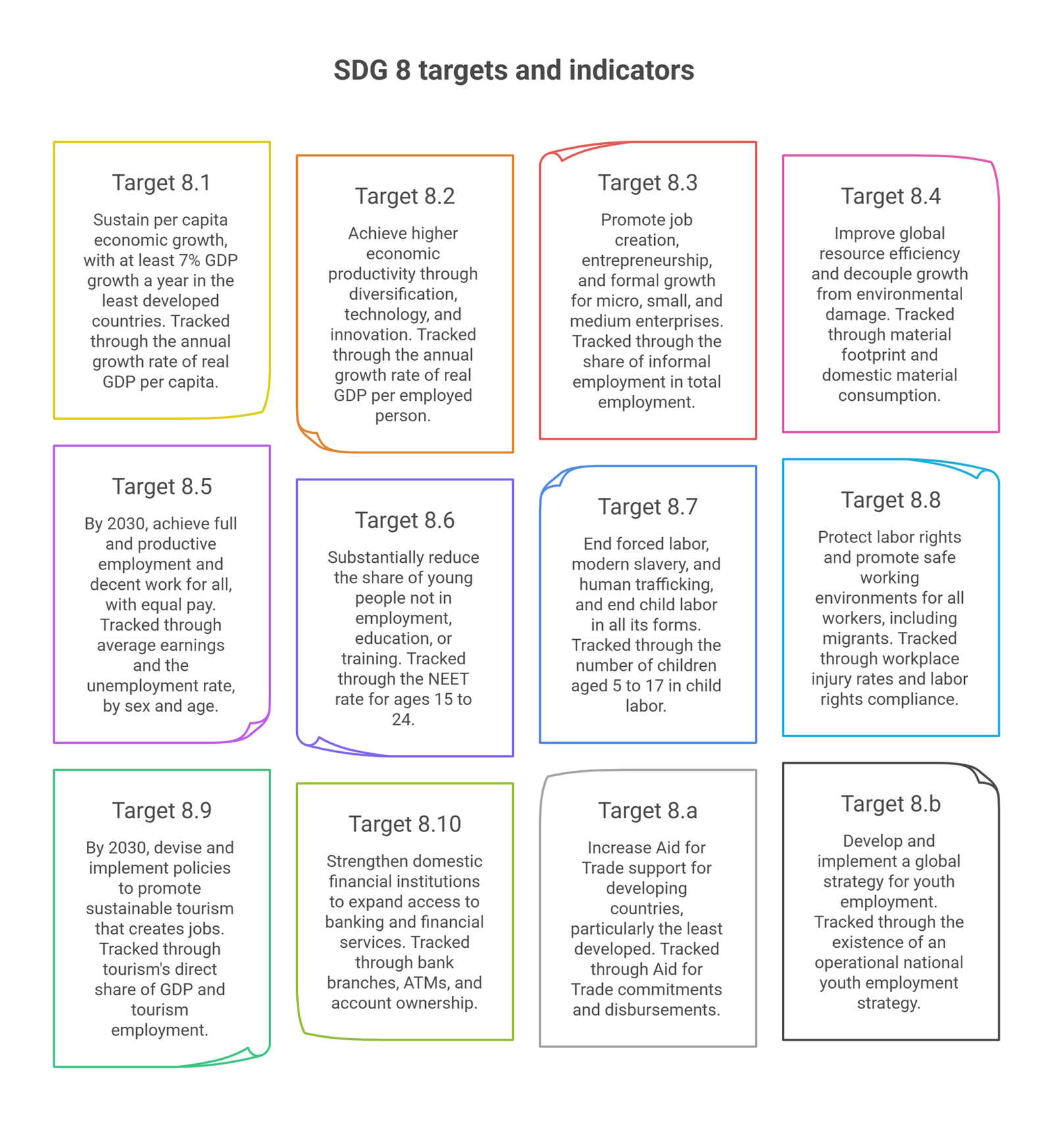
SDG 8 breaks down into 12 targets, tracked through 17 indicators, according to the UN’s SDG 8 page.
Target 8.1: Sustain per capita economic growth, with at least 7% GDP growth a year in the least developed countries. Tracked through the annual growth rate of real GDP per capita.
Target 8.2: Achieve higher economic productivity through diversification, technology, and innovation. Tracked through the annual growth rate of real GDP per employed person.
Target 8.3: Promote job creation, entrepreneurship, and formal growth for micro, small, and medium enterprises. Tracked through the share of informal employment in total employment.
Target 8.4: Improve global resource efficiency and decouple growth from environmental damage. Tracked through material footprint and domestic material consumption.
Target 8.5: By 2030, achieve full and productive employment and decent work for all, with equal pay. Tracked through average earnings and the unemployment rate, by sex and age.
Target 8.6: Substantially reduce the share of young people not in employment, education, or training. Tracked through the NEET rate for ages 15 to 24.
Target 8.7: End forced labor, modern slavery, and human trafficking, and end child labor in all its forms. Tracked through the number of children aged 5 to 17 in child labor.
Target 8.8: Protect labor rights and promote safe working environments for all workers, including migrants. Tracked through workplace injury rates and labor rights compliance.
Target 8.9: By 2030, devise and implement policies to promote sustainable tourism that creates jobs. Tracked through tourism’s direct share of GDP and tourism employment.
Target 8.10: Strengthen domestic financial institutions to expand access to banking and financial services. Tracked through bank branches, ATMs, and account ownership.
Target 8.a: Increase Aid for Trade support for developing countries, particularly the least developed. Tracked through Aid for Trade commitments and disbursements.
Target 8.b: Develop and implement a global strategy for youth employment. Tracked through the existence of an operational national youth employment strategy.
Where global progress actually stands
The picture comes from the UN’s 2026 SDG 8 progress update, part of the annual Sustainable Development Goals Report. Global real GDP per capita grew 1.9% in 2024, a figure expected to hold through 2026. Growth in least developed countries reached 3.9% in 2024, still short of the 7% target.
Labor productivity, measured as GDP per worker, grew 1.7% in 2025. That is a real recovery from 0.7% in 2023. It still sits slightly below the pre-pandemic average of 1.8%, according to the same UN tracking data.
Informal employment barely moved. It stood at 57.9% of the global workforce in 2025, above 2015 levels. More than half the world’s workers still lack legal protection or social security. Global unemployment fell to a record low of 4.9% in 2025, projected to reach 4.8% by 2027. Youth face a very different picture. Young people are nearly four times more likely to be unemployed than adults.
The youth NEET rate, the share not in employment, education, or training, edged up to 20.0% in 2025. That is more than 4 million additional young people left without a path to skills or work. The rate is projected to keep rising through 2027.
Child labor fell to 138 million children in 2024. That is down more than 20 million since 2020, per the SDG Knowledge Hub’s review of the UN’s progress report. Eliminating it by 2030 would need progress 11 times faster than the current pace.
Labor rights compliance kept eroding. Global compliance scores fell 6.4% since 2015, with scores unchanged in 80% of countries. Financing is a real constraint too. Developing countries paid over $400 billion in debt servicing in 2024. That contributed to a fiscal gap near $982 billion for jobs and labor market recovery, per the same brief.
Financial inclusion is one bright spot. The share of adults with a bank or mobile-money account reached 79% by 2024, up from 74% in 2021. Formal saving rates in developing economies rose from 24% to 40% over the same period.
The table below summarizes where the core SDG 8 indicators stood in the latest reporting.
| Indicator | Latest figure |
| Global real GDP per capita growth | 1.9% (2024, holding through 2026) |
| Least developed countries’ GDP growth | 3.9% (2024, target is 7%) |
| Global labor productivity growth | 1.7% (2025, below pre-pandemic average) |
| Informal employment share of global workforce | 57.9% (2025), roughly 2 billion workers |
| Global unemployment rate | 4.9% (2025, a record low) |
| Youth NEET rate (ages 15 to 24) | 20.0% (2025, rising) |
| Children in child labor | 138 million (2024) |
| Labor rights compliance decline since 2015 | 6.4% |
| Adults with a financial account | 79% (2024, up from 74% in 2021) |
Source: UN Department of Economic and Social Affairs, SDG 8 progress data, and the SDG Knowledge Hub’s 2025 HLPF review.
Countries ranked by SDG 8 performance
Ranking countries on GDP growth alone hides half the story. A country can grow fast and still fail its workers. The list below weighs both dimensions together: growth speed first, job quality second. It runs from the best combined performer down to the weakest.
Vietnam and Rwanda lead this list on the strength of fast growth paired with real formal-job gains. The United States trails both on raw growth speed, but deep labor-market institutions and near-4% unemployment keep it close behind. Ethiopia grows just as fast as Rwanda but carries more economic risk. Bangladesh cut child labor sharply while informality stays high. The UAE and Qatar sit further down: wealthy, diversifying economies where kafala-linked labor issues persist despite reform. South Africa and Djibouti anchor the bottom on youth employment alone.
| Rank | Country | Growth signal | Labor quality signal | Standing |
| 1 | Vietnam | 8.02% GDP growth (2025), fastest since 2011 | Labor productivity up 5.7% (2024) | Best combined performer: fast growth paired with real productivity gains |
| 2 | Rwanda | 9.4% GDP growth (2025) | Growth led by services, construction, and formal investment | Governance-led growth, among Africa’s most consistent performers |
| 3 | United States | 2% GDP growth (2025), projected 2.4% (2026) | Unemployment near 4.3%, labor productivity growth of 2 to 2.5% through 2025 | Slower growth than the leaders, but deep, formal labor-market institutions keep quality high |
| 4 | Ethiopia | 9.2% GDP growth (2026 forecast) | High inflation and a devalued currency add real risk | Fast growth, but on a fragile macroeconomic footing |
| 5 | Bangladesh | Universal electricity access, garment-led export growth | Child labor and informality both remain high | Real gains alongside real gaps, still a work in progress |
| 6 | India and other large emerging economies | Strong aggregate GDP growth | Informal employment remains the norm for most workers | Growth outpaces formalization across much of the developing world |
| 7 | United Arab Emirates | 3.6% GDP growth, non-hydrocarbon sectors driving diversification | Kafala-linked abuses persist despite wage protection reforms | High-income, diversifying economy still built on a largely unprotected migrant workforce |
| 8 | Qatar and the Gulf states | High per-capita income, wealthy economies | Kafala-linked labor abuses persist despite reforms | Wealth without matching labor protections |
| 9 | South Africa | National unemployment at 32.7% (Q1 2026) | Youth unemployment at 60.9%, the world’s second-highest | Among the weakest labor market performers globally |
| 10 | Djibouti | Growth concentrated in ports and logistics | Youth unemployment at 76.3%, the world’s highest | Worst youth labor market outcome on this list |
Vietnam and Rwanda

Vietnam posted 8.02% GDP growth in 2025, its strongest performance since 2011, according to Trading Economics data. Labor productivity grew 5.7% in 2024, well above the global average. The country also climbed 13 places in a global economic freedom ranking that year.
Rwanda’s growth reached 9.4% in 2025, up from 7.2% in 2024, per the African Development Bank’s economic outlook. Services, construction, and manufacturing all contributed. Analysts point to institutional quality and disciplined public investment as the real drivers, not just a low starting base.
United States

The US economy grew 2% in 2025, a pace the IMF expects to rise to 2.4% in 2026 as tariff effects fade. That is nowhere near Vietnam’s or Rwanda’s growth rate, but the labor market underneath it is far deeper and more formalized. Unemployment sat near 4.3% in early 2026, and the Treasury’s own labor market readings describe a “low hires, low fires” environment rather than a deteriorating one.
Labor productivity growth ran between 2.0% and 2.5% through 2025, and wage growth has kept pace with inflation. The bigger risk sits ahead rather than behind: near-zero labor force growth means, as the Federal Reserve notes, that future GDP growth will need to come almost entirely from productivity gains rather than a bigger workforce. Youth unemployment, at 9% in January 2026, is also low by global standards, though it has drifted since the record lows of 2025.
Ethiopia

Ethiopia’s economy is projected to grow 9.2% in 2026, among the fastest rates in Africa. But the same growth data comes with real caveats. Foreign exchange reserves are critically low, and inflation has run above 20%. The currency was devalued by more than 30% in 2024 under an IMF-backed reform package.
Ethiopia shows a pattern worth watching elsewhere too. Fast headline growth does not always mean stable, resilient job creation underneath it.
Bangladesh
Bangladesh has leaned on export-led, garment-sector growth for two decades. Child labor has fallen globally by more than 20 million since 2020. Bangladesh’s own labor reforms have contributed to that decline. Informal employment still dominates much of its labor market, though, a gap shared across most of developing Asia.
United Arab Emirates and the Gulf states

Wealth and decent work are not the same thing. Nowhere shows that better than the Gulf labor market.
The UAE’s economy grew 3.6% in 2023, driven by non-hydrocarbon sectors like tourism, construction, and financial services, with GDP per capita (PPP) above $83,000, according to the BTI 2026 country report. Migrants make up roughly 88% of the UAE’s population, and most still work under the kafala sponsorship system. The government has introduced a Wage Protection System and rules against passport confiscation, but the same report notes abusive treatment and unpaid-wage cases persist, and families of blue-collar workers still struggle to access social protection and health care.
Qatar officially abolished its kafala sponsorship system in 2016, and introduced further contractual reforms since. Yet Human Rights Watch’s 2026 country report still documents wage theft, dangerous conditions, and continued employer control over workers. Qatar’s minimum wage has not been revised since 2021.
Reform across the wider Gulf Cooperation Council follows a similar pattern. Golden visas and long-term residency now exist for investors and skilled migrants, according to the Migration Policy Institute. Low-wage workers, who make up most migrant labor in the region, remain largely excluded from those same protections.
South Africa and Djibouti
South Africa’s national unemployment rate stood at 32.7% in the first quarter of 2026, according to Statistics South Africa. Youth unemployment for ages 15 to 24 hit 60.9%, the world’s second-highest rate. Djibouti tops that list at 76.3%, per Africa Check’s analysis of ILO data.
More than a third of young South Africans are also NEET, neither working nor in school. That combination, weak formal hiring alongside weak education pathways, is the hardest version of the SDG 8 problem to solve.
What organizations and institutions are doing
Several UN bodies and agencies track and coordinate progress on SDG 8, alongside national governments.
UN Department of Economic and Social Affairs: DESA compiles the annual SDG progress report. It also coordinated the High-Level Political Forum review of SDG 8 held in July 2025.
International Labour Organization: The ILO sets global labor standards. It also produces most of the underlying employment, informality, and labor rights data used in official SDG 8 reporting.
The Global Accelerator on Jobs and Social Protection: The UN Secretary-General launched this initiative to expand social protection systems. It also aims to create decent work opportunities, according to the UN’s own SDG 8 update.
World Bank: The World Bank leads on financial inclusion data. Its Global Findex surveys track account ownership and financial resilience worldwide.
How businesses can contribute to SDG 8
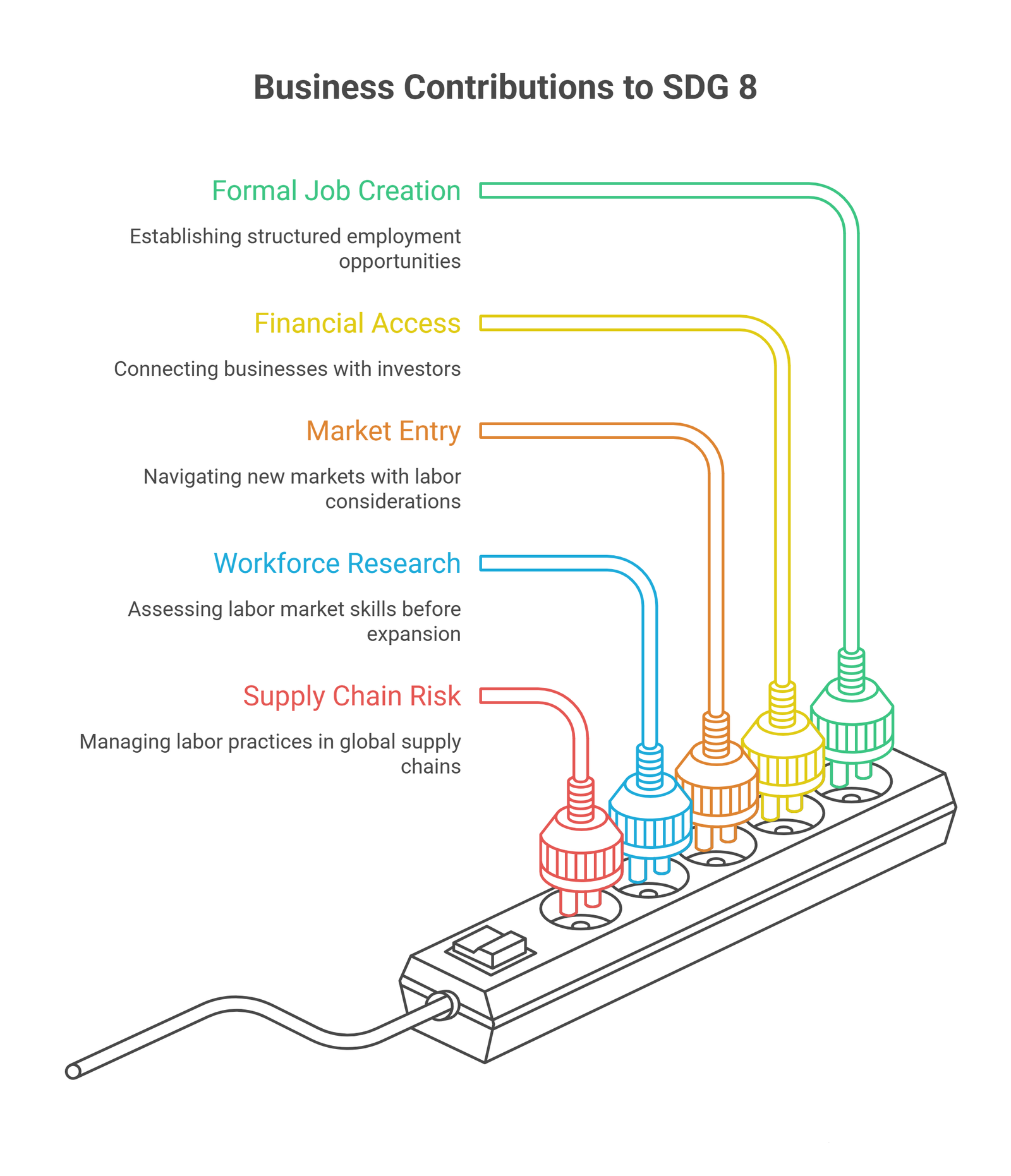
The same approach applies here as with any SDG a company has no formal mandate on. Start with where operations touch labor. Then look outward from there.
Formalize before you scale. Target 8.3 is about formal job creation, not just job creation. A clear business plan and proper financial model turn an informal side hustle into a bankable, hireable company. That structure is also what most formal financing actually requires.
Treat access to capital as a decent work issue. Target 8.10 is about financial access, and MSMEs face this gap most directly. Matchmaking founders with the right investors turns a funding search into a structured process, not a guessing game.
Model labor costs honestly before entering new markets. Companies expanding into fast-growing but informal-heavy markets should expect a different hiring landscape. Oak’s work expanding a ride-hailing platform across 11 African markets shows what that entry work looks like.
Research the labor market before you commit to it. Growth rates alone, like Vietnam’s or Rwanda’s, do not reveal whether a market has the skilled workforce your business needs. Market research services can size that gap before capital moves, not after.
Treat supply chain labor practices as real business risk. Companies sourcing from the Gulf, South Asia, or Sub-Saharan Africa should expect informal or precarious labor somewhere in their chain. Ignoring it is a compliance and reputational risk now, not just an ethical one.
Frequently Asked Questions
How many SDG 8 targets and indicators are there?
Twelve targets, tracked through 17 indicators. Ten targets are numbered outcome targets. Two cover trade finance and youth strategy.
Is the world on track to meet SDG 8 by 2030?
No. The UN’s own 2026 progress report calls it one of the most off-track goals, especially on informality and labor rights.
Which countries are performing best on SDG 8?
Vietnam and Rwanda combine fast GDP growth with real productivity and formal job gains. The United States trails on growth speed but ranks close behind on the strength of its formal labor market and low unemployment. Both outperform faster-growing but less stable economies like Ethiopia.
Which countries are performing worst on SDG 8?
Djibouti and South Africa have the world’s highest youth unemployment rates, at 76.3% and 60.9%. The UAE and Qatar pair high wealth with weak migrant labor protections.
Why does global unemployment keep falling while informal work stays high?
Unemployment only counts people actively seeking formal jobs. Informal employment, at 57.9% of the global workforce, is a separate and much larger problem.
Is child labor actually going down?
Yes, from about 160 million in 2020 to 138 million in 2024. The pace still needs to be 11 times faster to hit the 2030 elimination target.
Can a business without a labor mandate still contribute to SDG 8?
Yes. The clearest levers are formalizing operations, widening access to capital, and treating labor practices as a real business risk.
Conclusion
The number worth sitting with is not the record-low 4.9% unemployment rate. That number is real, but it only counts people who already have formal access to the labor market. The more telling number is different. Roughly 2 billion workers, 57.9% of the world’s labor force, still work without any safety net.
Vietnam and Rwanda show what growth paired with real formalization looks like. The United States shows that slower growth can still mean high job quality when labor institutions are deep. Ethiopia shows that fast growth alone is not the same as stable growth. The UAE and Qatar show that wealth does not guarantee decent work. South Africa and Djibouti show what happens when neither growth nor job quality shows up for young workers.
None of that gets solved by GDP growth alone. It gets solved by businesses and governments that build formal, financeable, well-modeled companies on purpose.
Structuring a business to scale formally, or sizing up a new market before you enter it? Oak’s business planning and market research services can help. Oak builds the numbers behind the growth.