Angel Investors vs Venture Capitalists
Angel Investors vs Venture Capitalists: Which One Is Right For You
Pick the wrong investor type and the money is the least of your problems. Take venture capital too early and you can hand over a board seat before you have the traction to negotiate terms. Lean on angels too long, and you may stall out just when growth needs a bigger check. The two funding sources solve different problems. Knowing which one fits where you are right now is worth more than either check on its own.
What angel investors actually bring
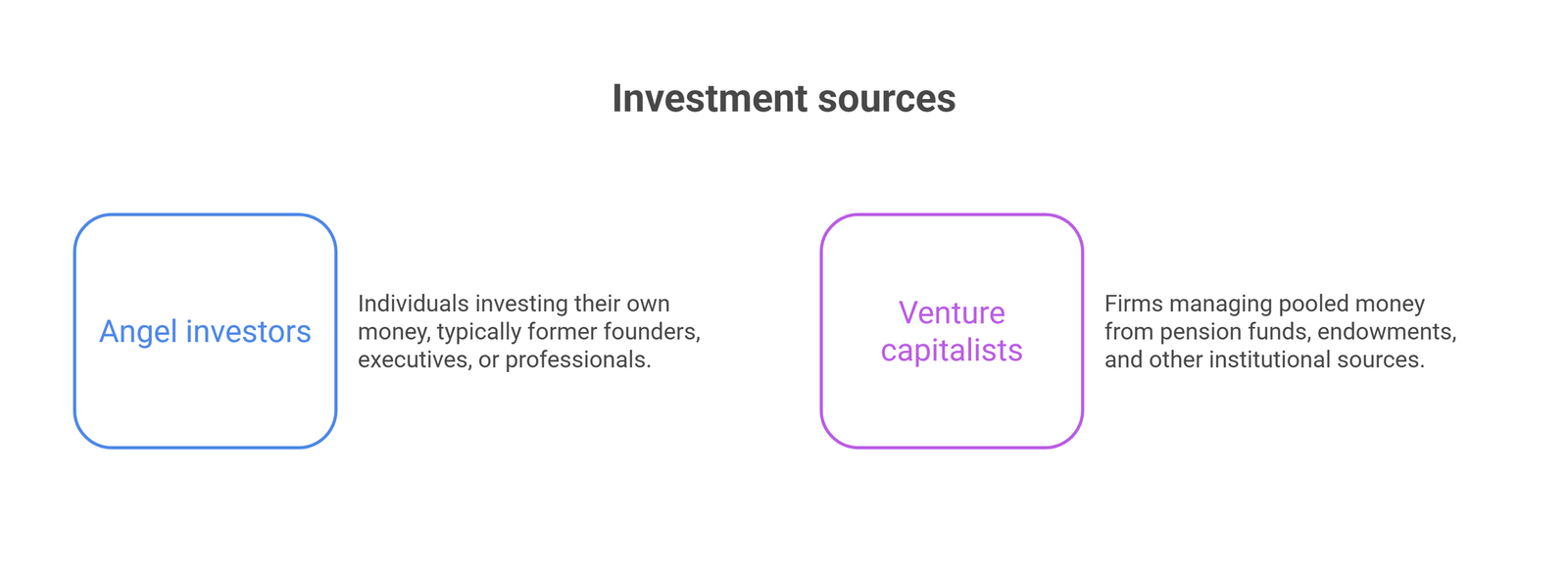
Angel investors are individuals investing their own money, usually former founders, executives, or professionals with capital to put to work. Checks typically run from around $25,000 to $500,000, though a well-heeled angel can go higher. Because it’s their own money on the line, decisions come faster than what you’ll get from a fund. Terms tend to be more negotiable too.
Angels will back a business at the idea or prototype stage. There’s often little to show beyond a plan and a founder they believe in. In exchange for that risk, many angels expect a return of three to ten times their investment within five to seven years. They’ll still want updates along the way, even if those updates stay informal.
What venture capitalists actually bring
Venture capitalists manage pooled money from pension funds, endowments, and other institutional sources, not their own. That structure changes everything about how they invest. VC checks typically start around $1 million and can run into the tens of millions. Because the money isn’t theirs, the firm is accountable to its own investors for the return it delivers.
VCs generally step in from seed stage onward. By then a startup usually has some proof it works, whether that’s paying customers, real usage, or a product further along than a sketch. Global venture funding runs into the tens of billions of dollars per quarter, so firms can afford to be selective. Most target high annualized returns across their whole portfolio, not just one winning bet. That’s why the ones who say yes tend to want real influence over what happens next.
Angel investors vs venture capitalists: the real differences
| Factor | Angel investors | Venture capitalists |
| Whose money | Their own | Pooled fund from institutional investors |
| Typical check size | $25,000 to $500,000, sometimes more | $1 million to $10 million or more |
| Investment stage | Idea, prototype, pre-seed | Seed through growth stage |
| Decision speed | Days to weeks | Months, after formal due diligence |
| Equity sought | Smaller, more negotiable | Larger, often with a board seat |
| Return target | 3x to 10x within 5 to 7 years | High multiples across the fund |
| Day-to-day style | Personal, informal, mentorship-driven | Structured, scheduled reporting |
The pattern underneath the table: angels are underwriting you. VCs are underwriting the fund’s whole portfolio. That difference shapes every other decision they make about your company.
What it’s actually like working with each
An angel relationship often feels personal. You might get a text on a weekend, an informal check-in over coffee, or advice offered because your angel genuinely wants the idea to work. It’s rarely a full-time job for them, so updates can stay casual unless you both agree otherwise.
A VC relationship feels more like reporting into a company. Expect scheduled board meetings, a set cadence for updates, and a team behind your point of contact rather than one person. That structure has real upside, though. A VC firm typically has more hands to put on your hiring and partnerships than a single angel does on their own.
Neither style is better. It depends on whether you want a mentor in your corner or a growth engine behind you. Most founders end up wanting both at different points.
Due diligence and paperwork you’ll need
Angel due diligence tends to focus on the founder’s background, the idea, and basic financial health. You’ll still need incorporation documents and any IP paperwork in order. The bar is lower than what a fund requires, though.
VC due diligence is a different exercise entirely. Expect to produce audited or reviewed financials, a detailed market analysis, and customer contracts. You’ll also need a clean cap table showing exactly who owns what. Getting an early business valuation done before you’re deep in a raise helps too. It keeps you from negotiating your own numbers on the fly against a due diligence team that already has its own model of what you’re worth.
Choosing the right investor for your stage
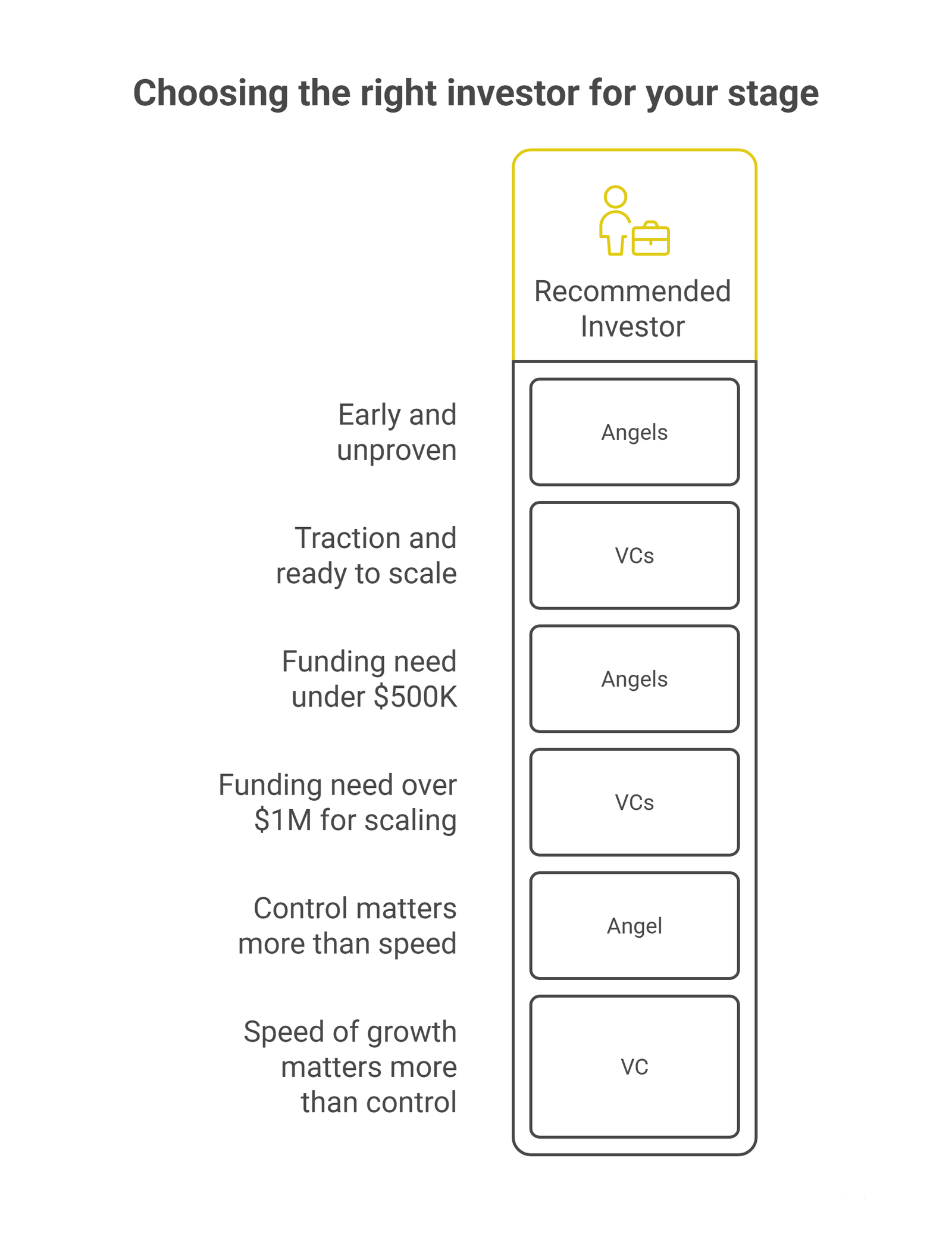
Match the investor to where your business actually is, not where you’d like it to be.
Early and unproven: If you’re still validating the idea or refining an MVP, angels are the better fit. They’re comfortable with more risk and won’t expect the traction metrics a VC screens for.
Traction and ready to scale: Once you have paying customers, real usage data, or repeatable revenue, VCs become realistic. They’re built to fund the kind of growth that early angels usually can’t underwrite alone.
Funding need under $500K: Stay with angels or a mix of angels. Bringing in a VC for a small check dilutes you for a relationship built around much larger rounds.
Funding need over $1M for scaling: This is VC territory. Think expanding into new markets, building out a team fast, or funding R&D at a pace bootstrapping can’t match.
Control matters more than speed: If you’re not ready to give up a board seat or answer to institutional expectations, lean angel. If speed of growth matters more than retaining full control, VC funding buys you that speed.
Whichever direction you’re leaning, the pitch itself has to earn the check. A business plan and pitch deck built for the right investor type matter. A generic version sent to both angels and VCs rarely lands as well.
Can you use both?
Yes, and most founders end up doing exactly that. A common path is angel funding first, to get the product built and prove early traction. A VC round often follows once there’s real metrics to show. Angels also show up alongside VCs in later rounds, so the choice usually isn’t either-or so much as which order.
If you go this route, watch your cap table closely. Every investor you add dilutes your ownership a little more. Stack angel rounds on top of VC rounds without a plan, and you can end up with less control than expected by Series B. A funding consultancy that understands both sides of the table can help you sequence this instead of raising reactively.
Frequently Asked Questions
How much do angel investors typically invest?
Most angel checks fall between $25,000 and $500,000. The exact amount depends on the investor and how convinced they are by the founder and idea.
How much do venture capitalists typically invest?
VC checks usually start around $1 million and can reach tens of millions, depending on the round and the company’s stage.
Do you pay back angel investors like a loan?
No. Angels typically take equity or convertible debt. They’re repaid through the company’s growth and eventual sale or exit, not through scheduled payments.
Can a startup raise from angels and venture capitalists at the same time?
Yes. It’s common to see angels participate alongside a VC in the same round, especially once a company has some traction to show.
Do angel investors expect a board seat?
Rarely at the early stage. Most angels stay informal and advisory rather than requiring board representation, though some negotiate an observer seat.
How long does it take to close a VC round?
Plan for three to eight months once you start actively pitching. Most founders begin building investor relationships around a year before they need the money.
What funding stage should I target VCs instead of angels?
Once you’re past idea validation and into seed stage or beyond, you’re in range for VC conversations, assuming you have some traction to point to.
Conclusion
The investor you choose shapes more than your bank balance. It shapes who sits across the table from you for the next several years. It shapes how much say they expect in your decisions, and how fast you’re expected to grow. Angels fit best when you need a smaller check, more flexibility, and a mentor who believes in the idea. VCs fit best once you have traction to prove and growth ambitions that need real capital behind them.
If you’re not sure which stage you’re actually in, Oak’s startup fundraising consultants can help you figure out the right path. If you just need your pitch ready for either type of investor, they can help with that too.