Top Healthcare Industry Financial Models
Introduction: Why Healthcare Needs Specialized Financial Models
The healthcare industry is one of the most financially complex and consistently growing sectors in the global economy. Whether you are an ophthalmologist launching a private practice, an entrepreneur building a nutrition technology platform, or a hospital group planning its next expansion, one thing remains constant: you need a robust financial model built specifically for the unique demands of healthcare.
Unlike retail or SaaS businesses, healthcare organizations face a distinctive combination of regulatory requirements, insurance reimbursement structures, variable patient volumes, high capital expenditure, and significant staffing costs. A generic spreadsheet simply cannot capture the financial dynamics of running a dermatology center, a medical devices company, or an online pharmacy. You need purpose-built models that reflect how healthcare businesses actually generate revenue, control costs, and grow over time.
In the United States alone, healthcare accounts for nearly 20% of GDP and provides employment across millions of small businesses and independent practices. Globally, the sector is projected to grow from $10.5 trillion in 2023 to over $16 trillion by 2030, driven by aging populations, rising chronic disease burdens, and the rapid expansion of digital health. For entrepreneurs and investors entering this space, a well-structured healthcare industry financial model is not optional. It is the foundation of every credible business plan, funding pitch, and operational decision.
This guide covers the top healthcare financial models Oak Business Consultant has developed and refined for ten distinct sub-sectors. For each, we explain the industry context, the critical financial drivers, and exactly what a well-built model must include.
What Is a Healthcare Industry Financial Model?
A healthcare financial model is a structured Excel-based tool that translates the operational assumptions of a healthcare business into a comprehensive financial forecast. It integrates revenue projections, cost structures, staffing plans, capital expenditures, and working capital into three core financial statements: the income statement, the balance sheet, and the cash flow statement.
What distinguishes a healthcare financial model from a general-purpose template is its treatment of sector-specific inputs. These include patient visit volumes and appointment frequency, payer mix (insurance vs. self-pay vs. government programs), average revenue per procedure, regulatory and licensing costs, medical supply chains, and the capital requirements for equipment such as diagnostic machines, surgical tools, or sterilization systems.
A well-constructed model also incorporates break-even analysis, sensitivity testing across key assumptions, and a project evaluation framework that calculates metrics such as Net Present Value (NPV), Internal Rate of Return (IRR), and payback period. These outputs are what potential investors and lenders need to evaluate the viability of a healthcare venture.
Core Components of a Healthcare Financial Model
| Component | What It Captures | Why It Matters |
| Revenue Projections | Patient volumes, procedure fees, payer mix, subscription income | Forecasts top-line growth under different scenarios |
| Startup Summary | Initial capital requirements, equipment, licensing, leasehold | Ensures adequate funding before operations begin |
| Income Statement | Monthly and annual revenue, COGS, operating expenses, EBITDA | Tracks profitability and cost control over time |
| Cash Flow Statement | Operating, investing, financing cash flows | Reveals liquidity and identifies cash shortfalls |
| Balance Sheet | Assets, liabilities, and equity at each period end | Provides a snapshot of financial position |
| Break-Even Analysis | Fixed vs. variable costs, minimum revenue threshold | Identifies when the business becomes profitable |
| Sensitivity Analysis | Impact of changing key inputs on outcomes | Stress-tests assumptions for investor confidence |
| Project Evaluation | NPV, IRR, payback period, EBITDA multiples | Supports funding and valuation decisions |
Key Financial KPIs Every Healthcare Business Must Track
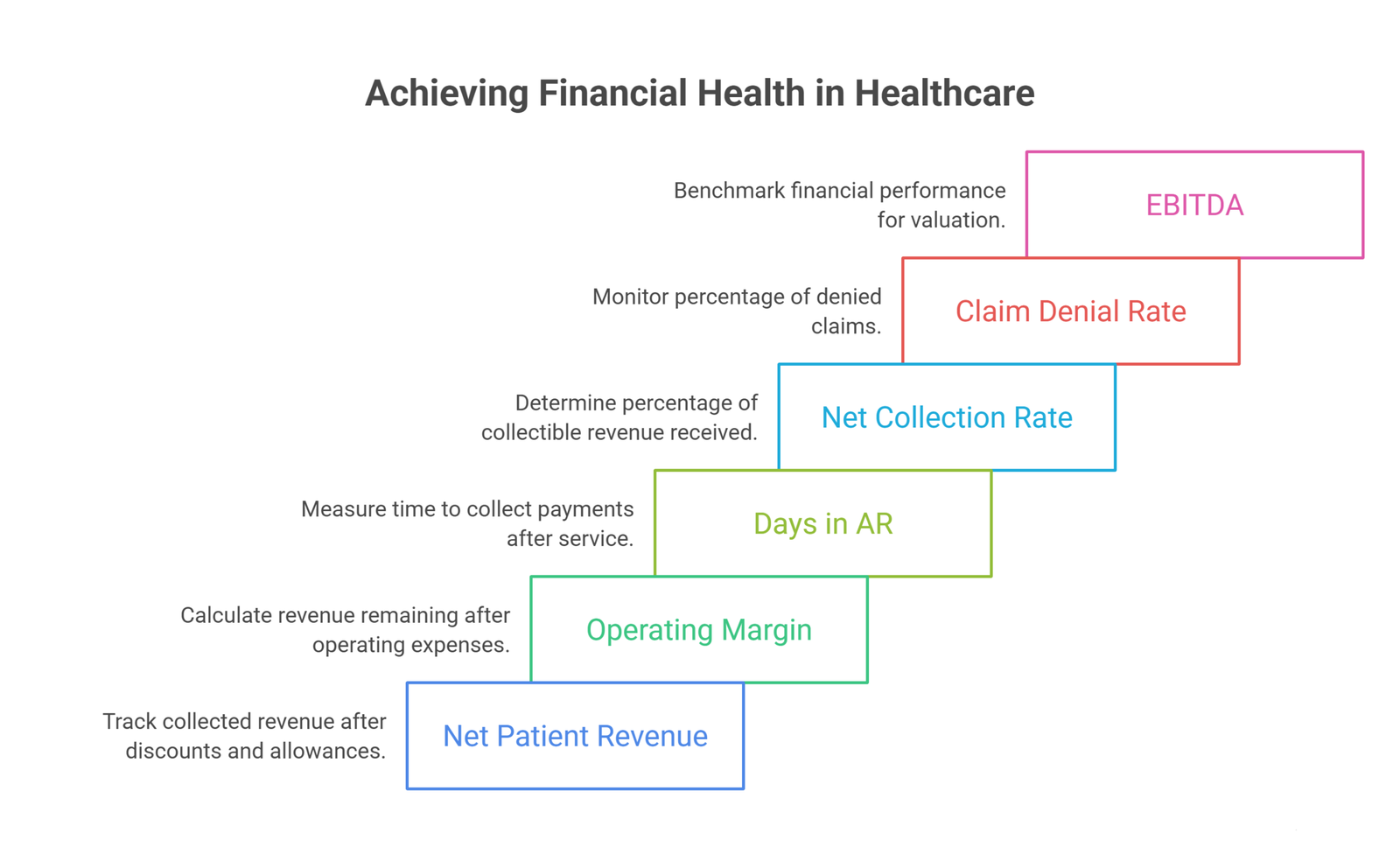
Before examining individual models by sub-sector, it is important to understand the financial KPIs that underpin every healthcare financial model. These metrics are the language of healthcare finance, used by CFOs, investors, lenders, and practice managers to evaluate performance and guide decisions.
Net Patient Revenue (NPR)
Net Patient Revenue represents actual collected revenue after deducting payer discounts, contractual allowances, charity care, and bad debt. It is the single most important top-line metric for any clinical healthcare business. Tracking NPR monthly helps identify shifts in payer mix, revenue gaps, and the true financial impact of pricing decisions.
Operating Margin
Operating margin calculates the percentage of revenue remaining after all operating expenses are deducted. In the US hospital sector, median operating margins stand at approximately 4.3%, highlighting just how thin the financial line is in healthcare. For private clinics and specialty practices, target operating margins typically range from 15% to 35% depending on specialty and cost structure.
Days in Accounts Receivable (AR Days)
AR Days measures how long it takes to collect payment after a service is delivered. Best-in-class healthcare organizations maintain AR Days below 30. Values above 50 signal collections problems, payer disputes, or billing inefficiencies that directly erode cash flow.
Net Collection Rate (NCR)
NCR measures what percentage of collectible revenue is actually received after accounting for contractual allowances. A strong NCR is 95% or higher. Declining NCR typically signals poor denial management or inadequate charge capture processes.
Claim Denial Rate
The industry average denial rate runs between 12% and 15%, but top-performing practices target below 5%. Each denied claim costs time, administrative resources, and in many cases permanently lost revenue. A healthcare financial model should project denial rates as a direct input to net revenue calculations.
EBITDA
Earnings Before Interest, Taxes, Depreciation, and Amortization serves as the standard benchmark for comparing healthcare businesses with their peers and for valuation purposes. Healthcare businesses are often valued at 5x to 12x EBITDA depending on specialty, growth profile, and market position.
1. The Ophthalmologist Practice | Healthcare Industry Financial Model

Eye care is one of the most specialized and capital-intensive areas of outpatient medicine. An ophthalmologist’s practice requires significant upfront investment in diagnostic equipment such as slit lamps, optical coherence tomography (OCT) machines, and laser systems, alongside ongoing staffing, consumables, and regulatory compliance costs. Our Ophthalmologist Excel Financial Model Template was built to address every one of these variables.
Revenue in an ophthalmology practice is driven by patient appointment volume, the mix of routine eye exams versus surgical procedures such as cataract operations, and the proportion of insurance-covered versus self-pay patients. Surgical cases generate significantly higher revenue per encounter but require higher capital investment and greater scheduling precision.
The first step before building any financial model for an ophthalmology practice is conducting thorough market research. Understanding local demand, proximity to competing practices, population demographics, and insurance coverage prevalence in the target geography directly shapes the revenue assumptions that feed into the model. Starting with market research before modeling ensures your projections are grounded in real demand rather than optimistic guesswork.
What This Model Covers
- Monthly and annual income statement with procedure-level revenue segmentation
- Startup summary capturing equipment costs, leasehold improvements, and licensing fees
- Cash flow projections on a monthly basis for the first five years
- Break-even analysis showing minimum appointment volumes required
- Sensitivity analysis across patient volumes and average revenue per procedure
- Project evaluation metrics including NPV and IRR for investor presentations
This model has been validated by financial industry experts and is designed so that operators only need to enter their specific assumptions. All calculations, from revenue projections to depreciation schedules, update automatically. It integrates directly with the broader financial modeling framework Oak uses across all healthcare engagements.
2. Dermatology Center | Healthcare Industry Financial Model

Dermatology centers occupy a unique position in the healthcare landscape: they generate revenue from both medical treatments covered by insurance (acne, psoriasis, eczema, rosacea) and elective cosmetic procedures that are entirely self-pay. This dual revenue structure creates planning complexity that a standard clinic model cannot handle well. Our Dermatology Center Excel Financial Model Template separates and models both streams independently.
The financial planning for a dermatology center also involves specific location analysis (proximity to target demographic, parking, and accessibility), staffing models that account for both dermatologists and aesthetic practitioners, and equipment capital plans for devices like laser systems, phototherapy units, and injectables storage.
A recurring decision point for dermatology entrepreneurs is whether to set up an independent clinic or purchase into a franchise. Franchise structures offer brand recognition and an established referral base but come with ongoing licensing fees and operational constraints that compress margins. The model enables direct financial comparison between both paths so the decision is driven by data rather than intuition.
What This Model Covers
- Monthly income statement distinguishing medical versus cosmetic revenue streams
- Quarterly balance sheet with liability tracking and working capital analysis
- Cash flow statement with operating and capital expenditure separation
- Break-even analysis across both revenue streams independently
- Depreciation schedule for high-value dermatology equipment
- Financial ratios including current ratio, debt-to-equity, and return on assets
- Working capital analysis for seasonal demand fluctuations
3. Nutrition Technology Company | Healthcare Industry Financial Model

Nutrition technology sits at the intersection of healthcare and consumer products. Businesses in this space range from personalized meal planning platforms and macro-tracking apps to direct-to-consumer functional food brands and corporate wellness programs. Our Nutritionist Technology Financial Model was built to handle the revenue diversity and growth dynamics of this rapidly expanding sub-sector.
Revenue modeling for a nutrition technology company must account for subscription tiers, one-time product sales, corporate contract revenue, and partnership income from supplement or grocery brands. On the cost side, the model must capture product formulation costs, regulatory compliance (especially for health claims), digital marketing acquisition costs, and the customer lifetime value dynamics that determine whether the subscription economics are sustainable.
The growth in health-conscious consumer behavior, particularly among millennials and Gen Z, has created a large addressable market for nutrition technology businesses. However, the unit economics must be carefully modeled to ensure that customer acquisition costs are recovered within a sustainable payback period. A fractional CFO can help founders stress-test these assumptions before committing capital.
What This Model Covers
- Multi-stream revenue projections covering subscriptions, product sales, and B2B contracts
- Customer acquisition cost (CAC) and customer lifetime value (CLV) analysis
- Monthly and annual income statements with gross margin broken out by revenue line
- Startup investment plan including product development and regulatory approval costs
- Cash flow forecasting over a five-year horizon
- Sensitivity analysis on churn rate and average subscription value
4. Medical Devices Business | Healthcare Industry Financial Model

The medical devices sector is one of the most capital-intensive and regulated areas within healthcare. Businesses in this space manufacture or distribute surgical devices, diagnostic equipment, home healthcare products, consumables, and maintenance services. Revenue streams are typically a mix of one-time equipment sales and recurring consumable or service contracts. Our Medical Devices Excel Financial Model models all of these streams with the precision this sector demands.
Financial planning for a medical devices business must account for regulatory approval timelines (FDA clearance in the US, CE marking in Europe), product liability insurance, significant research and development costs, and the long sales cycles associated with institutional buyers such as hospitals and surgery centers. The model must also reflect the different margin profiles of direct sales versus distribution partnerships.
Revenue Segmentation by Product Category
| Product Category | Typical Revenue Model | Key Financial Driver |
| Surgical Devices | One-time sale + service contract | Hospital procurement cycles, surgeon adoption |
| Diagnostic Equipment | Capital lease or outright purchase | Facility expansion, reimbursement coverage |
| Home Healthcare /Products | Direct-to-consumer or distributor | Aging population, insurance coverage rates |
| Consumables | Recurring, high-volume repeat sales | Installed base size, reorder frequency |
| Maintenance Services | Annual service agreements | Equipment installed base, technician capacity |
The model captures competitive advantages that directly influence financial projections: patent protection, FDA approvals, distribution network strength, and after-sales support capabilities. These qualitative factors translate into pricing power assumptions, market penetration rates, and churn risk on maintenance contracts.
5. Sterilization Products Business | Healthcare Industry Financial Model

Sterilization is a critical and non-discretionary segment of healthcare infrastructure. Hospitals, dental clinics, surgical centers, and veterinary practices all require reliable sterilization products and services to maintain regulatory compliance and patient safety. This consistency of demand makes sterilization businesses highly defensible, though they require careful management of chemical supply chains, equipment maintenance, and compliance certifications.
Our sterilization products financial model captures the B2B sales dynamics of this sector, including institutional contract pricing, volume-based discounts, and the recurring nature of consumable replenishment. It also models the capital requirements for autoclave equipment and the logistics costs of bulk chemical distribution. Entrepreneurs in this space can use the model in conjunction with our business planning services to develop a complete investor-ready package.
What This Model Covers
- Revenue modeling by product line: chemical agents, hardware, and service contracts
- B2B contract revenue with volume tier pricing structures
- Supply chain cost modeling with raw material price sensitivity
- Regulatory compliance cost allocation across product lines
- Working capital analysis for inventory-heavy operations
- Five-year cash flow projections with monthly granularity for the first year
6. Online Pharmacy | Healthcare Industry Financial Model

The online pharmacy sector has experienced exceptional growth following the acceleration of digital health adoption. Consumers now expect the convenience of prescription management, OTC products, and wellness supplements delivered directly to their door. For entrepreneurs building in this space, the financial modeling challenges are significant: pharmaceutical margin structures are complex, regulatory requirements vary by jurisdiction, and the cost of customer acquisition through digital channels requires careful management.
An online pharmacy financial model must distinguish between prescription revenue (often thin margins but high volume and recurring), OTC product sales (higher margins, more discretionary), and subscription wellness programs (predictable recurring revenue with strong lifetime value). Our model handles all three streams and integrates cash flow analysis specific to the inventory-intensive nature of pharmaceutical retail.
What This Model Covers
- Multi-channel revenue projections: prescription, OTC, and subscription wellness
- Gross margin by product category accounting for pharmaceutical cost structures
- Customer acquisition cost modeling by channel (SEO, paid, referral)
- Inventory carrying cost and working capital requirements
- Regulatory and licensing cost allocation by market geography
- Monthly cash flow projection with a focus on inventory financing cycles
- Break-even analysis at both unit and revenue level
The competitive landscape for online pharmacies is intensifying as major retailers and telehealth platforms expand their pharmacy capabilities. A well-modeled financial plan helps founders identify their defensible market position and the unit economics needed to compete without burning through capital prematurely.
7. Beauty and Health Products Business

The convergence of beauty and health has created one of the fastest-growing retail categories in consumer commerce. Wellness supplements, skincare therapeutics, hair health products, and functional beauty items now represent a significant and growing share of healthcare-adjacent consumer spending. Our Beauty and Health Marketplace Financial Model is designed for both marketplace platforms connecting buyers and sellers, and direct-to-consumer brands operating in this space.
The financial model distinguishes between marketplace commission revenue (a percentage of gross merchandise value), direct product sales revenue, and subscription or membership income. It models the platform’s gross take rate and the sensitivity of that rate to category mix and brand concentration.
Gross Merchandise Value (GMV) and Take Rate
GMV represents the total value of products sold through the platform. The take rate applied to GMV (typically 15% to 35% for health and beauty marketplaces) determines net revenue. Modeling GMV growth requires assumptions about seller acquisition, product listing growth, and conversion rate optimization across the platform.
Gross Income Less Business Expenses (GILB)
GILB provides a cleaner measure of platform profitability than standard gross margin for marketplace businesses. It deducts all direct business operating costs, including payment processing fees, platform hosting, and seller support, from gross revenue.
Gross Margin Percentage
For direct product sales within the marketplace, gross margin percentage is critical. Beauty and health products typically carry gross margins of 50% to 70%, but these are eroded by customer acquisition costs, returns, and fulfillment expenses. The model projects contribution margin after these deductions to reveal true product-level profitability.
8. Fitness Subscription Business

Fitness subscription businesses, from digital workout platforms and app-based personal training services to hybrid gym-and-app models, are now firmly part of the healthcare landscape. Their subscription revenue model creates predictable recurring income, but the financial sustainability of these businesses depends entirely on getting the balance right between subscriber growth, churn, and the marginal cost of content or service delivery.
Our fitness subscription financial model is built around core subscription economics: Monthly Recurring Revenue (MRR), Annual Recurring Revenue (ARR), churn rate, average revenue per user (ARPU), and lifetime value. These metrics connect directly to the fractional CFO advisory work Oak regularly delivers for fitness and wellness founders navigating growth financing rounds.
What This Model Covers
- MRR and ARR projections with cohort-based churn modeling
- Subscriber acquisition funnel with CAC by marketing channel
- Content production and technology infrastructure cost modeling
- Revenue bridge analysis: new subscribers, upgrades, downgrades, and churn
- Five-year income statement with monthly detail for years one and two
- Cash flow projections with emphasis on free cash flow conversion
- Investor-grade metrics: LTV/CAC ratio, payback period, net revenue retention
The fitness subscription market is increasingly competitive, with major platforms competing on content breadth, community features, and personalization. A well-constructed financial model helps founders identify their sustainable growth rate and the subscriber economics needed to achieve profitability without depending on permanent external funding.
9. Smart Hospital Financial Model

Modern hospital development is no longer just about beds and operating rooms. Smart hospitals integrate AI-assisted diagnostics, IoT patient monitoring, digital workflow systems, and value-based care delivery models. These innovations require a fundamentally different financial model that accounts for both traditional clinical operations and significant technology infrastructure investment. Our Smart Hospital Excel Financial Model covers financial planning needs across specialties including Cardiology, Neurology, Orthopaedics, and Oncology.
The model provides detailed revenue projections by department and specialty, capital expenditure plans for smart technology infrastructure, staffing models that account for both clinical and technology personnel, and operating leverage analysis that shows how smart hospital efficiencies improve margins over time.
What This Model Covers
- Department-level revenue projections by specialty and care type
- Capital expenditure plan for technology infrastructure alongside clinical assets
- Staffing model integrating clinical, administrative, and technology headcount
- Operating leverage analysis demonstrating efficiency gains from smart systems
- Five-year income statement, balance sheet, and cash flow statement
- Investor evaluation metrics: NPV, IRR, and EBITDA multiples
10. Longevity Clinic Financial Model

Longevity medicine is one of the fastest-growing segments in private healthcare. Clinics offering advanced diagnostics, functional medicine protocols, IV therapy, hormone optimization, and preventive health programs serve a growing high-net-worth consumer base willing to pay premium prices for proactive health management. Our Longevity Clinic Excel Financial Model provides the five-year financial projection framework these practices need to attract institutional funding and plan sustainable growth.
Financial modeling for a longevity clinic is particularly important when seeking debt financing, as lenders require a clear demonstration of cash flow coverage, break-even timelines, and revenue sustainability. The model integrates revenue forecast modeling with a full three-statement output and KPI dashboard, giving clinics everything needed for both operational management and investor presentations.
What This Model Covers
- Premium service program revenue modeling with tiered package pricing
- Membership and subscription revenue alongside one-time diagnostic fees
- Supplement and product sales revenue integration
- High-net-worth client acquisition cost modeling
- Five-year projections with monthly granularity for the first two years
- Cash flow statement and analysis highlighting inflows, outflows, and net cash impact
How to Choose the Right Healthcare Financial Model
With so many sub-sectors within healthcare, selecting the right model starts with clarity about your business type and financial planning objectives.
| Business Type | Primary Revenue Driver | Recommended Model |
| Ophthalmology / Eye Clinic | Appointment fees, surgical procedures | Ophthalmologist Practice Model |
| Dermatology Center | Medical treatments + cosmetic procedures | Dermatology Center Model |
| Nutrition Tech Platform | Subscriptions, product sales, B2B | Nutrition Technology Company Model |
| Medical Devices Manufacturer/Distributor | Equipment sales, consumables, service | Medical Devices Model |
| Sterilization Products Business | Institutional contracts, consumable replenishment | Sterilization Products Model |
| Online Pharmacy | Prescription, OTC, wellness subscriptions | Online Pharmacy Model |
| Health & Beauty Marketplace | GMV take rate, direct sales, subscriptions | Beauty & Health Marketplace Model |
| Fitness Subscription Platform | MRR/ARR, tiered memberships | Fitness Subscription Model |
| Hospital / Multi-Specialty Facility | Inpatient, outpatient, specialist revenue | Smart Hospital Model |
| Longevity / Functional Medicine Clinic | Premium program fees, diagnostics, supplements | Longevity Clinic Model |
The Role of a Healthcare Chart of Accounts in Financial Modeling
A financial model is only as reliable as the underlying chart of accounts it draws from. A properly structured chart of accounts for the healthcare industry ensures that revenue, expenses, assets, and liabilities are categorized in a way that produces meaningful financial statements and makes audit preparation straightforward.
For healthcare businesses, a well-structured chart of accounts separates revenue by service line or payer category, tracks cost of services delivered separately from administrative overhead, maintains distinct accounts for regulatory compliance costs and medical waste disposal, and provides the granularity needed to calculate procedure-level gross margins. Oak Business Consultant integrates chart of accounts best practices into all of its healthcare financial models to ensure the output is immediately usable for both management reporting and investor presentations.
The Financial Modeling Process for Healthcare Startups
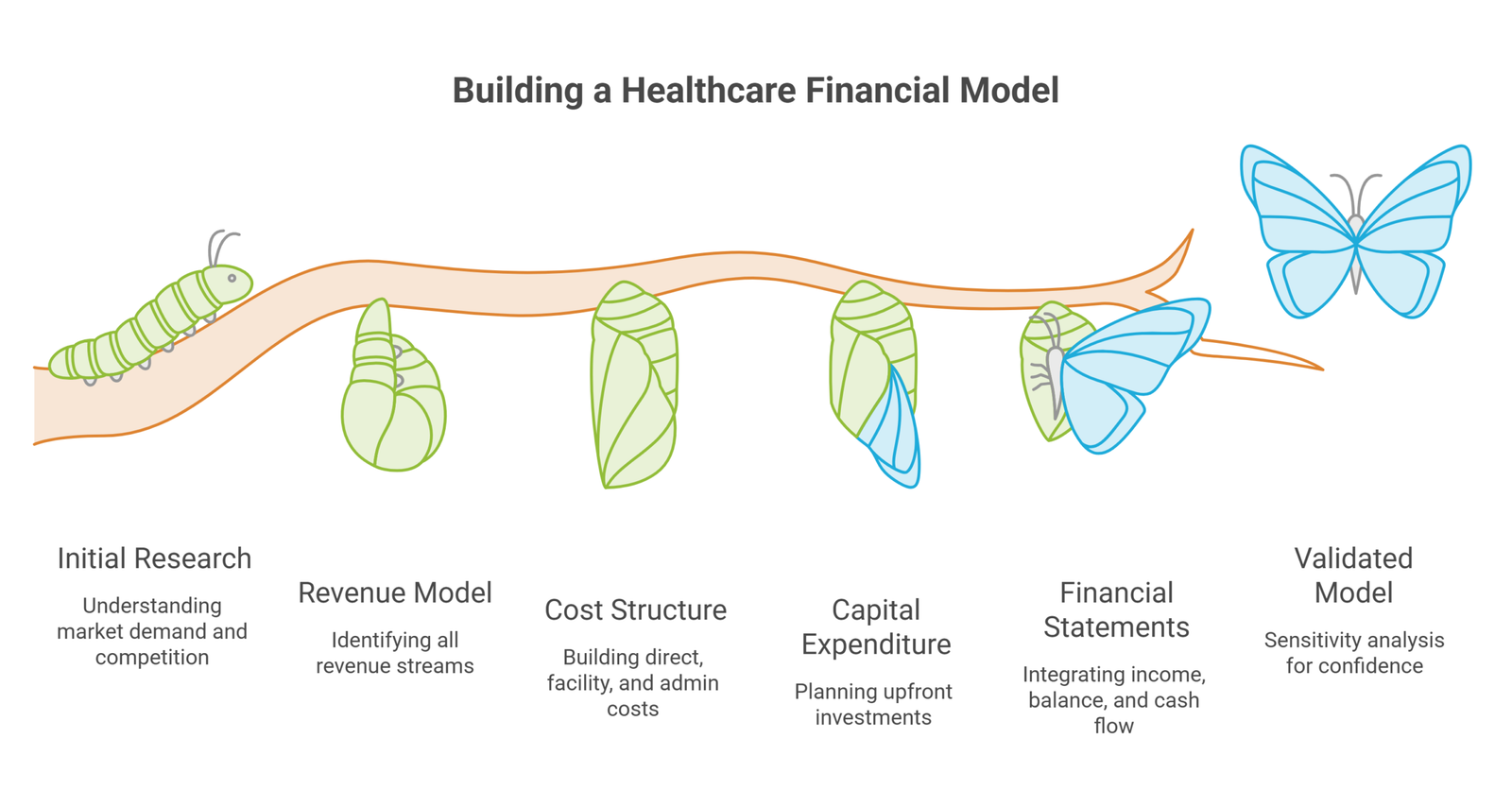
Building a healthcare financial model from scratch is a multi-step process that begins well before any numbers are entered into a spreadsheet. The foundation is market research: understanding local demand for the services you plan to offer, competitive pricing, payer mix in your target geography, and realistic patient acquisition timelines. Only after this research is complete should you begin structuring your business plan and financial model.
Step 1: Define Your Revenue Model
Identify every revenue stream your healthcare business will generate. For a clinic, this means mapping out each service type and its associated fee, insurance reimbursement rate, and expected visit frequency. For a product business, it means defining units, pricing tiers, distribution channels, and reorder dynamics.
Step 2: Build Your Cost Structure
Healthcare cost structures typically include three major categories: direct clinical costs (staff salaries, medical supplies, consumables), facility costs (rent, utilities, maintenance), and administrative overhead (billing, compliance, insurance, management). Each cost category should be modeled separately to enable meaningful margin analysis.
Step 3: Capital Expenditure Planning
Healthcare businesses often require significant upfront investment in equipment, technology, and leasehold improvements. A startup summary that clearly separates one-time capital expenditures from ongoing operating expenses is essential for understanding true cash requirements at launch.
Step 4: Integrate the Three Financial Statements
The income statement, balance sheet, and cash flow statement must be fully integrated. Changes in revenue assumptions should automatically flow through to all three statements. This integration is what separates a professional financial model from a basic spreadsheet. Our financial modeling service ensures this integration is built correctly from the start.
Step 5: Validate with Sensitivity Analysis
Once the base model is built, run sensitivity analysis on your most critical assumptions: patient volume, average revenue per visit, payer mix shifts, and staffing costs. Understanding how your financial outcomes change under different scenarios gives you confidence in your plan and prepares you for the tough questions investors will ask.
Frequently Asked Questions
Why do healthcare businesses need specialized financial models?
Generic templates cannot handle insurance reimbursement structures, payer mix variability, procedure-level margins, medical equipment capex, or regulatory compliance costs. A purpose-built model captures these dynamics and produces credible, actionable projections.
How long should a healthcare financial model project?
Five years, with monthly granularity for at least the first two years. This gives investors enough runway to assess the path to profitability and evaluate return on investment.
What is a good operating margin for a healthcare business?
US hospitals average around 4.3%. Specialty clinics typically target 15% to 35%. Medical devices manufacturers and subscription-based health platforms can reach above 40% at scale.
What financial metrics do healthcare investors focus on most?
Net Patient Revenue, operating margin, EBITDA, AR Days, cash flow from operations, NPV, and IRR. For subscription models, they also look closely at LTV/CAC ratio and net revenue retention.
Can I customize an Oak Business Consultant healthcare financial model?
Yes. All templates are fully integrated Excel files. Change any key input and every financial statement updates automatically. For more complex needs, Oak also offers bespoke modeling services.
What is the difference between a financial model and a business plan?
A financial model is the numbers: projections, statements, and scenarios. A business plan wraps those numbers in strategy, market analysis, and operational narrative. Most investors require both.
How do I know which healthcare financial model is right for my business?
Start with your primary revenue driver and business type. The selection table in this article maps both to the right model. Oak’s advisory team can also recommend and customize the right fit for your situation.
Conclusion
The healthcare industry rewards those who plan with precision. Whether you are launching a specialty clinic, scaling a health technology platform, or developing a medical devices distribution business, the quality of your financial model directly influences the quality of your decisions, the confidence of your investors, and the sustainability of your growth.
Oak Business Consultant has spent over 16 years developing financial models, business plans, and pitch decks for healthcare entrepreneurs and operators across every sub-sector covered in this guide. Our models are not generic templates with placeholder numbers. They are purpose-built tools developed through deep industry research, validated against real-world operational data, and designed to be immediately useful from the first day you open them.
If you are ready to build the financial foundation for your healthcare business, explore our complete range of healthcare industry financial model templates, or contact Oak Business Consultant for a customized model tailored to your specific business requirements.