When Should a Startup Hire a CFO?
When should a startup hire a CFO? A stage-by-stage answer
Hire a CFO too early and a senior salary sits on the payroll with little to do. Hire too late and the gaps show up at the worst moment, usually in the middle of a funding round. Founders rarely get a clear signal about which side they are on.
This guide gives the direct answer first. Then it covers the signs, the cost of each hiring model and the steps that make the hire easier.
The short answer
Most startups need CFO-level support from the seed stage. Most do not need a full-time CFO until Series B, or until revenue nears $10 million, whichever comes first. In between, a fractional CFO covers the work at a fraction of the cost.
Two things pull the date earlier: a complex business model and a raise less than a year away.
| Stage | What the business needs | Usual CFO model |
| Bootstrapped or pre-revenue | Clean books, a simple model, runway tracking | Bookkeeper plus a financial model |
| Pre-seed and seed | A fundraising model, cash discipline, investor-ready reporting | Fractional CFO or advisor |
| Series A | Board reporting, diligence prep, hiring plans tied to runway | Fractional CFO, moving toward full-time |
| Series B and beyond | Several entities, audit readiness, a finance team | Full-time CFO |
| Acquisition or exit | Reporting clean-up, deal integration, diligence | Interim CFO |
Revenue rules of thumb vary. Published guidance for a full-time hire ranges from about $10 million to $20 million a year. Complexity matters more than the number.
Do you need a CFO, a controller or a bookkeeper?
Many founders say CFO when they mean controller. The roles do different jobs.
| Role | Focus | Hire when |
| Bookkeeper | Records transactions and reconciles accounts | From day one |
| Controller | Runs the month-end close and keeps reporting accurate | Reporting outgrows a bookkeeper |
| CFO | Strategy, fundraising, capital allocation, investor relations | Capital and growth decisions outrun the founder |
If monthly financials are late or wrong, fix that first. A CFO who inherits messy books spends the first months on cleanup. Many early-stage companies need accounting and bookkeeping support for startups well before they need executive finance leadership.
Seven signs it is time
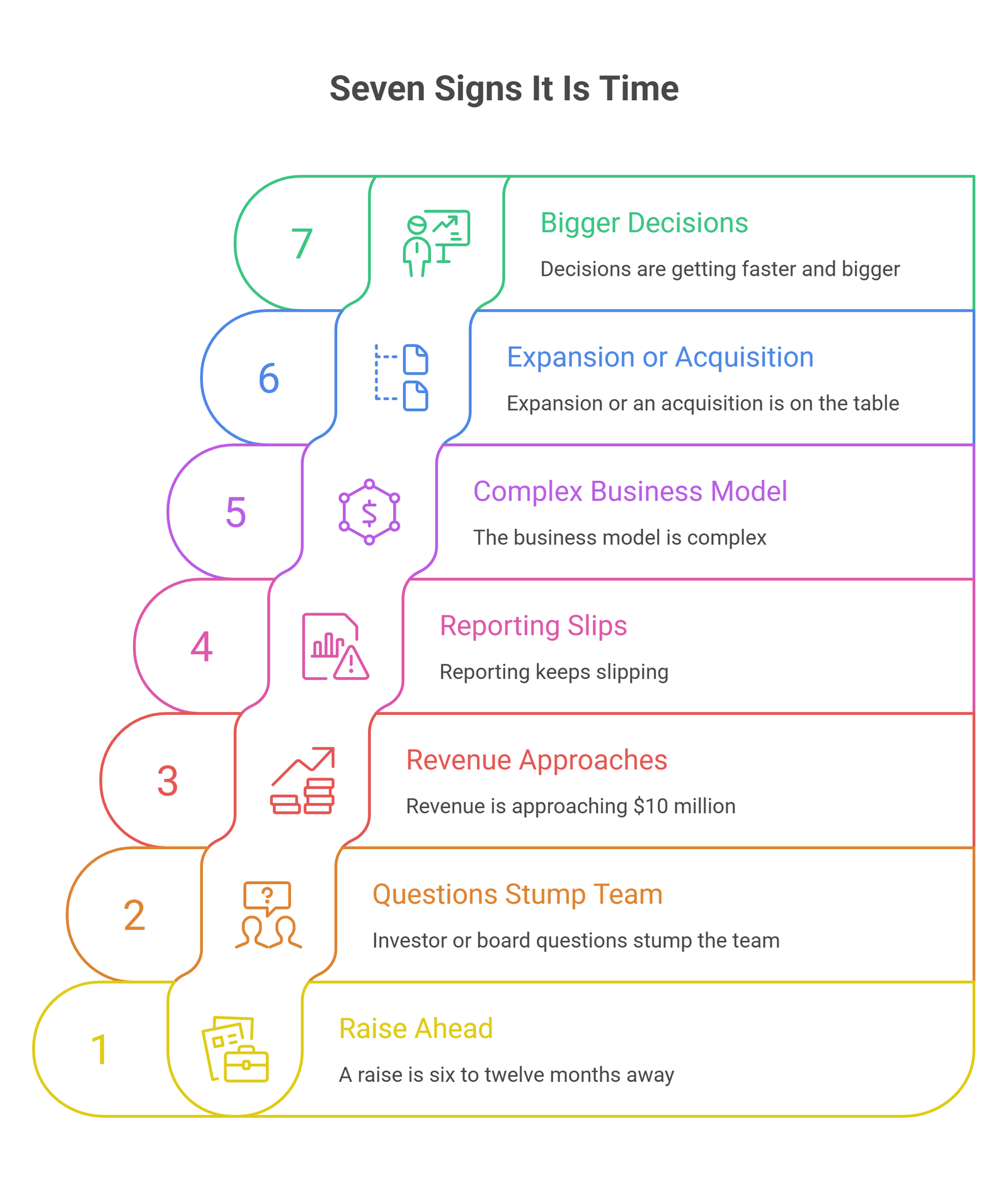
No single number settles the question. These signs tend to show up together.
- A raise is six to twelve months away. Investors test the model, the unit economics and the data room. A CFO who knows the story before the roadshow shortens the process.
- Investor or board questions stump the team. If an answer takes a day of spreadsheet work, the finance function is behind.
- Revenue is approaching $10 million. Costs, commissions and revenue streams multiply. Intuition stops being enough.
- Reporting keeps slipping. The close takes longer each month and nobody trusts the forecast.
- The business model is complex. Marketplaces that touch customer funds, several entities, several currencies or heavy use of debt all call for a CFO sooner.
- Expansion or an acquisition is on the table. New markets bring new tax, compliance and currency exposure.
- Decisions are getting faster and bigger. Hiring ahead of revenue, pricing changes and large spend commitments now carry real runway risk.
Fractional, interim or full-time CFO
The right model depends on stage and budget, not on the title.
| Model | Time commitment | Commonly cited cost | Best for |
| Fractional CFO | A few hours, or about a day a week | $3,000 to $10,000 a month | Seed and Series A companies |
| Interim CFO | Full intensity for a set period | Priced by scope and length | Raises, CFO transitions, acquisitions |
| Full-time CFO | Permanent, on payroll | Roughly $200,000 to $500,000 or more in total pay | Series B and beyond, several entities, a finance team |
Fractional support fits when the need is strategy, modeling and investor readiness rather than daily operations. A virtual CFO is the same idea delivered remotely. The virtual CFO guide for startups covers services and pricing in detail.
Some situations call for something shorter and more intense. A fundraising push, a CFO departure or a deal to integrate all suit an interim CFO.
Fractional support works until the workload outgrows the hours. When board work, audit readiness and a growing finance team fill the week, the role has become full-time. Many startups keep the fractional CFO who knows the business and offer that person the full-time seat.
What hiring too early or too late costs
Hiring too early puts a large salary against a small workload. The new executive ends up doing controller-level work. A CFO from a big company can also be a poor fit. Seed-stage businesses have modest capital needs.
Hiring too late costs more. Cash management turns reactive, and liquidity crunches follow. Models are built inconsistently, so investors stop trusting them. Weak controls surface during diligence. Tax planning gets missed. Each problem is cheaper to prevent than to repair.
Timing also depends on the search. Korn Ferry’s North American financial officers practice leader has put the average full-time CFO search at around 20 weeks. A fractional CFO can usually start within a week or two. Start the search, or the fractional engagement, before the need turns urgent.
How to prepare before you hire
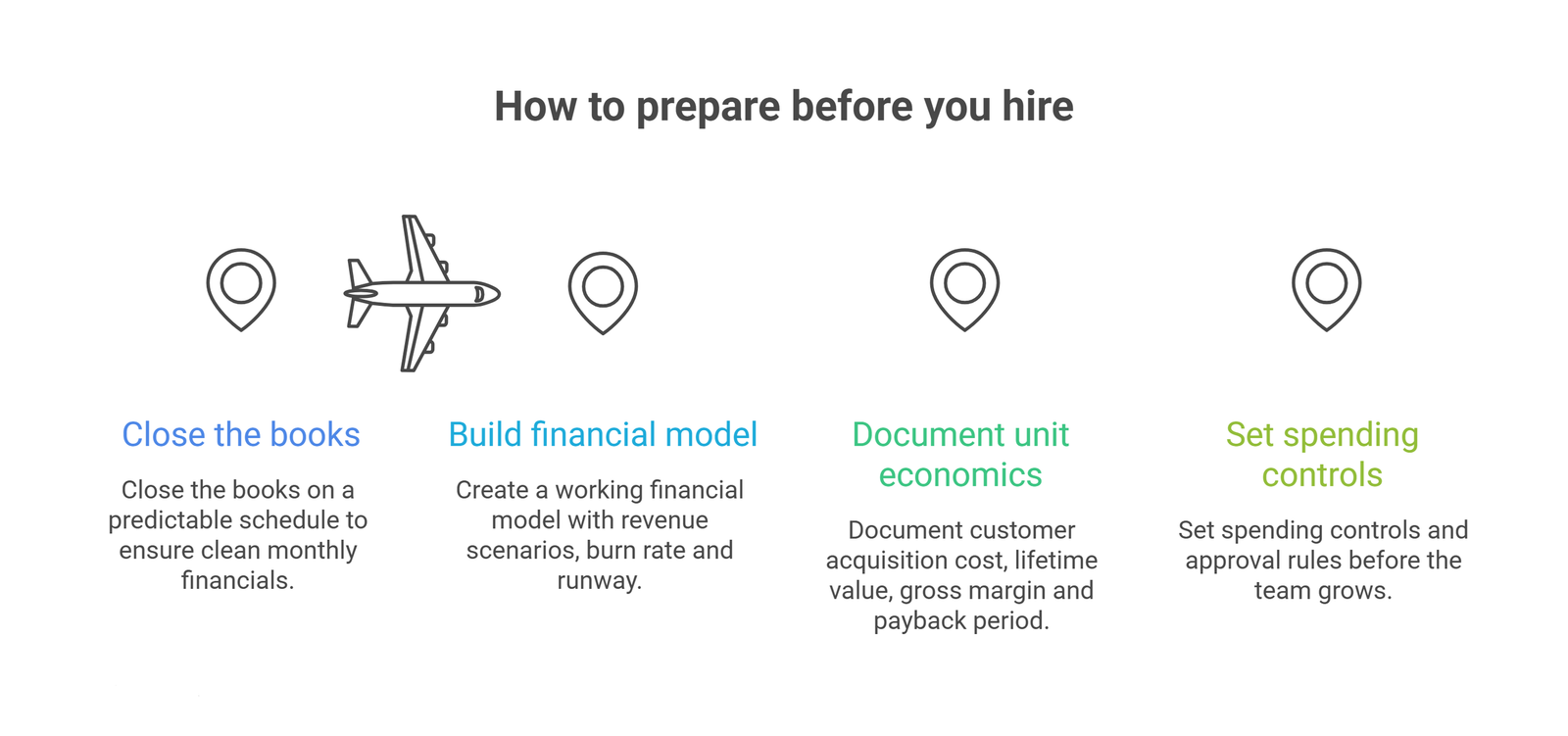
A hire several months away still deserves preparation. Four steps shorten the road.
- Close the books on a predictable schedule. Clean monthly financials are the base for everything a CFO builds.
- Build a working financial model with revenue scenarios, burn rate and runway. Even a basic version supports serious conversations with investors.
- Document unit economics: customer acquisition cost, lifetime value, gross margin and payback period.
- Set spending controls and approval rules before the team grows and more people make financial decisions.
What a new CFO does in the first 90 days
A good CFO starts with an audit of systems and reporting. Next comes a forecast and a dashboard the CEO can read every week. Budgets get tied to company goals. Then a scenario plan covers burn, cash and risk.
If none of this has started by day 90, the role was probably scoped wrong.
What to look for in a startup CFO
Stage experience matters most. A CFO who has run nine-figure raises is not automatically right for a seed-stage company. Look for someone who has built finance from scratch, handled cash through uncertainty and worked with investors at your stage. Ask which rounds they led and what investors pushed on.
Systems depth and fit with the CEO come next. The CFO should judge the accounting stack and close its gaps. The CFO is also often the CEO’s closest sounding board on hard calls. Trust and room for healthy debate matter as much as technical skill.
Frequently Asked Questions
When should a startup hire a CFO?
Most startups need CFO-level support from the seed stage. A full-time CFO fits around Series B, or when revenue nears $10 million. A complex business model or a raise within a year can move the date earlier. Until then, a fractional CFO usually covers the work.
Do startups need a full-time CFO before Series A?
Rarely. Before Series A, the work is modeling, cash discipline and investor readiness. A fractional CFO and a solid bookkeeper handle that for much less. Companies that hold customer funds or run several entities are the usual exceptions.
At what revenue does a company need a full-time CFO?
There is no fixed line. Published guidance ranges from about $10 million to $20 million in annual revenue. Complexity matters more than the number. A company with several entities and heavy debt may need a full-time CFO sooner.
Should a startup hire a CFO before raising?
CFO-level help should start before the raise, ideally three to six months out. Investors test the model, the unit economics and the data room. A fractional CFO is usually enough for that stage.
What is the difference between a CFO and a controller?
A controller keeps the books accurate and runs the month-end close. A CFO uses those numbers to set strategy, raise capital and manage investors. Most early-stage companies need a controller before a CFO.
How long does it take to hire a CFO?
A full-time search averages around 20 weeks, by one executive search estimate. A fractional CFO can often start in one to two weeks.
Can a fractional CFO become a full-time CFO?
Yes. Many startups begin with a fractional CFO who learns the business. They offer a full-time role, or hire a successor, once the workload demands it.
Conclusion
The right hire date is rarely the day a founder feels ready. A better test is the next two quarters of financial decisions. If any of them would be hard to defend to an investor, the company needs help now.
Oak Business Consultant provides fractional, interim and full-time CFO support for startups at every stage. Start with the CFO services for startups page to find the model that fits your stage.