Mastering the Stress Test Financial Model
Stress Test Financial Model Guide
Every financial model looks solid in the base case. Revenue grows on schedule, churn stays flat, and the runway chart ends in a comfortable upward slope. Then an investor asks what happens if customer acquisition cost doubles for two quarters, or a lender asks what happens if a single enterprise client leaves. If the model was never built to answer that question, the founder is doing the math live, in the room, and the numbers rarely hold up.
Stress-testing a financial model is not the same as building one. It is the process of deliberately breaking your own assumptions before someone else does it for you, so you know exactly where the model bends, where it snaps, and what that means for cash, valuation, and decision-making.
Why “it works in the base case” is not good enough
A model built around one set of assumptions tells you what happens if everything goes roughly to plan. It does not tell you how much room you have before things stop going to plan. That gap is where most founders get caught off guard, not because the model was wrong, but because it was never asked the harder questions.
A model that survives scrutiny needs to show three things: what happens in a downside case, which specific assumptions drive the outcome, and at what point the business runs into a real constraint like a cash shortfall or a covenant breach. None of that shows up if the only version anyone builds is the optimistic one.
Three ways to stress-test a financial model
Most stress-testing falls into one of three approaches, and each answers a different question.
| Method | What it tests | How it’s built | When to use it |
| Sensitivity analysis | How one output responds to changes in one or two inputs | A data table that flexes a single assumption (like churn or price) across a range of values | Isolating which assumptions the model is most exposed to |
| Scenario analysis | How the whole model performs under a defined set of conditions | Toggle-driven base, upside, and downside cases with their own linked assumptions | Presenting a range of outcomes to investors, lenders, or a board |
| Reverse stress test | What combination of events would break the business (run out of cash, breach a covenant, miss payroll) | Start from the failure point and work backward to the assumptions that would cause it | Finding the specific threshold where the business stops being viable |
Sensitivity analysis is usually the starting point because it is the fastest to build and the easiest to explain. Scenario analysis takes more setup but produces something you can actually walk an investor through. Reverse stress testing is a technique borrowed from how banks and regulators test capital adequacy; almost no SMB or startup runs one by default, but adapting the same logic (start from the outcome you cannot survive and work backward) is one of the more useful things a founder can take from it.
Which assumptions actually deserve stress-testing
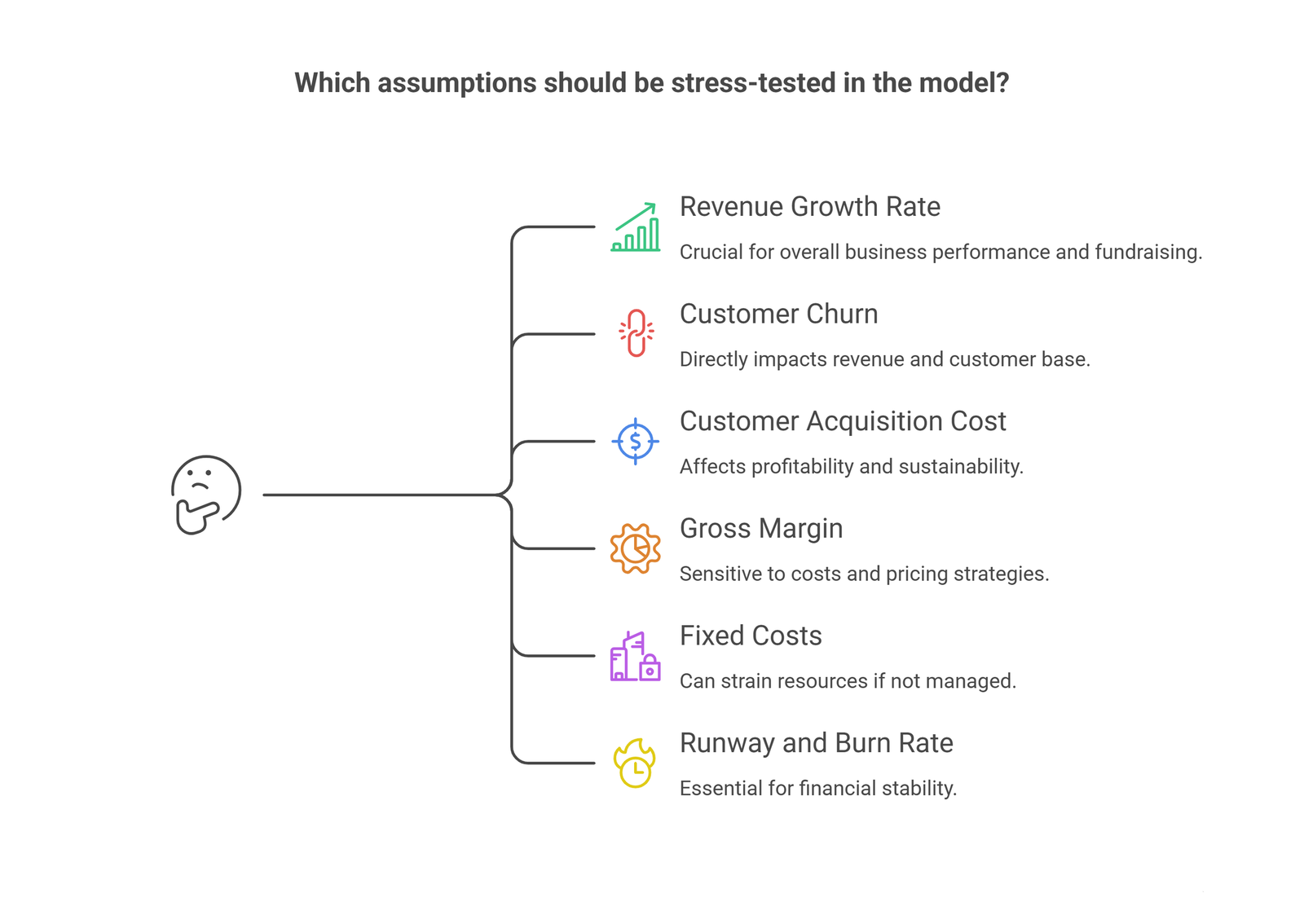
Not every input in a model is worth flexing. Focus on the handful that genuinely drive the outcome:
- Revenue growth rate and sales cycle length
- Customer churn or retention
- Customer acquisition cost and payback period
- Gross margin, especially if cost of goods sold depends on a supplier or an exchange rate
- Fixed costs that cannot be cut quickly, like leases or committed headcount
- Runway and burn rate under a slower fundraising timeline than planned
If an assumption barely moves the outcome when you flex it, it is not worth building a scenario around. The goal is to find the two or three variables the business is genuinely fragile to, not to stress-test every line item in the model.
How to build the stress test without breaking the model itself
A stress test only works if the underlying model is built to support one. That means every driving assumption lives in a clearly labeled input cell, not buried inside a formula. Hard-coding a growth rate directly into a revenue formula might look fine in the base case, but it makes the model impossible to flex without editing the logic every time, which is exactly how new errors get introduced.
The mechanics that make stress-testing possible:
- Separate inputs from calculations. Every assumption should sit in one place, referenced everywhere else. A well-built financial model in Excel treats the input sheet as the only place numbers get typed by hand.
- Use a scenario toggle. A single dropdown or switch cell that flips every linked assumption between base, upside, and downside cases at once, rather than manually changing a dozen cells one at a time.
- Confirm the balance sheet still balances under stress. Flexing an assumption should never break the integration between the three statements. Specifically: assets should still equal liabilities plus equity, the change in retained earnings should still equal net income minus dividends, and the ending cash balance on the cash flow statement should still match the cash line on the balance sheet. If any of those breaks the moment you change an assumption, the model has a structural problem that has nothing to do with the scenario itself.
- Watch cash, not just profit. A model can show positive net income under stress while cash flow still turns negative, particularly if receivables stretch out or a large payment shifts timing. Stress-testing that only looks at the income statement misses the failure mode that actually shuts a business down.
- Push one assumption to an extreme value to expose formula errors before you trust the model at all. Before running a realistic downside case, take a single assumption and push it to a deliberately unrealistic extreme, for example CapEx at 50% of revenue instead of a normal 4-5%. Predict what should happen (fixed assets should rise sharply and cash should fall) and check that the model actually does that. If it doesn’t, there’s a broken formula, not a real business insight, and it needs fixing before the stress test is worth anything. Do this one assumption at a time, since a single input can flow through several line items at once and make it hard to tell which one caused an unexpected result.
Common mistakes that make stress tests useless
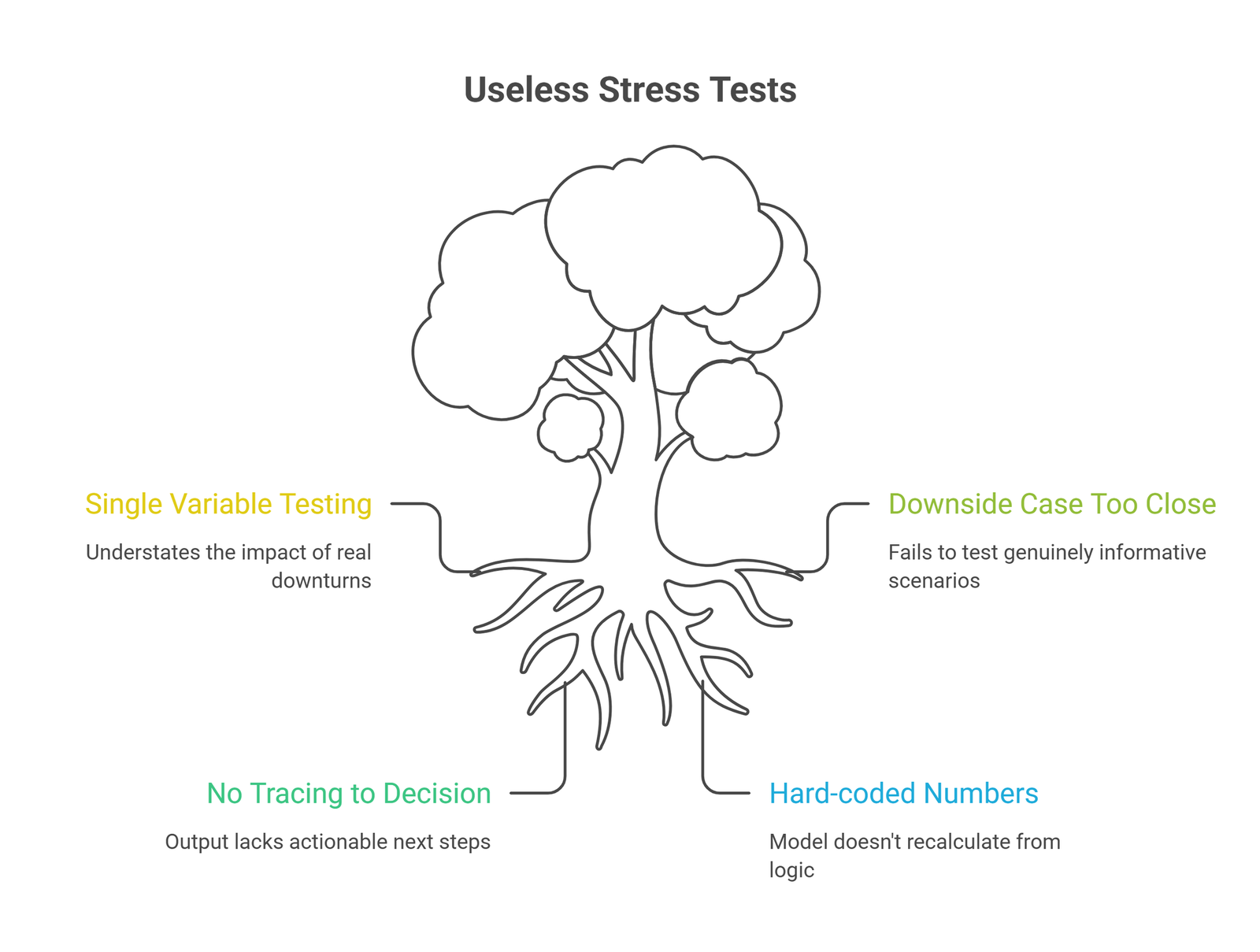
- Testing only one variable at a time. Real downturns rarely move a single assumption in isolation. Slower growth usually arrives with higher churn and tighter margins at the same time, and a model that only ever flexes one input at once will understate how bad a genuine downside case looks.
- Setting the downside case too close to the base case. A “stress test” where the worst case is only 5% below plan is not testing anything. The downside scenario should be uncomfortable enough to be genuinely informative.
- Not tracing the result back to a decision. A stress test that produces a number without a next step is just an exercise. The output should tell you something actionable: raise more runway now, renegotiate a fixed cost, delay a hire.
- Hard-coding the “stressed” numbers instead of flexing assumptions. Typing a lower revenue figure directly into a cell to simulate a downturn defeats the purpose. The model should recalculate from the same logic, just with different inputs.
Frequently Asked Questions
How many variables should I flex at once?
Enough to reflect a realistic downturn, usually two to four related assumptions, but not so many that it becomes hard to tell which one is driving the result. Start narrow, then widen once you understand the individual sensitivities.
Do I need special software, or can I do this in Excel?
Excel handles this well for most SMBs and startups, using data tables for sensitivity analysis and a toggle cell for scenario switching. Specialized tools only become necessary at a scale where dozens of variables interact simultaneously.
How often should I re-run the stress test?
At minimum, whenever a major assumption changes materially, such as after a pricing change, a new competitor, or a shift in the macro environment. Many finance teams rebuild it quarterly alongside the regular forecast update.
What is a reverse stress test, in plain terms?
It’s a technique banks use to test capital adequacy, adapted for a smaller business: instead of asking “what happens if X changes,” you start from an outcome you want to avoid (running out of cash, missing a loan covenant) and work backward to find exactly which combination of assumptions gets you there. It answers the sharper question of how much room you actually have.
If my model breaks under a stress test, does that mean it’s a bad model?
No. A model that never breaks under any downside scenario is more likely to be built on unrealistically resilient assumptions than one that shows real strain under pressure. The point of the exercise is to find the breaking point, not to avoid one.
Conclusion
A financial model that only ever shows the plan working is not a finished model, it is a forecast with no shock absorbers. Building in sensitivity analysis, scenario toggles, and at least one reverse stress test does not make the numbers worse. It makes them defensible, and it means the first time anyone asks “what if” is not the first time you find out the answer.
If your model has never been pressure-tested, or you are not confident it would survive the questions an investor or lender is likely to ask, Oak’s financial modeling team can build or rebuild it with sensitivity and scenario analysis included from the start.